Sylvie Simmons – The THT Interview Part 1
By Dale Nickey
Los Angeles, CA (The Hollywood Times) 9/27/20 – I had the privilege of being the first journalist to review Sylvie Simmons’ new album Blue on Blue for The Hollywood Times in advance of its release. Recently, I interviewed Sylvie on the album’s day of release. Simmons’ backstory and insights were so compelling, I felt the interview should be published in two parts. Nine months into this year of living dangerously, Blue on Blue is starting to make the type of noise that could result in an “Album of The Year” pick in many music publications. Here is Part One of my interview with Sylvie Simmons.
****************************************************
DN: You are one of the preeminent Rock Journalists of our time and have written biographies on Neal Young, Serge Gainsbourg, and of course Leonard Cohen, which has been published in over 20 languages:
SS: It’s over 25 now. It makes me so happy, I’m just grinning like a child every time the agent says they’re going to buy it in Russia or something.
DN: Well “Blue on Blue” is your second album. You must be relieved to get it out there and are now able to bask in the glow of these great reviews you’ve been getting. How do you feel about it now that it’s out?
 SS: That feeling of being able to say, ‘I’ve got another album out, guys!, is really just overwhelming. That it’s finally out there. I hadn’t planned to take six years to make a follow up to my debut album Sylvie. I kind of felt on a roll, I was writing a lot of songs, getting amazing reviews that I had not expected at all because the great laws of music journalism are ‘you don’t make an album’ and ‘you certainly don’t play ukulele’ and I broke them both. I was going on the road having a great time; and then…life has a way of spoiling your plans sometimes. It did in this case. I was working on a book in collaboration with somebody which took a lot longer than we’d originally thought; and also, I had the accident that put my hand out of action for a long long time.
DN: I don’t think the effect of that event (your accident) can be overstated, you began recording songs for your second album in 2017, and then…
SS: In the studio that first day, it was just going so wonderfully, you know…everything was going well. And then that same night I had an accident (sighs) and it kind of got complicated afterward, and so all I was doing really was fighting to get my hand back.
DN: Yes, without putting you through it, you had every guitarist’s nightmare, an injury to your left hand. You had to go through rehab before you could return to writing and playing?
 SS: If it was just rehab, I wouldn’t have minded, but it was a whole series of surgeries and procedures and rehabs. It really was madness. I could not move my hand. It was the size of a baseball mitt and the fingers didn’t move. This was my strange horror story of a life. Everything went on hold for a while. It was like suddenly somebody snatched everything away from you. Almost to the point where I could hardly bear to listen to music – and I had to do it for my living (as a journalist) – which was only because I couldn’t play it. I had also broken my knee in half, so I was stuck at home in a top floor apartment. Friends would come over and musician friends would sometimes bring an instrument that they thought I could play with one hand, like a dulcimer or a jews harp, or suggest “you could put your Uke in an open tuning.” And all I would think was, ‘I don’t like this, I want to go home, let me go back to my old life’. But it was lovely they were thinking of things to help. Other friends were bringing food and trying to keep me clean! My life was being taken care of by lovely people because for the first time couldn’t take care of myself.
DN: You mentioned Ukulele. When people think of a songwriter accompanying themselves on Ukulele, you tend to think you’re going to get a Ukulele album. Blue and Blue is not that at all. However, the Uke seems to be a connective thread that runs through the album.
SS: It made me smile when a couple of people reviewing Blue on Blue thought that someone was picking a guitar when actually me on my little Uke! I understand there are prejudices with the Ukulele. I had those prejudices too, I had always thought of the Uke as a toy. And of course, Tiny Tim, although he was a great musicologist who knew more about early American music than just about anybody you could imagine – was always considered a bit of a joke. When I got my first Ukulele six years ago, it was given to me as a gift, and I took it with a slight raise of one eyebrow. At the same time, I didn’t have any of my other instruments with me. All my instruments were still In England after I moved out to San Francisco. So, when I first picked up the Ukulele I tried to treat it like it was some sort of four-string guitar, but it’s something much more than that. It’s special. And so much more intimate. And the way that you play it, holding it very close, sitting down clutching it close to your heart… There’s something about the Ukulele, for me, that seems to translate emotion so much better than a guitar did. The guitar seems like an instrument where you have to impress someone with your playing. With a Uke, somehow, it’s much more modest and intimate.
DN: Yes, I fell in love with the Ukulele myself, when I found it to be the most practical instrument for sitting on the couch and watching the telly:
 SS: That’s exactly my life now in lockdown! A bottle of wine on the floor and a glass I invariably kick over – so now I’m drinking white wine just to save the floor. What I didn’t really particularly take to with the Ukulele was the jumping flea aspect of it, the bounciness. You kind of keep up that perpetual rhythm because it doesn’t have a huge amount of sustain. You play a note and it disappears before you’ve even heard it, like a snowflake on a hot day. I liked that it had this little… kind of broken guitar or broken harp feel to it. But as someone who listens to music all the time, I knew it needed more, you need arrangements. To listen to an album of solo Ukulele – unless it’s someone like Jake Shimabukuro – could be a bit much, so the arrangements were very, very important. Howe (producer Howe Gelb) had a huge part in that on both of my albums.
This album’s got more musicians on it than last time. We started off with one extra musician which was Gabriel Sullivan (Giant Sand; XIXA), and Gabriel added most of that sort of Spanish guitar, sort of lacey and intricate. Howe played several different guitars, including a lower toned guitar. But he’d be doing that while the guitar was on his lap and he’d be playing keyboards; and being a very tall man with long arms he could play two keyboards. So, I had a sort of one-man-band playing with me plus the other members, including Brian Lopez (Giant Sand; XIXA) who played the solos on two songs. But Howe somehow … I don’t know how it happened, but his musical instincts, in general, were so sympathetic to my own that when he came in with whatever he was his playing, it often tended to be exactly what I wanted and what I was hearing in my head.
DN: Sometimes producers get so invested in a project they sometimes start trying to make their own album using their artist’s songs. But it sounds like (with Howe) you didn’t have to reign him in, he knew exactly what you wanted:
SS: A lot of the time he absolutely did. There were times when I stepped in and asked for more or less of something, or decided on something different. But Howe was working with me, to an extent, before I ever started recording. He encouraged my songwriting and kept talking about us making an album together, sending me emails now and then with ideas of what we should do and how it should be.
DN: What started you recording your own stuff and putting out records, to begin with?
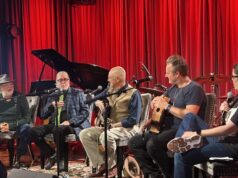
 SS: It came down to two people: Howe and Leonard Cohen. My biography I’m Your Man: The Life of Leonard Cohen had taken a long, long time to write. When it came out in the U.S. in 2012, I’d been staring at my four walls for so long – even longer than lockdown – and I wanted to get out of here, you know? The publisher set up a few book shops to talk in. But I wanted to go on the road. So, I got in touch with a few musician friends and they’d say ‘hey, come out to this record store or this bookshop and we’ll do something’. I thought it would be a nice idea if I took my Uke on the road as well as my book and sing a few Leonard Cohen songs. Because I’m a bit of a Leonard Cohen jukebox – I’ve loved his music my entire existence just about – and nobody’s ever nasty to someone with a Ukulele.
Sylvie and Leonard Cohen
DN: Yes, the Ukulele is a very friendly instrument:
SS: Yes, so this began to take on a life of its own and by the end of it I thought…Yeah! I’m ready to do that album. Howe had been asking me to do an album of my songs for the longest time, so when I got back home I called him and said I would do it. He booked a studio in Tucson. Howe, bass player Thoger Lund and I recorded the whole thing in less than two days live to tape – which I might add was terrifying for someone making their first album.
DN: A nice thing I appreciated when I was listening to “Blue on Blue”, is I felt like I was listening to an “album” if you know what I mean?
SS: I know exactly.
DN: Was that on your mind when you were recording, that you were doing a large-scale work and it all had to fit together in some way?
 SS: Kind of… I knew that the songs on Blue on Blue were taking a slightly different direction. It was while sequencing the album – and I had a different idea to Howe on the order in which the songs should appear – that I really understood the story the album told and how it had to fit together. The first album was a bit different. Because it was my first time in the studio I was a little nervous, so I initially played the songs in the order of which ones I felt most confident about playing – which was the easiest song? “Moon Over Chinatown.” And having done it, it felt like it ought to be the opening song of the album (Sylvie). I knew, for different reasons, what the opening song for this album would be – and that was also the first thing we recorded – “Keep Dancing”. So that song became a big part of the story, which was about love and loss, and staying and moving on, and those little moments between the love and loss and leaving or staying – or just looking back at a memory of someone happily dancing alone. It’s really interesting to me that just hours after cutting that song live on the first day in the studio, the accident threw me into a world where I was forced to stay in one place on my own and could only dream of leaving; and months after completing the album, much of the world went into lockdown, borderlines were closed and tours were canceled, and now many of us are stuck in one place, looking back on memories.
Stay tuned (or subscribe) for Part 2 of my Sylvie Simmons interview