By Sarah A. Spitz
Culver City, CA (The Hollywood Times) 1/27/26 – More Miracles: 3 Original One Act Plays is the latest offering by The Actors’ Gang. I reached out to the playwrights to ask about their love and devotion to this unique artists collective. All three plays are now onstage through February 21 at The Actors’ Gang’s iconic Culver City venue. In a Zoom room together, their voices overlapped and they laughed a lot, leading playwright Mary Eileen O’Donnell to observe, “This feels very Actors’ Gang already!”
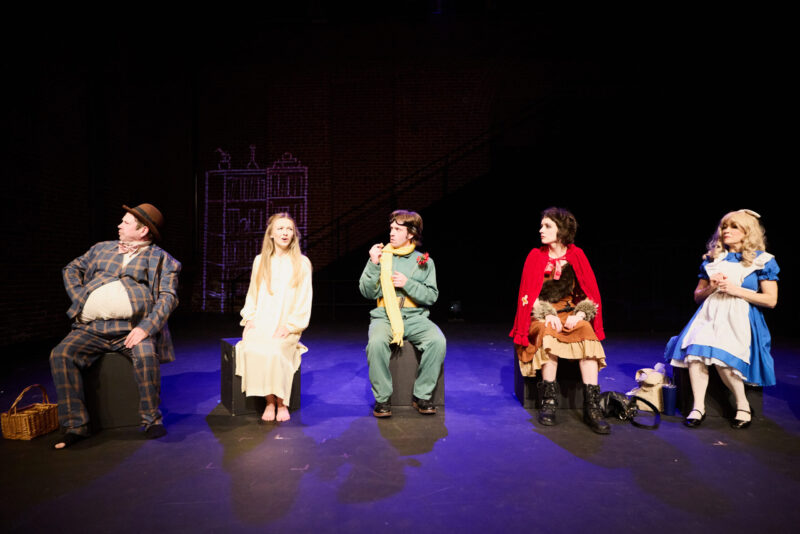
Her play, “In Recovery” directed by VJ Foster, features storybook characters (Pinocchio, Hansel and Gretel, Humpty Dumpty, Red Riding Hood and more) who confront their traumas, and each other, in a modern-day PTSD group therapy session.
THE ACTORS’ GANG
Led by actor, director and activist Tim Robbins, The Actors’ Gang was founded in 1981 by a group of punk rock theater artists looking to create a new style of relevant, entertaining theater in Los Angeles. Renowned for their Prison Project, they’ve performed for audiences in Los Angeles, worldwide and in 40 US states.
The company engages in rigorous training, featuring a physical performance style rooted in commedia dell’arte (14th-century Italian street theater), mask work, and ensemble training. Actors who fit the bill often stay for years. That commitment has helped create a rare ecosystem in Los Angeles theater—one where actors practice their performing art, and develop their chops as writers to bring their own creative visions to life on stage.
“It’s not a place you dabble,” playwright Willa Fossum said. “You either commit to the style or you don’t.”
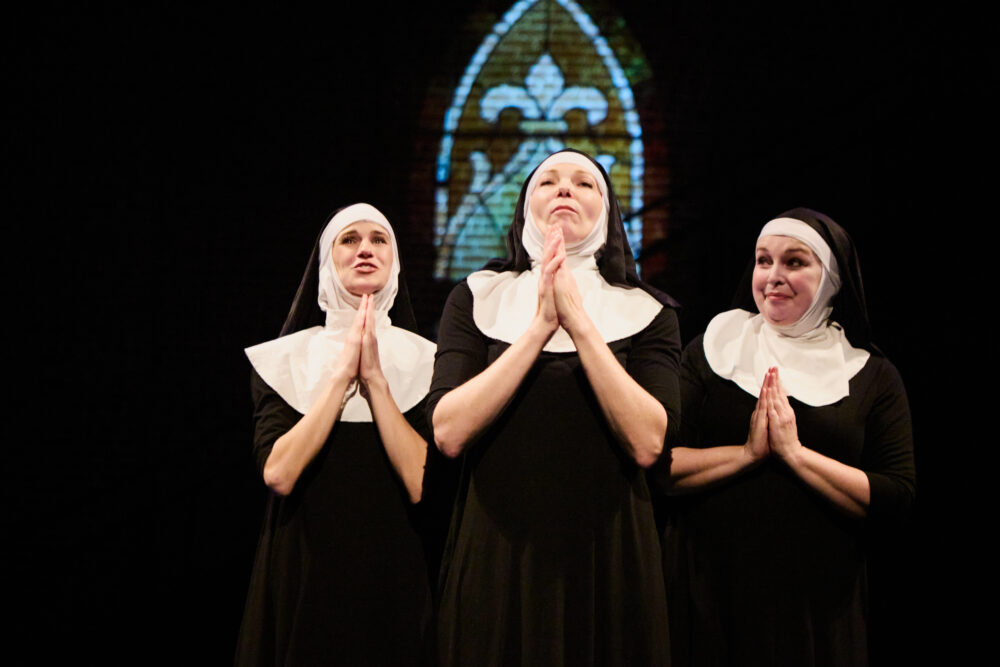
Willa’s play, “Nun Fight” is equal parts blasphemy and outsized hilarity and epitomizes all of the Actors’ Gang techniques, with simple staging, wall projections, dramatic lighting, singing, dance and fight choreography, and in this case, jealous nuns, murder and Zombies!
Mary Eileen O’Donnell
Mary Eileen has been part of The Actors’ Gang for more than two decades, and she speaks about the company with the ease of someone who has grown along with it. “I’ve been here long enough that the style isn’t something I think about anymore—it’s just how I tell stories,” she said.
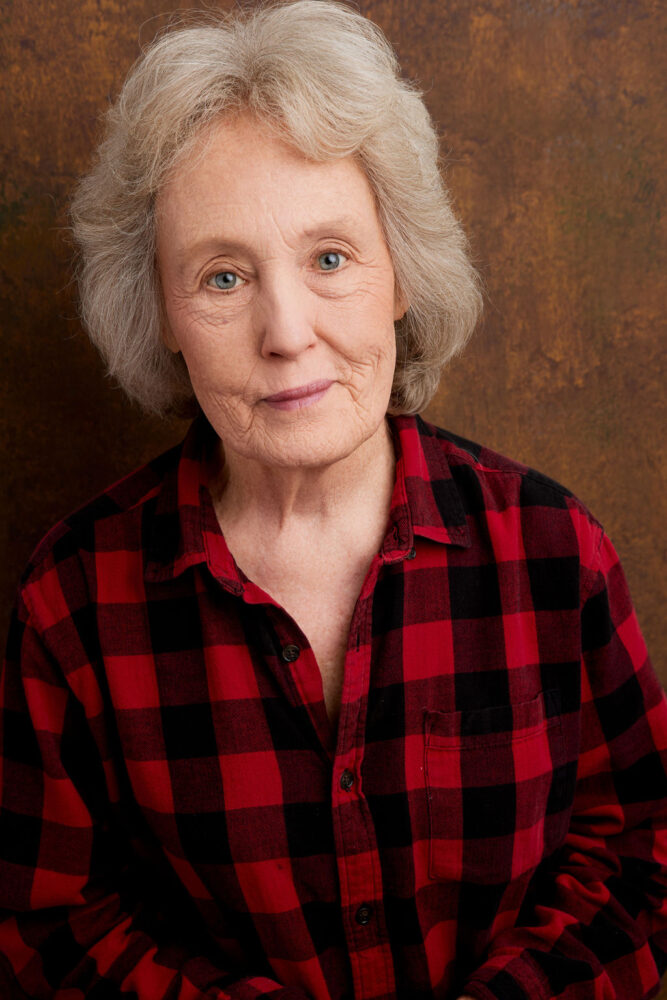
She got her degree in the US, then trained and performed in New York and London. Her first play was with dancer, choreographer and avant-garde theatre director Jean Erdman. As she recalls, it was a myth-based play about Hawaii. “Her husband occasionally sat in the back of the room watching rehearsals and would later explain the mythology.” He turned out to be Joseph Campbell, who wrote The Hero with a Thousand Faces, about the archetypes shared throughout world mythologies, and later hosted a PBS series based on it.
Mary Eileen says she’s always lived in fantasyland in her head, so for her, writing In Recovery about classic storybook characters came quite naturally. It was an expanded version of an experiment Actors’ Gang did during the Covid shutdown. The company would meet on Zoom, and Tim suggested they try writing 10-minute plays. All were submitted, the list was culled and Tim selected the ones he wanted to see fleshed out as full-blown plays.
Mary Eileen doesn’t appear in her play but “sets the structure and lets the ensemble handle the collisions. I don’t want the audience to leave feeling finished, I want them imagining scenes I didn’t write.”
Ayindé Howell
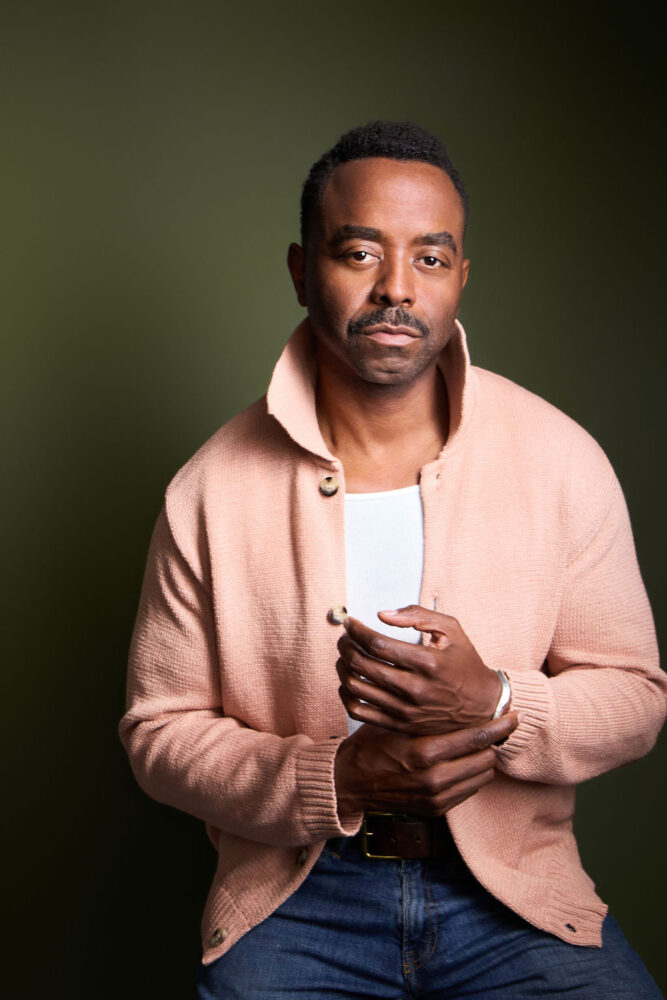
Ayindé uses his own life as source material, particularly the influence his father had on him, in his play Sixteen Summers, directed by Gloria Briseño. He’s not just an actor and playwright, but a spoken word poet, former food blogger, a member of the improv company Upright Citizens Brigade, an entrepreneur, and the author of a plant based cookbook The Lusty Vegan, for which he earned the title “Hot Vegan Chef.”
“I grew up in the family business, a corner store (in Tacoma, Washington), then my mom started a food distribution business, then it was a restaurant, so we’ve always been cooking. It was an overly religious family. My father was a Southern Baptist who turned into a Rastafarian, and we were vegan, then entrepreneurs, and I was even homeschooled for a while. But I just wanted to be normal and cool.”
It wasn’t an easy time for a kid with strong sexual urges whose father defined that as a sin. The play, he says, “Is about fathers and sons and a journey through manhood as told through three different life lessons my father was always trying to teach me. Vision, faith, patience. Though I was contrary, I tell the story through different parts of my life where those things came into play.
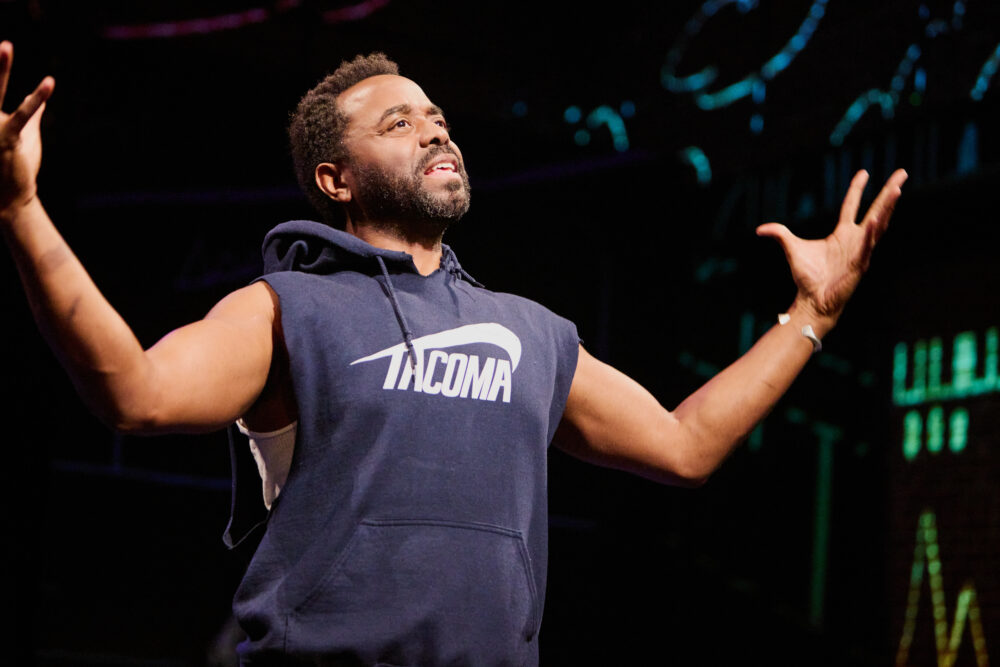
“I try to figure out what it means to be a man, and there’s a part where I talk to the audience and get input from them to determine what we expect a man to be versus what a man tries to be.
“And I’ve come to realize that the cool part is being yourself. Like whatever version of man you are, that’s actually the coolest thing. In writing the show there’s, a lot of embarrassing and cringey stuff but my guiding principle was, how do I make it more true?”
Willa Fossum
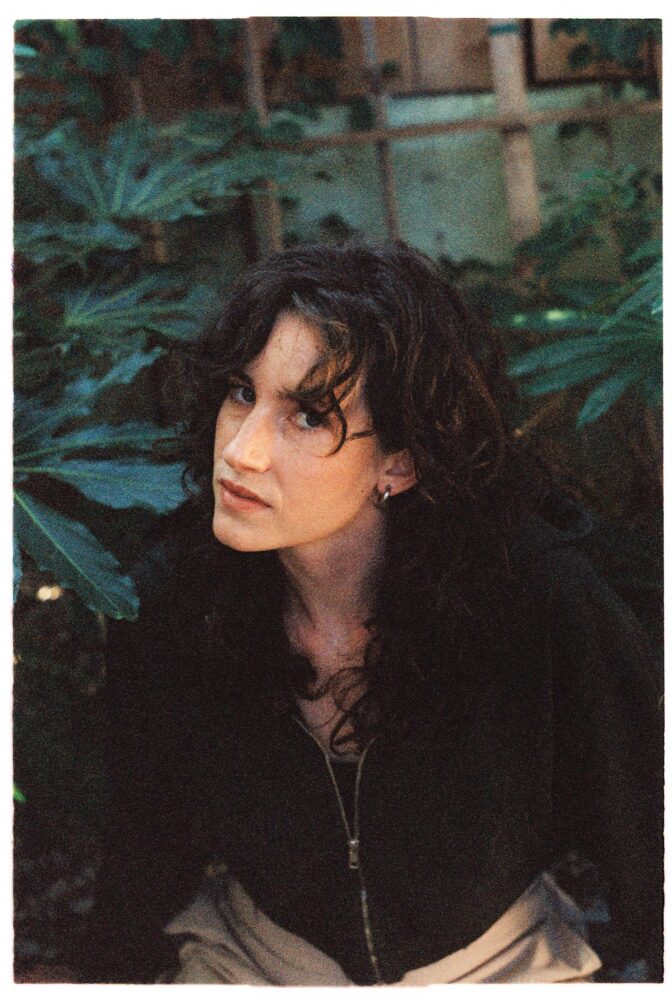
Willa’s Nun Fight, which she directs but doesn’t act in, explores ritual, absurdity and the idea of the Divine Feminine. She moved to LA four years ago and has been with Actors’ Gang for two years, after studying in Texas with a former company member, Lauren Lane.
“She taught a little bit of the style in this class called characterization, and she brought a drum in and had us go through these states of emotion. So I was pretty acquainted with the lore of Actors’ Gang before I even got to Los Angeles. She talked about the work like it changed her life. That stuck with me.”
After a brief stint working in music management, she “found her way back to acting through Actors’ Gang classes. I forgot how much I missed being in my body, and the training demands that.”
Nun Fight unfolds during a vigil service and leans into heightened theatricality. Drawing from Catholic ritual, exploitation-film aesthetics, and exaggerated movement, the piece examines women’s relationships through humor and violence.
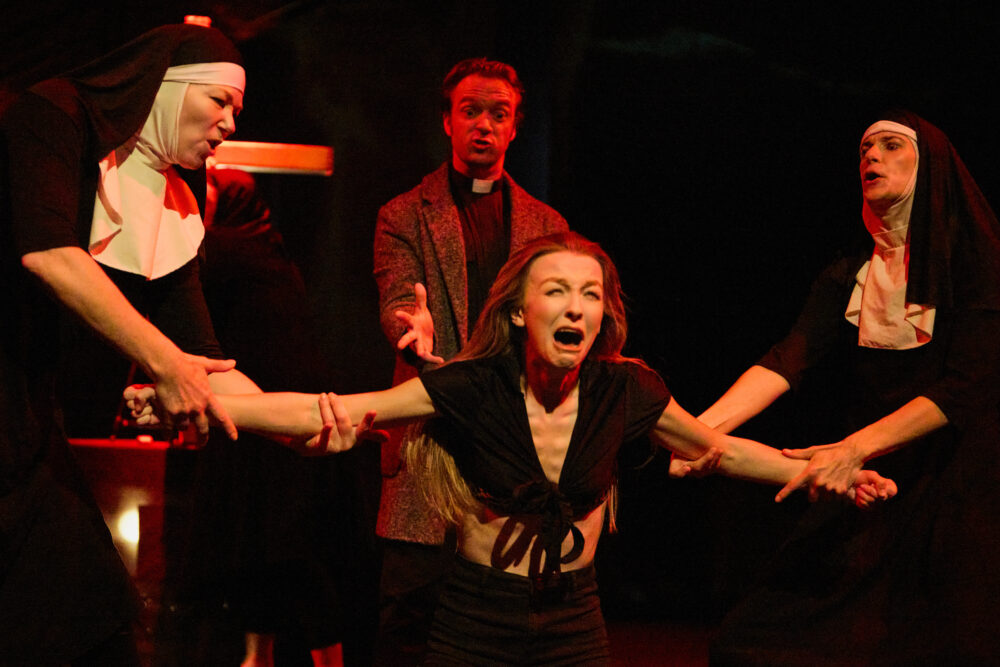
“It’s absurd on purpose,” Willa explained. “Exaggeration lets you get at things realism can’t.”
How they connect
What connects these playwrights isn’t subject matter or tone, but a shared belief in the process. “The style forces honesty,” Mary Eileen said. “And honesty is generous—it invites the audience in.”
Listening to the three of them together, it’s clear that The Actors Gang doesn’t just produce plays. It produces a community of creative artists passionately devoted to experimenting with and expanding their skills and craft.
All performances take place at The Actor’s Gang theater, 9070 Venice Blvd., Culver City, CA 90232. Tickets are available at www.theactorsgang,com and by phone at 310-838-4264.