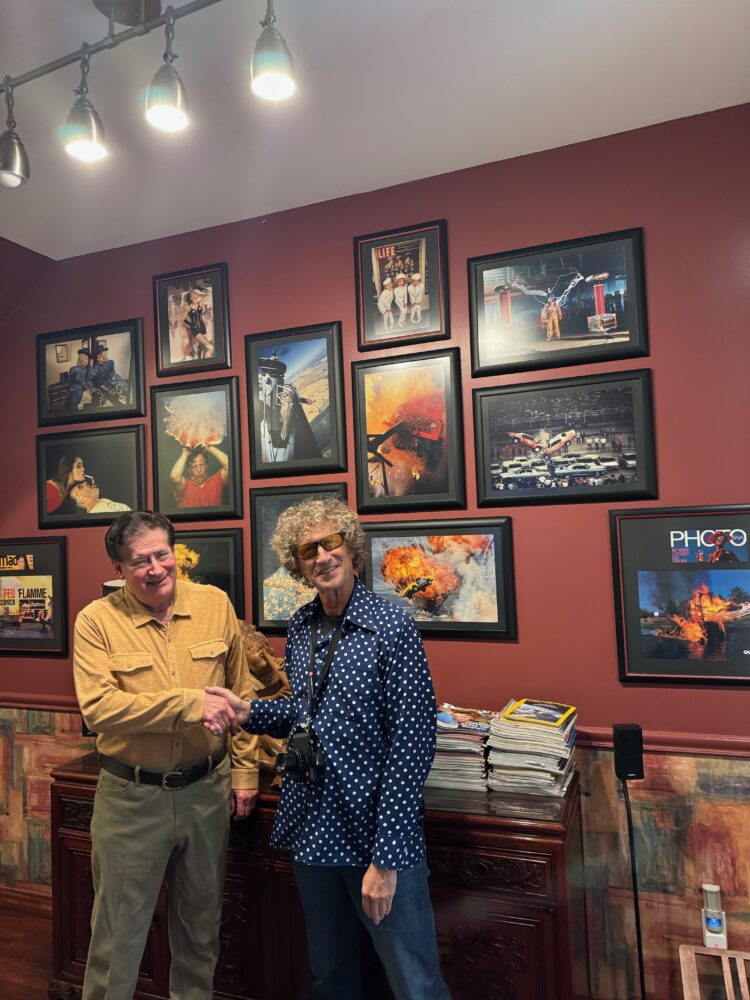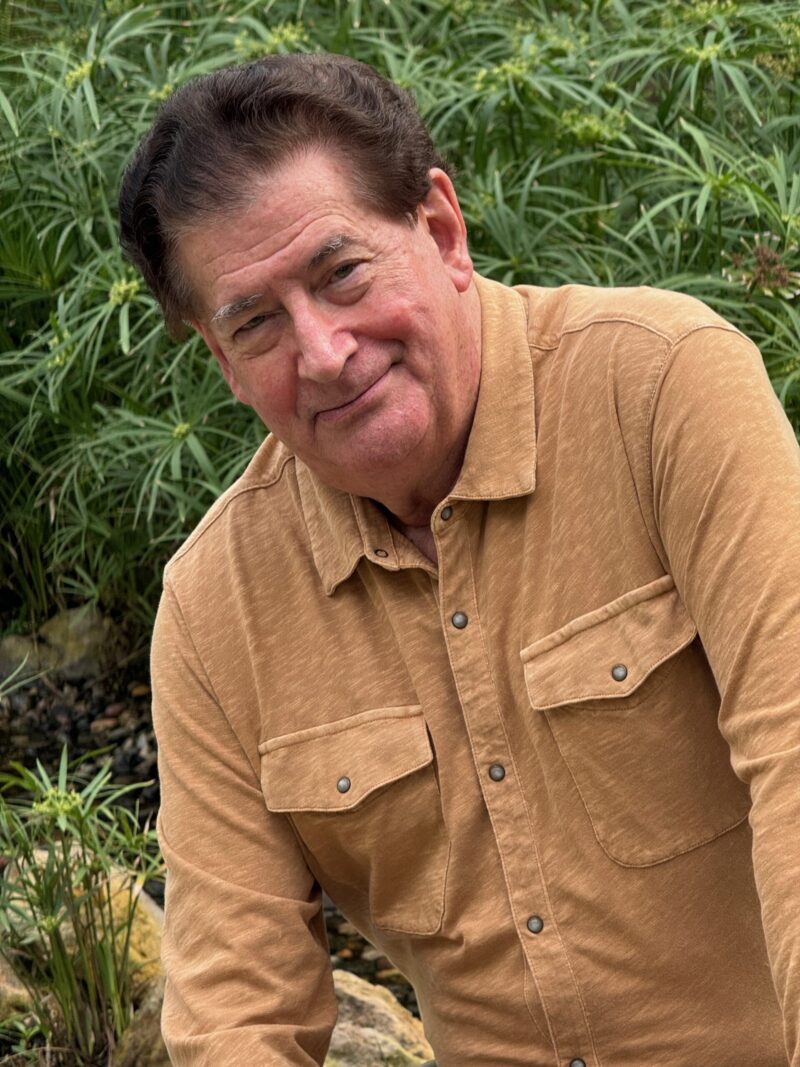
Jimmy Steinfeldt: How often do you clean your lens?
Jeffery Werner: At least once every ten years.
JS: What photographers influenced you?
JW: I started out as a reporter. I studied journalism in college and ended up in World Campus Afloat which they now call Semester at Sea. I majored in journalism, criminology, and penology; all of which aided in my career as I became a photojournalist. Among many other subjects I did some crime stories (the OJ and Robert Blake murder cases among others.) I also did a number of prison stories, including two exclusive prison weddings, the most notorius of which was an exclusive coverage of Kenneth Bianchi’s (the Hillside Strangler) at Walla Walla State Penitentiary.
After attending Drake University in Des Moines, Iowa for a year, I switched to Mankato State University in Minnesota, and did a photography summer course at the University of Minnesota before taking my second voyage on World Campus Afloat as a graduate student, and writing for the ship’s daily newspaper, the HELM. The “Semester at Sea,” as it is now called, takes 500 students for on-board studies around the world, while being able to observe what they’re studying in books and bring them to the places they’re actually reading about. I attended again two years later as a graduate student. On my second voyage I was head of the newspaper and wrote a daily column. There were 500 students and everybody was talking about my column. It was then that I met Vince Streano, who had been hired as the ship’s photographer for the voyage. He had been five years with the L.A. Times. He was 28 and I was 22. He liked the way I wrote and he was a great photographer. He wanted to work for Life magazine but it had just gone out of business. He said to me “Why do you want to go back to Minnesota and freeze your ass off. Move to Laguna Beach where I live and we can work together.” I thought I’d always wanted to do the adventure, travel writer, journalist thing. So I’ll give it a shot for a year and see what happens. In paradise.
Our first shoot was in Alaska in February. World Champion Dog sled races and the Eskimo games. I froze my ass off for a month. I had taken one semester of photography at the University of Minnesota so I brought along a camera. I had a Nikon and a couple lenses. Because there was a lot going on Vince had me shoot as well, sometimes side by side with different lenses. Our very first sale was to Ford Times magazine for the Ford Motor Company. I wrote the story and they ended up using one or two of my photos along with Vince’s great shots.
Vince and I worked together for three years. While out for a drive one day , he found a story about a Vietnam Vet with one leg in a wheelchair. This guy was wheel-chairing down the Pacific Coast Highway to San Diego dragging a mini-trailor behind him with a sign that said “ San Diego or Bust.” Vince followed him all the way in his wheelchair doing the pictures and I interviewed him for the story. The guy had lost his leg in Vietnam, and walked with a peg leg painted red,white, and blue. He even went into the ocean on a beach stop with one leg for a swim. Vince said “This is a great Life magazine story but Life is gone.” I told Vince there is this new magazine that just came out called People. Vince said “I don’t want to do People magazine. It’s celebrities and I don’t want to get involved, it’s terrible, it’s Hollywood.” He went on a trip to the mountains for a few days, and I decided to write a full letter and send some proof sheets to People in New York. Two days later I got a call at six in the morning. The editor for People said “We’ve got your story proposal which we like very much and we want to do it for next week. We need the pictures on a plane tonight and we need your copy by 4am through western union.” The closest western union office was across town in Santa Ana. I wrote the story, then broke into Vince’s apartment for the film and went to LAX and shipped the film. The next Monday it came out, a two-page spread. Thus, began our short-lived career for People. We did about half a dozen stories together, including some exclusives, as a writer/photographer team.
Scholastic Magazines in New York was one of the first markets that Vince had visited to secure freelance work even before I met him. They became one of our chief markets for stories of all kinds while we worked together, and after for the first seven years of my career. Later I also did some work for National Geographic World and Geographic kids Magazines.
Watching Vince work, by osmosis, I learned photography. He was going to go to Guatemala and I’d join to write the story. It was to cover Mormon archaeologists that were looking for lost Mayan cities. At the last minute everybody was telling him “Vince you’re out of your mind. You’ll get killed down there in the jungles for a month.” He said to me “Do you want to do it?” I said yes. I bought an extra camera and some extra lenses. Vince went to Hawaii (laughs.) I went to Guatemala with 140-degree heat, with vampire bats swooping down. We started out at Tikal and walked all the way to the Yucatan and it was great. I was 130 pounds back then, yet I made it. That was my first jungle expedition but not my last. When I came back Vince made his biggest mistake. He went through my pictures and said “Jeff, I couldn’t have done better myself.” He did however give me a couple lessons on fill-flash (laughs.) I ended up with a cover story on the Chewing Gum Hunters of Guatemala for Scholastic, and a number of other stories for travel mags.
We did a deal with Scholastic that we’d go around the world and do culture stories for them and they’d give us upfront money. By then we’d covered the Vietnam refugees at Camp Pendleton. I met a girl there who use to work for U.S. Intelligence at tan sanut air base in Saigon. The Vice President of Vietnam, Nguyen Cao Ky was there. He was in a tent surrounded by guards. I was bold and I said to the girl could you divert that guard for a few minutes and I ran into his tent and asked for an interview. His aid said “No interviews” but Ky looked at me and said “OK sit down” So I got an interview.
Vince and I called People magazine in New York. They said “We had a team there and we couldn’t get near him!” The editor forgot to push the mute button and we heard him scream at the new Bureau Chief at the People magazine L.A. Bureau. This cost me later. My first lesson in office politics. He then said to us “Get back in there for a second interview and get pictures.” We got that story, and it ran double page. Then we did Pat Nixon after Watergate. She hadn’t been seen in a year after the resignation. Another photographer who had a secret service contact and who had been staking out Nixon for the entire year told Vince Pat was going to be in her home town to dedicate a school. Vince called People, and again the editor put the phone down and didn’t mute it, “How come we don’t know about this!” We covered the story, it got another people spread.
Vince went to a People magazine photographer party in Los Angeles. I didn’t go since I was a writer. Vince came back laughing “Boy does the Bureau Chief of the L.A. office at People hate you!” I said “Me, what did I do?” She was mad I got the Vietnam Ky story and the Pat Nixon story which they knew nothing about. The funny thing was, Vince had come up with the Nixon story, not me, I just wrote it. But he was careful not to tell her that (laughing). By the way, the story on the Vietnam Vet with one leg got made into a movie for ABC TV. He made it all the way to San Diego on his wheelchair quest. This was one of several stories I did over the years that got made into movies. I should have made up some kind of TV contract for those but didn’t think about it at the time. Now I know better. A couple years later Vince met my next door neighbor, Carol, and they ended up getting married, and working together as Streano/Havens.
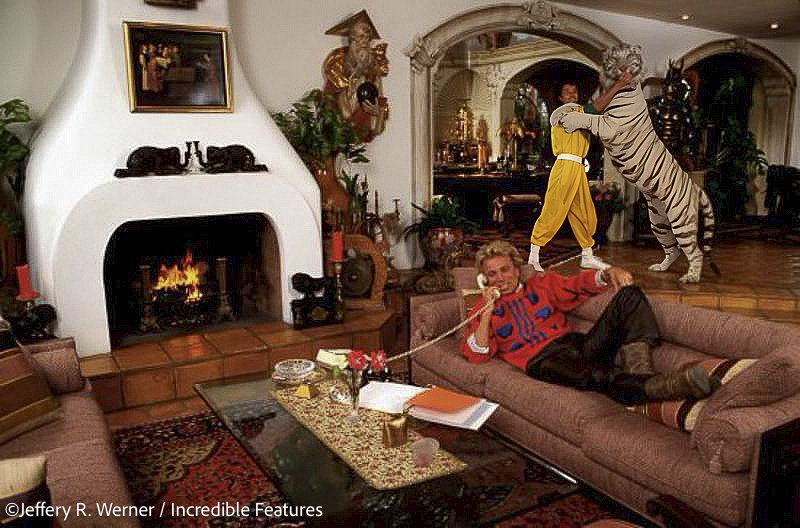
Now on my own, and living in west Los Angeles, I started to see a lot of editors at newspapers and magazines and I went to see the lady at People. Sure enough she was cold as ice. She said we don’t like teams and you are a writer and photographer team. Just then someone in the hallway said “Are you Jeff Werner, didn’t you used to work for us?” For the next several years whether in N.Y. or L.A. I heard someone on their staff say “Didn’t you used to work for us?” My career there was stagnated but I did do some more shoots for them. The L.A. bureau had five photographers at that time and the west coast photo editor liked four of them because those photographers were assholes. She believed in order to shoot celebrities you had to be a Hollywood asshole. To get celebrities to sit in a bathtub or something like that she thought you had to be an A-type. The photo editor at the time didn’t think I fit into that category, so I would not be good at shooting celebrities. Just real people stories. But in later years my mild mannered personality worked for me much more then against me, and helped me get hired by Dar Robertson for “That’s Incredible!” at ABC, and the trust of celebrities like Siegfried & Roy for their shoot at home with their White Tigers, which many Enquirer staffers told me was the best center-spread the tabloid had ever run.
JS: What little hints did Vince teach you about fill-flash?
JW: To use it! There are times during midday where you really need a fill light. I started with a Vivitar flash and later moved up to Dynalites and White Lightnings. I did a photo shoot with actress Maureen O’Sullivan, Mia Farrow’s mother, in her New York home, with nothing more then one rented light that I barely knew how to use. After that I got a set of decent lights, dynalites and white lightnings. Eventually I had a lighting case that weighed 90 pounds. By the way, nowadays I shoot with an on-camera bounce flash but if I get a big job where I need lots of lights I get an assistant. The days of my lugging all that stuff myself and performing the shoot too are over. Of course, now I use battery operated Profoto lights which are fantastic. Lightweight and I can put them anywhere. Also, I thank whoever invented the four-wheeled camera/light bag.
JS: Vince really set you on your path. Are there other photographers who influenced you?
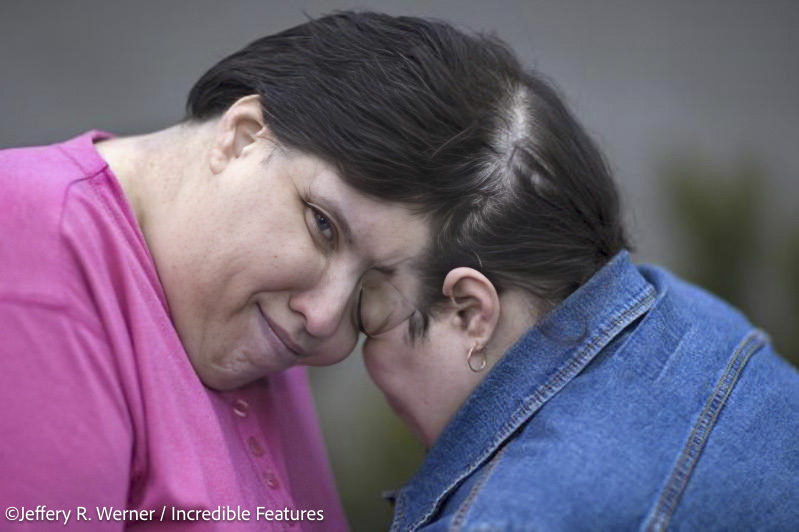
JW: Diane Arbus except that her subjects never smiled and mine often do even when they shouldn’t. Maybe because I make them laugh. I admired the kind of subjects that she did. I hate to use the word freaks. When the National Enquirer did their book, they were only paying $100 a photo and many photographers said they weren’t interested. I thought it was a good thing. Everything is a moment in history which you begin to appreciate as you get older. I like that she, Arbus, photographed twins and unusual people. I did a lot of that. I did conjoined twins. In fact two sets of conjoined twins. Little girls and the older ones died recently. People with unusual diseases and disabilities, and how the get through them. That inspires me. I did get six full page pictures in the National Enquirer coffee table book. They asked for several more pictures, but frankly, I wanted to do my own book, which I did a few years later.
I knew Peter B. Kaplan pretty well. We met in Albuquerque when I was shooting hot air balloons. I almost tripped over him because he was taking a picture while lying on the ground. He said “That will cost you a drink!!” Thus began a long friendship. He was known to be crazy, out of his mind, but a great photographer. He did iconic pictures of the statue of Liberty from on top of the Statue of Liberty with these long poles. Also pictures of bridges, he loved heights. I was scared to death of heights but I had to get over it for a lot of the work I did of stunts. Including helicopter jobs where half my body is out of the chopper. As to influence I’m basically self-taught. What I didn’t pick up from Vince, I got by watching other photographers, or on my own. Peter didn’t go anywhere without his camera. We’d be at lunch in New York City and he’d see a homeless guy on the street and he’d take his picture.
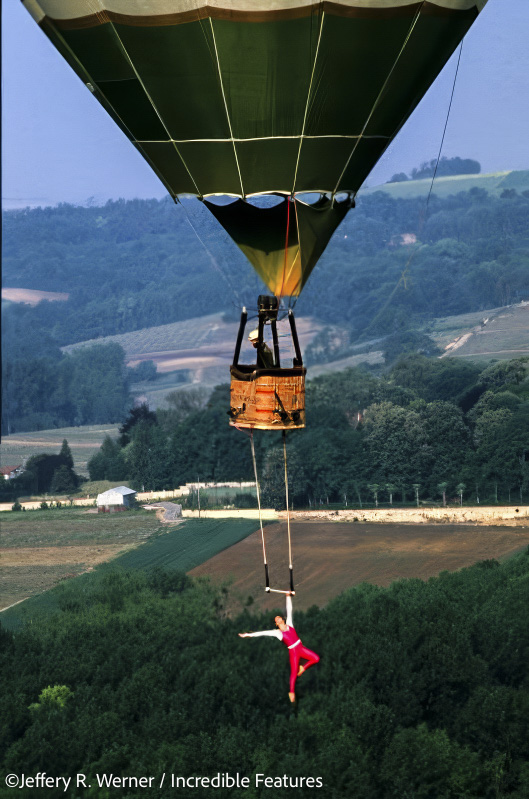
I learned to always have a camera of some kind on me, albeit a small portable one. You never know when there will be a picture worth taking. Of course, now-a -days, everyone has a camera phone, including me. I get a new iPhone every year, mainly to keep up with the camera and video improvements. Everyone has a Peter B. Kaplan story. I double dated with him once in New York City. He was driving and you took your life in your hands when he drove.
Bruce Talamon is another photographer I admire. I met him on a movie set. He was a major music photographer back in the day and now he does big books including Soul, R&B, Funk. He recently looked at my book Incredible Stunts and said “This is really good stuff. I think you could do a book for Taschen.” Another photographer I liked was Wegee. His New York pics from the 40’s and 50’s were great.
JS: who besides photographers have influenced you?
JW: Dar Robinson inspired me. What a great guy he was. He died way too young. He said “Jeff, I’m doing a movie in Miami with Burt Reynolds (called Stick) and I’d like you to be there.” It was two high-falls from the 22nd floor dressed for two different characters in the movie, including the bad guy he was playing. The second stunt I shot from the ground with a camera on another building as well. Burt said a prayer for him before his stunt. He made us all bow our heads. This had never been done before. In this movie Stick instead of an airbag (which I had photographed him and other stuntmen and women many times) he had a whole contraption that went around the building and would gently stop him by his ankle around the 5th floor. The camera could be right overhead. Dar also played the bad guy in the movie and could shoot all six rounds from a gun at Burt dropping backwards.
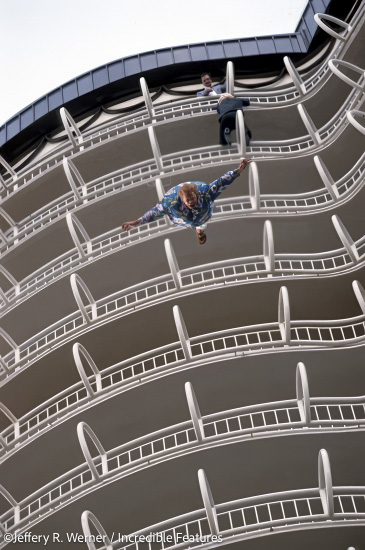
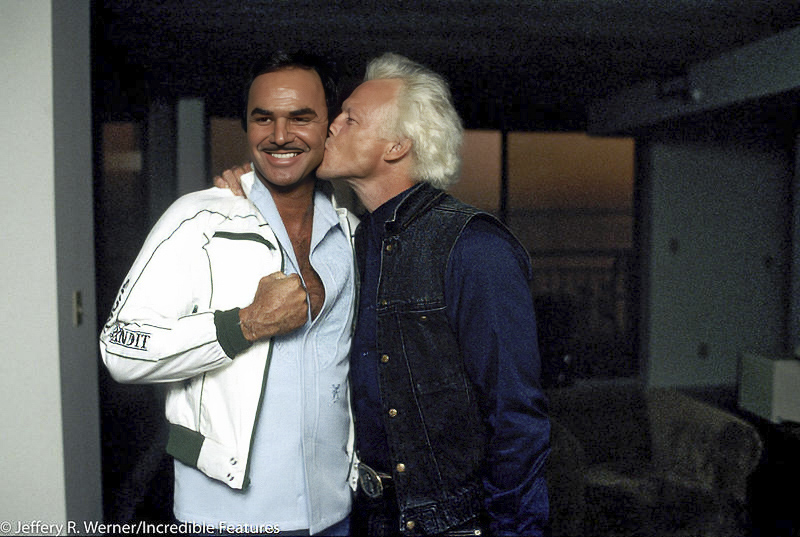
It was not CGI, it was real with the swimming pool 22 floors down in the background. Dar introduced me to Burt Reynolds and said “Jeff is one of the good guys.” Then he kissed him on the cheek and that photo of mine was published in the National Enquirer.
Other people I’ve met over the years have influenced me just how they get through life, and death. The way many people I’ve met approach life is an influence. Some of the people I’ve photographed are like a Profile in Courage. One girl was basically turning to stone. Her mother hated what the press had done with her. She had me come out and I took a totally different approach and made her look upbeat. I took photos of her in the pool with her family. She called me up later crying thanking me for what I did for her daughter. One woman was a gorgeous 21 year old on the beach in a bathing suit and when she hit 30 she suffered Gigantism. I got a TV documentary from that shoot. Her mother wanted the story done to get the word about this rare disease out around the world, including medical researchers who might be working on a cure. Unfortunately, not long after the story ran, her daughter passed away.
Human beings are each very special people. I shoot a lot of very special people. I also photographed the Hillside Strangler. He wasn’t so special but I shot his wedding at Walla Walla prison. I took Criminology, Journalism and Penology in college and it helped me a lot later because I did a lot of prison stories. I spent a lot of time in prisons but fortunately didn’t have to wear the prison uniform. They let me out at the end of the day. Back in the day the Hillside Strangler and I looked very much alike. I was a little worried about that. In some of the photos I did of him I would have him pose and ask him to squeeze and I’d have to tell him “No, no, stop squeezing!” (laughs.) That photo shoot was a rare instance where I shot it as a buyout but it paid a day rate of $2500.
JS: What was your first camera?
JW: My first real camera was my father’s Canon reflex camera. I took that on my first voyage at sea on World Campus Afloat. I went around the world for three months. I went on safari with that camera. I wasn’t very good but I had taken a course with the camera and before I went back on the ship for my 2nd voyage I took a summer photography course at the University of Minnesota because I wanted to take better pictures the next time. In the dark room I kept dropping the film but I did learn how to print. I was working at my father’s office and took a bunch of pictures there. One picture I took my teacher went ape-shit over. It was a picture I took in Duluth on a pier and there was a woman with a cigarette dangling out of her mouth and my lady friend at the time was sitting at the end of the pier and the lady was clutching her baby. My teacher said my photo was an art piece, a “Fellini” she called it, and yet she still only gave me a B for the class since my other pictures weren’t much. I don’t have that negative, but I remember it as the first good photo I ever took. I went from that camera to Nikon when I started working with Vince. I remember my first motor drive. It was the kind where you had to take it off the camera to put film in.
On my third voyage with WCA they hired me to go as the public information officer but I did take a lot of photos even though there was a photographer on board. I remember buying some camera stuff in Hong Kong. A guy from the national newspaper of India comes up to me and asked “Do you have any equipment I could buy? We can’t get anything in India. We could pay you some very good money.” I did a deal in the backseat of a car at midnight. They had all this American currency. I made like $2000 on a $500 camera. I wish I had bought more in Hong Kong. I couldn’t sell any more of my stuff because I wanted to keep taking pictures. Over time I started using Canon so I had both brands. The reason is each company would out do the other and I wanted the newest, best camera. A better autofocus, a better flash, a special lens. I had a Fuji that I didn’t like too much.
JS: What’s your main camera now?
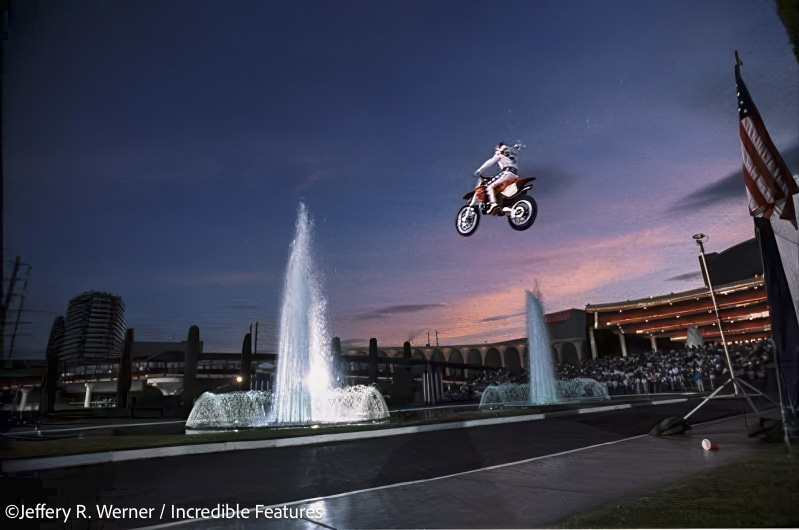
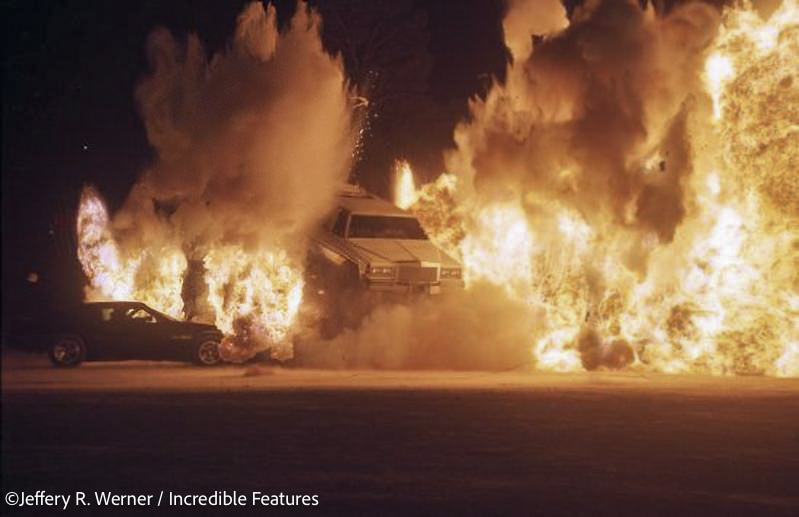
JW: Sony RX10 IV F2.4-4 with a 40-600mm lens. I can do almost everything with that camera. Unfortunately Sony discontinued it as of this year. I shot a wedding with it, it’s unbelievable but I do have several other cameras as well, both Nikon and Canon. I’ve been going around the world for 40 years with heavy cameras for stunt shoots. Six to twelve cameras. Setting them on tripods and brackets. I became known as a stunt photographer. I used 14 cameras at Caesars Palace when Evel Knievel’s son Robbie redid his father’s famous stunt jumping a motorcycle through the fountain. Caesars hired me and I put cameras everywhere. The best shot was from behind, him going through the fountain. I was shooting color negatives. I also shot a stunt with a limo leaping over other cars and then bombs exploding underneath and the limo flying up in the air. For that shoot I had many cameras because I wanted different exposures including some shots set for daylight with 100 speed film. I got a call from the owner of the company that put it on. He said “You gotta help me out. We didn’t pay you but we put you up in a hotel and we gave you exclusive access to all our stunts. We need your pictures! The video we shot is crap, we got nothing.” Turned out, despite a dozen video cameras shooting, all they got of the explosion was a big flash of white light. They didn’t know how to shoot fire at night. My pictures turned out great and I gave them some pictures for their use only. You gotta learn and know what you are shooting. I shot lots of fire walkers over the years and you want to see the hot bed of coals and the flames coming up. You have to expose for that and use the correct film, shutter speed, aperture, and drag the shutter.
JS: Tell me more about some of your amazing experiences.
JW: I did a book on stunts and Daredevils. It’s a specialty I got into. I met a guy at a track. He invited me to Minneapolis to shoot his son who was doing this human rocket thing. That lead me to his friend Dar Robinson, the greatest stuntman ever. I shot a high-fall stunt with him in 1979 and I didn’t know what I was doing. I met his wife and kids too. A couple years later he got a contract with That’s Incredible. The early version of the show they had too many accidents, so they hired Dar to oversee all the stunt work to avoid accidents. I went to a meeting where I learned he didn’t like the other photographer who was loud and always yaking a lot. I can be quiet when I need to be.
On the spot Dar said “We’re shooting two stunts tomorrow in the desert. Are you in?” I said “What are they?” He said a fire tunnel stunt with a motorcycle going through. Then a parachute jump into a moving jeep. I said “I’ll be there” The first stunt was a 200 foot long fire tunnel and it was great. The stuntman went through and jumped over it on a motorcycle. I had a number of remote cameras. I had a remote control button and I was on a fire truck up high. That fire went from 75 degrees to 2000 degrees in about three seconds. The TV crew all started running backwards because it was so hot. I jumped off the fire truck but pushed the button and I got an outstanding picture of the motorcycle between two laps of fire with my remote cameras. They had to redo the stunt because the TV crew ran away. But my pictures from the first stunt were the ones that got published.
JS: Did you own all those cameras?
JW: I started out buying extra cameras but sometimes I would rent. It took 6-12 cameras in different areas to get the full sequence. Early on I went to New York to show editors the shoots I had done. Like Kitty O’Neil the deaf stunt woman. Also pictures I’d taken overseas and other photos. While in New York I looked in the yellow pages and found a publication called The Star. I didn’t know what it was. I didn’t know it was a tabloid. I made an appointment to see the New York editor of The Star, Bob Young. Bob is British, like many tabloid editors, a product of Fleet Street in London. Most people looked at my work and said “Very nice, we’ll call you.” This editor looked at my work and said “I want this one, I want that one and also this one.” Photos of a guy with advertising tattooed on his head, a beautiful blind lady who made a business from making menus for the blind and a photo story on Kitty O’Neil a famous deaf stuntwoman on who’s story was later made into a TV movie.
Then Bob said “I want these photos right now and I want you to call me every week whether you have something for me or not.” Thus, began my career in tabloid photo journalism. That led to the National Enquirer. They started to see my stuff in The Star. At that time, they were black and white but soon they were in color and I was known for color. I had a knack for color but I didn’t realize it because I also shot black and white. Having shot a lot of color helped my career at that time in the late 70s early 80s. My timing was spot on, because while many news photographers only shot B&W, I had a portfolio full of color.
Something else happened. I was on a wild west stunt show in Arizona. I had photos of a stunt guy doing a high fall and missing the airbag. Many years later I would photograph him again getting killed in a head-on car crash stunt. That sad occurrence happened when we were all done for the day. My friend Allen was shooting for the Enquirer and I was shooting for myself freelance. He called the Enquirer and told them I had shot it too. They knew my name and Allen sent them his photos and all my raw unprocessed film as well of the entire shoot. I was crazy for doing it, but it worked out for the best, even though I didn’t think either one of us had good shots of the high fall miss from where we were standing.
Soon after I went to visit my family in Florida and that’s where the Enquirer was. I called on the editor in Lantana. She said “You know Allen talked up this Wild West show but all the photos are crap. However, I gave you a center spread in the next issue of your photo sequence of a cowboy falling off a horse during a rodeo stunt. It was a great sequence. We’d like to use you a lot.” Then Allen went and got the That’s Incredible contract. Later, I got the contract. Then ABC said let’s have Werner do all the photos for the show and they gave me other shows to shoot. One of the best things I did during this time was I always kept my copyrights. I had a contract but I had the rights to the pictures. That is virtually unheard of. Today it would never happen. It’s always best to own your work.
JS: How did it occur to you to ask for rights. You started as a writer and you became a photographer. Were you a member of the ASMP?
JW: Yes. In fact, Vince became president of ASMP-L.A. and then National. We met someone on a shoot who was in ASMP and he recruited us. I knew that Allen made that deal so I figured if that’s his deal I want the same deal. Later I discovered how important it is to own your rights whenever you possibly can. I own the rights to virtually everything I shot and I never signed over my copyright.
JS: During those years did you feel you were well paid?
JW: The production company paid me nothing. I would pitch these shoots to the Enquirer or The Star and they would pay me. At that time, they paid $200 a day and later $250, where it stayed for a long time. But that was against space. If I got a spread it was a $1500 payday. Then of course I could syndicate it. That’s where the big money came in. On a good stunt I could make $10,000 maybe $20,000 over time. They’re timeless. Even today I could make a sale of those pictures shot 30 years ago or more.
JS: Tell me about photographing The Jim Rose Circus.
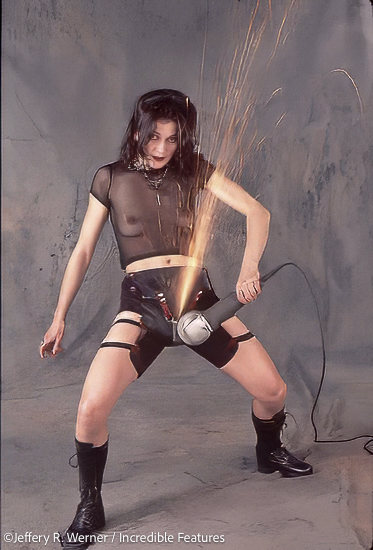
JW: I don’t specialize in one kind of photography. If I did, I’d go nuts. So I shoot stunts, but I also photograph other subjects as well, such as medical miracles, freak shows, animal stories, and general human interest. I went to Vancouver when the Jim Rose Circus were performing there. I befriended Jim Rose and he let me bring in my lights and backdrop before the show and I photographed everybody in the show on slide film. One guy had a barbell attached to his private parts. I did all the shots with my lights and backdrop but one shot I did in darkness. It was of Jim Rose’s wife and I guess you could call it the hot crotch shot. Then I shot the actual show on color negative. The photos did very well over time for many years. I saw Jim years later and he said “Wow Jeff you got me so many gigs with the photos you did” The really wild stuff ended up in Bizarre magazine in England and also in Newlook in France among others world-wide.
JS: I photographed the Jim Rose Circus in 1995. Later I moved to Los Angeles and ran into Jim and did his headshots. He was making a name for himself in the acting world. Jeff, are you your own agent?
JW: Kind of. I started an agency called Incredible Features, Inc. However, I used a lot of agents over the years. I started with a stock agent in Laguna Beach. The woman who owned it said “Jeff Werner sold his own mother to get into Time magazine.” That’s Ellen Bowen the After-Image agency owner. One thing I liked about her agency was she put a daily list of subjects that clients asked for on a voice recording daily. I could phone everyday to see what kind of photos they needed. One day I learned they needed photos of older people looking awkward playing sports. My mother was actually a famous golfer but not so much into tennis. I sent in a few photos including my mother playing tennis. Never in a million years did I think it would end up in Time Magazine. Which is why the agent said later jokingly I had “sold my mother to get into Time Magazine.” At the time I was living in West L.A. in a $175 a month apartment. My phone rings and it’s the editor at Time magazine. The editor said “I really like this photo of the lady playing tennis.” I thought oh my god Time magazine! It ended up in Time magazine seen all around the world with my mom playing tennis and my name in the credit. All her friends started calling her and I thought “oh well there goes my inheritance.” My mother forgave me, although she liked the picture that a Look Magazine photographer did of her swinging a golf club in front of her Minneapolis home with me next to her back in 1956 better.
I learned another lesson working for the agency. Ellen said she had a photo of mine of a guy reading a paper on a park bench. I said yeh the light was nice and he was wearing glasses and I took the ‘street photography’ shot. I enjoyed doing this type of photography. She said “Do you have a release for that picture?” I said “A release? He didn’t even know I took it.” She said if I could get a release some company wants to use it as a calendar shot, but we need a release.” The pay would be $600 which was a lot back then. I went down to Laguna Beach where I shot it. Went to the Laguna Beach Hotel and they knew the guy. I got his address knocked on his door, gave him a copy of the picture and handed him a dollar and asked him to sign the release and he did. From that experience I learned to always get a release, when possible, because you never know. Of course, for editorial, you don’t need a release to publish a picture in a newspaper or magazine. But for commercial purposes, or for some pictures containing nudity, you do.
Working for the tabloids I had to learn to be a paparazzi once in a while. I never was one of the guys who purposefully went out to do paparazzi but I did a lot of paparazzi like assignments. I got very good at it. Helicopter shots. I outfitted my van with black Velcro drapes with holes to shoot through, and everything. You need to be very patient. I didn’t like the anxiety of the whole thing. I started to get calls from the tabloids “What are you doing today?” I thought oh-oh, another paparazzi shoot, I’m anxious. “Can you go out to Tom Hanks’ house, he had a baby. See if they come out with the baby.” I went to his house and I’m praying there is a place to park. There was, right in front. I had my curtain up so no one could see in. I had a rule never get out of the stakeout van. You have to keep your eyes on the subject. All of a sudden there he is with his wife and new baby, and I got the shot. I’m shooting film so you don’t know if you really got the picture or not. I got good at this but I never liked it. The anxiety wasn’t for me. You might get chased by some guy with a baseball bat. But I liked it a little more when I scored. I always say, I can do anything as long as I’m seeing it through a camera.
I was the first photographer to get photos of Bruce Willis and Demi Moore together. They were dating and no one had any pictures. I was in Malibu in my Nissan 300 ZX on another shoot related to Willis so I was near his house. My car was great for a chase but lousy for a stakeout. I’m standing near the Willis house and some lady says to me “Are you a Paparazzi?” And I said no I was just taking a picture of a bird atop the house. Just then I see a woman going in the front door. I don’t know Demi Moore but I saw a pretty brunette go in the door. I told the editor at the Enquirer and he said “Oh my god that’s Demi Moore and we don’t have pictures.”
The next morning the editor calls me up and says “We can’t find Bruce anywhere, he’s not on the set he’s nowhere. Can you go back to Malibu and see if he’s at his house?” this was in the 80’s before portable cell phones, except the ones the size of a book. I had a car cell phone installed in my 300 ZX and used a voice pager back then as well. I drove to his house walked out to the beach in the back of his house through a public beach entrance and walked along the sand until I went by his house, bringing with me a small camera and a lens with a doubler that would make it 300mm. I was shooting color slide film. I had this all in my pocket.
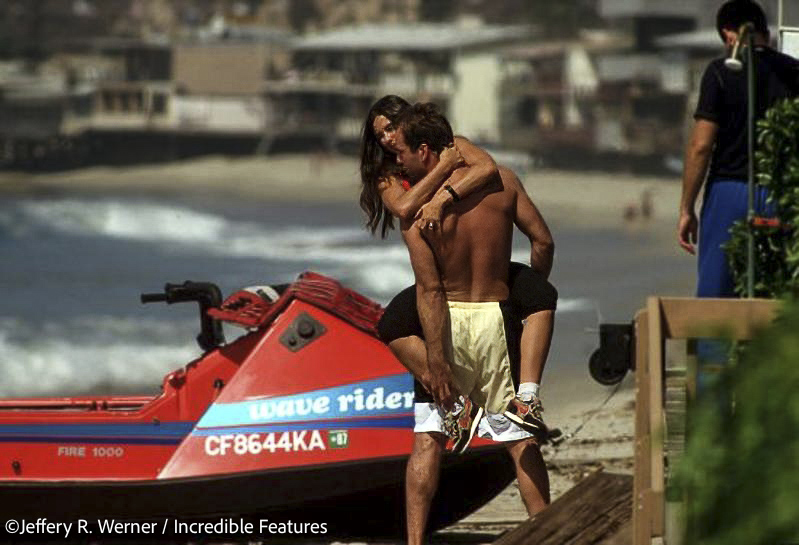
I then saw him drinking coffee watching the waves from his balcony inside his home. I went down behind a rock with the sun at my back with my camera ready. Then he came out to the beach with Demi. He picked her up and spun her around. I stepped out and took pictures. It was beautiful light and I thought I was getting good photos but you never know for sure. Then my last shot was Demi pointing in my direction and Bruce has his hands up to his eyes and I said to myself “I’m screwed.” He starts walking towards me although I’m a long way away. I start to pretend I’m shooting some birds. He came up to me and said “Don’t take pictures of me and don’t take pictures of my house.” I said “Why would I take pictures of your house I did that yesterday.” He smirked and walked away. They went out on the water with their motorized jet skis and I used that as a chance to escape since I had to walk by his house to get to my car. I called it in to my editor and he said “You’re kidding, you mean you got it!” I said I think so. He said “Get to a lab fast we’re going to hold the press.” I went to the lab and took it right to a plane. Those pictures were on the cover and ran for a long time and then again when they got married.
JS: My agent for a while was Shooting Star. You probably knew Yoram Kahana.
JW: I knew him and I posed as him twice to cover the Academy Awards. I had his pass and was shooting for him. I was also the first photographer for Outline Press. It was started by Bob Young and Jim Roehrig. Bob recruited me into his Outline Agency when he was ending his days at the Star. He went on after a while and took a new job with Murdock to be the chief photo editor at the New York Post. Jim Roehrig stayed on and later sold Outline to Corbis. I continued to work for Bob Young at the Post until he went into television and for Jim at Outline.
My editor at the National Enquirer Bill Graham, kept getting calls from Picture Group asking who shot the spreads that ran in the Enquirer. They couldn’t believe the same photographer had shot so many different types of subjects, from stunts to wild animals living in people’s homes. They gave me some big assignments. Then Bob went to the New York Post and I worked for him. Then he went into television. Outline became a very big agency. They were close with NEWLOOK magazine out of Paris. I was only getting 25% payment and my agent dealt directly with them so I should have been getting 50%. But I was loyal to them and loyalty was my problem.
Then the agency Picture Group started calling me a lot and they asked “Who shot Siegfried and Roy?” and my Editor said “That’s Werner.” The next week they asked “Who shot this big stunt?” My editor says “That’s Werner.” “Who shot the pig in the bed?” This went on and on and Picture Group tried to get me because they had one photographer in L.A. who wasn’t very good. Finally, when Outline hung up on me one day I said “Bye.” I met with Picture Group in Rhode Island and they signed me up. But when the agency’s owners went their own way, Picture Group didn’t last.
JS: I’ve been with Getty for over 20 years and it’s worked well.
JW: I have to say that I worked directly with many overseas agencies. I also had an agent in Paris who represented only me and one German photographer. She was the best. She would collect every magazine I was published in and send it to me. I also worked with Rex in England. I had a LAPD press pass and Secret Service pass through them. I had agents in Spain and Italy. I left Rex in the early 2000’s, mainly because their sales at that time went to near zero.
But then in 2005 or 2006, I got a call from Sam Barcroft in London, a veteran of Fleet Street, who was starting his own news and features agency there. He had seen my work published in various magazines and tabloids and was interested in recruiting me. The deal was, any assignments he gave me would be 50-50, and any stories I sent to him would be 60-40. That call came at a good time; when the Enquirer work was winding down and the markets in general were collapsing. Then all of a sudden, my photos began appearing regularly in the Daily Mail, The Sun, the Telegraph, the Daily UK Star and a number of English women’s magazines who had rather good budgets at that time.
When I went to visit Barcroft in London, I had just finished my stunt book. Barcroft took pictures I had given them for syndication and publicity for the book, and in one glorious Wednesday, typically a slow news day in England, Sam was able to place stories on me and the book with my pictures in every single tabloid newspaper in the country. Which also got picked up from many other magazines around the world who contact me directly (Barcroft only had rights to license my work in the UK and the British Isles.)
One day Sam called me up and said “I want you to shoot a Junior Bull riding School in Montpellier, Idaho.” As usual he would pay half the expenses and 50-50 on the sales. But then he asked for something new. “We need video too.” When the Canon 5D Mark II came out, it was a game changer. Suddenly, still photographers who had never shot video before were asked to shoot it as well. On-line tabloid news sites began to request and run video features along with stills. So, for the first time, with my new 2006 Canon 5D Mark II in hand, I made my first attempts at shooting video with sound on a story. Since I didn’t have an assistant or 2nd photog on the shoot, I was forced to put it on a tripod, point it in the right direction, and let it run. I was in a bull ring for much of the shoot, so I also had to run from time to time. But that was the beginning of a new era for me as a photographer. Video.
Not long after that I visit Barcroft in London and in Sam’s office was a video camera sitting on his office couch. He pointed to it and said, “That’s the Enemy.” Not for long, however. When I met him in London a couple of years later, he said that stills used to be 80% of sales and video 20%. Now it was reversed. Video is 80% of the story sales, with stills only 20%. In fact. Video had become so important that he had to hire many new video editors and often separate some shoots into video days and still days. He told me that his YouTube channel was pulling in six figures a month. Barcroft later sold his agency to Channel 5 in London. His video stories had become that good.
I was in Paris in 1987 on a shoot and working with my agent there, Elisabeth van Dierdonck. Elisabeth worked with a lot of French magazines on my behalf, and had taken it upon herself to make an appointment with the editor of French Photo, known as the world’s most prestigious photography magazine which featured some of the world’s greatest photographers. One of their most well-known editors, Jean-Jacques Naudet, had called me personally a couple times to submit portfolio pictures to him. Even though my pictures had been published in many magazines around the world, I still considered myself a tabloid man, and for whatever reason, probably a self-confidence issue, I never sent him anything. Then Elisabeth dragged me, kicking and screaming so to speak, to their offices in Paris with a large portfolio of my work she had sent to her by my assistant in Los Angeles. Then someone called Jean Jacques to tell him I was in their office with Elisabeth. He said, “What, you‘ve got Jeff Werner there! Don’t let him leave. I’ve been trying to get him to send his stuff for a couple of years now!”
So they took my rather heavy portfolio of pictures and clips into another room, and asked us to follow. They had a room with a very large set of Y-shaped tables set up to edit pages, and began by clearing the table of whatever pages they had on it. I asked Elisabeth what are they doing. “Jeff, they are laying out your stuff for the next issue! This is their layout room and they almost never let photographers back here.” Sure enough, next issue of French Photo came out with a 16-page portfolio spread, which also was published in Italian Photo with a cover mention. And it was picked up by magazines in a number of other countries as well. I thought to myself, I must be an important photographer now. I mean, none of these famous photographers features in French Photo had ever shot the motorcycle stunt frog! (laughing)
Another thing that happened had to do with Brian Wolf a photographer friend of mine who works on copyright matters now. He was picked to do A Day in the Life of Hollywood. I was in Hong Kong and Bangkok. He called me and said “You gotta get in this book.” He basically talked me up and got me in. They already had all the photographers come in. I had to get on a plane immediately. They give you 100 rolls of film and a $600 stipend and they give you a few assignments. This book, A Day in the Life of Hollywood, was done at the very wrong time. There was nothing much going on in Hollywood at that time because it was spring and most productions hadn’t started up yet. There were a couple of things sort of. Like an actor on the other side of town doing something that was really nothing. I started working at midnight the day before. I worked straight through till midnight the next night. I did a dozen assignments half of them my own.
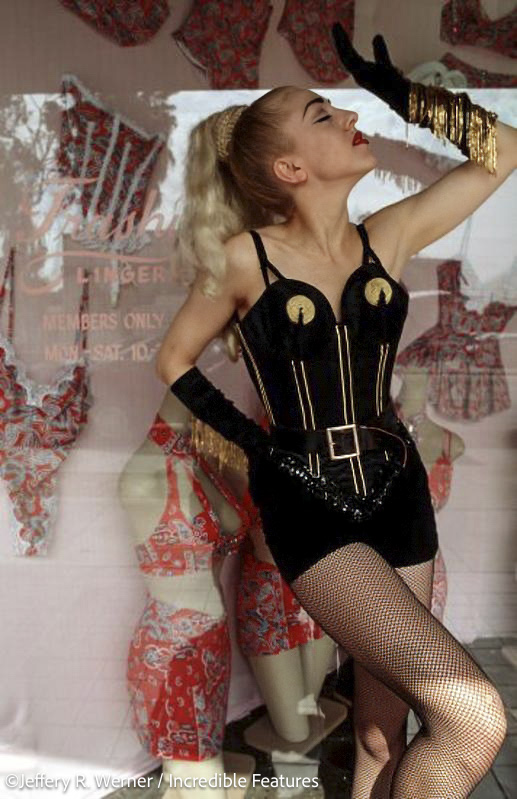
Shooting the Star Trek makeup guy (Michael Westmore)who was head of makeup for Star Trek Next Generation and many of the other franchise shows and movies. I previously had done a shoot of him for National Geographic World. Another idea I came up with for the book came by way of a famous stuntman and action movie producer I had worked with who called with a story about Madonna’s bra. Her famous bustier that had gone missing and was then found. He made it possible for me to get my hand on it, so to speak, and since I had already worked with Denise Vlases, a professional Madonna look-a-like, what better person to wear it for a Hollywood shoot. Didn’t think Madonna herself would be available. I called Denise and we went to a couple of places in L.A. that sell hot lingerie. First we went to Frederick’s of Hollywood on Hollywood Blvd., but there was already a very famous photographer there that I recognized doing a shoot. So we went to another location, and did the portrait in front of Trashy Lingerie, which made a full-page picture in the book. It looked just like Madonna.
For another self-assigned shoot, I visited a stuntman at his house who did an air ram stunt for me using an air ramp that releases high-pressure air to violently, yet safely, launch a stunt performer in the air for a dramatic yet controlled flight. He was supposed to fly right over my head, but he missed his mark and he flew into my head instead, and I fell over in a pool of my own blood. But I was ok. Just bandaged it up, although the book office was calling and pleading with me to go the Emergency Room, I refused. My best shoots were coming up. The other stunt I shot that day was far more successful. It was a stuntman who set himself on fire in a vacant hilly area, which I used my entire expense account of $600 for. He brought along his stunt fire safety crew of course. That picture not only made a full page in the book, but an out-take of it landed on the cover of American Photo. I heard from some pissed off photographers, “Oh, who’s the guy that got the cover (of American Photo that did a story on the making of Day in the Life of Hollywood book.) I got all the publicity, not to mention the three TV crews following me around. I asked one of them why I’ve got so many TV guys following me when some or the more famous photogs only had one or none. One of the producers said “because you’re the guy that shoots the crazy stuff.” Still, that was the last Day in the Life Book I worked on. Go figure.
JS: Did you ever have a photo Rep or manager?
JW: Kind of. Even though he works for me Brian Wolff thinks he’s my manager (laughing). He’s great at copyright protection. I had a girl who worked for me who was like a Creative Director. We had an office because we started a reality TV company. Getty came out twice and my mistake is I should have met them myself because maybe it wouldn’t have hurt to be with Getty. Actually, there were some of my photos on Getty that we had to take off. Basically, I’ve been my own person. The closest I had to a Rep was Elizabeth in Paris. She would go around and show my portfolio and sold a lot of stuff. She was friends with all the editors. Everybody respected her.
Maybe because I did all these different kinds of stories, in her French accent she would say to me “You are a legend in France!” People actually wanted my autograph. Although I was mostly known as a stunt photographer in France, I also did a lot of world record stunts of all kinds. Even a world record gang bang porn shoot. I covered this because I knew the guy putting it together. He was a very funny guy. They had this whole warehouse full of men. The girl in the gang bang was going to break the world record, 300 guys. Ron Jeremy, the infamous porn star, was there as an emcee interviewing everyone. I expected it would be quiet on the set. I brought my blimp and long lenses. I had this girl assistant which was a bit strange. When I arrived, I saw all the photographers who shoot for the porn magazines and they looked like they didn’t know what they were doing and they all had flashes on their cameras. I changed my equipment. I used a ladder but I didn’t use straight flash. I bounced the flash and I used some gels. The guy running the show was wearing a suit and he said to me we gotta have lunch sometime. I didn’t want to make this my full-time gig so I politely said “Maybe.”
My agent Elizabeth pitched it to French Penthouse and others. They said “Oh we get pictures from another company.” I shot anyway and I’m there all day. My favorite photo is when everyone broke for pizza and the girl put an ice pack on her private parts. After the shoot Elizabeth got a call from French Penthouse “Did Jeff shoot that?” She said yes. “Could we see his stuff because the stuff we have is all crap. It’s all flash and it’s terrible.” She took my photos over there and they were all blushing. Here’s Elizabeth my agent a very sophisticated older French woman showing them the very x-rated photos. Sure enough. I got a six-page spread. I found out much later I was pictured on the back of the DVD taking pictures of the “event.” They also wanted me to do a shoot with the girl at her home, which I would have loved to do. She lived right near me but I was on a shoot in Canada for two weeks. Her name was Jasmin St. Clair.
JS: I photographed her! For a calendar for Epiphone guitars. She posed nude covered by the guitar. I lit it like a fashion shoot and it’s one of the best “fashion” shoots I’ve done. I also have been my own Rep or manager. January 1, 2026 is the 30th anniversary of my California photography business. Are you still shooting photos or mostly working your deep archive?
JW: I didn’t want to retire. I had two reporters working with me. One in Los Angeles and one in New York. I was doing my own shoots and their job was to come up with five stories a day, and I’d choose which ones I wanted to shoot. I didn’t always think about if it would make money, I simply had to like the idea. I would go all over the country and shoot stories. Like amputee summer camp. It was up in the mountains near Idyllwild, California. I did a simple panning shot of amputees running. Just for fun never thought about it again. That turned out as a double page spread in Stern magazine. I photographed a cop who lost his leg and went back to work with a new leg.
I was shooting rodeos for a while including a gay rodeo and a prison rodeo. I made a special direct deal with the Daily Mail. Now adays, unlike the days of printed magazines, the tabloids can run 30 of my photos in a story. I also love to shoot bulls. Many bullfights, Costa Rica, Spain, etc. It’s so crazy and dangerous. I’ve actually been in the ring with them. I was photographing a matador in Mexico and had an assistant with me because I was using a Hulcher camera and I could shoot 65 photos per second. I looked around and thought, where did my assistant go? I was told “You’re Loco, you’re inside the ring, not outside the ring!” I said yeh I get the best pictures here. Sure, I’ve had to run up on a gate a couple of times. As far as today the last few years I’ve gotten involved in registering my work.
JS: With the Library of Congress?
JW: Yes. It used to be easier. The new rules are more complicated. I’m trying to get everything that’s not registered, registered so I can do more with it in the future. I’m involved with the copyright work with the help of Brian.
JS: Have you done stills on feature films, were you in the Cinematographers union?
JW: Yes, I was in the union. After I worked on all the TV shows I realized I have enough days to join the union. $5000 to join! Once I got into the union I realized I liked to own my pictures and there were attitudes I didn’t care for. Even when I was on an assignment from a magazine the attitudes bothered me. I did a shoot for Time Magazine back in 1981 on the set of Thief, I wish I hadn’t done it. This was a major motion picture starring James Caan and directed by Michael Mann filmed in Hollywood in 1981. That was long before I was able to join the photographer’s union myself. It was a stunt I shot. Cann was torching a safe. The problem was the union still-photographer wasn’t happy I was there.
He said “You’ll be great if you shoot over here because it’s so loud you won’t need your blimp.” Turned out of course I did need a blimp because with it I could have gotten closer and gotten better pictures. Another time on Thief the union guy showed up and all of a sudden he’s screaming and yelling at me. I said “I’m from Time magazine” He said “You better be!” I thought is this what it’s like? The shoot was supposed to happened at 7pm I was there till 4am with the star of the show James Caan. He was wearing a welder’s helmet for the shot. They could have used a stand in. What good was the whole thing?
When I got in the union I was in the middle of shooting two actors and the photo was just to be used as a photo on a desk as set dressing. We start to shoot and someone calls lunch. I say we just started shooting and it’s only gonna take two minutes. The union guy says “No, this is a union set, when we say lunch you go to lunch. Right now!” At the end I had to give all my film to the production company and sign a release and get my $400 for the day. Later I watched the movie. I shot a lot of wedding scenes, just like I would have if it had been a real wedding, but instead of guests, they were extras in the movie, and some were the stars of the movie. For the movie the main actress layed out all the wedding pictures I had shot, and another actress said “Oh, I love your wedding pictures.” I didn’t even get my name on the movie. I kind of lost my appetite for shooting on sets.
I did shoot on independent sets. Mostly stunts. On another shoot for Time I shot on the set of Kennedy with Martin Sheen on location in Hyannis Port. It was great, I ate lobster every night. He was so nice. I was dressed as a Secret Service agent and he bumped into me and said “Well at least he’s carrying a camera not a gun.” I did a group shot of everyone in the movie. Some of the actors came up and introduced themselves to me. I turned in my film to Time and someone at Time said “They don’t look enough like the Kennedys” I thought are you kidding, Martin Sheen looks just like him.
JS: Do you have a story of a big failure.
JW: We had old walkie talkies that we made into remotes controlled by foot pedals. You could press it with your foot and all your cameras would go off. Everything was attached via a cord. I was doing this stunt shoot alone with no assistant and I was to shoot a guy jumping 50 cars. He had a parachute and he was going to pull the parachute half way across the 50 cars. At the last minute someone stepped on the main cord knocking out four cameras. I thought I was screwed. In addition to the remote cameras, I had planned to shoot the stunt myself with a 50mm lens but now I quickly switched to a zoom lens 70-200mm. When he crashed I was zooming out and not sure if I got the shot. I thought the guy was dead when he crashed. I ran up to him and there was blood everywhere. He spent a year in the hospital. I sent the film to the Enquirer lab and my editor said “I haven’t seen a better sequence in my life. This is great.”
On another shoot I went to New Zealand to shoot a guy jumping off a waterfall on a jet ski. It took forever to build a takeoff ramp so he decided last minute to just do a quadruple dive right off the waterfall. He was a world-famous diver. I had to shoot it with high-speed film. 800 pushed to 1600 because it was backlit and dark. He goes into this pond it’s got eels and things in it. I got the shot. I shot him all the way down and the pictures look fine to me but Mr. Pope, the publisher of the National Enquirer hated anything grainy. They didn’t run it. I was there a week on assignment setting up and then nothing. I probably sold the images later somewhere though.
I also remember once I had to go back to Michigan for a reshoot because I was a quarter inch off. I was shooting a little girl famous for picking up real cars. I shot her with barbells against a backdrop. The barbells were to long for the backdrop so I cropped in slightly. They sent me back to Michigan to re-shoot it because I cropped in a quarter inch! They ended up using the original picture for some reason. Oh well, two trips for one picture.
JS: What advice would you have for a young person today who wants a career in photography?
JW: I can start with one word. Don’t (laughs) I feel sorry for a lot of photographers who went out of business. There were a lot fewer photographers back in the day who were real photographers. Some of the cameras today are amazing. Every 18 months to 2 years you gotta get a new camera to stay competitive. I’m sure there is still a way to make a living in photography. Today’s advanced phone cameras along with their video capabilities, are all great but it has had an effect on our business. Everyone has a camera on them at all times these days. Also in the old days, my Nikons could go a decade or more before needing replacement. In fact I still have most of them locked away somewhere in a time capsule.
I worked for Rona Barret for a year and I shot Jane Fonda at her home. I also photographed her then 18 year old daughter, Vanessa Vadim, who went down to Nicaragua in a war zone, to help build a school there with a group of students from Rhode Island. I was undercover for the Star with a reporter. I ended up driving her around in a small truck, through a war zone, with soldiers in the street carrying M16’s trying to thumb rides, even though I had never driven a stick shift before in my life. She said she wanted to be a photo journalist like me. Hard to believe that Vanessa is 57 now. I remember that before I left Nicaragua she gave me a letter to mail to her mother Jane when I got back to the States. I never opened it. I mailed it in L.A. Probably a good thing she hadn’t handed it to the reporter.
I did a shoot of a professional hugger. I went to New York to shoot her with a couple models and one of her clients. She was a snuggler. Someone had done that story but the photos were awful so I redid it and also shot video. I even hire cinematographers now because that has become so big. Remember when I told you my London agent said video is the enemy. Today you need to be able to shoot both stills and video. And be sure to get video releases as well.
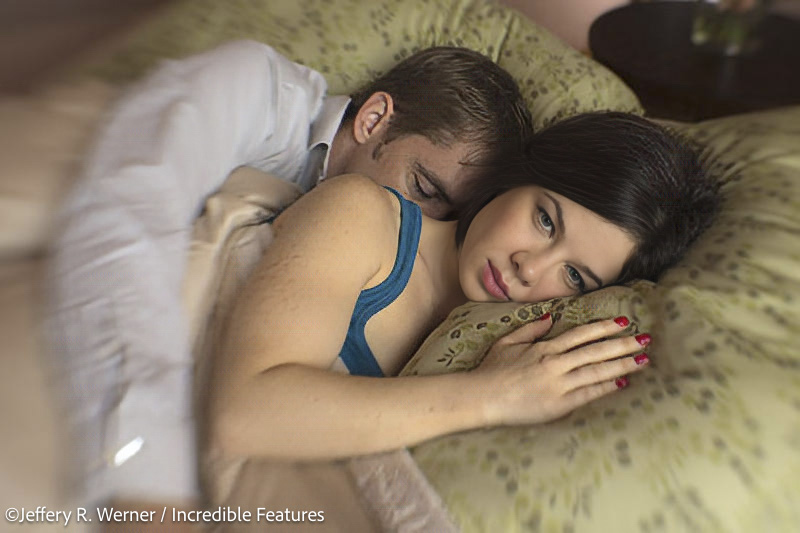
Another thing about the business of photography, always get a model release if you can. If you do a nude shoot you also need to get their driver’s license information. But the number one thing is keep your rights. I resell my photos all over the world. One sale doesn’t do it. I did a six-page spread with FHM and got paid $8000. All of the foreign editions of FHM contacted me directly to reuse the same story Stunt Kings. They were all separate licenses and separate negotiations. I ended up making over 25 thousand dollars in additional sales for the same story. Keeping in mind that all of the pictures were from separate stunts that also continued to sell over the years. Syndication and keeping your rights to your pictures are key. Remember to keep good paperwork. Even if it’s not often paper anymore, it’s still your invoices, delivery memos, licenses, signed receipts, model release when you have them, everything. Think of the future. Here I am, talking about shoots I did 30-40 years ago. And I will have the paperwork that helps prove their value, back then, and today, and in the future. Don’t forget to use good terms and conditions in your paperwork, like on the back of your invoices and delivery memos or deals. ASMP has guidelines for good legal terms and conditions.
JS: Do you have someone chasing down those who use your photos without permission?
JW: Yes, I have people who check that like RightsClick and Tineye that scour the internet. We also get reports from various people. Someone might call and say I just saw your photo on channel four news. Also don’t forget to register your photos. When I found out channel 4 news in Los Angeles was stealing my pictures my associate in Los Angeles called them and got $4000 as a back license for one-time use. That was before I found out how many of my pictures had been stolen and were all over the net. It was time to start taking actions to protect my copyrights.
The copyright laws in the U.S. are very pro creator and I hope it stays that way. The least you can get is $30,000 if they steal it and didn’t know they were stealing it, if you go to Federal Court. If they know they are stealing and don’t even call you to check if they can license it that could be up to $150,000. Per use. The very first time we went after thieves I got $70,000, without an attorney with Brian doing a negotiation on the phone. I won’t mention the name of the entity who used the two stories without permission. I’d rather not say it’s lucrative. I prefer licensing my pictures to clients who contact me. Not having to go after thieves which costs me time and money. I didn’t sue just for me, I did it because everybody was getting ripped off. Tons of people stealing especially with digital. It’s so easy to steal from the Daily Mail, The New York Post and other on-line publications. My photos would come out and then they’d be all over the place. It’s a lot of work to chase down the thefts. Some of these companies are in China and you think you can’t get them but they have offices in New York. If they have a footprint in the U.S. you can go after them. Generally speaking, we’ve won and settled every case. Although it can often be a long road to get settlements, going to Federal Court in New York or LA, sometimes depositions, etc. But in the end, we won every case.
The most important thing is keep your rights. 99% of what I shot I own. A couple of buyouts over the years but that’s it. One was a cover shot in the studio for the National Enquirer. I just took the $2500 and was happy. Next most important thing is to register your pictures. Very often I’ve won six figures. The Chinese communist party, Nationalists, Mexico, you name it. It took a lot of time and effort to get to them. Checking how long they use the photo and then figuring out what dollar figure to base the value on based on time and usage.
JS: My friend Lynn Goldsmith has been very involved in protecting photographer’s rights. I donated to her GoFundMe. She took it to the Supreme Court and won.
JW: Yes, I know of that, it helped all of us.
JS: Did you ever meet the guy who invented the blimp?
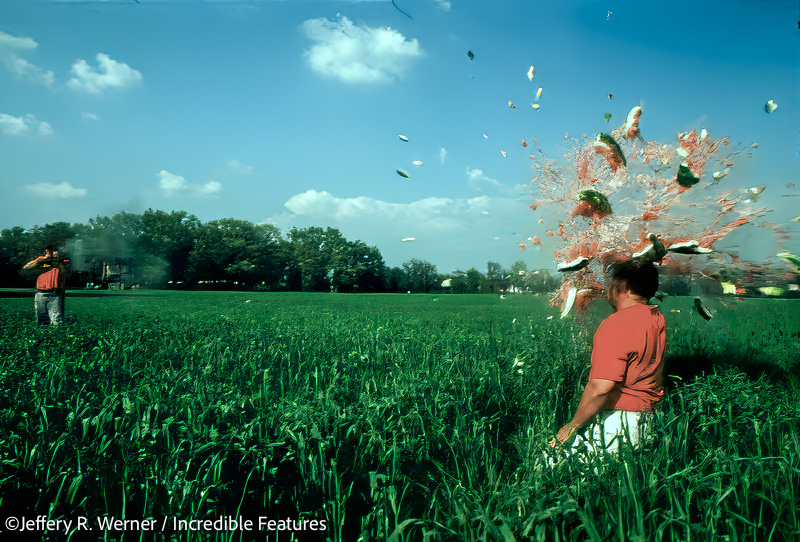
JW: Yes, and I did a whole story for a French magazine on the guy who invented the Hulcher camera. The story included my photo of a guy shooting a watermelon off his brother’s head at 65 frames per second.
JS: How are some of the ways you’d get leads for cool stories?
JW: In my office we had an Incredible Features newsroom with a reporter and researcher and interns in attendance, and I always insisted on keeping a couple of TV’s tuned to the news outlets on mute with captions in case an interesting story popped up. Back in the early days I lived near a news stand, and at 10pm every night I’d go get the next day’s copy of the L.A. Times. I found some good features stories to follow up on, and if I got the early edition I could get the jump on competition. Next morning at 6am I’d follow up on the stories before somebody beats me.
JS: Your company name is Incredible Features. Where did that come from?
JW: It sort of came from the fact that I was the photographer for That’s Incredible, the 1980’s ABC-TV show. French Photo also called me the “Incredible but True Photographer. The Sun once did a spread of my pictures with a picture of me in a bee suit and titled me “the Spunky Shutterbug.” Not sure I liked that one as much as everyone started calling me “Spunky.”
JS: Tell me about making a book. I’ve done two books of my work.
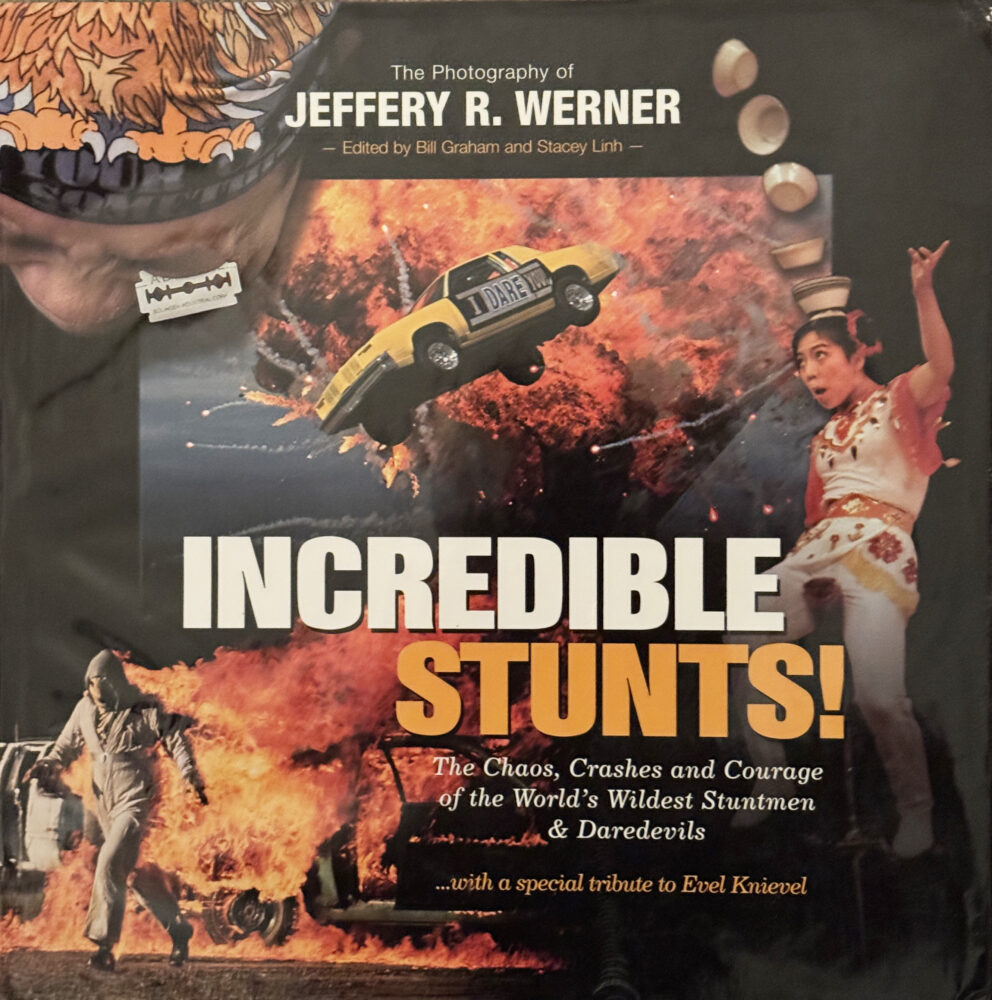
JW: My editor at the National Enquirer, Bill Graham, was the perfect guy to help me with the book because he already knew most of what I had shot over the years, especially the stunts and daredevil photography. His assistant, Stacy, helped by taking notes of everything we discussed, and which stories would be good to include in the book, and which ones might not be. We started with a 100-page book layout, and later expanded it to 160 pages. Bill knew an excellent designer who had done some work for American media in Florida, and we hired him. We also hired a girl to do conversions when the time came; and made decisions on scanning the photos. The ones used really big were drum scanned.
The first thing we did was to design the book cover, which I recall was an all-night affair given the time difference between L.A. and our designer in Florida. My original idea was to do a one picture big fire stunt on the cover, either a car stunt or motorcycle. But what we came up with was a juxtaposition of four pictures, all totally different, with a fire car stunt in the middle. And of course, several more pictures on the back. Some people loved the cover, others were not too sure. But the problem we had was that it looked too much like a Ripley’s Believe it or Not book cover. Ripley’s in fact called us to license a bunch of the pictures, but when they called a second time to license 50 more at normal rates, we refused. I heard from a distributor that we had been black banned. Later I did a second cover with a single motorcycle fire stunt picture and not as much writing on the cover, which I like a lot more. Although the original cover is imprinted on the hard inside cover.
Stacy said I need to put Evel Knievel photos in the book and dedicate the book to him because he was still getting a lot of clicks on the internet. I also dedicated it to Dar. Evel called me a few weeks before he died and said I understand you want to do a story on me. Write whatever you want just make it nice. It was perfect because the book was covering both daredevil type stunts and professional stunts. So everyone’s hero, Evel and Dar, were dedicated and in the book.
Even though I am a writer I hired a writer to assist. My ghost writer wrote the Evel Knievel story in first person. And another old print editor of mine from my writing days who helped write a lot of the captions. We had a girl do the color conversions and then we had to decide which pictures needed to be drum scanned and which could be scanned on our own scanner. I took two trips to Florida to design and redesign. The designer came up with the idea of putting four or five stunt photo spreads at the beginning like a prologue. I went to ASMP where they had a book meeting with the guy who published a book of his photos called Skin. He said the worst mistake he made was to not to go to the press run in China because they screwed up the colors on some of the pages. We found a printer who would do it at a reasonable price including the shipping. Stacy and I went to the press check run in Korea. Sure enough, there were a few pages that needed fixing. I went to Germany twice where they have the world’s biggest book convention and also to a convention here in L.A. and we found a distributor.
The first big problem I had was the change of cover and the second problem was it came out in the fall of 2008. The year of the world-wide recession. Nobody was buying books most especially expensive books. I priced it at $49, a reasonable price, but then reduced it to $29. If I were to do it again, I’d get someone in Germany to do the book. I paid all the costs myself and it came to much more than I thought. We also got a PR person. He got me three major radio interviews and a TV thing with the lady who had interviewed Barack Obama about his book before he became President. My agent in England got five publications to run a piece on my book on the same day. I got a lot of publicity but it wasn’t a best seller. Now we’re looking at redoing it as a smaller book maybe with Taschen. I’ve also wanted to do a book on Incredible Animals. I’ve shot so many people with their animals.
I was a little crazy when I look back on my career. When Life and Look magazines briefly came back to newsstands I went to Baja Mexico with another photographer who came to me with a whale story, and we went dibs on hiring a private plane to fly down and shoot pictures. I had no idea that Life and Look would be interested. We just freelanced it. We rented a plane and went down to Baja where they had 7 giant beached whales. No one knew how it happened. It was a mystery.
I got some ariels from the plane, not as easy as a helicopter. I got pictures of when they lighted them on fire. It stunk like you wouldn’t believe. I got whale guts all over me. I don’t know how the pilot could take it. I had to walk naked back into my apartment. I gave the photos to my agent and Life and Look ended up fighting over who would use them. And it ended up double page in Life and a ground fire shot in Stern. That was followed a month later by another double page in Life on water tubing, a new California sport.
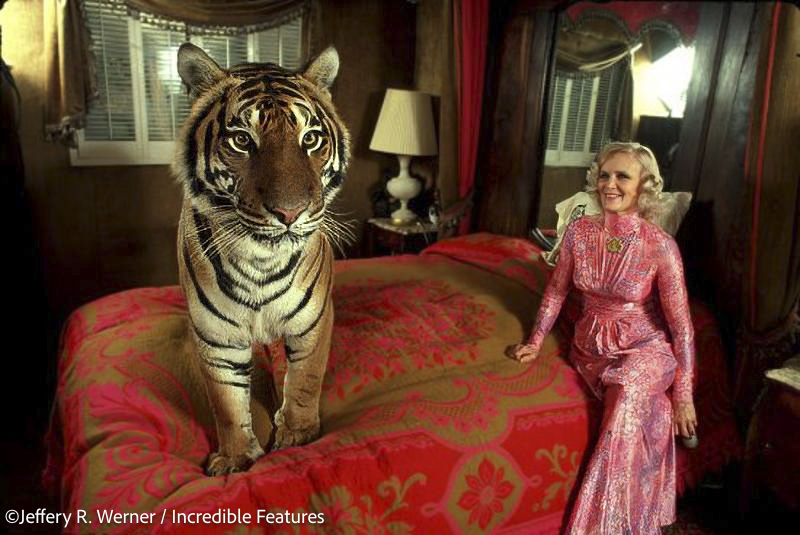
I photographed a lady in her bedroom close up with her pet Bengal tiger sitting up on the bed. She said “You are the only photographer who didn’t photograph my tiger from behind the window.” I have no fear of animals.
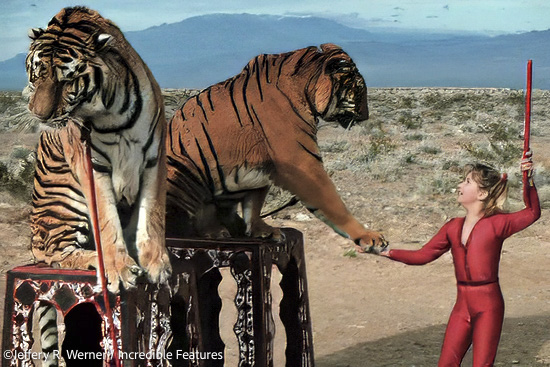
I shot the Berosini animal circus family a few times over the years, including their daughter Britte who at age 13 was the world’s youngest wild animal trainer. We’re talking full grown lions and tigers. When she was in her early 20’s she was bit by a spotted leopard, which is the shoot I was talking about earlier. The Enquirer sent me to shoot her on a Vegas stage which I did with lighting and so forth because the incident had made the news, and they thought a portrait of her with the animal would be newsworthy. But she was noticeably nervous, which I hadn’t seen before in the previous years of covering her around giant lions and tigers.
JS: What’s next for Jeff Werner?
JW: Put my million or so pictures together into certain categories. Either do one big book showing the breadth of my career or separate books for each category. Brian says I should do a book called “The Confessions of a Tabloid Photographer.”
Even though my photos have run in 100s of magazines and newspapers many originated in the Enquirer or The Star. I did work for Country Weekly and of course National Geographic, and In Touch. It seemed every time I got a good gig they went out of business, or fired the editor who had spent too much money, especially on my shoots. I like doing the home shoots with celebrities and I was good at paparazzi. I did the stunt photos, animal photos, street photography, unusual people sometimes known as freaks. The editor at the Enquirer wanted to do a book of my photos and call it Freaks but I couldn’t get myself to do a book called Freaks.
I photographed half-girl Rose Homan Siggins. I started shooting her for the Enquirer in Colorado beginning in the early 80’s at age 9. Then when she got her first car with hand controls at 16. Then later when she had her baby. Then when she got married. Then back for the second baby. Then back for updates. She had a rare disease that caused her to be born with no legs, actually nothing below the waist.
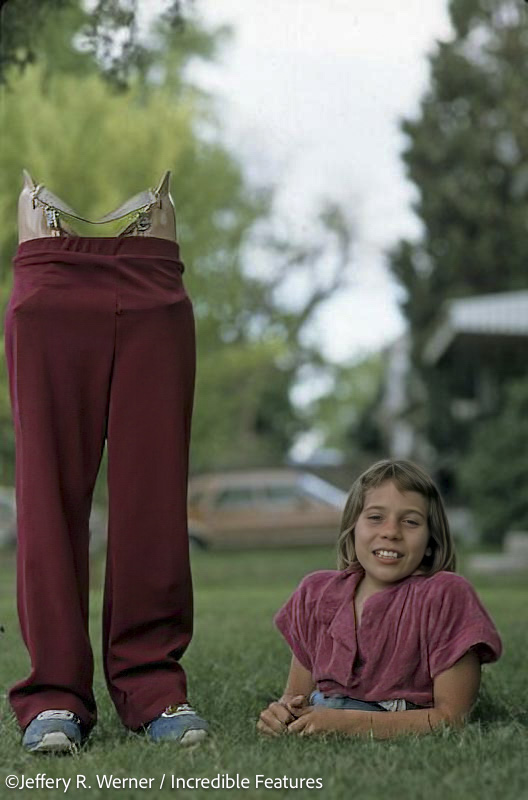
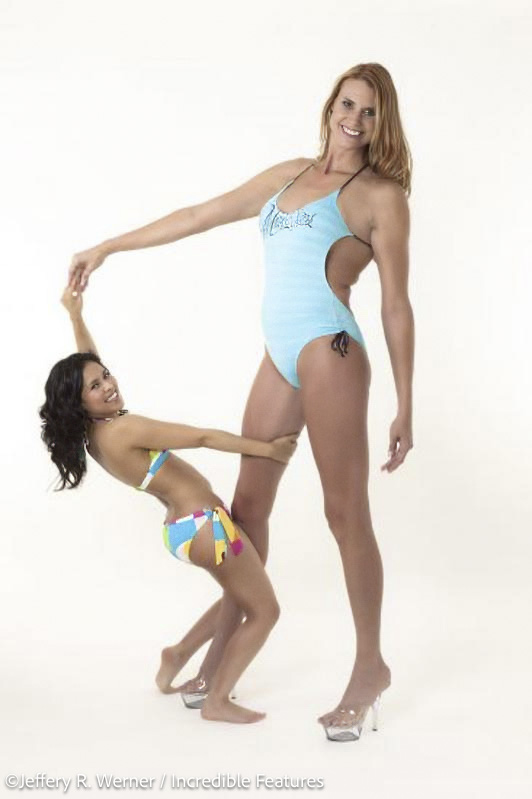
And yet she learned to get around on a skateboard and walking on her hands. At age 40 she appeared on American Horror Story: Freak Show, along with another subject of mine, Amazon Eve, the world’s tallest model.
Unfortunately, Rose passed away not long after the show wrapped from complications of kidney stones. But at age forty she did the TV show Freaks. Maybe I shouldn’t have been so worried about the word Freaks.
For more info on Jeffery R. Werner: https://agency.incrediblefeatures.com/