Home Classical Gustavo Dudamel’s Farewell in Juxtapositions – Beethoven’s Pastoral Meets the Fires of...

Gustavo Dudamel’s Farewell in Juxtapositions – Beethoven’s Pastoral Meets the Fires of Adès’ Inferno

0
Dudamel
As Gustavo Dudamel approaches the final curtain of his transformative tenure with the Los Angeles Philharmonic, his programming has begun to feel like a summation of everything he has championed during his time in Los Angeles. These concerts are not simply performances — they are statements about the orchestra’s extraordinary range.
At Walt Disney Concert Hall, Dudamel delivered one of his most striking juxtapositions yet: the serene, organic expansiveness of Beethoven’s Symphony No. 6, the “Pastoral,” paired with the jagged torment of Thomas Adès’ Inferno.
The result was electrifying. Within a single evening, the orchestra traveled from the peaceful indifference of nature to the desperate cries of the damned.
The program began with Beethoven’s Pastoral, and Dudamel allowed the music to breathe with luminous patience. Rather than presenting the symphony as a charming countryside narrative, he treated it as something larger and more elemental.
Under his baton, the LA Phil did not merely depict nature — they seemed to inhabit the sweep of the composition. The winds murmured with birdsong that felt spontaneous rather than decorative, while the strings moved with the gentle inevitability of flowing water. Even the famous storm sequence emerged less as theatrical drama than as a natural force. Here, thunder rolled across distant hills before giving way to the quiet calm that follows.
In this interpretation, humanity is not the protagonist, but a mere witness to the vast, Arcadian sweep of the seasons and the wind. After the intermission, that sense of equilibrium vanished. No, it was more than a vanishing. After intermission, that sense of equilibrium didn’t just vanish — it was incinerated in the fires of the Inferno.
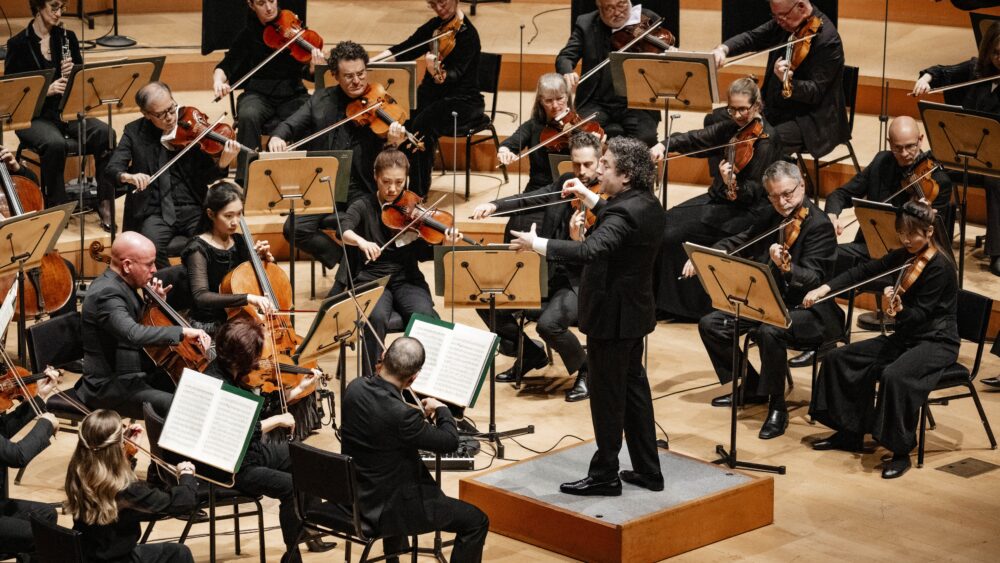
Gustavo Dudamel conducts the LA Phil in Adès and Beethoven (Photo by Timothy Norris, courtesy of the LA Phil)
Dudamel plunged the audience into Thomas Adès’ Inferno, the first part of the composer’s Dante-inspired orchestral trilogy. If Beethoven had opened a window onto nature, Adès dragged us deep into the human psyche.
The juxtaposition was startling.
Where Beethoven expands outward, Adès collapses inward. His score transforms the orchestra into a searing engine of sound, and the LA Phil attacked it with breathtaking intensity. The winds and brass didn’t just play; they shrieked with the specific, harrowing texture of human voices pleading for a second chance. Even the piano and harp, instruments often associated with delicacy, became jagged punctuation marks within the chaos.
Adès’ Inferno is claustrophobic, feverish, and unmistakably human. If Beethoven views the world through a wide-angle lens, Adès magnifies every emotional tremor under a microscope. The orchestra becomes a collective voice of anguish — pleading, raging, and searching for redemption that never arrives.
Navigating such radically different musical landscapes requires a conductor of unusual vision, and Dudamel proved once again why he has defined an era at the LA Phil. He guided the orchestra through this dramatic juxtaposition with remarkable clarity, allowing each work to speak in its own language while revealing the deeper dialogue between them.
The tension of the abyss finally broke when Thomas Adès himself stepped into the light to join Dudamel, shifting the energy from the harrowing depths of the Inferno to a rousing, visceral celebration of the present moment. The two embraced before a roaring Walt Disney Concert Hall audience, a moment that felt like a striking underscoring of the orchestra’s continuing artistic vitality.
The evening ultimately revealed the extraordinary capacity of the modern orchestra. In one moment, it dissolves into the quiet majesty of mountains and rivers; in the next, it becomes the anguished voice of a soul in torment.
With this powerful juxtaposition of Beethoven and Adès, Dudamel reminded us why the Los Angeles Philharmonic remains one of the most adventurous orchestras in the world, and why this farewell season continues to resonate so deeply with his audiences. We continue to realize how much he will be missed.
Photos by Timothy Norris (Courtesy of the Los Angeles Philharmonic Association)