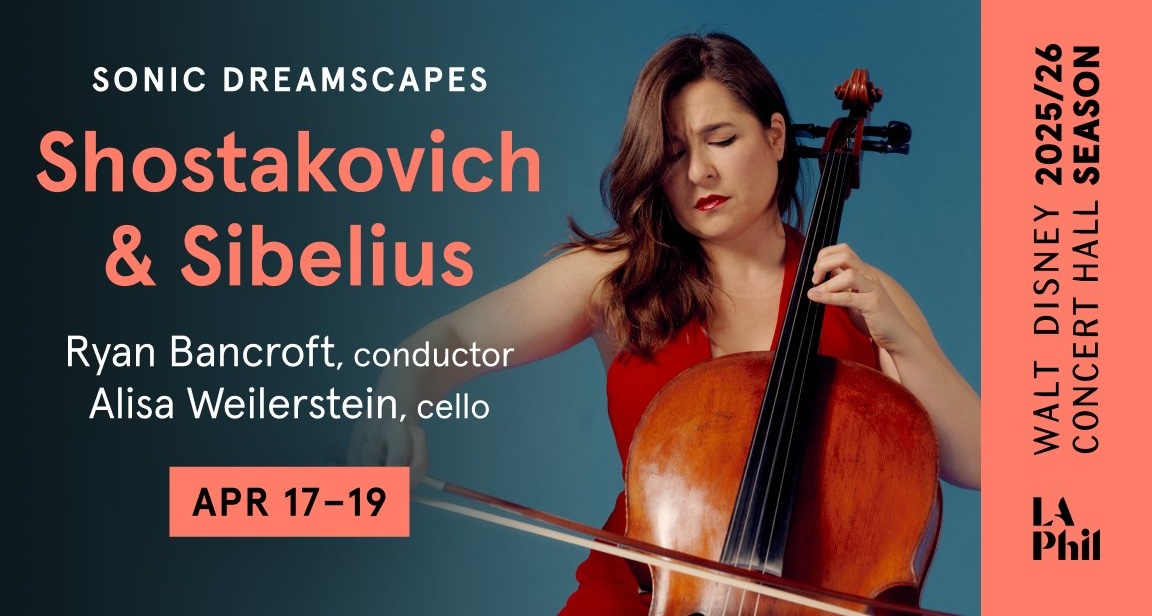
With Genius Grant-winner Alisa Weilerstein at the center, the LA Phil, under Ryan Bancroft, delivers a performance of raw intensity and existential force at the Walt Disney Concert Hall.
By John Lavitt
Los Angeles, CA (The Hollywood Times) 04-25-2026
Dmitri Shostakovich’s Concerto No. 2 for Cello and Orchestra, Op. 126, is not a polite conversation between soloist and ensemble. It is a confrontation. In Alisa Weilerstein’s hands, performing with the Los Angeles Philharmonic under Ryan Bancroft, that confrontation became visceral—less a performance than a sustained act of resistance. As a MacArthur Fellow, Weilerstein is widely recognized for her bold musical character and fearless creative vision.
From the opening measures, Weilerstein resisted any temptation toward lyrical comfort. Shostakovich begins sparingly — cello against low strings — but what cellist Mstislav Rostropovich, the composer’s soulmate, once described as deceptively simple orchestration quickly revealed its weight. Weilerstein leaned into that tension, drawing a sound that felt carved rather than played, each phrase etched with existential pressure.
This is late Shostakovich, composed in 1966 around his 60th birthday, and the music carries a sense of reckoning. The concerto does not so much unfold as accumulate, with a bevy of ideas colliding, fragmenting, and reforming. Bancroft understood this architecture. Rather than smoothing transitions, he allowed the seams to show, highlighting the work’s restless, unsettled character. Indeed, this is a piece of music made in the shadows of the Russian bear, the Soviet Union, under Joseph Stalin, Nikita Khrushchev, and Leonid Brezhnev.
What stood out most was the writing’s sheer physicality. Shostakovich throws everything at the soloist, and Weilerstein meets it head-on. The cello was not merely in dialogue with the orchestra; it was in conflict with it. Strings pressed in from one side, brass from another, while winds and harps added shifting colors that never settled into stability. The percussion, however, became the concerto’s shadow presence — an ever-advancing force.
Bass drum, snare, slapstick, woodblock, tambourine, tom-tom, and xylophone—this is not ornamental scoring. It is psychological. In the first movement’s cadenza, the eerie exchange between cello and bass drum created stark, almost theatrical tension, as if the soloist were being measured against time itself. Weilerstein navigated this passage with remarkable control, balancing precision with a raw, almost improvisatory edge.
The second movement’s sardonic dance evoked a different kind of unease. Here, Shostakovich’s humor curdles into something darker, reflecting the presence of Stalin, repression, and violence in the Soviet Union. Weilerstein captured that ambiguity without overstating it. There was wit, yes, but it was edged with something colder. Suddenly, the audience realized the joke might be on us.
By the final movement, the concerto’s underlying message was inescapable. As the percussion section quietly asserted itself — woodblock, tom-tom, and snare marking time beneath a sustained D in the cello — the effect was unmistakable. Not a climax, but a winding down. Not resolution, but recognition.
Weilerstein did not sentimentalize the ending. She held the line, letting the music speak in its stark language. Under Bancroft’s steady, unsentimental direction, the Los Angeles Philharmonic matched her intensity at every turn. A Los Angeles native on the podium, Bancroft emerges as a compelling future candidate to take up the LA Phil’s creative director baton.
This was not a performance designed to comfort. It was one that demanded engagement and rewarded it with something far more enduring. Indeed, there was a profound sense that the battles fought on the classical stage are as alive as they were under the Soviet banner and in the Stalinist shadows that Shostakovich and Rostropovich were forced to live.