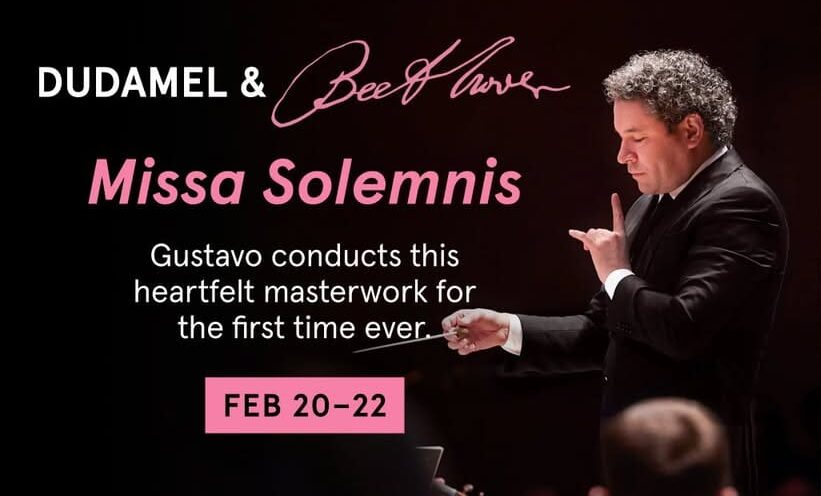
At the Walt Disney Concert Hall, Gustavo Dudamel scales the heights of Beethoven’s somewhat obscure masterwork with rare power and spiritual depth.
By John Lavitt
Los Angeles (The Hollywood Times) 02-24-2026
The Walt Disney Concert Hall became a sanctuary this weekend as Gustavo Dudamel finally engaged with what he calls the “holy grail” of the repertoire: Beethoven’s Missa Solemnis in D major, Op. 123.
It is a move that completes the multidimensionality of his Los Angeles journey. After 17 years of fruitful artistic growth, it is clear he has reached the profound maturity required to unlock this “piece never heard.”
Beethoven’s Missa Solemnis is a massive, 90-minute testament of faith grounded in Rationalist spirituality. The work is notoriously difficult, demanding an almost impossible level of endurance from the orchestra and soloists.
The performance brought together the staggering 125 voices of Barcelona’s Orfeó Català and the Cor de Cambra del Palau de la Música Catalana. Dudamel navigated these shifting landscapes with a palpable sense of discovery.
As he moved through the score, he treated each movement like a newly discovered room in a vast, spiritual mansion. Regarding the sheer scale of the work, Dudamel noted:
“The piece itself is incredibly difficult, with almost impossible requirements for singers, for orchestra, and for chorus, which creates this overwhelming feeling. It makes me believe in another dimension of greatness and beauty. Beethoven had to invent a new musical architecture for his solemn mass, and each time I look at the score, I find a new room. Often, conductors wait until they have reached a certain level of maturity and expertise before performing. Some are still waiting.”
While the choral forces were a tidal wave of sound under the guidance of Xavier Puig, the evening’s brilliance was not confined to sheer magnitude. Beethoven’s winds — particularly the clarinet and bassoon — emerged not as supporting color behind the strings, but as independent voices in sacred dialogue.
Throughout the Kyrie and especially within the Credo, the clarinet lines shimmered with a luminous intimacy, at times echoing the chorus and at others offering a more personal response to its proclamations. The bassoon, with its darker, resonant timbre, grounded moments of transcendence in the face of human gravity. These were not ornamental gestures. They felt like theological commentary — the individual believer stepping forward from the collective voice of faith.
Dudamel allowed these inner voices space to breathe. Rather than burying them beneath orchestral weight, he sculpted the textures so that the winds interacted directly with the chorus, questioning, softening, and illuminating the monumental declarations of belief. In doing so, he revealed Beethoven’s radical orchestral architecture — one in which timbre itself becomes narrative.
In the Benedictus, where transcendence hovers just above silence, the winds conversed with chamber-like intimacy, creating a striking contrast to the massed power elsewhere in the work. The effect was revelatory. The sacred was no longer overwhelming; it was intimate, searching, human.
While the choral forces remained staggering, the evening’s emotional anchors rested heavily on the stellar cast of soloists. Two performances, in particular, provided the structural spine of the evening.
Seokjong Baek delivered a performance of rare, piercing power. His tenor voice didn’t just carry over the massive forces; it cut through them with a heroic clarity that felt essential to the work’s ambitious scale.
In the more demanding passages, Baek’s strength was nothing short of revelatory. He met the “impossible requirements” Dudamel referenced with grounded, muscular vocalism that anchored the performance.
Contrasting Baek’s power was the wonderful, grounding presence of Sarah Saturnino. Her mezzo-soprano was imbued with a rich, velvety texture that provided a necessary warmth to the human element of Beethoven’s Mass.
Every time Saturnino stepped into the musical fray, there was a sense of grace and poise. She elevated the room’s spiritual atmosphere, providing a bridge between the divine and the terrestrial.
Watching Dudamel lead the LA Phil through this masterwork felt like witnessing the final pieces of a puzzle clicking into place. For nearly two decades, we have watched him grow from a firebrand into a master of the baton.
By tackling the Missa Solemnis now, he has demonstrated that his relationship with this orchestra has reached a level of expertise where the “impossible” becomes possible — not merely in volume or stamina, but in nuance. In Beethoven’s reimagined sacred architecture, every voice matters. Under Dudamel, even the quietest wind line carried spiritual consequence.
This was not just a concert; it was a rare glimpse into another dimension of beauty. It was a reminder that even as Dudamel prepares for his next chapter, his heart remains deeply entwined with the soul of Los Angeles.