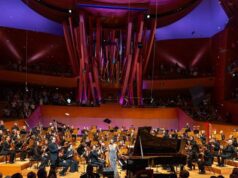
In a performance that offered a reinterpretation of Shakespeare’s Romeo and Juliet, the charismatic conductor allowed the classical music to inspire the dance company.
By John Lavitt
Hollywood, CA (The Hollywood Times) 09-16-2025
On September 11, 2025, the Hollywood Bowl became a stage where literature, music, and dance came together in a bold reinterpretation of Shakespeare’s Romeo and Juliet. The Los Angeles Philharmonic partnered with the Dance Theatre of Harlem, conducted by rising Franco-British conductor Stephanie Childress, seamlessly combining music by Pyotr Ilyich Tchaikovsky, Sergei Prokofiev, and Adolphus Hailstork into a performance that felt both timeless and refreshingly new.
What made the evening extraordinary was the dialogue between two Russian giants—Tchaikovsky and Prokofiev—across Shakespeare’s enduring tragedy. Tchaikovsky’s sweeping overture radiated romantic warmth, immersing the audience in the rush of youthful passion and doomed love.
Prokofiev’s ballet score, by contrast, portrayed Verona as a landscape of sharp edges, where tenderness clashed with brutality. Experiencing the two side by side offered a rare glimpse into how different musical languages can illuminate the same story: one painted in lush, lyrical colors, the other in stark, modernist contrasts.

The Dance Theatre of Harlem translated this dialogue into movement. With a company rooted in both classical ballet and African American cultural expression, the dancers brought Shakespeare’s tale to life with precision, vitality, and emotional clarity.
Every gesture embodied the tension between innocence and violence, love and hatred, transforming Shakespeare’s 16th-century tragedy into a story of immediate, contemporary relevance.
Indeed, the performance of the Dance Theatre of Harlem underscores that Romeo and Juliet belongs to everyone willing to breathe new life into it while respecting the masterwork that began such an illuminated tradition.
At the center was Stephanie Childress, whose controlled power and luminous musicianship shaped the entire evening. She drew warmth from Tchaikovsky’s melodies, navigated Prokofiev’s jagged rhythms with crystalline precision, and approached Hailstork’s score with insight and sensitivity.
In a deeply moving moment, Adolphus Hailstork himself—present at the concert—stood to applaud her, a gesture that captured the respect she is quickly earning across the music world.
With Gustavo Dudamel preparing to lead the New York Philharmonic in 2026, speculation about his successor at the LA Phil continues to grow. Childress’s performance highlighted why she belongs in that conversation. Her combination of artistic vision, clear communication, and intense focus—qualities she already demonstrates on both sides of the Atlantic—was on full display.
More importantly, her dedication to music education aligns with the Philharmonic’s mission of blending artistic excellence with community impact. She always supports the kids.

Ultimately, the evening became more than a performance: it was an act of artistic collaboration spanning centuries, continents, and disciplines. Shakespeare’s words found new vitality in Russian scores, which in turn were transformed by the Dance Theatre of Harlem’s powerful storytelling.
Through it all, Childress’s confident presence united tradition and innovation, proving that classical music and dance are not just museum pieces but living art forms—capable of thrilling reinvention under the stars of Los Angeles.
Photos by Elizabeth Asher, Courtesy of the Hollywood Bowl