Black, Red, Yellow is a dramatic narrative film from Kyrgyzstan director by Aktan Arym Kubat and it happens to be Kyrgyzstan’s submission for Best International Feature Film at the 2026 Academy Awards. The film was featured this year’s 11th Asian World Film Festival in Culver City – a festival that began due to the efforts of Kirghiz director Sadyk Sher-Niyaz. This is a lovely pastoral film, somewhat melodramatic, that captures village life in Kyrgyzstan in the 1990s after the collapse of the Soviet Union. The heart of this 3-part tale is Turdugal, the village weaver whose carpets reflect the lives of those they are made for.
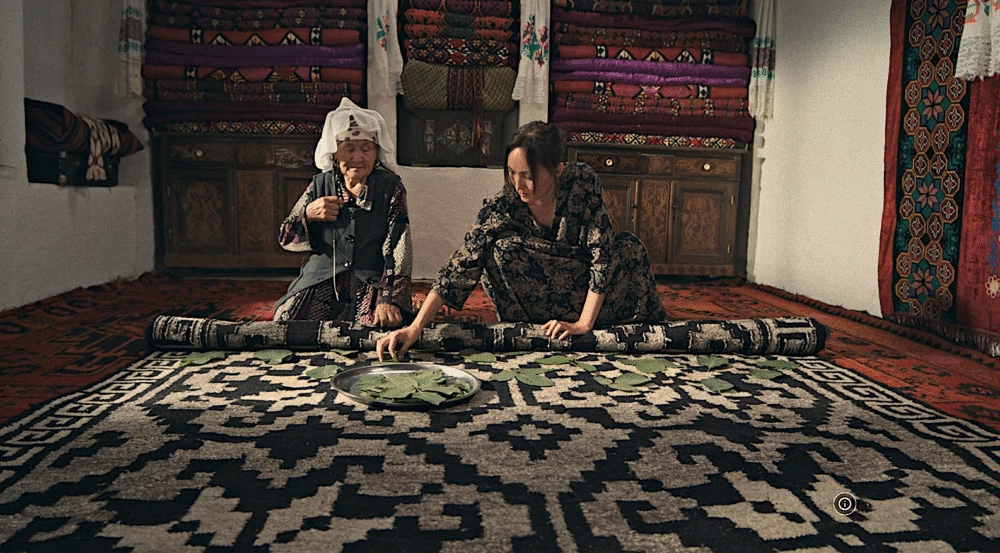
In her hands, carpets become mirrors of their owners’ fates: one black, one red, one yellow. These colors symbolize human nature – black as calm and grounded, red as fiery and intense, yellow as nostalgic and melancholic.
The whole story is set inside a frame narrative with an older woman boarding a van on a paved highway to the rural village – some 30 years later. We discover her significance at the end of the film. The director Aktan Arym Kubat is well-known for his films Centaur (2016) and the award-winning The Light Thief (2010), about an electrician in a small poverty-stricken town who illegally taps into a power station to provide light for his people.

The story centers around Turdugal because her carpets are the connecting link for people and their lives – both in life and in death. She arrives at the somewhat run-down home of Shirin and Kadyr, who were coupled by an arranged marriage and they have no children. Shirin feel incomplete because she cannot produce a child. Kadyr, whose main interest is his horse, is miserable in the marriage and unable to find work once the Soviet horse farms went out of business. Apparently, Shirin has asked Turdugal as the expert on weaving rugs to help her with an important rug for her house – one which she imagined would be made with black and red yarn. Turdugal comes by in the morning and sits down at the loom outdoors to work on the large rug, assisted by Shirin and another woman.
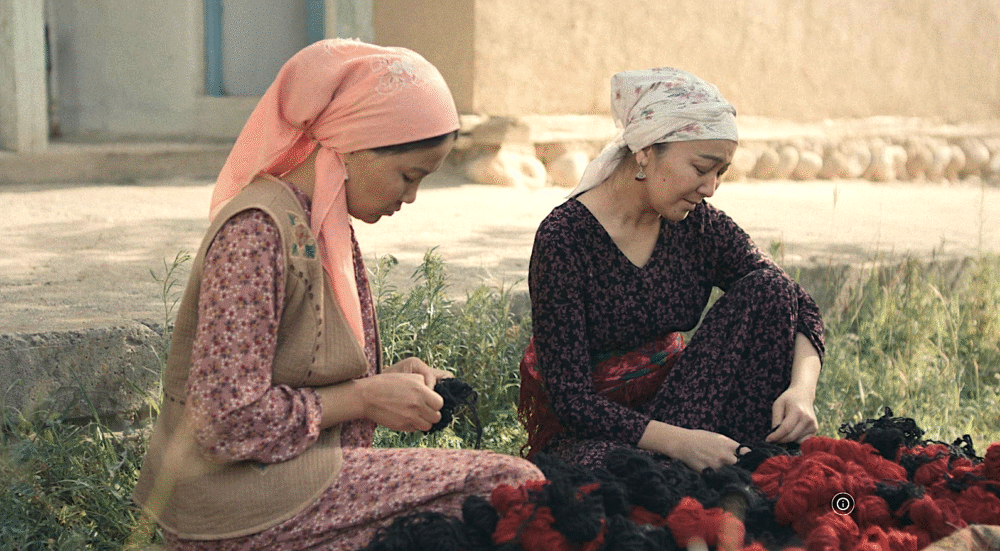
The bitterness of the constant fighting between Shirin and her husband Kadyr is bothersome but fortunately Kadyr is gone most of the day on his horse, riding along the river. A grandmother drops in with her granddaughter and Turdugal shows her the basics of weaving. Village life in Kyrgyzstan in the 1990s was isolated and full of women gossiping and men drinking too much. The economy was terrible in that time period. The elders held on to their traditional ways and at the center of that was the value of woven rugs. One old woman wants a rug on which her shroud will be placed at the time of her death. An old photographer come through the village along the dusty dirt road from time to time – taking photographs of villagers and selling them to the locals which prize them.
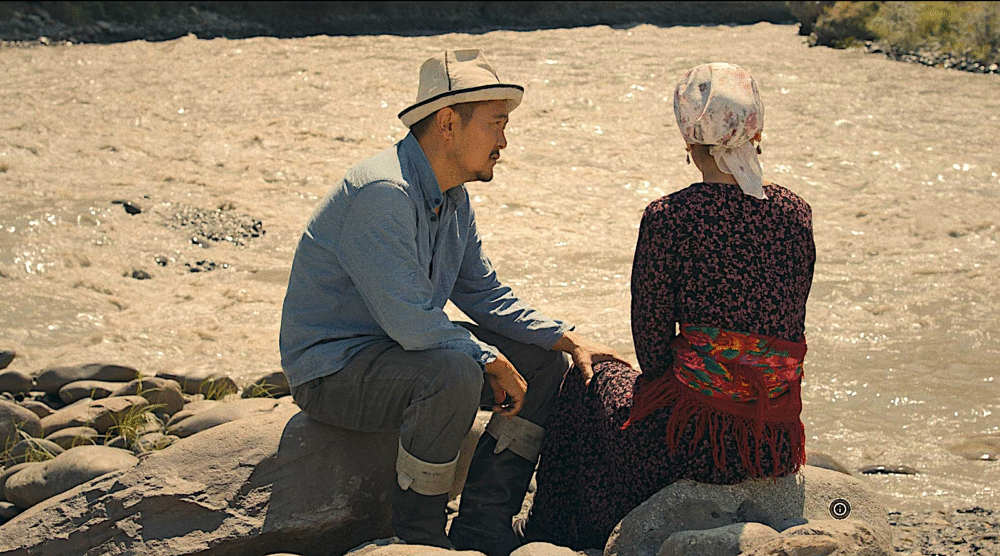
In the film’s first part “Black” – the calmness of village life is visible, although Shirin is quite unhappy that he husband Kadyr only cares about his horse, when she wants him to sell it and purchase a cow instead. The focus is on the weaving which is the center of the women’s activities. After Shirin throws an angry fit about Kadyr not caring about keeping up appearance, she threatens to throw herself in the river from the cliff. But that never happens, as the women stop her. Unlike many other men from the village, Kadyr is not willing to leave Kyrgyzstan and go Russia to seek work and income. The revelation here later in the film is that the villages are being abandoned by many local people who find work and opportunity in big cities. This is how the filmmaker juxtaposes the traditional life style of rural folk from the promise of money in urban settings. Those men who remain feel disconnected from opportunity and take to drinking excessively.
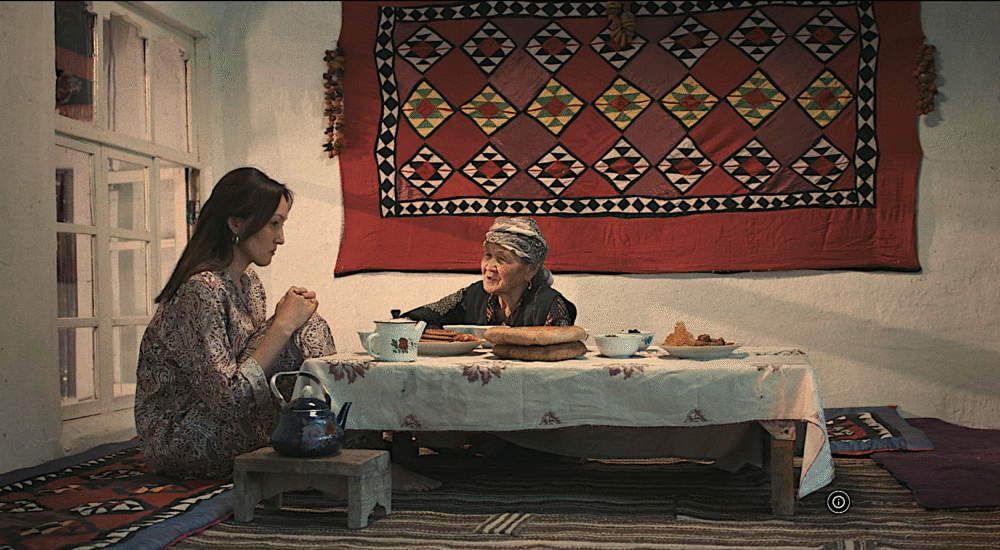
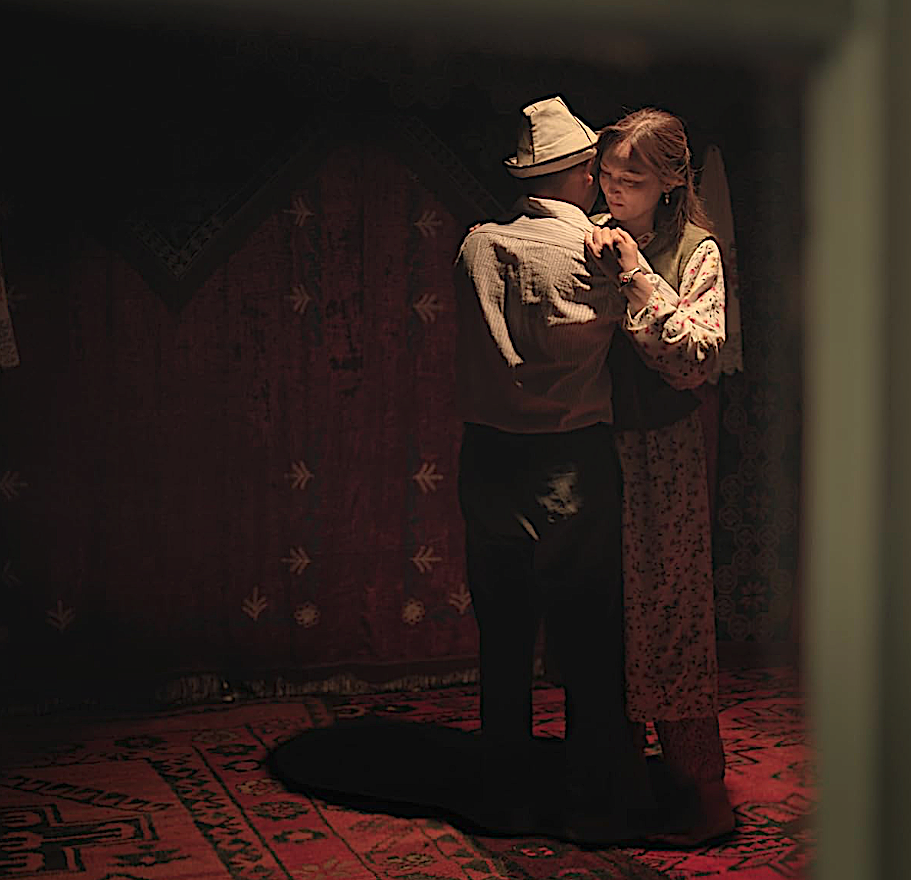
As we move into the second part of the film “Red,” we see Tugdugul the weaver painting her eyebrows and donning a prettier dress when she goes to work on the rug at Shirin’ s house. This does not go unnoticed by Kadyr, who is tired of his nagging wife and finds the unmarried Turdugul attractive. As a courtesy to the Turdugul and those working on weaving the new rug outdoors, Kadyr puts up a large fabric to keep the sun off the loom. Eventually this will bug Shirin far too much as she suspects Kadyr is up to no good. And, yes, he goes by Turdugol’s house in the evening and suggests that they meet up secretly on another day. The two spent time together the following day, despite the Turdugol’s mother stern warning. On following day, after drinking with some men from the village, Kadyr goes off to visit Turdugul’s home but accompanied by an older man with an accordion. He is encouraged by Kadyr to distract the old lady with music while in an adjacent room, Kadyr and Turdugol lock arms and dance.
This all leads of the third part of the story, “Yellow,” which is the betrayal. With Turdugol not showing up to work on the rug and Kadyr nowhere to be found, suspicions arise quickly. Angry as all get-out, Shirin takes revenge on what she assumes is her husband’s waywardness. She takes it out on the loom and the carpet being woven. What happens later is the remainder of the film and it involves more than weaving. Later we see Turdogol visiting a neighboring village further up the mountain. There she encounters an old grandmother who refuses to sell her family house to some interested men. She explains to Turdogol why the walls of her house are filled with photographs of individuals and families from her village. The grandmother explains that all these people have moved away and abandoned their houses. The grandmother is the surviving story-teller of the village. So, we have come full circle about why that old photographer kept driving around the mountain villages taking pictures of people.

The plot requires that Kadyr make a desperate attempt to persuade Turdogol to go with him and for him to abandon/divorce Shirin. What happens after that is what determines the future for these three main characters. Of course, with poetic simplicity it all leads us back to the carpets that Turdogol weaves and the lives that they encapsulate. The beauty of this film is reflected in the final scene with carpet that we once cared about. Like a well-told folk tale, the film doubles back on itself and we are left to ponder if tradition or modernity wins at the end.