By Tequila Mockingbird
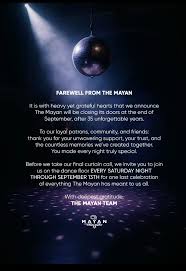
Los Angeles, CA (The Hollywood Times) 9/5/25 – The Mayan, a legendary Los Angeles landmark that stood as both a theater and a temple of nightlife, has closed its doors, leaving behind an irreplaceable void in the city’s cultural fabric. Built in 1927, the Mayan was more than just an ornate performance venue—it was an architectural marvel that embodied the opulence of the Golden Age of Hollywood. With its lavish Pre-Columbian design, hand-carved details, and cavernous dance floor, the Mayan stood as a monument to artistic imagination and community gatherings for nearly a century.
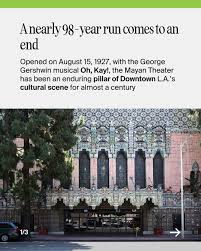 For decades, the Mayan was a versatile stage. It hosted vaudeville and film screenings in its early years, later transforming into a nightclub and concert hall that embraced everything from salsa and hip-hop to punk and electronic music. Generations of Angelenos and visitors alike passed through its doors, drawn to its immersive atmosphere and the way it seemed to blur time itself. The Mayan was a place where boundaries dissolved, where art, nightlife, and history converged.
The closing of the Mayan is not just the shuttering of a building but the end of a chapter in Los Angeles’s cultural story. Its absence will be felt by artists, dancers, musicians, and dreamers who found inspiration and community within its walls. Much like the great theaters of Broadway or the dance halls of Havana, the Mayan held a spirit larger than its walls could contain. It was a gathering space, a haven, and a stage for the voices that made Los Angeles one of the world’s cultural capitals.
I have my own special memories of the Mayan. I introduced my best friend to Timothy Leary there. He said to dr. Tim, my parents never approved of you and Dr. Tim looked at him smugly and sort of chuckled and then he said oh no it wasn’t the drugs it was that your Irish and they thought that your people were getting ahead of themselves. Tim let out a giant laugh.
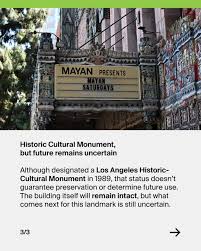 As the lights go out and the doors close, we remember the Mayan not as a relic but as a living memory that helped define the city’s soul. Its legacy endures in the stories shared, the music played, and the countless nights where life felt bigger, brighter, and endlessly possible. In mourning its loss, Los Angeles also celebrates what the Mayan gave us: a reminder that art, history, and community can coexist in one sacred space. The Mayan may be gone, but it will never be forgotten.