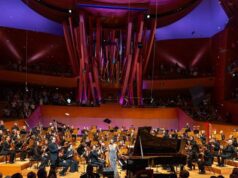
At the Walt Disney Concert Hall, Yuja Wang and Thomas Adès came together to put on a performance with the LA Phil that was nothing less than a lightning storm of brilliance
By John Lavitt
Los Angeles, CA (The Hollywood Times) 02-12-2026
The atmosphere at Walt Disney Concert Hall this past Sunday was nothing short of electric as two of the most formidable forces in modern music, pianist Yuja Wang and composer-conductor Thomas Adès, joined the Los Angeles Philharmonic for an afternoon of staggering brilliance and raw, visceral energy.
While the program promised a deep dive into Russian masterworks and contemporary premieres, it was Wang’s sheer magnetism that set the stage ablaze. She is a living and breathing masterclass in passion and charisma, electrifying the stage. In an era when technical perfection has become increasingly common, Wang stands apart not for her accuracy alone, but for her ability to make even the most familiar repertoire feel volatile, alive, and newly dangerous.
Prokofiev’s Fire: A Masterclass in Virtuosity
Yuja Wang is a pianist who thrives on the impossible, and Sergei Prokofiev’s Piano Concerto No. 2 in G minor is widely considered one of the most fiendishly difficult works in the repertoire. Stepping onto the stage with her signature poise and striking fashion – described by some as “animé visuals” come to life – Wang immediately commanded the room.
From the opening notes, her performance was a testament to athletic superstardom. She did not merely play the music; she danced with it, with a relentless, hair-raising intensity that left the audience breathless. Rather than treating the concerto purely as a vehicle for brute force, Wang emphasized its psychological volatility, allowing moments of fragility to surface beneath the violence.

Some of the many highlights included:
- The Monumental Cadenza: Wang navigated the sprawling, terrifying cadenza with a sense of internal focus that made it feel as if she were composing the music in real time.
- The Scherzo: Her precision was on full display during the Scherzo’s “1,500 strokes,” maintaining an exhilarating pace without missing a single beat.
- The Finale: Under Adès’ sharp, driving baton, Wang closed the concerto with an angular, triple-forte power that aligned perfectly with the orchestra’s ferocious brass and cymbals.
For a moment after the final note, the hall held its breath, as if unsure whether the violence of the performance had truly ended, before erupting into sustained applause.
Sensuality and Spontaneity: The Encores
If the concerto was a display of brawn and grit, the encores revealed Wang’s deep sensuality and playfulness. In a rare and unexpectedly intimate moment, Thomas Adès joined Wang on the piano bench for a four-handed performance of Satie’s Manière de commencement from Trois morceaux en forme de poire. The chemistry between the two was palpable, shifting the mood of the afternoon from monumental to intimate.

Wang then showcased her range with:
- Philip Glass: Etude No. 6, delivered with a hypnotic, rhythmic clarity.
- Felix Mendelssohn: Song Without Words, Op. 67, No. 2, which provided a sylvan, magical contrast to the earlier Russian fire.
Adès and the LA Phil: Navigating the Darkness
While Wang was the undisputed star, Thomas Adès led the LA Phil through a series of intensely powerful works. The program opened with the US premiere of William Marsey’s Man with Limp Wrist, a shadowy, atmospheric piece inspired by the paintings of Salman Toor. After the performance, Marsey came on stage to share the triumph with Adès and the LA Phil.
Following the intermission, Adès returned for a brutal and urgent reading of
Pyotr Ilyich Tchaikovsky’s Francesca da Rimini. The performance emphasized intensity over contrast, culminating in a final orchestral blow that felt like a “violent shock” to the system.
The afternoon concluded with Adès’ own Aquifer, a work defined by grinding monochromatic noises and splashing percussion that evoked the raw power of water. From the brilliance of Wang to his own compositions, Adès resisted the temptation to soften the orchestra’s impact, instead sharpening its edges, allowing the music to emerge with unsettling clarity.
Through it all, the pairing of Wang’s Va Va Voom virtuosity and Adès’s uncompromising conducting made for a performance that was as thought-provoking as it was spectacular.