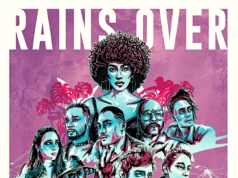
Wendy Eley Jackson’s documentary revisits the overlooked legacy of attorney Margie Pitts Hames, whose landmark Supreme Court case helped shape reproductive rights in America.
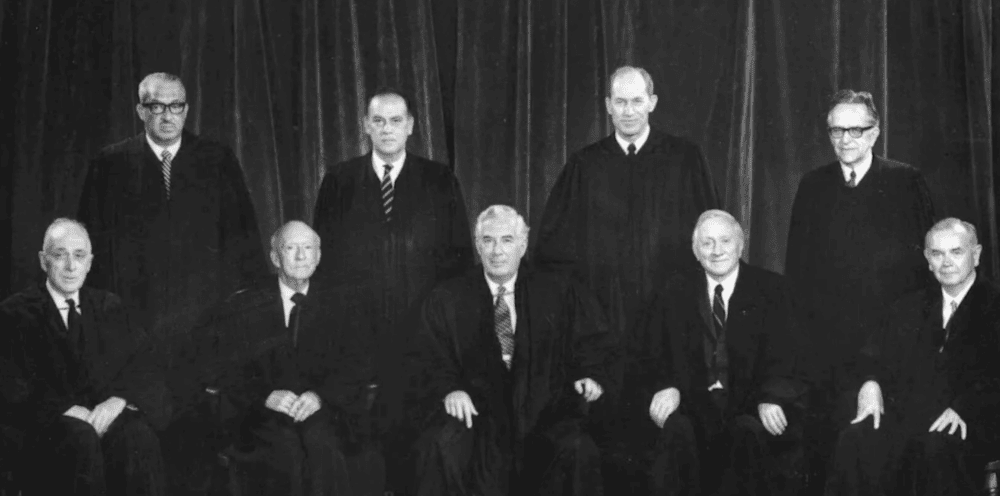
On January 22, 1973, the United States Supreme Court issued two landmark decisions that would shape reproductive rights for nearly half a century. Roe v. Wade, originating in Texas, challenged a law that prohibited abortion except to save a woman’s life. Its companion case, Doe v. Bolton, originated in Georgia, where attorney Margie Pitts Hames challenged restrictions that limited abortion to specific circumstances and required approval from hospital committees and additional physicians. Both cases were decided by a 7–2 majority, establishing constitutional protections for abortion decisions while striking down significant barriers to obtaining care. Yet while Roe became a household name, Hames and her contributions to Doe remained largely outside the public consciousness.
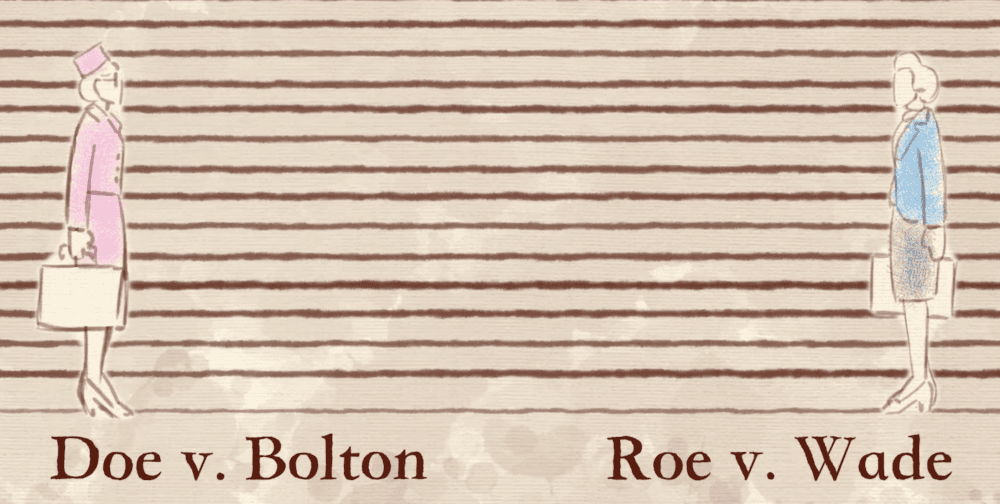
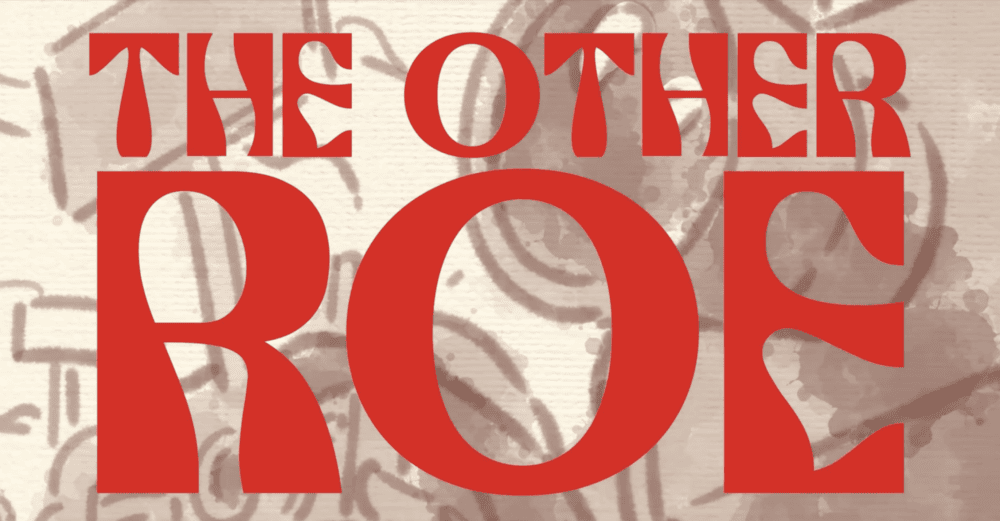
Director Wendy Eley Jackson brings Hames and her remarkable legal legacy into focus in her 17-minute documentary, The Other Roe. Through archival recordings, historical photographs, newspaper clippings, and personal testimony, Jackson traces a struggle whose consequences continue to reverberate through American life. The documentary opens with an illustration placing Doe v. Bolton and Roe v. Wade side by side, followed by archival audio from Supreme Court Chief Justice Warren E. Burger. These opening moments transport viewers to an era when abortion laws varied dramatically among states and women faced considerable barriers to reproductive healthcare.

As the documentary unfolds, Hames emerges as a woman whose legal advocacy extended beyond reproductive rights. Practicing law in the South during a period of profound social change, she challenged discrimination and supported racial integration. Former Georgia State Representative Mable Thomas reflects on the significance of Hames’s work at a time when such advocacy was especially challenging for women. Hames’s Southern drawl gives her arguments a distinctive presence in the archival material, particularly when she questions the relationship between efforts to prohibit abortion, opposition to contraception and sex education, and the continuing cycle of poverty. Her observations raise questions about the economic consequences of restricting women’s reproductive choices and whether such policies contribute to keeping economically disadvantaged women trapped in low-wage circumstances.
Jackson’s use of archival material allows Hames’s own words to establish the social and legal environment in which she worked, while the documentary gradually expands its focus to the opposition that followed the Supreme Court’s decisions. Footage of Operation Rescue protests in Atlanta between July and October 1988 introduces a considerably different atmosphere. Randall Terry, a former used-car salesman from New York who became an Operation Rescue leader, appears in television coverage as the film examines organized efforts to block abortion access. Protesters stalked and harassed women seeking care, confronting them outside clinics and turning already personal medical decisions into public ordeals. The demonstrations erupted into extraordinary chaos, with more than 1,300 people reportedly arrested and prosecuted in connection with the protests, according to the documentary. Watching this footage, I found myself reacting aloud to the disorder and the intensity of a conflict that had moved from courtroom arguments into the everyday lives of women seeking medical care.

Nearly half a century after the Supreme Court first recognized those constitutional protections, the legal ground beneath generations of American women gave way. On June 24, 2022, the world watched as the Supreme Court issued its decision in Dobbs v. Jackson Women’s Health Organization, overturning Roe v. Wade and ending the federal constitutional protection for abortion that had existed for nearly 50 years. Jackson captures that historic reversal through television news footage, bringing the documentary full circle from the legal victories of 1973 to their undoing in 2022. The passage of time becomes especially poignant as viewers recognize the decades of advocacy, opposition, and personal struggle contained between those two dates.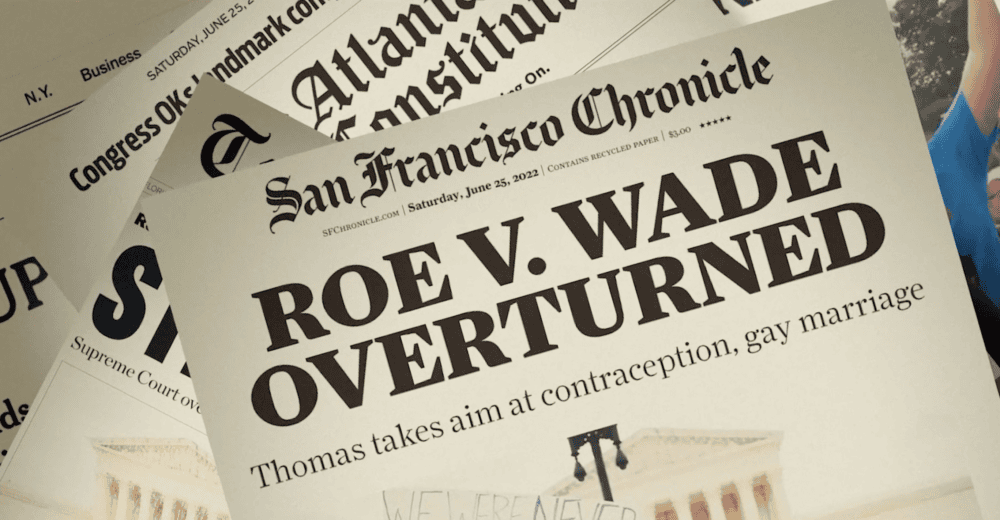
In its later scenes, The Other Roe introduces the experiences of healthcare providers confronting the emotional consequences of restricted abortion access. One provider describes the empowerment that comes from helping women make decisions about their reproductive lives, a sentiment that becomes especially moving when the discussion turns to patients who cannot obtain the care they seek. Hearing about women in tears, uncertain about what to do next, brings a personal dimension to a debate so frequently presented through legislation, court decisions, and political arguments. The documentary also emphasizes that abortions continue to occur even where restrictions have been enacted, raising questions about access, safety, and economic inequality.
Research from the Guttmacher Institute provides additional contemporary context. An estimated 142,000 people traveled across state lines to obtain abortion care in 2025, while 13 states had near-total abortion bans in effect by October 2026 and six others enforced early gestational limits. For women who must travel to obtain care, the financial burden can extend well beyond the procedure itself. Transportation, lodging, childcare, and time away from work can determine whether medical services are practically accessible. These realities add another dimension to the history Jackson presents, particularly when considering how reproductive decisions are influenced by circumstances beyond an individual’s control.
When My Own Voice Went Unheard
Watching The Other Roe brought me back to an experience from my own life that has remained painful for more than three decades. In 1990, while serving in the United States Navy in Norfolk, Virginia, I discovered I was expecting a child with a man I loved and trusted. He was also a Navy sailor, an aircrewman assigned to a different squadron. We had already spoken about having a baby and agreed that we would welcome that child into our lives. Yet within a week of learning the news, I was swept into a journey that left me little time to absorb what was happening, much less find the space to recognize and express my own wishes. My mother arranged an abortion in Birmingham, Alabama, and my boyfriend drove me hundreds of miles from Norfolk to the clinic, where my mother had become the person he turned to for guidance.
I remember crying in the backseat of the car, clutching a stuffed animal and feeling very much like a little girl, frightened and powerless in the company of the people I loved and trusted most. I can still picture myself looking back over my shoulder as I entered the facility, carrying a sense of helplessness that has never entirely left me. Abortion was legal in Virginia in 1990, just as it was in Alabama, yet the distance we traveled had little to do with the law. I had wanted to carry my child, but somewhere along that journey, my voice had been lost beneath the wishes and expectations of others.
The experience contributed to the end of that relationship and, alongside other moral injuries I was experiencing in my Navy assignment, eventually influenced my decision to request early termination of my shore duty and reassignment to Puerto Rico in the fall of 1990. I had neither mourned the loss nor fully grieved the betrayal. Instead, within a year, I sought to heal the damage by embracing another opportunity for motherhood. My daughter, born in June 1992, was beautiful then and remains so today. Her arrival brought a love that changed the course of my life and ultimately reshaped my naval career, as motherhood became the priority closest to my heart.
When Alabama enacted its near-total abortion ban in 2019, I found myself confronting a deeply personal contradiction. I consider myself pro-choice, yet I wondered whether the very restrictions I opposed might have prevented the abortion I had been pressured into having decades earlier. A law restricting abortion could never guarantee protection from the personal coercion I experienced, but the irony has stayed with me because it forces me to consider how differently my life might have unfolded.
In 1990, I was taken across state lines for an abortion I did not want, despite the procedure being legal where I lived. Today, women living in states with restrictive laws may cross state lines because they want an abortion they cannot obtain locally. The circumstances are profoundly different, but the contrast has deepened my understanding of reproductive autonomy. For me, being pro-choice includes respecting a woman’s decision to continue a pregnancy as well as her decision to terminate one. It means recognizing that coercion can come from intimate partners and family members as well as from institutional or legal restrictions. My experience has shaped how I understand that principle, and Jackson’s documentary brought those memories and questions into focus.
A Historical Perspective: From 1973 to 2026
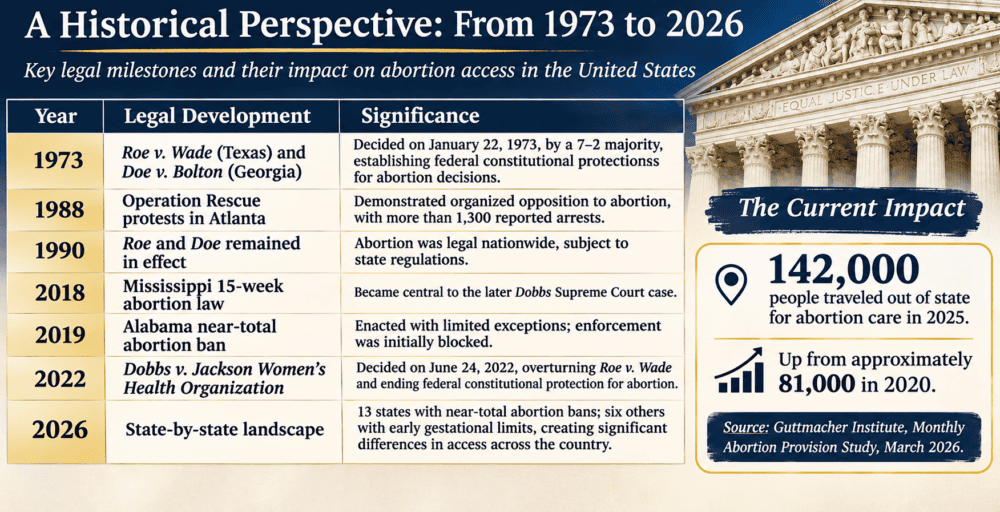
The changing legal landscape also has measurable consequences. These figures illustrate how legal geography, financial resources, and medical access continue to influence reproductive healthcare.
Remembering Margie Pitts Hames
As The Other Roe approaches its conclusion, those who remember Hames describe a woman who pursued justice despite the obstacles she encountered practicing law in the South. One reflection is particularly memorable: Hames was determined to stand on the right side of history and, when necessary, help make that history herself. Her advocacy was described as being about the women whose lives were affected by the law rather than personal recognition, and Jackson’s documentary gives her a place in the historical narrative alongside the much more widely recognized Roe v. Wade decision.
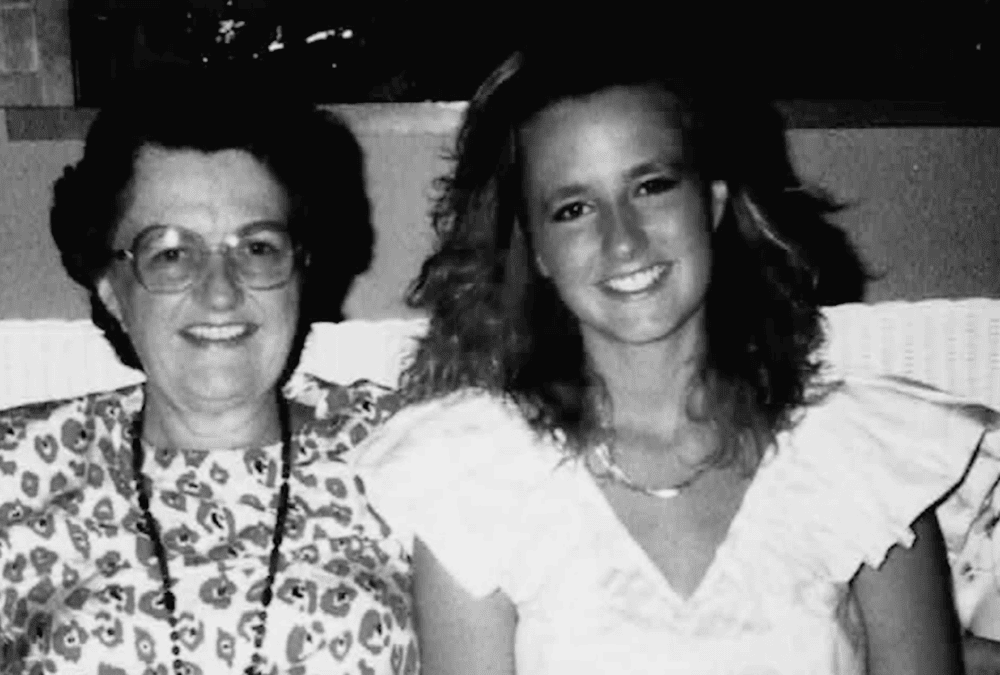
The film’s 17-minute running time makes its historical scope especially ambitious. Its archival material moves quickly across decades of legal developments, protests, and changing public policy, offering viewers an introduction to a woman whose contributions deserve greater public awareness. For me, the documentary also opened a door to a personal history I had carried quietly for many years. I watched a film about women fighting for the right to make decisions about their pregnancies and found myself remembering a time when that decision had been taken from me.
Margie Pitts Hames’s story reminds us that, from the womb to the tomb, human life is filled with choices that shape who we become. Take a moment to imagine bringing a baby into this world, holding that child in your arms, feeling the warmth of a life you have created, and wondering what kind of world awaits them. Now consider the other side of that decision. The circumstances surrounding a pregnancy can involve love, hope, fear, financial hardship, complicated relationships, violence, or experiences too painful to explain. Some women long to become mothers. Others cannot imagine motherhood within the circumstances they face. Who among us can fully understand another person’s life well enough to decide what their future should look like?
We are imperfect, complicated human beings. We fall in love, make mistakes, build families in unexpected ways, and sometimes find ourselves facing decisions we never imagined having to make. A woman’s worth, her ability to love a child, or her right to determine the course of her life cannot be measured by her income, her relationships, or someone else’s judgment of her circumstances. Personal expectations, social pressures, and political agendas may surround her, but her voice must remain her own. If we believe in freedom, we must confront what that freedom means when the most intimate decisions of our lives are placed in someone else’s hands.
The Other Roe brings an overlooked chapter of American legal history into view through the courage and conviction of Margie Pitts Hames. Her story leaves us with a question that reaches far beyond the courtroom: When a woman’s future hangs in the balance, whose voice should ultimately be heard?
The Other Roe
Director: Wendy Eley Jackson
Runtime: 17 minutes
U.S. Premiere: DOC NYC, November 11, 2026
Research context: Supreme Court opinions in Roe v. Wade and Doe v. Bolton; KFF abortion policy tracking (2026); Guttmacher Institute abortion provision research (2025–2026).