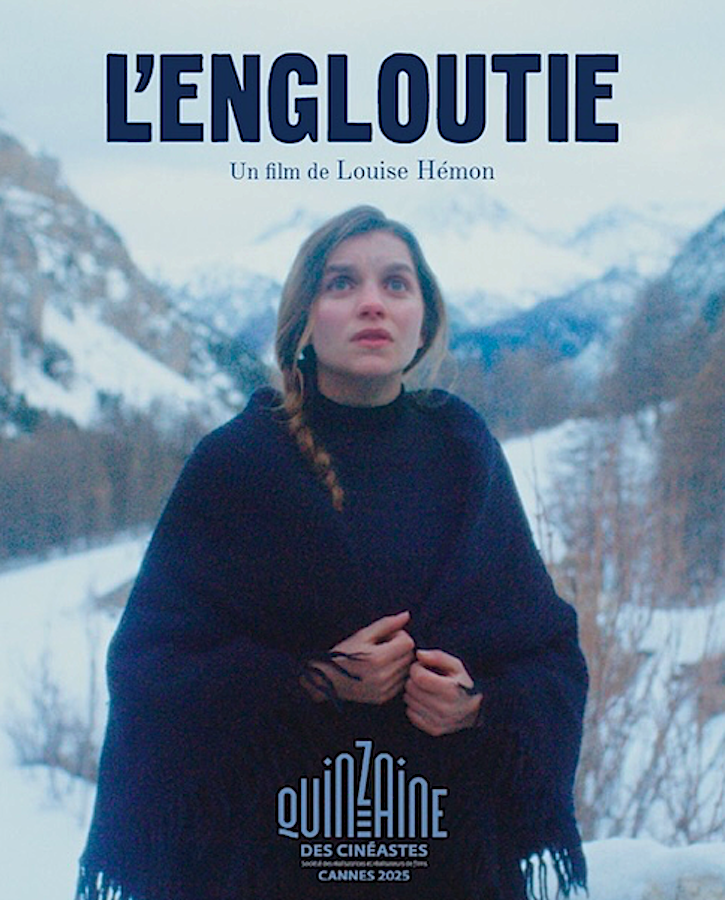
The Girl in the Snow is a new French narrative dramatic film by Louise Hémon set back in 1899 in a remote snow-covered Alpine hamlet of Soudain. With stunning 4:3 cinematography, The Girl in the Snow (L’Engloutie) tells the story of a young teacher named Aimée who goes to Soudain to educate the children. But the superstitious people are not happy with what she is teaching. The area is prone to avalanches and men start disappearing in the dead of night where they are literally “swallowed” (engloutied) by the snow. All eyes are on Aimée. It is a feature debut by Louise Hémon, so far best known for her short and mid-length documentaries. It should not come as too much of a surprise to learn that the story is rooted in actual events, stemming from the filmmaker’s own family history. The film is featured in the American French Film Festival at the DGA in West Hollywood this week.

The strong symbolism of the opening shot probably stands for the way the protagonist of the film, the young, idealistic, even a bit zealous teacher Aimée Lazare (Galatea Bellugi) sees herself coming to the environment. We are about to see that environment shortly, in brighter but still dim lighting, as she settles into her modest accommodation and starts reading Descartes in the candlelight. It is wintertime in the late 19th century, and the place is a secluded hamlet, somewhere deep in the Alps. Judging by the surroundings and the lack of utilities, seen next day in broad daylight, one might assume that time stopped there sometime in the Middle Ages and that Aimée brings enlightenment in the form of her knowledge of proper French language – the villagers speak their own dialect of Occitanian – geography beyond the terms of “California” and “Algeria,” where some of the villagers went but never returned to report about, as well as the hygiene.
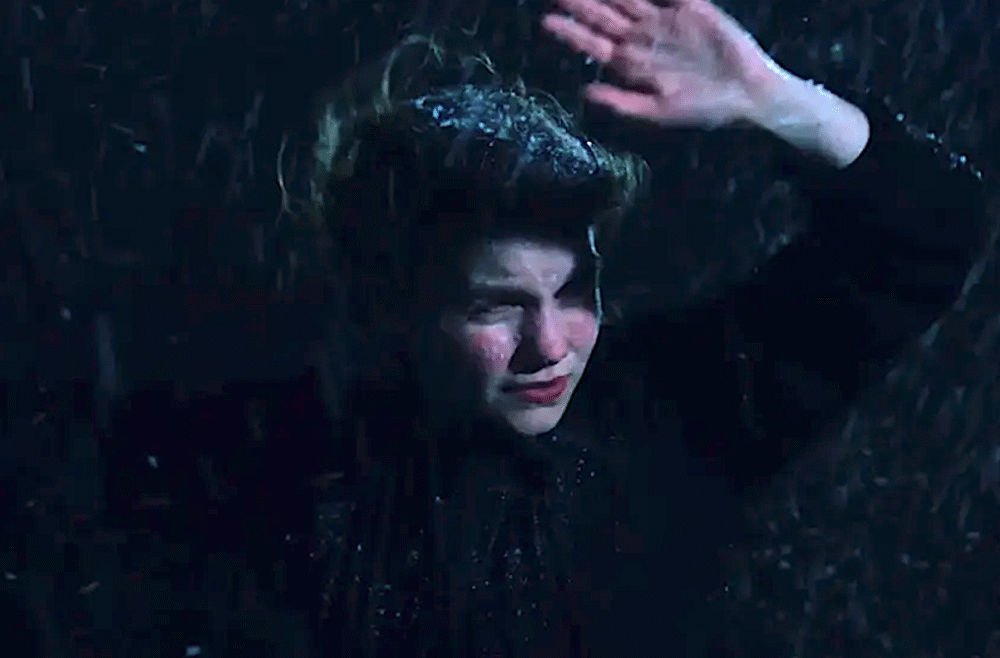
Her efforts are, however, met with the locals’ superstitions that exceed the level of skepticism. For them she might as well be a colonial oppressor, and not the well-meaning, educated and emancipated woman from “the big world.” Led by the elder women (who only speak in Occitanian), they are convinced that removing the crust of dirt on the head exposes brain to illness, that the window of the room where the deceased is placed should be left open so the soul can exit, and that their folklore would be lost for them once it is “captured” in writing by an outsider. It is safe to assume that if anything went wrong, it would be regarded as her fault. And when the two village hunters who were the only ones who were nice to her, Énoch (Matthieu Lucci) and Pépin (Samuel Kircher), disappear in the avalanche only shortly after they encountered her in a certain way, we can be convinced that our assumption was right.
The Girl in The Snow is a handsome piece of cinematic work, thanks to cinematography by Marine Atlan that utilizes the lighting contrasts to perfection and with an awareness for positioning the characters in the film’s dramaturgy. The seemingly simple, but period-faithful production design by Anna Le Mouël and costumes by Joana Georges Rossi are also spot on. Although, there are some echoes of a backwoods noir, mainly regarding the protagonist’s navigation of the social landscape, of folk horror in the way the villagers act towards their traditions, but with a very light touch, while also some “spaghetti western” Enio Morricone-lite infusions can be noted in Émile Sornin’s soundtrack. The film never ventures into the ethno-anthropological horror of Robert Eggers’ The Witch or last year’s The Devil’s Bath, by Veronika Franz and Severin Fiala.
Louise Hémon documentary credits include L’homme le plus fort (2014), Une vie de château (2019), Salomé sur sa slackline (2020), Voyage de documentation de Madame Anita Conti (2024), and an episode of the TV series Hobbies (2020). The Girl in the Snow, her first narrative feature, premiered in the Directors’ Fortnight section of this year’s Cannes Film Festival. It’s been awarded the Critic’s Prize at the Champs-Élysées Film Festival, and the Jury Prize at the Biarritz Film Festival, in addition to the 2025 Prix Jean Vigo for best first film.