By Sarah A. Spitz
Production photos by John Dlugolecki Photography
West Los Angeles, CA (The Hollywood Times) 6/3/25 – “Redux” is defined as “brought back” or “restored.” In “Lear Redux” at The Odyssey Theatre https://odysseytheatre.com through July 13, adapter and director John Farmanesh-Bocca borrows the shape of Shakespeare’s classic “King Lear” and dresses it in modern clothes; to tell the tale of the relationship between an aging celebrity actor, whose health and mind are on the decline, and his daughters.

This isn’t your grandfather’s Lear. There is a storm, there are (or were) three daughters, two caregiver/nurses and a brother (in dual roles), featuring rage and duplicitous deception, served with a side dish of quantum physics, which makes strange sense in the context of this production.

Farmanesh-Bocca has “reduxed” a number of Shakespeare’s plays, from “Tempest Redux” to “Titus Redux” to “Pericles Redux” which toured the world. He staged “Twelfth Night” on a municipal tennis court in Santa Monica in 2013. In 2017, he helped turned blind British poet John Milton’s 1667 ten-thousand-line epic, “Paradise Lost,” into a 60-minute wordless stage spectacle of dance, acrobatics, and digital videography, an immersive plunge into what felt like a 3-D video game with live-action performers. Farmanesh-Bocca’s trademark physicality is also present in “Lear Redux.”
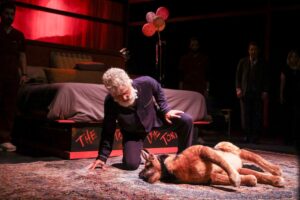
As does Shakespeare’s king, the Actor (played by long-time theatrical partner Jack Stehlin) demands to know who loves him best. While the other sisters, Goneril and Regan (Jade Sealey, Eve Danzeisen) cowtow with flowery language (quoting Shakespeare’s original) because they want their piece of his estate, Cordelia, the youngest who truly loves him most, refuses to engage in ass-kissery. Here Cordelia is represented by a full-sized puppet dog, operated by actor Emily Yetter, because the Actor’s daughter Cordelia died at a young age from alcoholism. The blame for her death is pinned on the Actor’s self-obsessed lifestyle.
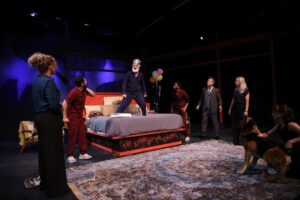
But why a dog? Farmanesh-Bocca says, “I am not interested in telling my audience how to think or feel about anything in this show. But there is a purity in the relationship between Cordelia and Lear. Cordelia’s love in King Lear is the purest form of love, not burdened by flattery, not burdened by expectation. And to me, a dog exemplifies the purest unconditional love there is.” Adding a personal note, three years ago, Farmanesh-Bocca’s own beloved dog died. “That was a heartbreaking loss for me.”

Other personal losses inform the play. He and Jack Stehlin both lost their parents and began having conversations about philosophy, family and relationships. “Jack is an amazing collaborator; he’s kind of a muse for me. It’s a lonely process normally, but all of my writing comes from conversation. We’ve been talking on and off for five years about this show and much more seriously over the last six months. We were looking at our lives, and where we meet is that theatre is a spiritual path for us. We’re not here to stay still. We really want to explore.”
There’s no expectation that the audience will be familiar with Shakespeare’s “King Lear.” “This is my eighth world premiere redux of a Shakespeare play, and I originally expected them to have some working knowledge of the plays. Now I don’t. They’re welcome to have that tape running in their head going, oh, I see what he did there, I see what he did there, oh, I see how that’s transposed to this, but it actually really isn’t necessary.
“We’re not really telling the story of King Lear so much as we are using the story of King Lear to tell our story. Go see ‘Lear Redux’ then go watch ‘King Lear’ and see if you can pick up on all the modern relatability that the play has. Maybe the tragedy in ‘King Lear’ isn’t who dies at the end, but that children will never fully know their parents, and parents may never truly know their children.”

In true Farmanesh-Bocca fashion, “Lear Redux” is as physical as it is poetic. The director’s background in dance and movement theater gives the piece a kinetic energy. Actors don’t just speak—they hurl, collapse, and stretch their bodies into metaphors. “Highly physical, at times surreal,” is how he describes his style, one that aims to “grab people by the lapels and not let them go until the curtain call.”
But Farmanesh-Bocca goes a step farther and offers a monologue on quantum physics delivered by a blind philosopher/bum (Dennis Gersten) whom the Actor stumbles upon after escaping the house, getting caught in a storm and sheltering in a 7-11.

“I don’t understand how anybody can age without looking up into the cosmos to try to understand where we came from, where we’re going, what this is all about and what we’re made of. When questioning the very fabric of reality, the fabric of being a human being, I didn’t think there could be anything more fitting than to add science and spirituality, as a quantum concept, into this play.
“It seems like a wild departure until you see it. I don’t need people to understand it completely, but I hope they get it, in the sense that they can hear a soliloquy from Shakespeare, and they may not be able to break down every single line of Shakespearean text, but they get it, they have an emotional experience just watching it. I hope that the quantum science I’ve snuck into ‘Lear Redux’ is received the same way.”
In the end, says John Farmanesh-Bocca, “Lear Redux” is not about one thing. “It’s about loss, grief, hope, family, these things are intrinsic in a lot of Shakespeare’s plays, but particularly ‘King Lear.’ It’s not a quiet, go gentle into the good night experience, it’s the human condition that Shakespeare brilliantly and beautifully elaborates on and heightens. That’s why his plays will remain relevant for hundreds of years even after we’re all gone.”
Sarah A. Spitz is an award-winning public radio producer, retired from KCRW, where she also produced arts stories for NPR. She writes features and reviews for various print and online publications.