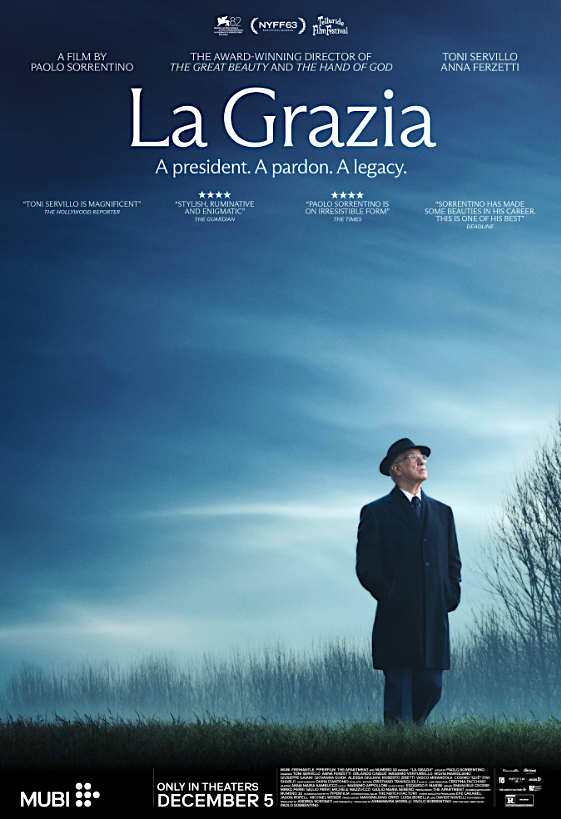
Paolo Sorrentino has rediscovered his voice, his wan humor and his flair for the surreal in his latest film La Grazia (Grace, Italy, 2025). Sorrentino’s La Grazia, sets its sights on a fictional Italian President in this last six months of his final term, as he unassumingly zeroes in on Mariano De Santis’s (Tony Servillo) creeping sense of despair as the man, taking meeting after dry meeting in the various rooms of Quirinal Palace in Rome, begins to see the end of his tenure in tandem with the end of his life. La Grazia is a dry comedy of grief and regret which wears its dreamy melancholy and ennui like a well-tailored if fussily old-fashioned suit, and it returns Sorrentino to the various mysterious tableaux of political power that recurred in Il Divo (2009), about political mandarin Giulio Andreotti, and his 2013 film The Great Beauty about a dissolute journalist and hedonist bidding a bittersweet farewell to everything he holds dear. La Grazia is still playing at art house theatres in Los Angeles.

Servillo plays Mariano De Santis, this fictional Italian President with six months left to serve. He’s in the December of his life, and he is, as is usual for such characters, haunted. Yes, he is haunted largely by the infidelity of his late wife. For as staid as he is in his personal dealings with those around him, and as unwavering as he is in his political decisions, he is feeling the vulnerability that accompanies heightened awareness of mortality. For good reason, his nickname is “Reinforced Concrete.” So, in his quieter moments, when he’s not listening to loud Italian rap music on his headphones, he speaks to her in an interior monologue, stressing out on events forty years behind him.


In six months, he will step down from his position to be replaced by the somewhat more dynamic Ugo Romani (Massimo Venturiello). As for the present, the President is compelled to watch his diet (a lot of quinoa, except on his birthday), takes multiple opportunities to sneak cigarettes, and ponders giving pardons that will excite public disapprobation. (His close advisor on these matters is his daughter Dorotea, a lawyer played with warmth by Anna Ferzetti.)

The movie’s story, such as it is, doesn’t even begin to take shape until about a half hour into the movie’s two-hour-and-change runtime. The point is indicated by the title, which translates as “Grace.” Grace is what De Santis is waiting for, even if maybe he doesn’t quite believe in it. He harps on the idea of zero gravity, and at one point even watches a closed-circuit video transmission of a space engineer trapped in that condition. Helpless, the astronaut sheds a tear, which begins floating toward his camera. De Santis reaches out to touch it on his flatscreen display, but of course, he can do that.

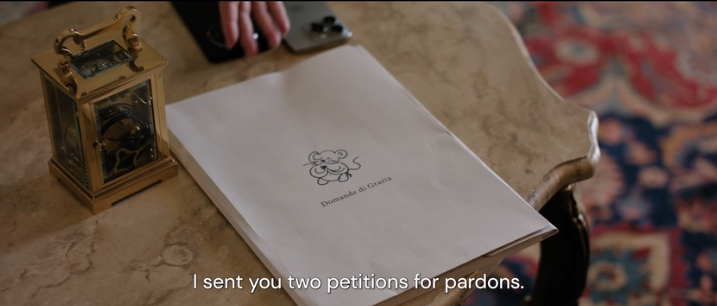
De Santis must decide on both the passing of a bill that would legalize euthanasia and the pardon petitions of two murderers. But it’s more personal matters that truly weigh on him, informing his passive governance. De Santis’s son, Riccardo (Francesco Martino), has shifted from composing classical music to writing pop songs, which De Santis disapproves of, and he obsesses over an affair that his late wife Aurora had 40 years prior, as he believes the other man to be his best friend and potential successor, Ugo Romani (Massimo Venturiello).
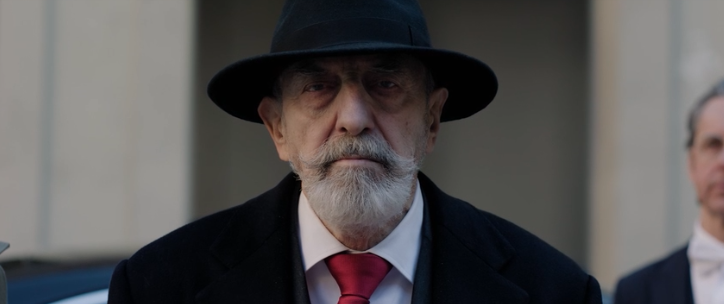
In a standout sequence that affects an almost religious sense of awe, Portugal’s decrepit president (Cesare Scova) arrives for a meeting before a sudden storm breaks out, with Sorrentino using slow motion to depict the rain and winds blowing the man over, as well as De Santis’s mute reaction to the moment. The significance of the sequence is undeniable, with the Portuguese president suggesting a spectral premonition of where De Santis could end up.

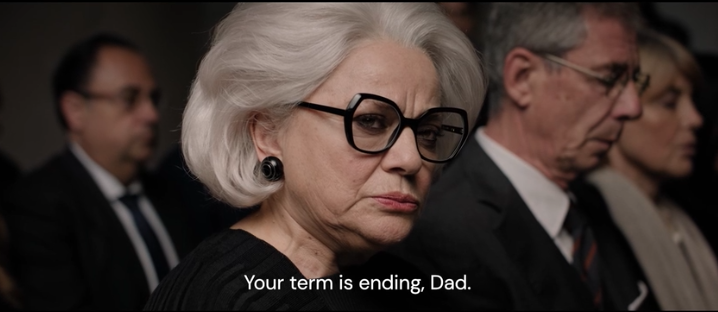
Although De Santis has been a brilliant jurist throughout his career, he offloads his legislative work onto his staffers. Most notable among them is his daughter, Dorotea (Anna Ferzetti), who micromanages every aspect of his life, right down to his diet. The president has taken historically decisive actions, but between his age, the degree to which he’s been catered to up to this point in his life, and the moral minefield of the euthanasia bill, he now finds himself in a state of docility. As a man of reason, he worries that not signing the bill would make it easy for people to label him a torturer, and as a Catholic, he worries that signing it would make him a murderer. He even visits the Pope (Rufin Doh Zeyenouin), a personal friend, to discuss his dilemma.

His lawyer daughter Dorotea, who is exasperated by his reluctance to make decisions. He must decide on whether to sign off a bill making euthanasia legal, and also whether to give pardons to a woman who killed her abusive husband in his sleep and a man who killed his dementia patient wife. The awful truth is that the end of his term of office has given him an inkling of the end of his life, but this has not brought Mariano any peace.
In fact, he is in agony, haunted by the thought of his late wife being unfaithful to him 40 years before. Mariano suspects his contemporary Ugo (Massimo Venturiello), who has slippery ambitions of his own.

The only person who knows for sure is his wife’s best friend and Mariano’s old classmate Coco Valori (Milvia Marigliano), a dyspeptic and opinionated critic; she is a very Sorrentino-esque character, a type in fact played by Servillo in “The Great Beauty.” She refuses to betray the confidence. As he prepares to leave his office as Prime Minister, Mariano suspects he will never know.

There’s no shortage of compelling figures in Sorrentino’s film that De Santis sees himself in, from the Portuguese president to the astronaut to his favorite horse, named Elvis, that’s on its last legs and he can’t bring himself to mercy kill. Indeed, De Santis’s decision paralysis leaves him in something of a similar state to the horse, which lies on the palace grounds.

Sorrentino’s attempt to capture the state of mind of the aging De Santis is moving and such a difference from the turbulent mind-set of some world leaders these days. Despite the uncertainty that hovers over the story to the very end, this story about disillusionment and contemplation blooms into one of existential revitalization in the final scenes.