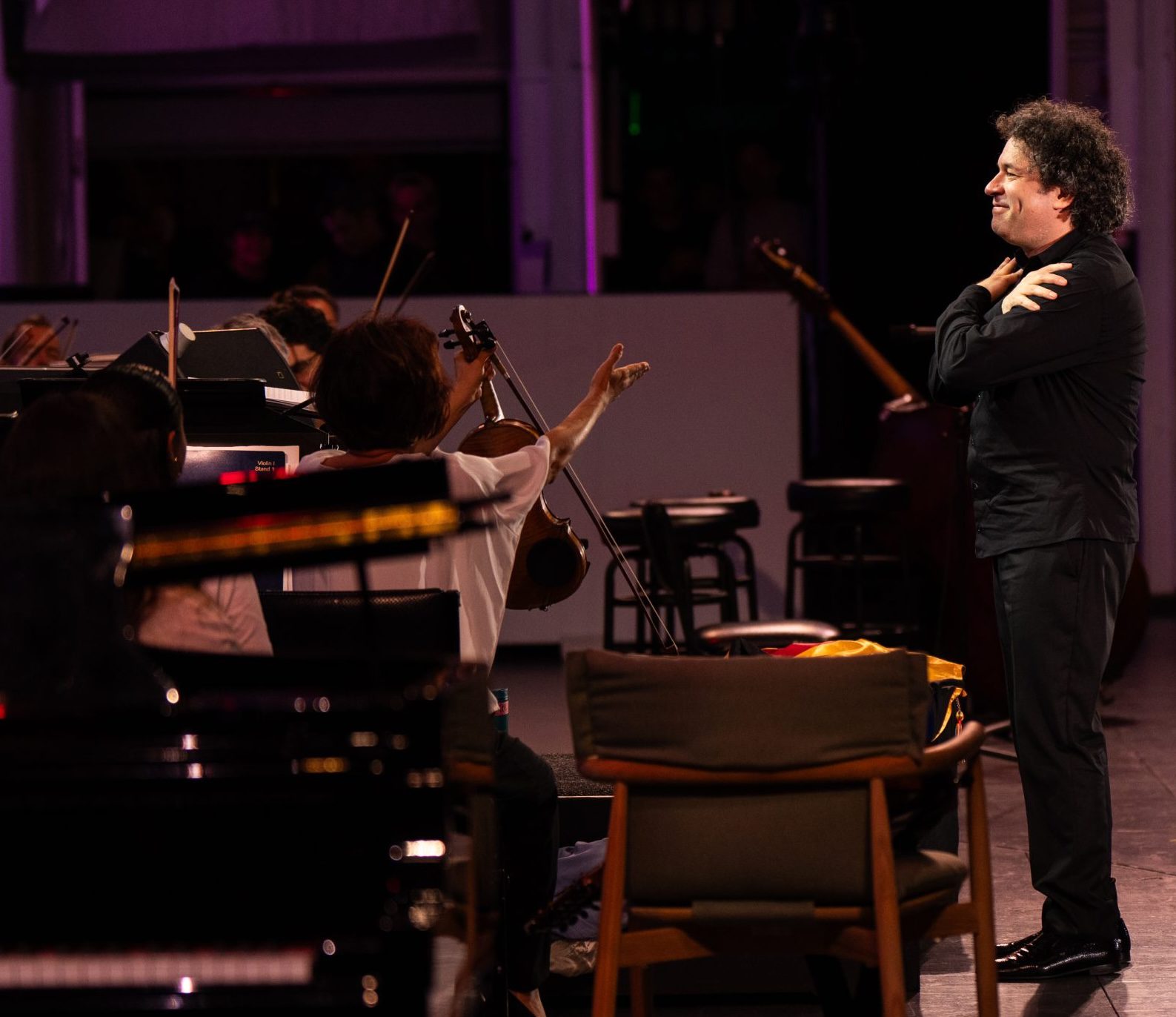
From El Sistema and John Adams to Natalia Lafourcade and Chris Martin, Dudamel’s Hollywood Bowl benefit revealed how Venezuela nurtured a global maestro.
By John Lavitt
Los Angeles, CA (The Hollywood Times) 08-27-2026
How does a teenage conductor from Barquisimeto, Venezuela, become the man entrusted with the New York Philharmonic? The mythology of genius prefers a simple answer: a prodigy appears, the world recognizes him, and destiny takes over. Gustavo Dudamel’s story is more revealing. Talent mattered enormously. So did the moment when a musical culture recognized that talent, chose it, and began pooling its finest resources to develop it.
Dudamel was the chosen fish in a small pond—but “small” describes Venezuela’s leverage within the international classical establishment, never the country’s geography, culture, or musical ambition. Barquisimeto was known as Venezuela’s musical capital, and José Antonio Abreu’s El Sistema had built an astonishing network of orchestras, teachers, rehearsal spaces, and young musicians. This was no shallow backwater. It was a concentrated ecosystem that could spot an exceptional fish and give him room to grow.
Abreu saw the 15-year-old Dudamel conducting the Amadeus Chamber Orchestra and recognized the gift. By 18, Dudamel had been appointed Music Director of the Simón Bolívar Youth Orchestra, El Sistema’s flagship ensemble. Such an appointment was not merely an honorific. It put a teenager before a major orchestra again and again, letting him learn repertoire, make decisions, fail, adjust, and return to the podium. Once Abreu chose him, Dudamel received a density of serious experience that young conductors elsewhere could scarcely imagine.
Composer John Adams saw the result firsthand in Caracas in 2005. On his first morning visiting El Sistema, Adams was led into a rehearsal room with more than 100 instrumentalists, a comparably large chorus, and several soloists. A curly-haired young man in jeans and a T-shirt bounded onto the podium and led the entire assemblage through the end of Mahler’s Second Symphony from memory. Dudamel was 24.
Adams immediately understood he was witnessing more than youthful charisma. He later wrote that Dudamel’s “astonishing talent” was evident from that single rehearsal. What amazed him was not only the young conductor’s physical command but also his knowledge: Dudamel absorbed scores quickly, knew the core repertory with something close to instant recall, and had already conducted much of it. Adams estimated that by his mid-20s, Dudamel possessed the experience that normally takes a conductor 30 or 40 years to acquire.
That is the essential answer to the riddle of Dudamel’s rise. He was spectacularly gifted, but Venezuela did not merely discover a rare talent and applaud it. Abreu mentored him from adolescence and gave him opportunities Adams believed would have been almost impossible to find elsewhere. El Sistema accelerated his development. It transformed raw brilliance into repertory, technique, judgment, and the peculiar authority required to persuade more than 100 musicians to breathe as one.
The wider world soon caught up. Dudamel won the inaugural Gustav Mahler Conducting Competition in Bamberg in 2004 at age 23. Esa-Pekka Salonen, serving on the jury, recognized the young conductor’s force and alerted Los Angeles Philharmonic president Deborah Borda. Dudamel made his American debut with the LA Phil at the Hollywood Bowl in 2005, was named the orchestra’s next Music Director in 2007, and assumed the position in 2009 at age 28.
Adams became one of the defining artistic witnesses and collaborators of the Dudamel era. For Dudamel’s first official program as Music Director, the LA Phil commissioned Adams to write City Noir, an exceptionally demanding, jazz-inflected symphony rooted in Los Angeles history and film noir. Dudamel learned and premiered it amid the near-carnival of “Dudamania.” Adams marveled at Dudamel’s concentration. Once Dudamel reached the podium, the surrounding celebrity commotion disappeared, and the score became the only matter at hand.
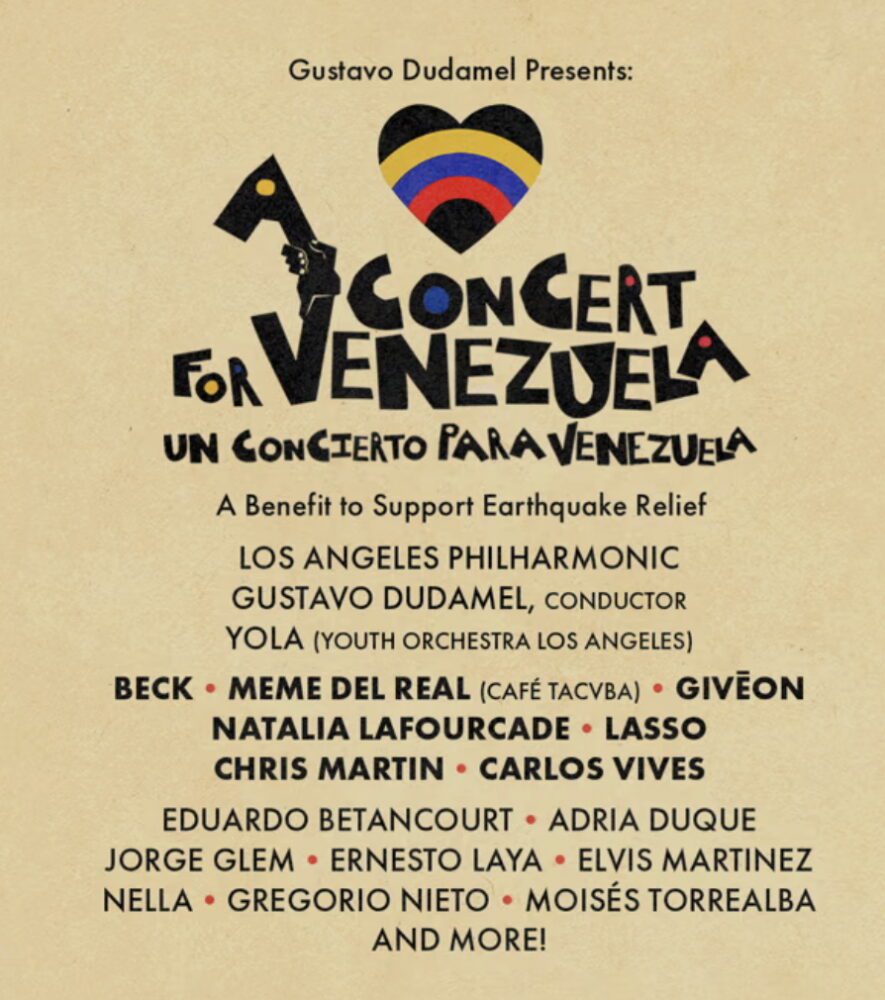
Seventeen years later, Dudamel’s final Hollywood Bowl concert as Music & Artistic Director brought those currents back to Venezuela. A Concert for Venezuela, held on Sunday, August 23, replaced a previously announced farewell program after the June 24 earthquakes devastated communities in northern Venezuela.
The benefit directed donations to relief efforts through the United Nations Development Programme and a CAF fund supporting affected El Sistema students, families, staff members, and facilities. Dudamel and the LA Phil musicians donated their services, and the orchestra pledged $50,000.
Venezuelan actor Édgar Ramírez hosted the evening, which opened with the national anthems of the United States and Venezuela. Dudamel then launched Paul Desenne’s Latinized arrangement of Johann Strauss II’s Tritsch-Tratsch-Polka, transformed into Triqui Traqui by the snap and propulsion of Latin percussion. The programming immediately made clear that European tradition and Venezuelan rhythm did not inhabit separate worlds. Under Dudamel, each could illuminate the other.
The first half unfolded like a borderless revue. Meme del Real of Café Tacvba brought a graceful, romantic ache to Eres. Venezuelan singer Lasso followed with En Otra Vida. Beck then stepped into a lineup dominated by Latino artists and performed Ride Lonesome with the orchestra. He might have seemed the night’s conspicuous outsider, but he represented Los Angeles itself: the city that had watched Dudamel turn an orchestra into a civic presence. Beck’s verdict was admirably concise: “He improved our city.” Dudamel gave the bond its simplest name: “Seventeen years later, I can say, ‘I am an Angeleno.’”
Venezuelan cellist Gregorio Nieto brought a different emotional scale to Anthony Hopkins’ Stella Aria, letting the cello speak without rhetorical excess. Colombian star Carlos Vives restored the extroverted pulse with Quiero Verte Sonreír and La Tierra del Olvido. The program risked fragmentation—celebrity benefits often become a procession of disconnected cameos—but Dudamel and the LA Phil provided a continuous musical bloodstream.
After intermission came the evening’s most meaningful biographical piece, disguised as repertory. Aldemaro Romero’s Fuga con Pajarillo combines the formal machinery of a fugue with the syncopated energy of Venezuelan dance. It was also the work Dudamel took to the 2004 competition in Bamberg. The piece that helped introduce him to the international classical world now returned at the end of his Los Angeles tenure.
This was more than a nostalgic callback. Venezuelan masters Eduardo Betancourt on harp, Jorge Glem on cuatro, Ernesto Laya on maracas, Elvis Martínez on bass, and Moisés Torrealba on bandola llanera joined the LA Phil and YOLA musicians. Their instruments were not folkloric garnish added to a prestigious American orchestra. They became the focal point. Laya’s maracas solo, hushed yet visually electric, showed how virtuosity can command an amphitheater without volume. The audience leaned toward a rhythm it could almost see before it could fully hear.
The pond had expanded, yet its original water remained within the music. Romero’s Fuga connected Barquisimeto, Abreu, Bamberg, Los Angeles, and the young musicians of YOLA in a single seven-minute span. It also corrected the most misleading version of Dudamel’s biography. He did not become great by escaping Venezuela. Venezuela gave him the musical language, institutional confidence, and ample podium time with which he entered the world.
Natalia Lafourcade then delivered the concert’s most beautifully shaped vocal sequence: Pajarito Colibrí, Simón Díaz’s Tonada de Luna Llena, Alma Llanera, and Hasta la Raíz. The medley moved from Mexican intimacy to Venezuelan memory without becoming a cultural sampler. Lafourcade’s restraint gave the orchestra room to breathe around her, and young YOLA singers joined in on Hasta la Raíz, turning a song about origins into an affirmation of inheritance.
GIVĒON’s dark, unmistakable baritone on Heartbreak Anniversary broadened the night’s stylistic range. Nella and Adria Duque then performed Venezuela with members of YOLA as the Bowl took on the colors of the Venezuelan flag. The song could have tipped into pageantry. Instead, following images and testimony from the earthquake’s aftermath, its openhearted patriotism felt earned.
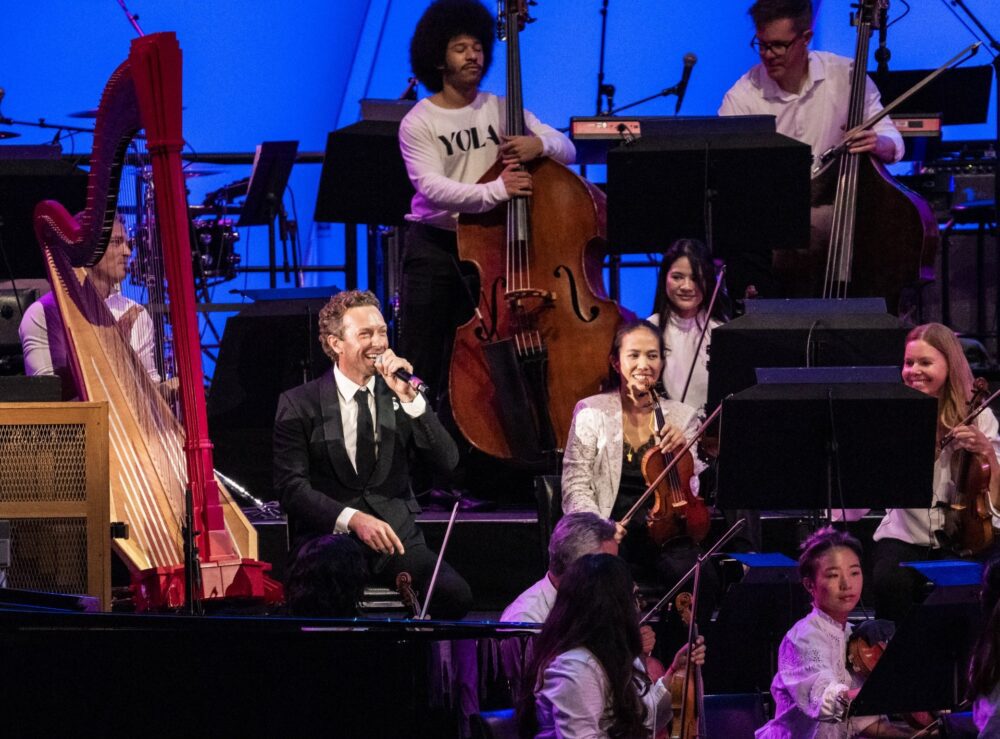
Then came Chris Martin. The Coldplay frontman was the final featured performer, but celebrity wasn’t the point of his appearance. Instead, it was a playful encounter between two old friends. The two men have known each other for roughly 12 years. With Dudamel conducting the LA Phil, Martin began with Fix You. The performance wasn’t perfectly synchronized, and Martin did something far more charming than pretending otherwise: He joked that he couldn’t follow the baton or keep time without the drums.
His solution was to rev up the evening with Viva La Vida. The rhythmic engine arrived. Martin positioned himself to watch Dudamel closely, and the Bowl rose almost as one. An exposed musical mismatch became a communal release. The moment also revealed something essential about Dudamel. His authority does not depend on solemnity. He can absorb imperfection, laugh, adjust, and turn that adjustment into joy.
Martin then ordered Dudamel into a chair, draped him with a sash, and serenaded him with an improvised, personalized rendition of Santa María—a tribute that, in spirit, became San Gustavo. Singing partly in Spanish, Martin thanked “Santa María” for his brother and teased the conductor about leaving Los Angeles for New York. The joke gave way to something unguarded. Martin grew visibly emotional, and Dudamel—the man who had controlled the night’s currents—was required to sit still and receive the love.
The final song, feelslikeimfallinginlove, sent the evening into the future. Dudamel is not retiring, disappearing, or even fully leaving Los Angeles. Indeed, the conductor will remain connected to the orchestra as the LA Phil’s Artistic and Cultural Laureate and to YOLA as its Founding Director and Conductor Laureate. In September 2026, he will assume one of classical music’s most storied posts, serving as Music and Artistic Director of the New York Philharmonic, joining a lineage that includes Mahler, Toscanini, and Bernstein.
How did the small-time Venezuelan conductor get there? First, by not staying small-time for long. At 15, Abreu recognized him. At 18, the Simón Bolívar orchestra became his laboratory. At 23, Bamberg revealed him internationally. Salonen called Los Angeles. Adams saw a young man conduct Mahler from memory and recognized decades of knowledge in a 24-year-old body. The LA Phil then gave that talent a larger civic and artistic canvas.
Dudamel was the chosen fish, but he was never carried passively downstream. He repeatedly justified that faith through preparation, memory, curiosity, courage, and an almost startling absence of cynicism. More importantly, every larger pond he entered became connected to the first. El Sistema inspired YOLA. Venezuelan composers entered major American programs. Young Angelenos received instruments and orchestras of their own.
At A Concert for Venezuela, gratitude completed its circle. Venezuela had concentrated its resources around Dudamel’s journey. Los Angeles had amplified what Venezuela began. Now, on his way to New York, Dudamel used his final Bowl concert as Music & Artistic Director to direct attention, money, and music back toward home. He never outgrew the pond that chose him. He kept expanding it until the whole world could swim in it.