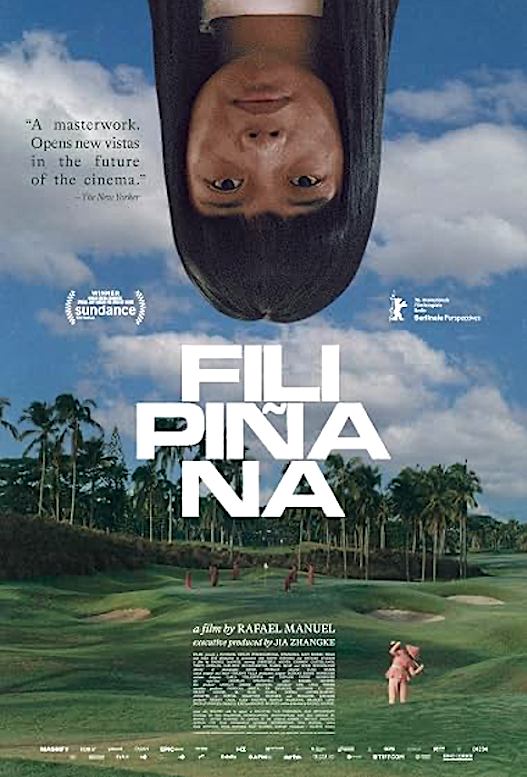
Rafael Manuel’s Filipiñana is not your typical comedic movie from the Philippines. With its quiet satiric edge, the film opens with the manufactured tranquility of an elite golf course in Manila, where we quickly sense that this is not the gritty Manila of most films from the Philippines. The golf course is a prime example of the inequality that sits at the base of Filipino society, clearly separating the “haves” from the “have nots.” The film follows 17-year-old Isabel (Jorrybell Agoto) through her day of work at this ritzy country club with its manicured lawns and pristine landscape, which seems like an idyllic pastoral scene from a different part of the Philippines. After premiering at Sundance 2026, “Filipiñana” was garnered much praise from critics and has become the official submission for Best International Feature Film at the 2027 Academy Awards. Filipiñana”is currently playing at the Lumiere Theatre in Beverly Hills.
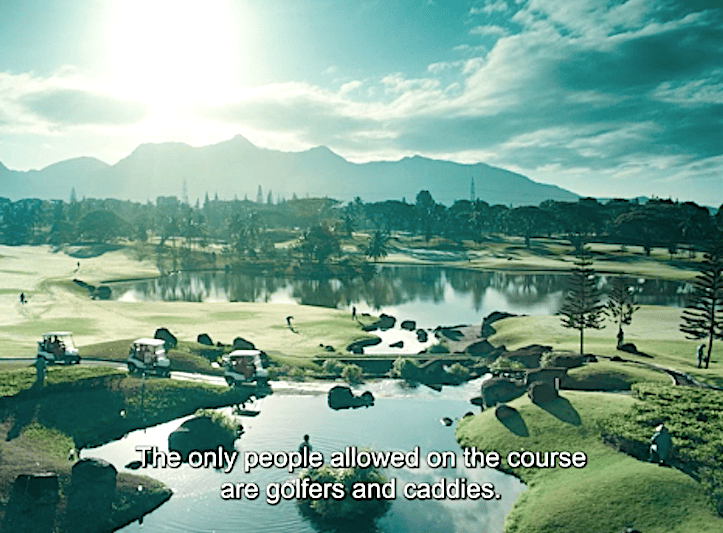
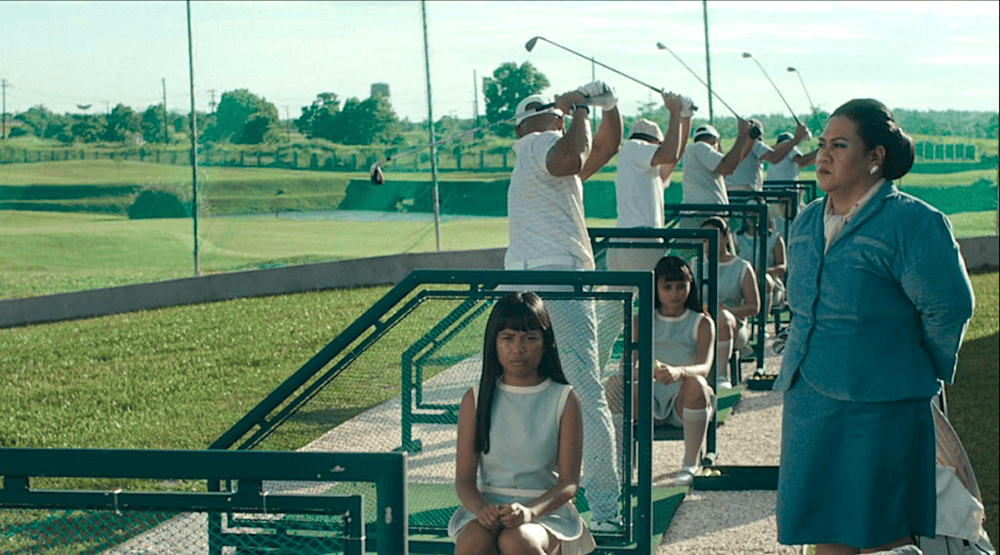
Isabel is one of the many “tee girls” at the golf club whose jobs it is to position the golf balls on the driving range for clients to practice their swings. The “tee girls” wear prim pastel uniforms and hats that are part of the color palette of whoever designed the entire country club and golf course. We see the “tee girls” carefully washing the retrieved monogrammed golf balls from the driving range. Curiously enough, many of the male golfers at the country club are wealthy patrons and Chinese tourists, who seems to like being waited on by young, subservient girls who have come from the countryside.
We first meet a group of Chinese tourists on a bus in a crowded intersection of Manila, where the group guide apologizes for the bus delay, as she leads the tourists past a long line of Manila residents in queue for get water, because, as reported on television news channels, there is a severe drought. But at the country club, the sprinkler system operates without a glitch to keep the fairways green. This is one of the many sharp contrasts that illustrate nature of the Philippines, with the country club serving as a metaphor for the urban core of the still developing country.
“One water container per family,” yells a government worker to a long queue of people surrounding a water truck on a busy street during the film’s opening sequence. That’s the sole instant where Manuel shows what’s beyond the country club’s domain. He cuts from that crowded urban scene to the sprinklers watering the grass in that enclave of amusement for the most privileged. There’s no scarcity of water on the golf course. Such woes are reserved for the poor. Like most spaces that cater to the rich, their number one goal is to shield their patrons from any inconvenience. Their escapism, of course, is built on exploitation.
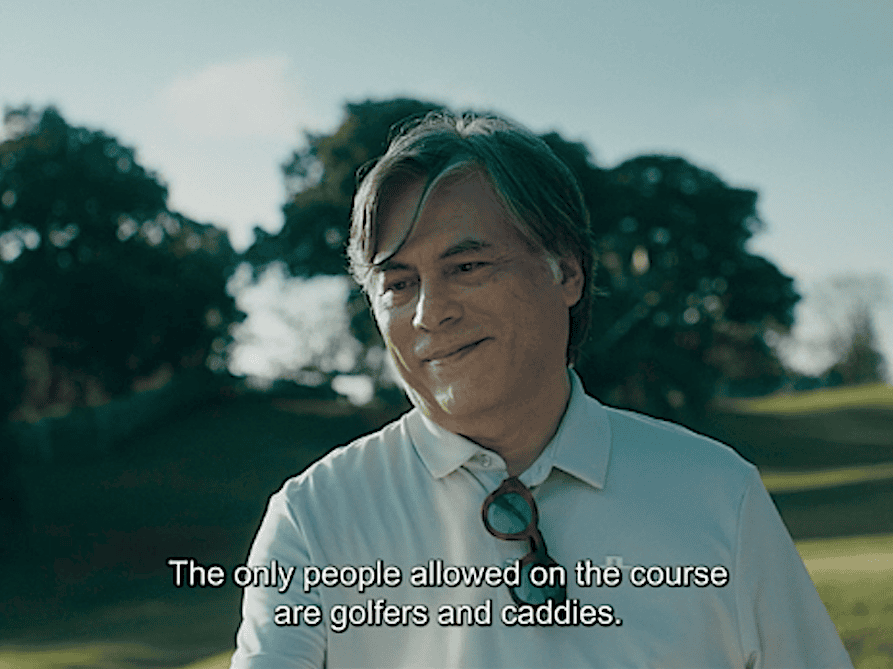
We meet Dr. Palanca (Teroy Guzman), the owner and president of the country club, and soon Isabel learns that he is from “Ilokana,” the rural part of the northern island of Luzon where Manila is also located, but at its southern end. That strikes a bell in Isabel’s head because she learns the golf course was designed to resemble a rural tropic setting in the north of Luzon where Dr. Palanca came from, as did Isabel. It is no coincidence that the same Dr. Palanca heads up a resort development company that bulldozed the very village in Ilokana, where Isabel’s family lived. This piece of information forms a simulacrum for the Philippines in general, but also might apply to other places in the world where big money talks.
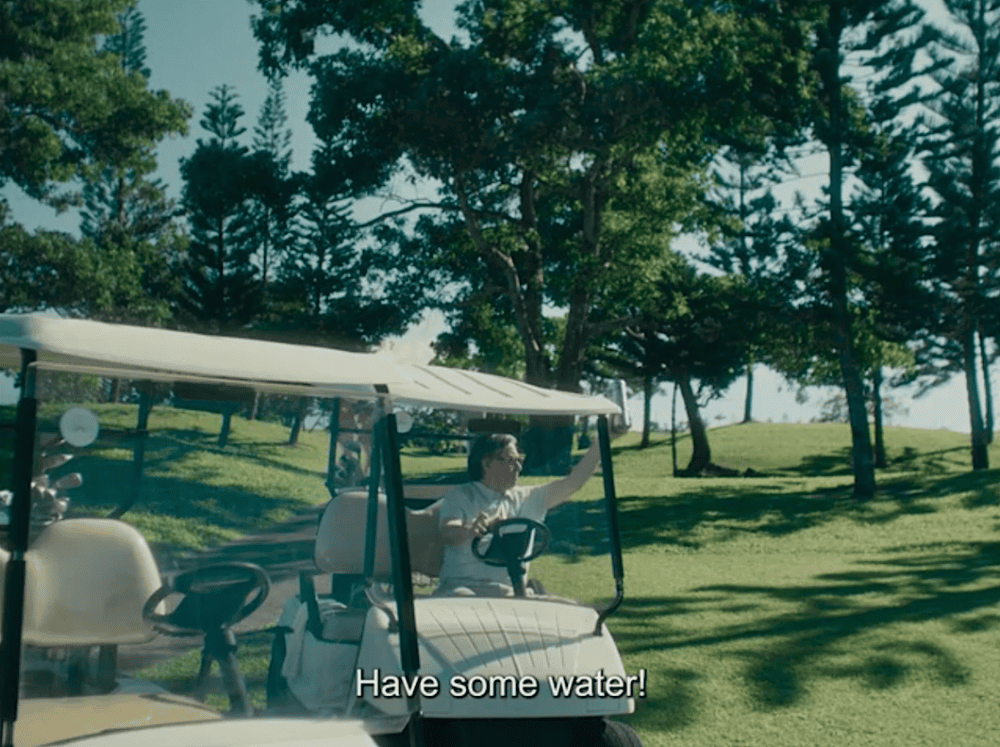
Isabel has been newly hired to work at the golf club. We see the club and its activities through her eyes as she tries to absorb her new professional surroundings. We soon meet Clara (Carmen Castellanos), the niece of Dr. Palanca, who has been away in the USA studying at a university and returns to Manila to visit her uncle at his country club. She does play golf, but does not understand why every golfer needs a cute caddy. She mentions that in the States, most people carry their own golf club bags. Some of Clara’s family members implore Clara to stop the Filipino brain drain and return from New York for good.
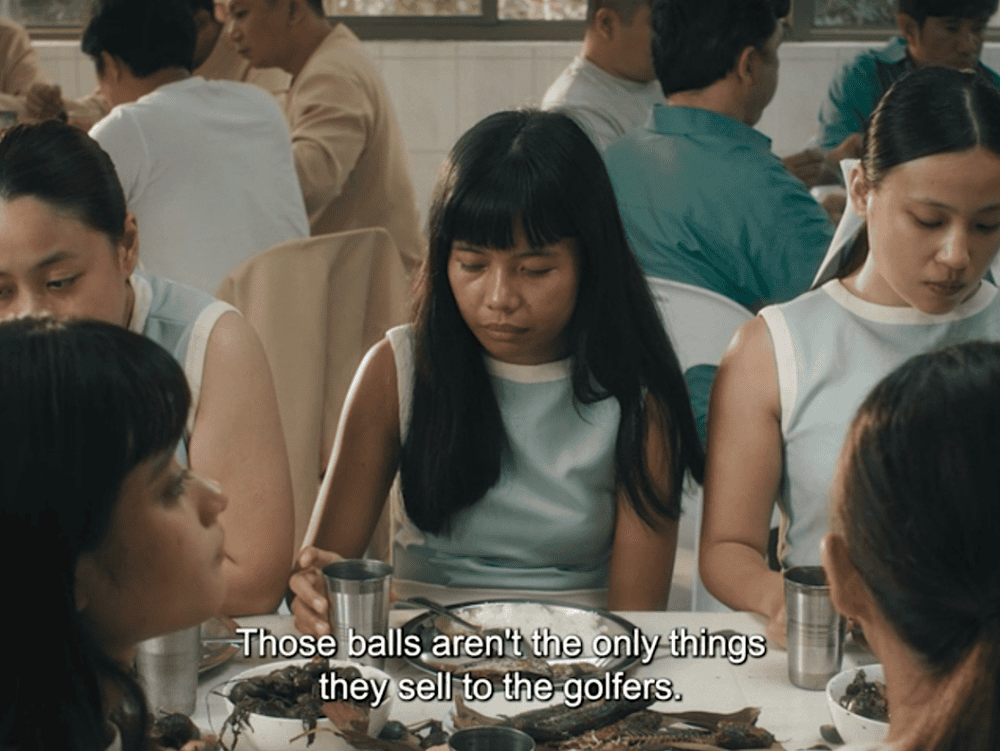
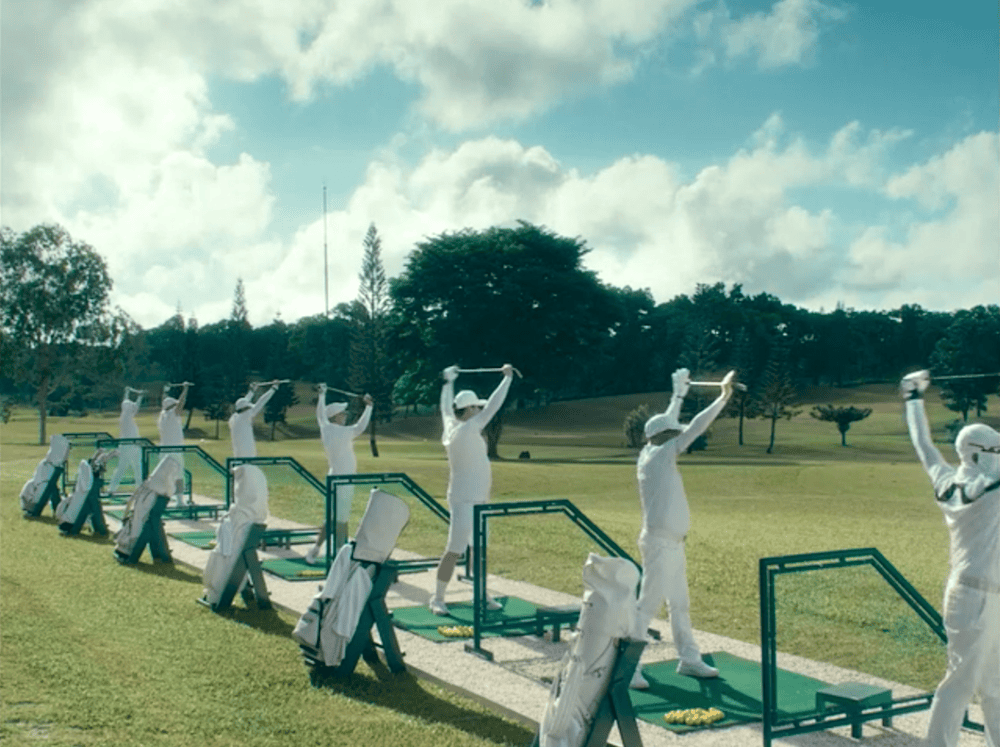
Isabel and Clara are both outsiders. Director Manuel and cinematographer Xenia Patricia adopt the characters’ sense of displacement and estrangement as the default visual language of ”Filipiñana.” Shot by shot, an unease mounts that sits in tension with the immaculate aesthetics. For all the artifice of the daily operate of the country club, the perspective in each scene seems warped in some way, from the setting’s scale to the uncanny strangeness of the symmetrical composition of the scenes. Director Manuel displays his own visual within largely static frames in a manner similar to Roy Andersson and Aki Kaurismäki.

Everything that happens around Isabel and Clara seems unnatural. The new “natural” of the golf courses is an installation with artificial ponds and huge trees trucked in and planted. The labor of the workers at the country club performs their assigned tasks with a creepy choreography. The scene at the driving range is one of the best examples of that, with the “tee girls” setting all the golf balls on the tees in unison and the Chinese golfers hitting their strokes simultaneously. Cinematographer Xenia Patricia filmed Isabel with the camera between the legs of the men at the driving rang. The image feels strangely uncomfortable, if not explicitly sexualized, reinforcing the gendered hierarchy that requires servitude to performed with a smile.
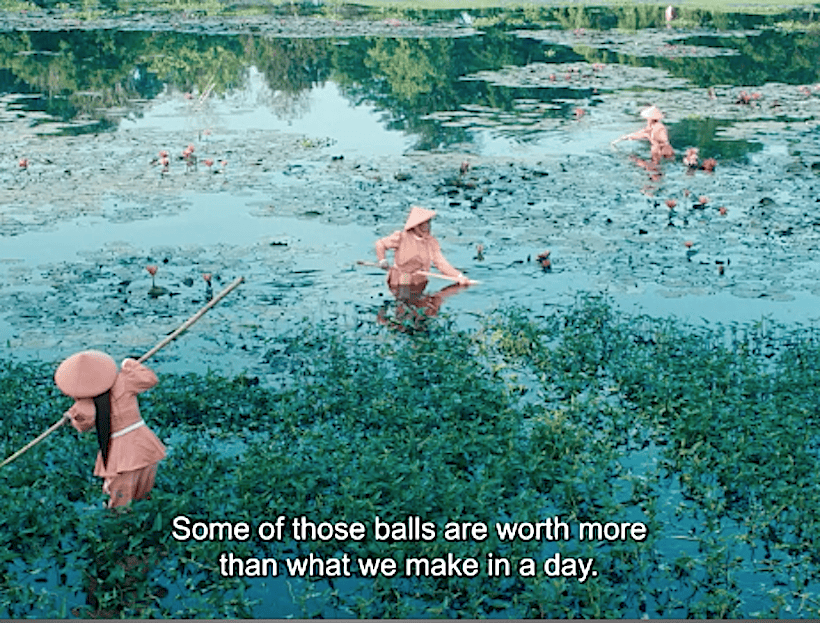
Isabel’s work at the golf club lays bare the harsh inequalities faced by people like her in the Philippines. Her main task in Filipiñana consists of returning a golf club to Dr. Palanca, the facility’s director who inspires a cult-like reverence from members and employees alike. While Isabel attempts to return a MacGuffin to Dr. Palanca, Isabel experiences different areas of the country club. The golf club itself doubles as an emblem of the club’s misguided priorities.

Rafael Manuel’s film show that the lack of perspective shared by the characters is due to their lack of self-awareness, as we discover by listening in the private conversations of those at the top of Filipino society. Underlying the routine activities of the workers at the country club, Manuel coyly incorporates a real-life drama of a missing girl on the premises. We don’t really understand the impact of the missing girl part of the story until the film’s final shot. Once the closing credits begin to roll, Manuel lays bare the unsavory truth and violent foundations of his chosen milieu. It’s an ending that serves as a walloping indictment of all those distracted by superficial concerns – including his own audience.