By Robert St. Martin
In At the Door of the House Who Will Come Knocking (Bosnia/Herzogovia, 2024), Maja Novaković tenderly portrays the solitary life of Emin, an elderly man trapped in time and tormented by his past, set against the stark beauty of Bosnia’s mountains. Featuring on Thursday, May 1, at SEEfest South East European Film Festival in Los Angeles, this film was written and directed by Maja Novakovia, co-written by Jonathan Hourigan. Set in the harsh yet beautiful landscape of Bosnia and Herzegovina, following an elderly man (Emin Bektic) living in isolation, weaving together a tapestry of dreamlike visuals as it records the routines of his daily life. At the Door of the House Who Will Come Knocking is almost purely an observation of this elderly man in a cryptic but instinctively intelligible picture of loss, grief and loneliness. Novaković’s film has received numerous awards at international film festivals and was certainly a great addition to the SEEfest line-up.
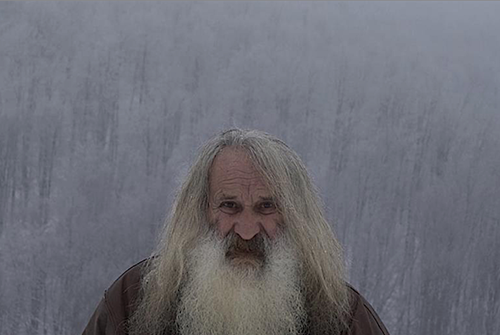
The natural beauty of Bosnia is usually described as “rugged”, but it is Novaković who finally gives real meaning to this platitude by creating the emotional landscape of her troubled protagonist. We are introduced to the unnamed old man as he breaks the ice in a trough for his horse, his solitary companion, to get a drink of water. It is in the reflection that we first see his face: with gray hair and beard, he looks about very old, and it is impossible to tell his age, even in the rare but powerful close-ups.
His little old house stands on the edge of a village and near the forest. He has no electricity, uses a petroleum lamp and a burner stove, but we see that there are power lines in the village, so we figure that he probably doesn’t want it. A neighbor visits him, looking for firewood. Soon, we watch him hack at a tree in the forest with an axe and struggle to get it home after attaching it to the horse’s harness.
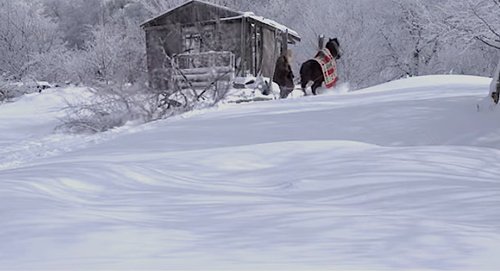
In the heart of a harsh winter, Emin’s daily routine is reduced to a few repetitive tasks: Struggling out of bed, putting on his boots and sweater, lighting the stove to warm his cramped and spartan home, and then heading out to tend to his animals. Among them is his horse, which he leads to a frozen trough for a drink before guiding it up the mountain, shielded from the bitter cold by a blanket with traditional patterns.

We keep watching the protagonist undertaking monotonous daily activities (a playful kitten adds some warmth and softness), but Novaković introduces an element that may represent a dream, a vision or a memory: a little boy is seen running through the woods in misty darkness. This time around, there is no snow – the film’s story takes place during a snowy winter. The few scenes in springtime seems to be recollections from the past.

A bit later in the film, we see a young boy interacting with the old man: As the kid unspools a ball of wool, the man is rolling it onto his fingers. At one moment, the child is literally connected to the old man by a thread that is being unspooled, but the nature of that link remains enigmatic and for the audience to define. The beautiful but puzzling image seems to be a piece of the old man’s memories. Perhaps he is himself as a child from long ago. Or is it someone he has lost – possibly his own child? What should we make of the old wedding photo on the wall? Was he once married to the woman in the photo? The emotional landscape Novaković has built definitely points to loss, grief and loneliness. We are presented the images without explanation or exposition, leaving us immersed in the life of this old man.
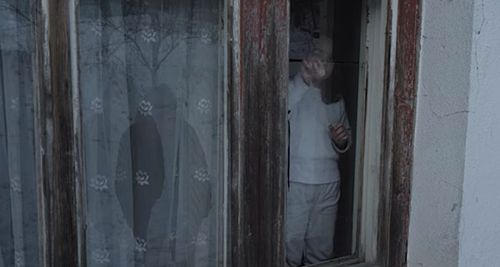
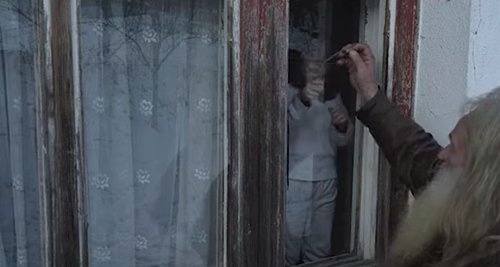
Loneliness is one of the strongest elements of the documentary because Novaković and Jonathan Hourigan portray such depth to it, without needing to use a lot of editing and stylistic choices to highlight it. It’s plenty poignant and clear on its own, just from the very minimal interaction that we see Emin have with fellow villagers. They are surprisingly impactful, seeing how much he yearns for even brief human contact and how important it is for communities to support one another. So, seeing how he doesn’t receive that, is almost heartbreaking.
Unable to express his emotions, Emin broods over the scars of his past. The director uses fiction to represent the melancholic thoughts of the old man. These sequences, increasingly interwoven with direct cinema, are embodied by a little boy who sometimes wanders through the woods and at other times sings a lullaby to a sleeping Emin. Sitting atop a snow-covered mountain, Emin imagines springtime landscapes, as if envisioning better days after the turmoil.
The surrounding nature looks gorgeous, and there are recurring visual symbols, such as a traditional, brightly colored carpet, used to enhance the hero’s world. Some shots are as beautifully composed as masterworks of painting. There is barely any dialogue, but there is a narrative line, told through visuals, intense sound design and music. At times, Novakovic even brings through an intriguing playfulness, veering into a folk horror styled atmosphere.
Aided by the strong score by Luka Barajevic, the film builds on iterative daily aspects of the old man’s life, as we watch this dream-like folk tale move along in its depiction of isolation. The spare score from Luka Barajevic, with low strings and woodwind, largely mirrors and enhances the elegiac mood. “You and the mountains are the only ones who understand me,” the old man tells his horse. So, it appears, does Novakovic, and her careful articulation of the real and the imagined also allows a connection to bloom between subject and audience.

One might be tempted to note some influences of Tarkovsky and the folkloric aspects which seem more of a nod to the mis-en-scene of Andrej Parajanov. It might be worth considering the opening moments of the film with a quote from the French poet Pierre Albert-Birot and his Les Amusements Naturels:
“At the door of the house who will come knocking?
An open door, we enter
A closed door, a den
The world pulse beats beyond my door”
At the Door of the House Who Will Come Knocking is a quietly compelling exploration of isolation. The atmospheric setting adds fascinating layers giving it that dreamlike, folk tale quality. Maja Novakovic has made a remarkable film that is worth seeing.