Los Angeles, CA (The Hollywood Times) October 13, 2026 — As entertainment capitals continue wrestling with generative AI in virtual soundstages and writing rooms, an even bigger, higher-stakes AI story is quietly unfolding just a couple of hours east of Sunset Boulevard.
Out in the California desert—spanning the arid expanses of Imperial Valley, the outskirts of the Coachella Valley, and the high-desert corridors of the Inland Empire—tech giants and private equity consortiums are going “All In.”
They aren’t betting on films or streaming rights. They are placing multi-billion-dollar wagers on the raw physical infrastructure required to power the artificial intelligence revolution: massive, hyper-scale data centers. “All in at All Costs” Flash Bang
If you want to understand where the AI boom is actually heading, you don’t look at algorithm code—you follow the money.

The Silent Takeover: How the AI Machine Is Sucking America’s Water and Power Dry
1. WHO: The Players Staking the Desert
The financial weight backing these desert megaprojects comes from an unprecedented alliance of Silicon Valley tech giants, wall-street infrastructure funds, and specialized industrial developers:
The Tech Giants (Hyper-scalers): Microsoft, Amazon Web Services (AWS), Google, and Meta are funneling hundreds of billions globally into capital expenditures, with a huge percentage earmarked for Southern California compute nodes.
Private Equity & Infrastructure Funds: Private equity powerhouses—including Blackstone, Global Infrastructure Partners (GIP), and Brookfield Asset Management—are pouring tens of billions into specialized data-center REITs and land acquisition platforms.
Energy Developers: NextEra Energy, Ormat Technologies, and major regional utility providers are stepping in as key financial partners, building dedicated solar, wind, and geothermal micro-grids to power these facilities directly.
2. WHEN: The High-Speed Gold Rush Is Now
The timeline isn’t decades away; it is happening right now.
Driven by the explosive compute demands of Large Language Models (LLMs) and real-time generative video rendering, tech firms ran out of existing server space in early 2024.
Between late 2025 and 2026, land acquisition across Southern California’s desert zones reached fever pitch. Breaking ground on these multi-million-square-foot campuses is slated throughout late 2026 and 2027, as developers race to bring gigawatt-scale capacity online before competitors saturate regional grids.
3. WHERE: Why the Desert Surrounding Los Angeles?
To the untrained eye, the remote California desert seems like an unforgiving place for sensitive supercomputers. To real estate financiers, it’s prime territory for three reasons:
Proximity to L.A.’s Fiber Spine: The desert regions sit immediately adjacent to major transpacific fiber-optic corridors and high-speed data trunks running into Los Angeles, delivering ultra-low latency back to media hubs, aerospace sectors, and enterprise centers.
Available Footprints: You cannot build a 2-million-square-foot campus in West Hollywood or Santa Monica. The desert offers vast, contiguous plots of flat land at a fraction of coastal real estate prices.
Abundant Solar & Geothermal Infrastructure: Imperial County and surrounding regions boast some of the highest solar radiation levels in the country, alongside established geothermal energy reserves near the Salton Sea—offering a path toward clean energy credits.
4. WHY: The Trillion-Dollar AI Engine
Why are investors risking billions on sand and scrubland?
The Generative Compute Wall: AI isn’t like traditional cloud storage; training next-generation AI models requires exponential increases in processing power and cooling.
Hollywood’s Cloud Shift: From real-time visual effects (VFX) rendering to localized AI production pipelines, the entertainment industry itself is demanding high-density compute power close to home without swamping local city power grids.
Unprecedented Yields: For real estate investors, data centers have become the single highest-yielding asset class in commercial real estate, outperforming traditional office, retail, or industrial warehouse spaces.
The Catch: Water, Power, and Local Pushback
While the capital flowing into the desert is astronomical, the “All In” bet faces massive friction on the ground:
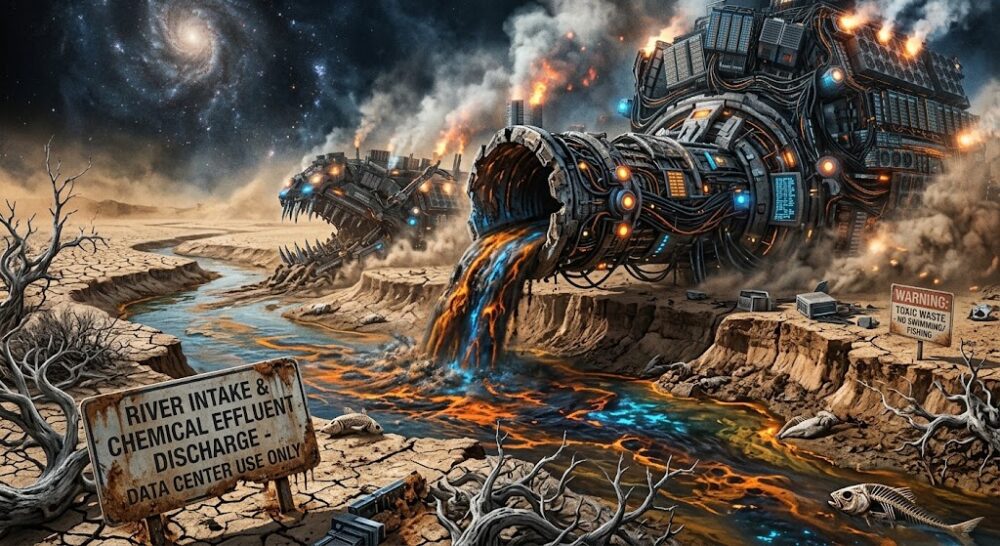
1. The Water Crisis: Cooling supercomputers in 110°F summer heat requires millions of gallons of water daily, sparking fierce opposition from local desert communities and agricultural stakeholders protective of regional aquifers and Colorado River allocations.
2. Grid Congestion: Utility providers are warning that hooking up gigawatt-scale facilities threatens to push energy costs onto local residents and stretch grid capacity to its limit.
3. Regulatory Battles: Desert residents and environmental coalitions are actively organizing against attempts by developers to streamline environmental impact reports or bypass California Environmental Quality Act (CEQA) reviews.
The Bottom Line
The AI revolution isn’t just taking place in cloud software or high-tech boardrooms; it is taking physical form in the sands outside Los Angeles.
As billions continue to flood into the desert, the battle lines between high-tech capital, local energy supplies, and desert water rights are officially drawn. California is going “All In”—and the rest of the country is watching to see who wins the gamble.
Local Grassroots & Regional Coalitions
Alianza Coachella Valley
Website: alianzacv.org
Email: info@alianzacv.org
Sierra Club (California & Desert Chapters)
Website: sierraclub.org/california General / Member Email: information@sierraclub.org | member.care@sierraclub.org
Center for Biological Diversity (CBD)
Website: biologicaldiversity.org
Email: membership@
National Alliances & Advocacy Watchdogs
Food & Water Watch
Website: foodandwaterwatch.org California Regional Contact / Research: aaker@fwwatch.org
Our Revolution
Website: ourrevolution.com Contact Portal: ourrevolution.com/about-us