In Bellow, a strange yet profoundly resonant theatrical work by Brokentalkers, an Irish accordionist transforms music into an act of revelation where the past is confronted.
By John Lavitt
Los Angeles, CA (The Hollywood Times) 03-31-2026
It has taken me too long to write this review.
In the wake of a startlingly powerful production at The Nimoy, I was not sure I could put into words what I experienced. What unfolded onstage went beyond performance. It revealed something raw—where creativity and trauma are not separate forces but intertwined. Not only can art heal, but it can also give us the courage to expose what never fully heals.
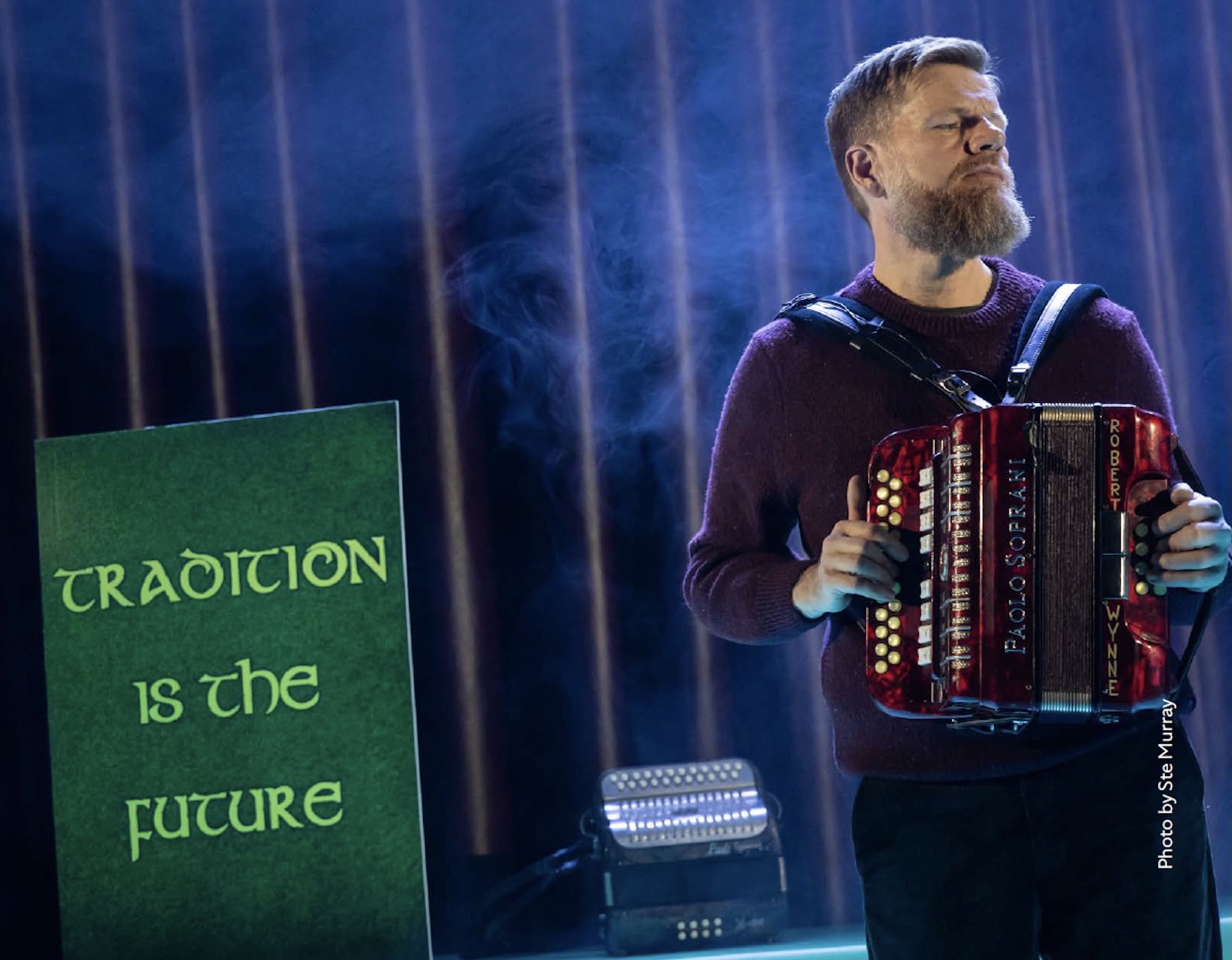
Presented by CAP UCLA at The Nimoy, Bellow is a production by Brokentalkers, a multi-award-winning Dublin-based theatre company. Created by Brokentalkers co-directors Feidlim Cannon and Gary Keegan with Danny O’Mahony, it is built around a simple but difficult truth: no one else can tell this story.
Danny resisted the process at first. He did not want to perform himself. Yet, as the piece makes clear, there is no separation between the man and the music. Surrounded by four accordions from different periods of his life, each instrument carries a history only he can access. The performance becomes an act of necessity rather than choice.
Onstage, Danny is joined by Keegan, appearing as himself, and dancer Emily Kilkenny Roddy, whose movement interprets what cannot be spoken. Together, they construct the story in real time — revealing both Danny’s past and the struggle to uncover it.
Before this performance, I never thought much about the accordion. If anything, I associated it with cliché and novelty. That perception did not survive the first piece of music. It scattered like dust in a sudden wind.
When Danny plays, the instrument transforms into something completely different — expansive, melodic, and deeply human. Each passage feels alive, as if it is bringing memory into the here and now. More than once, I found myself wishing the music wouldn’t stop. It was like being on a raft, carried by the music to sounds you thought you had forgotten.
However, you must understand, Bellow is not simply about musical mastery. It is about what the music carries with it.
A photograph of O’Mahony as an eleven-year-old boy appears — wide-eyed, already committed to the tradition he was trying to preserve. That commitment came at a cost. His devotion to the music and the tradition was recognized but not understood. What mattered most to him was often reshaped into something more marketable, more easily consumed.
That fracture — between authenticity and expectation — sits at the center of the work. The music he needed to play was not what audiences were ready to hear. They did not have time to go on this journey with him. So he went alone.
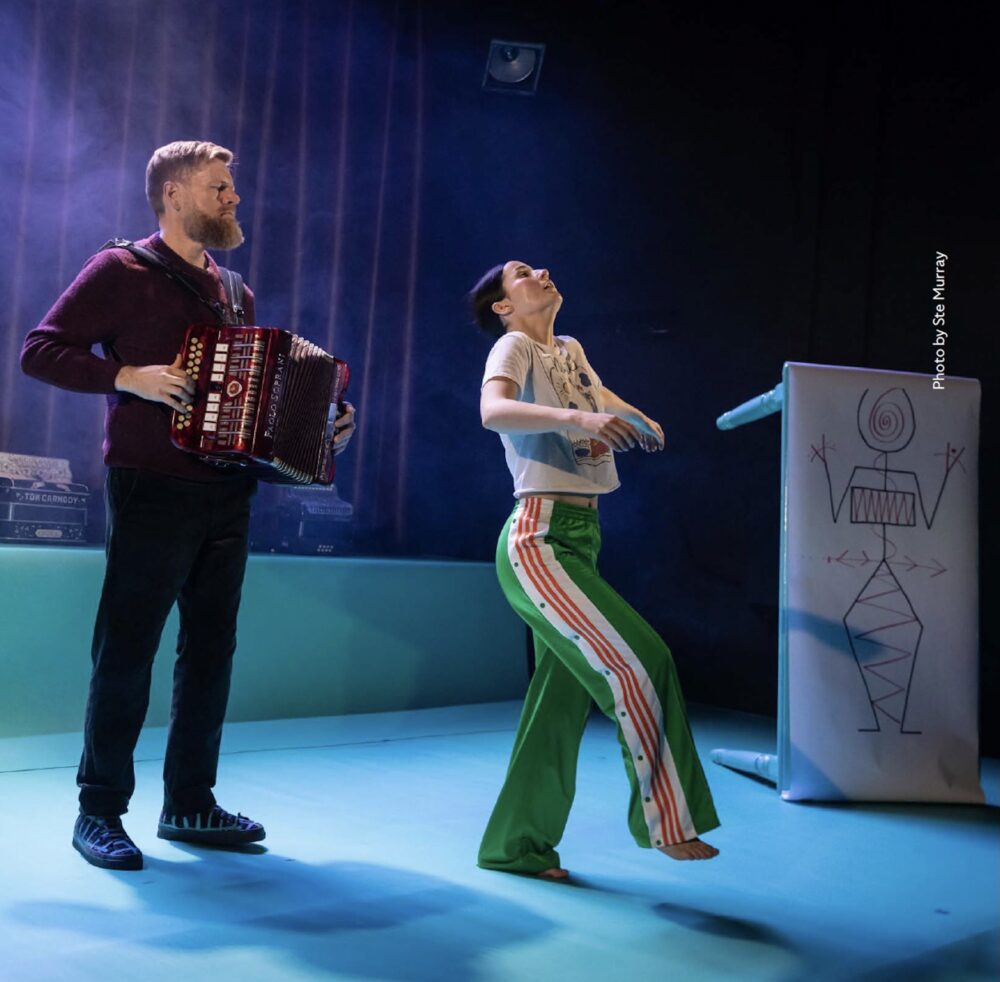
The fracture is given form through a striking visual: a puppet representing the young boy, worn and animated by Roddy. Even in motion, the face does not change. The mouth does not speak. The child remains fixed in the moment of abandonment.
What Bellow ultimately reveals is not a clean narrative of healing. The adult artist may find his voice, but the child does not move forward with him. He remains where the rupture occurred.
And that is what stayed with me after leaving the theater.
Not simply the beauty of the music, though it is extraordinary. Not even the courage required to perform this story. What lingers is the recognition that creativity does not erase trauma — it gives it shape. It allows it to be seen, heard, and, for a moment, shared.
Some performances entertain. Others impress.
Bellow does something far more difficult. It reveals.