
The Proud Princess may begin with a familiar archetype, yet what unfolds moves through memory, influence, and the return to self.
“A greedy man never has enough.”
The line lives inside the story as a pattern. The people surrounding the princess operate from scarcity, shaping her world in ways that benefit them. Over time, they remove what once grounded her. Her nanny—the one who held her sense of care, humility, and innocence—is pushed out of the castle and into a small dwelling beyond its walls. Her father, the king, remains within the kingdom, yet even he has lost connection to what once held meaning. Her mother’s presence is taken from sight. What once lived around her is no longer reinforced. In its place, influence takes hold.

In the Sun Kingdom, King Benjamin looks upon Princess Carolina’s portrait from the Midnight Kingdom and sees something he believes in.

He imagines himself beside her, certain in what he feels before they have ever met. Their first exchange happens through portraits. She sees his image and dismisses him, focusing on what she perceives as beneath her—his hand holding an apple. From that single detail, she forms her judgment, saying he is not even worthy of tying her shoelaces. He receives that message. “She doesn’t even know me. ” He goes to find her.

To be near her, he takes on the role of a gardener, placing himself within her world so he can be close to her. From there, he sees what is happening around her and begins protecting her from within it. When he sings to Princess Carolina, he sings the song her mother used to sing to her. It reaches her immediately. She doesn’t have to think about it—her body remembers. The feeling comes back to her, warm and familiar, something she hasn’t felt in a long time.
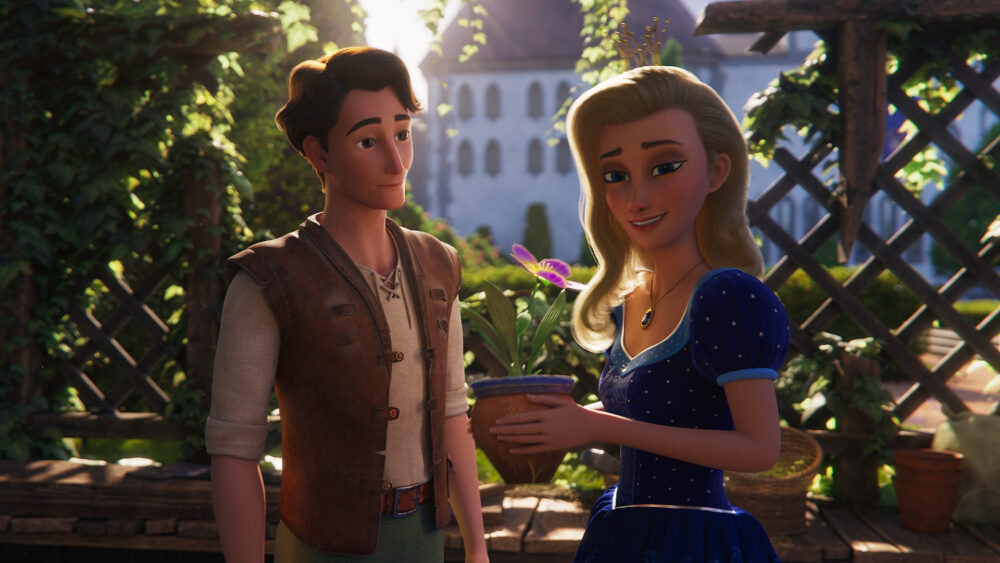
There is a single purple flower growing in the space he has been tending on the castle grounds. It carries light, music, and a sense of joy that reflects the care he brings into that environment.
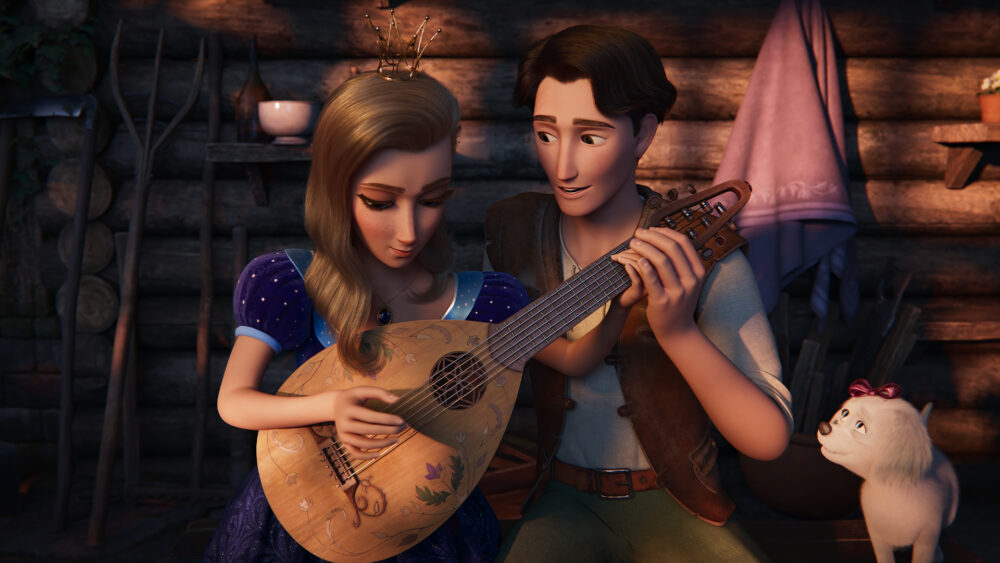
She wants to learn that song—the one he just sang, the one her mother sang to her—so she can play it herself and stay connected to that feeling. “Please, teach me,” Princess Carolina says to him. They sit together, and he shows her how to play. He places her hands on the lute and guides her through the notes. She follows, taking her time, staying with it as the melody begins to come through. That is where their connection begins—through the music and through the time they spend together.
As the story continues, the truth comes forward. The gardener she has come to know is revealed to be King Benjamin. As an audience, we expect the reaction we have seen before—the emotional response that comes when someone realizes they have been misled, the anger, the sense of distrust that can rise in that moment. We recognize that feeling, even here, where we want her to receive this new truth with openness.
As expected, in a fight-or-flight-or-freeze response, she chooses to ride away. When he catches up to her and pulls her onto his horse, the moment resolves. She softens. “I love you… anyway,” she tells him—even as a king. What she has experienced with him remains clear, and she holds onto it. In the end, the moment he once imagined becomes real. They are on the horse together, just as he had seen from the beginning—now lived instead of imagined.

There are moments throughout the film that show how easily outward appearance can shape behavior. A change in clothing shifts posture and presence, showing how quickly identity can be influenced by what is seen. The music carries the story forward. It is layered, orchestral, and expressive, moving with each moment and shaping how it is felt.
Visually and structurally, the film reflects its international, collaborative roots—blending European storytelling with a richness of animation and musical expression. As an animated film, it held my attention throughout. I found myself fully engaged—drawn in by the detail, the movement, and the way each scene unfolded. The story develops through its own specific moments, and I stayed with it the entire time.
In the end, as an audience, we can clearly see the difference—who is grounded, kind, and steady, and who is driven by ego, self-interest, and a need to appear above others. And yet, in our own lives, we don’t always make that same clear choice. We overlook what is right in front of us. And when we watch the princess finally recognize the difference and choose the one who is genuine, grounded, and truly cares for her, there is relief.