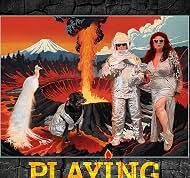
A tribute to more than two decades of artistic leadership in Sherman Oaks, where Bryan fostered a home for new voices, solo explorations, and independent theatre.
By John Lavitt
Sherman Oaks, CA (The Hollywood Times) 09-17-2026
After more than twenty years as the owner and artistic director of the Whitefire Theatre, Bryan Rasmussen is stepping away from the intimate Sherman Oaks stage that became synonymous with his name. He has sold the theatre and is moving into the next chapter of his life, with his family, his health, and his creative passions at its center.
For the independent Los Angeles theatre community, his departure marks the close of a remarkable era. For the many artists whose work he encouraged, produced, directed, taught, or simply made room for, it is an opportunity to recognize what he built: not only a theatre but a creative home for theatrical exploration.
Bryan’s path to the Whitefire was neither predictable nor easy. He earned his degree in theatre from Cal State Long Beach, trained at the American Conservatory Theater, and spent nine seasons with South Coast Repertory. He built an actor’s life the difficult way, performing in productions such as Equus, Spring Awakening, and his Vincent Van Gogh solo show, Sincerely Yours, Vincent.
Working dozens of service jobs to survive and pay the bills, Bryan did not see owning a theatre as a landmark on the map of his future. However, Bryan is known for the courage to venture off the map and into the unknown. Indeed, in 2005, an unlikely opportunity arrived.
With help from friends and family, a bartender trying to make ends meet became the owner of the Whitefire Theatre. Bryan has recalled standing on its bare stage, wondering how it had happened. Over time, he came to see it as destiny.
The name itself offered a fitting metaphor. The original owner told him that white fire is the hottest flame, capable of transforming metal and glass. The Whitefire, he said, was a creative crucible. Under Bryan’s leadership, that description became a mission.
We all need to remember this. Independent theatre in the 21st century exists because people are willing to take risks that larger institutions cannot or will not. It gives artists a place to test an idea before a live audience.
In a culture shaped by screens, algorithms, and massive entertainment companies, a small theatre preserves something elemental: people gathering in one room to imagine together. If we lose independent theatre, we lose part of the soul of the American dream.
Believing wholeheartedly in this, Bryan fought tooth and nail for twenty years to keep the Whitefire a vital source of innovation and opportunity in the Los Angeles theatre community. Film and television can create a world through editing and imagery. Theatre asks the audience to help create that world. Words, bodies, light, sound, and shared attention are enough. Celebrating presence is at the heart of the Whitefire Theatre.
With this value at his core, Bryan converted the Whitefire into a flexible black box because he believed stagecraft should serve the story, not overwhelm it. The result was a space where theatrical imagination could take precedence over production scale. He opened the door for alternative and emerging voices to find a stage where they could fully express themselves.

Bryan also confronted the practical question that defeats independent artists: How can the work remain affordable? When an unbooked six-week period threatened the theatre’s survival, he filled separate nights with solo pieces, one-act plays, and ten-minute comedies. That experiment led to Whitefire’s vertical repertory model, in which several productions run once a week. One audience of sixty made more sense than three audiences of twenty. Costs fell, and more artists gained access to the room.
Rather than operating solely as a rental house, the Whitefire developed a coproduction structure that allowed productions to pay their fees from box-office proceeds rather than writing a large check in advance. That change may sound administrative, but it was profoundly artistic. Every dollar not required to be risked upfront widened the circle of people who could create. Artists, audiences, and the venue depended on one another.
Nowhere was that philosophy more evident than at SoloFest. Bryan knew the particular vulnerability of solo performers because he had been one himself and had taken his Van Gogh show to the Edinburgh Fringe Festival. A solo artist often inherits another production’s set, lighting, and schedule while carrying the entire dramatic burden alone.
Bryan wanted the Whitefire to offer something better: a safe, supportive space built around the individual performer and the story only that person could tell. His model was elegant. By giving each show a single performance, a solo artist could often sell enough tickets to cover costs. The audience, not the performer’s checkbook, supported the production.
Over fifteen years, SoloFest presented more than 1,000 solo shows and became one of the nation’s preeminent festivals of one-person theatre. Those numbers matter, but human achievement matters more. Bryan gave hundreds of people permission to stand alone under the lights and say: This is my experience. This is my voice. Listen.
Solo performance turns a life into an encounter between a storyteller and a roomful of strangers. At its best, that encounter dissolves isolation. A private truth becomes shared meaning as audience members recognize themselves in a life unlike their own. SoloFest did not merely program shows. It multiplied voices and created community through courageous self-revelation.
That community proved its strength during the pandemic. With the Whitefire closed to the public and rent still due, Bryan and a tiny team livestreamed 175 solo performances worldwide. Three people operated cameras and computers while one performer took the stage. Ticket sales helped sustain the theatre, and a local venue became global. At a moment when silence threatened stages everywhere, Bryan kept the Whitefire speaking.
The accomplishment came at a real personal cost. For years, the pressure to keep the theatre alive was relentless. Bryan has spoken candidly about believing, month after month, that he might lose it and about the physical toll of that fear. He later survived a near-fatal heart attack. His story should never be reduced to a romantic myth about suffering for art. Instead, it reminds us how much independent cultural life has depended on individuals shouldering responsibilities that should be shared more broadly.

Yet even amid mounting toil and struggle, and under the shadow of a pandemic that closed many independent theatres, Bryan remained grateful. His friend Bobby Moresco once told him, “True success is doing what you love.” Bryan held that wisdom close. For more than two decades, the Whitefire presented world premieres, film screenings, classes, comedies, and solo works. It became a place where artists could take risks and where strangers could leave feeling less alone.
Bryan Rasmussen’s legacy cannot be measured solely by seasons, premieres, or ticket sales. It lives in the confidence of performers who found their voices at SoloFest; in the collaborations that began in the lobby; in the writers who first heard their words spoken aloud; and in the audiences who entered a small room in Sherman Oaks and discovered a larger world. It also lives in the people, including me, who experienced Bryan as a positive and sustaining influence.
Under Bryan’s artistic direction, the Whitefire became a creative crucible. He stepped into its heat, risked everything, and helped transform others. Now, as he moves on to a new future, the community he fostered can return the gift by celebrating him. The theatre has been sold, but what Bryan created cannot be contained within a building. It endures wherever an artist finds the courage to speak, an audience chooses to listen, and people gather to make meaning together.