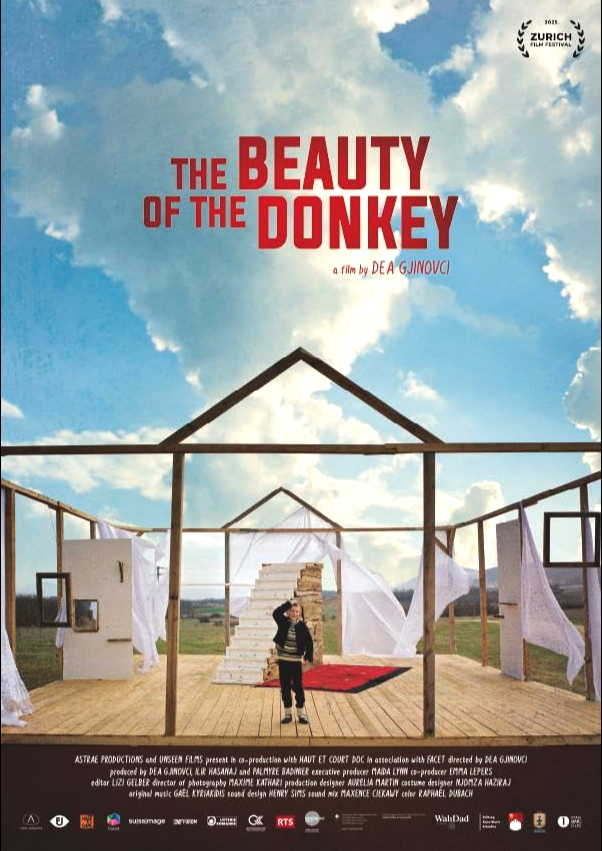
One film in this year’s South East European Film Festival (SEEfest) that I particularly enjoyed was Dea Gjinovci’s documentary The Beauty of the Donkey. Dea Gjinovci lives in Switzerland but her roots are in Kosovo, the small Balkan country tucked between Serbia, North Macedonia, and Albania. Dea Gjinovci is a filmmaker and she decided to make a film about her father returning to his home village in Kosovo – 25 years after a devasting war that led to him fleeing Kosovo for Switzerland. The Beauty of the Donkey is really about Asllan Gjinovci, the filmmaker’s father, who returns to his small village of Makermal in Kosovo with his daughter for the first time in nearly 60 years. While there, her father Asllan, shares memories that Dea Gjinovci decides to stage as an abstract theatrical production, in order to bring the past back to modernity.
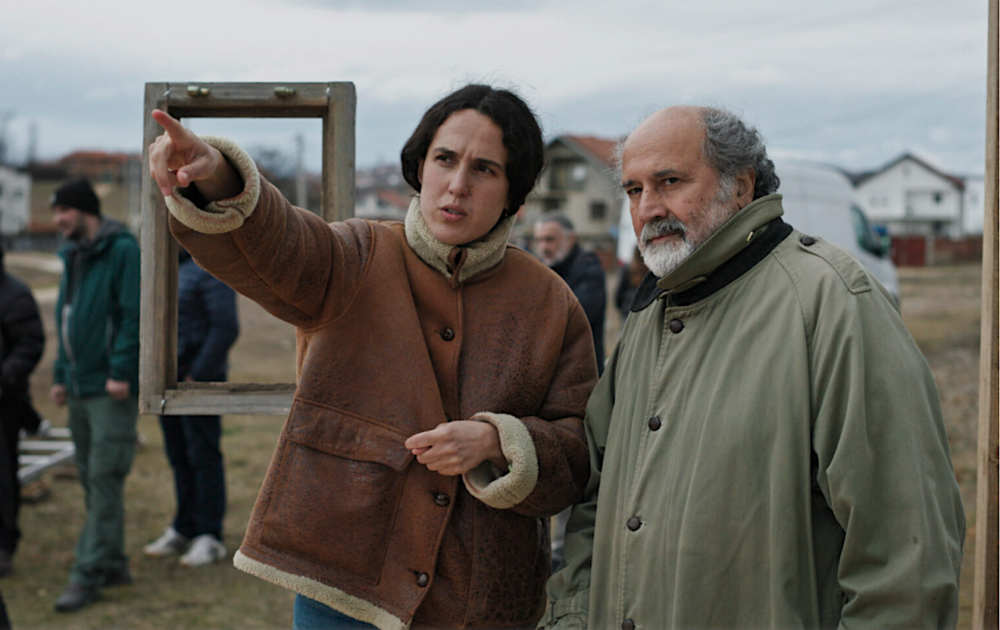
Dea Gjinovci goes to stay in Makermal along with her father, Asllan, in the village of Makermal because she has never been there and wanted to know about the place where her father grew up in Kosovo. Asllan fled from Kosovo in 1968. He was then a young student militant, wanted by the Yugoslav police after demonstrations for a free Kosovo. In 1968, Kosovo experienced significant, widespread demonstrations by ethnic Albanians demanding greater rights, including the status of a republic within Yugoslavia, the establishment of the University of Pristina, and the official use of the Albanian flag. While these November protests were suppressed by Yugoslav authorities, they catalyzed increased autonomy, leading to constitutional changes in 1974 and the establishment of the university.
After 1968, Asllan has spent most of the years of his life in exile in Geneva, where he has worked, married, and had children. It was in Switzerland his daughter Dea was born in the French-speaking Geneva. So many years have distanced A Asllan from distant memoires of his childhood in Kosovo. Returning to the village of his youth in Kosovo seems an odd experience. There are no old wooden houses left and even the stone walls on various properties have disappeared. Like so many rural villages in South East Europe, the past seems erased.
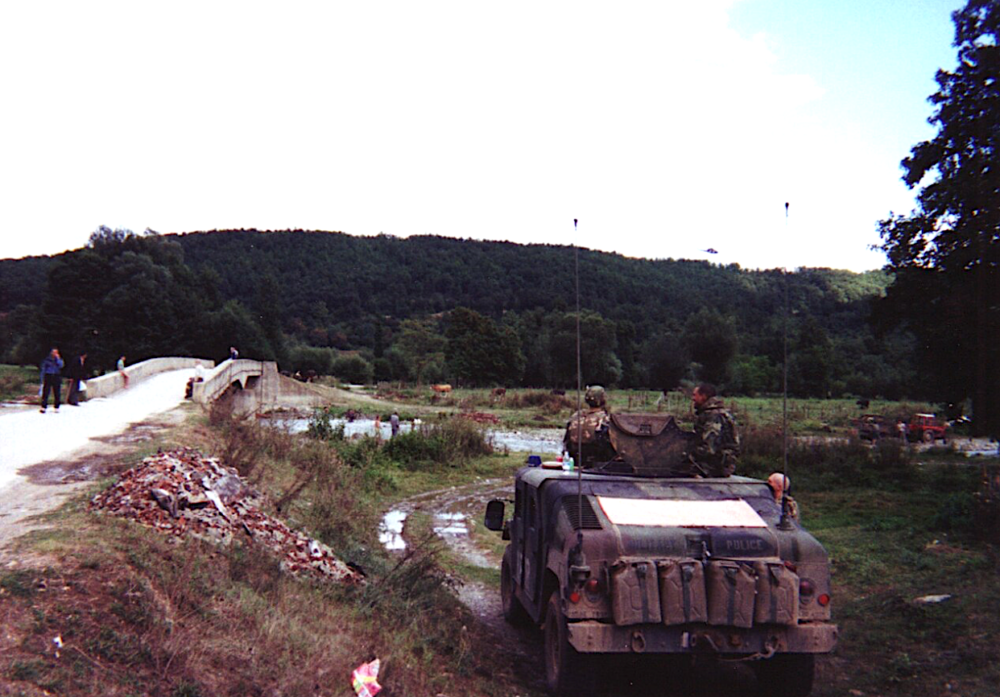
Dea brings in her film crew to document her father’s return and there seems to be little to remind one of the old Kosovo. When they reach the lot where the family home stood, there is a sense of the haunting reverence for the place where there was once a large two-story home built of stone and wood. But now there’s nothing but a large grassy lot with no walls, no stones, nothing that would suggest a piece of the past. Say Asllan: “I don’t even find any traces of it.” What happened? What to do when the war has not only destroyed the houses, but also obliterated the very footprint, so there are no ghosts?
In 1968, Kosovo experienced significant, widespread demonstrations by ethnic Albanians demanding greater rights, including the status of a republic within Yugoslavia, the establishment of the University of Pristina, and the official use of the Albanian flag. While these November protests were suppressed by Yugoslav authorities, they catalyzed increased autonomy, leading to constitutional changes in 1974 and the establishment of the university.
The Beauty of the Donkey explores the village’s post-war reconstruction through the memories of returning villagers, following its destruction during the Kosovo War. The Kosovo War was an armed conflict in Kosovo that lasted from 28 February 1998 until 11 June 1999. It was fought between the forces of the Federal Republic of Yugoslavia (dominated by Serbia), which controlled Kosovo before the war, and the Kosovo Albanian separatist militia known as the Kosovo Liberation Army. The KLA was formed in the early 1990s to fight against the discrimination of ethnic Albanians and repression of political dissent by the Serbian authorities, who began after the suppression of Kosovo’s autonomy and other discriminatory politics against Albanians by Serbian leader Slobodan Milosevic in 1989.
In early 1998, KLA attacks targeting Yugoslav authorities in Kosovo resulted in an increased presence of Serb paramilitaries and regular forces who subsequently began pursuing a campaign of retribution targeting KLA sympathizers and political opponents; this campaign killed 1,500 to 2,000 civilians and KLA combatants, and had displaced 370,000 Kosovar Albanians by March 1999. During time period in 1999, there were a number of massacred of local Albanian civilians by Serbian security forces in response to Albanian separatist activity in the region. This had a huge impact on Asllan’s own family in Makermal, where his aged mother was separated from the rest of her family and last scene sitting in the abandoned railway station.
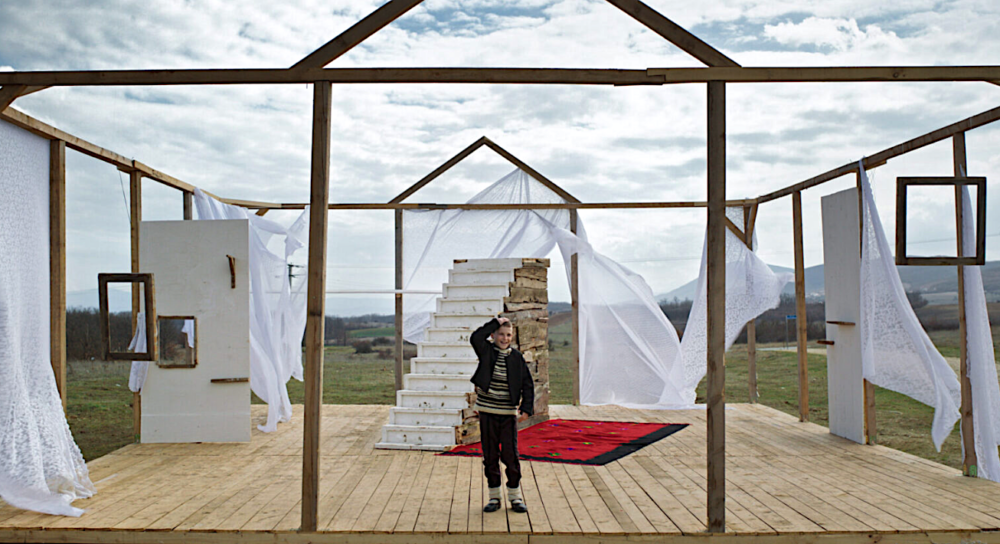
Of course, this part of the story is a discovery for Asllan who has lived his own life in Switzerland, far away from his Kovoso family for more than 50 years and really know nothing but memories of his childhood in the village. Revisiting Makermal comes with a great sense of loss but also an attempt to understand what happened during his long absence. Rather than trying to make a film about absence, the filmmaker decides to build a world of memory. Together with the inhabitants of the village, she erects a frame of a building to represent her father’s childhood house. Its functions as an imagined reconstruction of Asllan’s home: The simple wooden structure, made of old patinated boards and newly worn ones, with a simple staircase, broken windows, a snow-covered carpet, windows that move floating in the wind, billowing white curtain material – provide the contours of Asllan’s house on the hillside property where his childhood home once stood. The space becomes at once a home and a theatre, a refuge and a stage. The magic is ably captured by cinematographer Maxime Kathari.
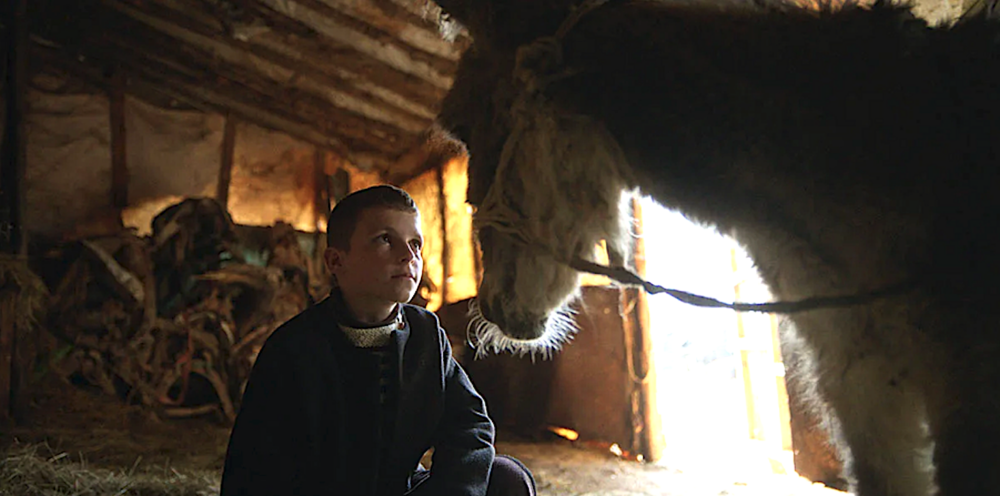
Dea Gjinovci calls on the village to play itself but in costumes from 60 years ago. The inhabitants take on the roles of inhabitants that they could have been. A young boy is selected to play young Asllan. He is first scene in the opening credits carving the image of donkey on a wooden shingle that was once part of a traditional Kosovo rural home. He is the young Asllan and we see the tranquil donkey as a symbol of a world long gone. Of course, the image is a powerful cinematic touchstone of the patience of a donkey in an often cruel world – riveted in Robert Bresson’s Au Hazard Balthazar(1966). Perhaps this cinematic indulgence of the filmmaker makes fiction amplify the reality of the lost past – much like the involuntary memory triggered by the madeleine cake in Proust’s Remembrance of Things Past.
This device reveals an intimate truth about memory itself – always a reconstruction, always an approximation, always a bit of new patina to resemble the old. The house is nothing more than a wooden frame, but in its skeleton form that seems lacking a remembered life in the past can emerge. The non-existent walls are covered with white drapery material and translucent plastics to animate the space of this stage forms with children from the village acting as Asllan’s kinfolk and a woman taking on the role of Asllan’s patient, loving mother. As scenes are recreated, we see this woman carrying a young Asllan and his brother across a creek at night. In childhood, his father left for another woman, and Asllan’s mother is left to care for the family alone. His uncle looks after the family as well and Asllan grows up very close to his cousins. We see them herding sheep and cows in the open fields and playing tag in their free time. Life seems idyllic in Asllan’s fond memories.
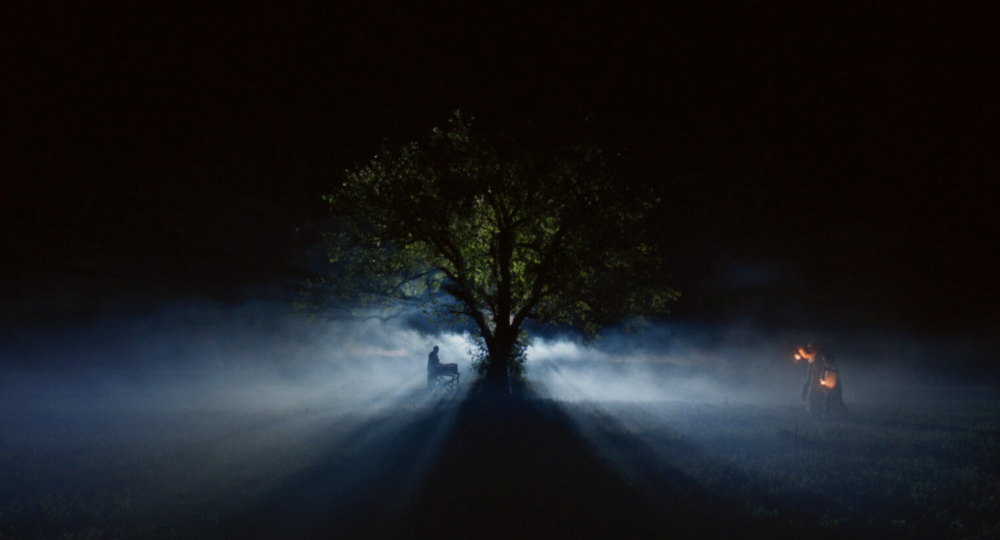
Darkness begins to descend on the Gjinovci household as problems with the Serbian authorities make life more difficult for the ethnic Albanians in Kosovo. There are Serbian gangs who terrorize and target ethnic Albanians. Sometimes they come in the night, raiding houses, and arresting the men. In one night scene staged on the make-shift house stage, lights projected from behind the hanging white cloth illuminates the shadowy figures of Serbian soldiers who break into the house and arrest the men, hauling them off to an uncertain fate in prison. The children hide under their blankets, hoping to not be noticed and their mother attempts to protect them. Tricky as memory tends to be, the filmmaker is trying the capture the emotional resonance of life in that distance time as remembered by the elderly Asllan. Everything seems floating, as if space was suspended between presence and disappearance. The past is not reconstructed stone by stone. It appears in fragments.
This scene of the disruption of the Gjinovi household by the Serbian soldiers is undoubtedly the most striking example of the power of memory: The menacing silhouette of the soldiers first appear behind the plastic tarps that make up the walls. Then these shadowy shapes filter through the translucent material and enter the house seizing men and forcing some children to hide and others to flee. As the violence thickens, this traumatic memory is made tangible and concrete, roughly embodied.
Dea Gjinovci’s film positions itself as a work at once deeply personal and universal, formally never before seen without invention. Some of the villagers recall the more recent events of the 1994-1995 Kosovo War which Asllan himself never experienced except on television or in newspaper article he saw in Switzerland. The parallels between 1968 and 1995 are blurred in a strange confabulation of history and memory. In the film, an old lady explains that everything in Makermal has been rebuilt. There are only “new houses.” 90% of the villages were destroyed. Asllan learns that his family home in Makermal had disappeared before the war in 1995. His aged mother was probably living somewhere else in the village by time of her disappearance and death in 1995. The film points out that in an ethnic cleansing of what happened to so many Kosovo Albanians was the loss of the “soul” of places – on the part of destructive will of the perpetrators and also in the reconstruction of post-war societies. Is it even possible to reconstruct an identity when the architecture of our memory has been physically erased?
In an interview with the director, Dea Gjinovci explained: “When I started the building the frame of a house in the village, I went to see all the families to ask them if they had any pictures of their original house. In fact, there almost weren’t any. Those who had pictures were only from after the war, but none of the destruction of the original house. In the research process, I asked the neighbors to help me recreate the surface of their house, to describe to me what it looked like. That’s what my dad is seen doing at the beginning of the movie.”
Dea went on to elaborate: “It’s crazy, this architectural memory persists despite the material disappearance. Oral history makes the exact shape of their houses, sometimes even within the exact dimensions, clear to the eyes of the residents. These memories are remarkably accurate.” This shapes the construction of this unusual documentary. “That’s also why I decided not to completely rebuild a house, bur to have an almost metaphorical representation of what a house is, with just a wooden frame, nothing more. Because I knew there was absolutely no possibility of reconstructing this material memory. I’m saying to myself: if we’re no longer in the material, what can we be in the imaginary? It’s a very important element.”
During the research and pre-production phase, the costume designer, Njomza Haziraj, who is Kosovar, spent a huge amount of time discussing clothes with Dea’s father. She asked him how exactly Asllanlooked as a boy. Since Asllan has an incredible memory, he remembered white wool socks he wore with his shoes – either leather or rubber – and wool pulls. Such small aspects enrich the film with an authenticity that is both visual and visceral. Oral history makes the exact shape of their houses, sometimes even within the exact dimensions, take shape in the memory. Haziraj spent several months traveling across Kosovo to find exactly these clothes. There’s actually quite an ethnographic aspect to the retrieval of all these elements in the film.
With Aurelia Martin, the film’s chief decorator, it was decided to involve the village in the design of this house set. The director went from house to house, asking villagers if they could borrow some items from their original homes. Often, they didn’t have anything because everything had burned in the war. But sometimes they had a table or an old stove and those were used to recreate the atmosphere of the old village houses. All the characters in the film come from the village, including many of the children. In Kosovo in general, there is a very young population, with an average age of 25 years. The Serbian soldiers in the Yugoslav Army were not from the village, as it would have been too traumatic for the inhabitants·to play these roles.
Along with her editor, Lizi Gelber, the editing process began by mapping out all the scenes. These were divided into several narrative threads: The story of my father’s return, that of memories through fiction, those of my grandmother and grandfather, and finally the story of the search for Asllan’s disappeared mother (presumed dead). In front of the old train cars at the disused train station, we see Asllan n imagining the scene from 1995, when the Gjinovci family were boarding a crowded train to leave the village taken over by the Serbian soldiers, as they were fleeing to neighboring Macedonia. Asllan never knew the mystery surrounding his mother’s fate on that fateful day when she did not go with the others. Filmmaker Dea Gjinovci conducted her own investigations because her father Asllan was hoping to know what happened.
Apparently Asllan never sought out the truth for himself. He only knew the story of his mother’s fate from his brother, who he greatly admired and with whom he maintained a very close relationship. He knew it was his brother, his brother’s wife and kids who were all staying with Dea’s grandmother when all this happened. Asllan accepted this version of events by saying that his brother had no reason to lie, but also by protecting himself because he wasn’t there. The sense of guilt that goes with the loss seems unbearable. Even in the official records of Kovoso War victims, Asllan’s mother’s fate remains unknown.
The singular beauty of this film The Beauty of the Donkey” is in its construction and well-chosen scenes that tell a complex story that is sometimes a chain of memories and remembered places. The film closes with the donkey we saw at the beginning of the film. Asllan as an old man now is with the donkey and the donkey’s presence is the persistence of memory.