


Howard Skora’s world premiere transforms a landmark Supreme Court case into a deeply human theatrical experience without sacrificing humor or emotional complexity.
By John Lavitt
Sherman Oaks, CA (The Hollywood Times) 10-20-2026
“In the landscape of extinction, precision is next to godliness.”
— Samuel Beckett
Did you ever consider that behind every landmark Supreme Court decision, there are flesh-and-blood people grappling with fear, prejudice, personal demons, and circumstances beyond their control? In Texas Sodomy: The Incredible True Story of Lawrence v. Texas, playwright and director Howard Skora, the talented craftsman behind Freud on Cocaine, transforms one of the most consequential LGBTQ+ civil rights cases in American history into an extraordinary theatrical experience. Presented at the Whitefire Theatre in Sherman Oaks, the world premiere blends biting humor, legal complexity, and uncommonly authentic performances.
In September 1998, John Lawrence and Tyron Garner were arrested in Lawrence’s Houston apartment under a Texas law that criminalized certain forms of consensual sexual conduct between people of the same sex, even in the privacy of their own home. Their arrests ultimately led to the landmark 2003 Supreme Court decision Lawrence v. Texas, which invalidated laws criminalizing consensual same-sex intimacy nationwide and fundamentally reshaped the constitutional landscape for LGBTQ+ Americans.
However, the legal victory was anything but inevitable, and the men whose names became synonymous with the case were far from typical civil rights heroes.
What makes Skora’s achievement remarkable is his ability to reimagine an extraordinarily complex legal and historical journey as a theatrical experience that never loses momentum. Indeed, the play’s river keeps flowing from beginning to end. Although the play deftly navigates constitutional arguments, historical precedents, Supreme Court filing requirements, and years of litigation, the storytelling remains fluid, engaging, and consistently entertaining. Rather than yawning at the legalese, you become enraptured by the proceedings.
Skora’s direction is exceptionally precise. Every scene advances the narrative, and transitions among comedy, courtroom drama, political history, and intimate personal revelation feel completely natural. Even when the dialogue ventures into dense legal territory, the production never becomes an academic lecture. Instead, audiences stay emotionally connected to the individuals whose lives the proceedings both heighten and warp.
Perhaps Skora’s greatest accomplishment, however, lies in what he and his exceptional cast avoid. A production exploring such a significant moment in LGBTQ+ history could easily succumb to the temptation to wave flags, blow trumpets, and turn a human story into a political diatribe. One can easily picture such a play becoming a testament to the righteousness of a cause, at the expense of character development. Throughout theatrical history, even gifted playwrights have struggled to balance the urgency of their message with the humanity of their characters.
Yet Skora and his cast never fall into that trap.
Every scene remains grounded in the emotional reality of the people involved. These are not idealized heroes delivering speeches on justice and equality. They are complex human beings grappling with addiction, trauma, personal insecurities, and the consequences of living in a society that has repeatedly denied their dignity. Their failings are neither excused nor exploited. Instead, they are treated as essential to their humanity.
This artistic restraint gives the production its extraordinary power. Skora and his cast maintain this extraordinary focus on emotional authenticity because it offers audiences something invaluable: a way into the story. As a result, any theatergoer, regardless of politics or sexuality, is given a door to walk through and to experience the play through universal human emotions.
By refusing to sacrifice character development to political messaging, the play lets the historical significance of Lawrence v. Texas emerge naturally from the lives of those who made it possible. The audience is never told what to feel or believe. Instead, we are invited to understand these individuals and appreciate the enormity of their accomplishment.
At the center of the production is Drew Droege’s remarkable portrayal of John Lawrence. From his opening moments, Lawrence emerges as a sassy, outspoken, unapologetically flamboyant gay man whose sharp tongue and irreverent humor are integral to his identity. In less capable hands, the character might have become a collection of exaggerated mannerisms and easy laughs.
Droege refuses to let that happen.
Instead, he gradually reveals that Lawrence’s sass and theatrical posturing are defense mechanisms forged over a lifetime of rejection, discrimination, and emotional trauma. Beneath the jokes and confrontational bravado lies a deeply wounded man grappling with alcoholism, substance abuse, and the psychological toll of living in an openly hostile environment, where he spent most of his time hiding his true self.
Droege never sacrifices emotional authenticity for comic effect. Even at his most outrageous, he remains attuned to the vulnerable humanity beneath the verbal fireworks. His portrayal becomes increasingly moving as the legal battle forces Lawrence to confront both his personal history and the unexpected responsibility of becoming a symbol of constitutional freedom.

Equally impressive is Fred Henson, who, as an understudy, stepped into the role of Tyron Garner and delivered a phenomenal performance. As a young Black gay man navigating the treacherous social landscape of Texas at the end of the twentieth century, Garner faces intersecting prejudices that make daily life an exercise in survival. Henson understands that such a character cannot always afford to express his anger openly.
Indeed, the most powerful elements of his performance often lie in what he chooses not to reveal. Beneath Garner’s outwardly pleasant demeanor, a lifetime of suppressed rage, fear, and humiliation simmers like a volcano waiting to erupt. Rather than releasing that anguish in overt theatrical outbursts, Henson conveys it through subtle shifts in expression, physical restraint, and carefully controlled vulnerability.
His performance demands attention, revealing that survival in a hostile environment often depends on concealing the very emotions that most urgently need expression. Henson brings extraordinary dignity to a man whose contributions to history could easily be overshadowed by the more flamboyant personalities around him. He quietly demands that we pay attention.
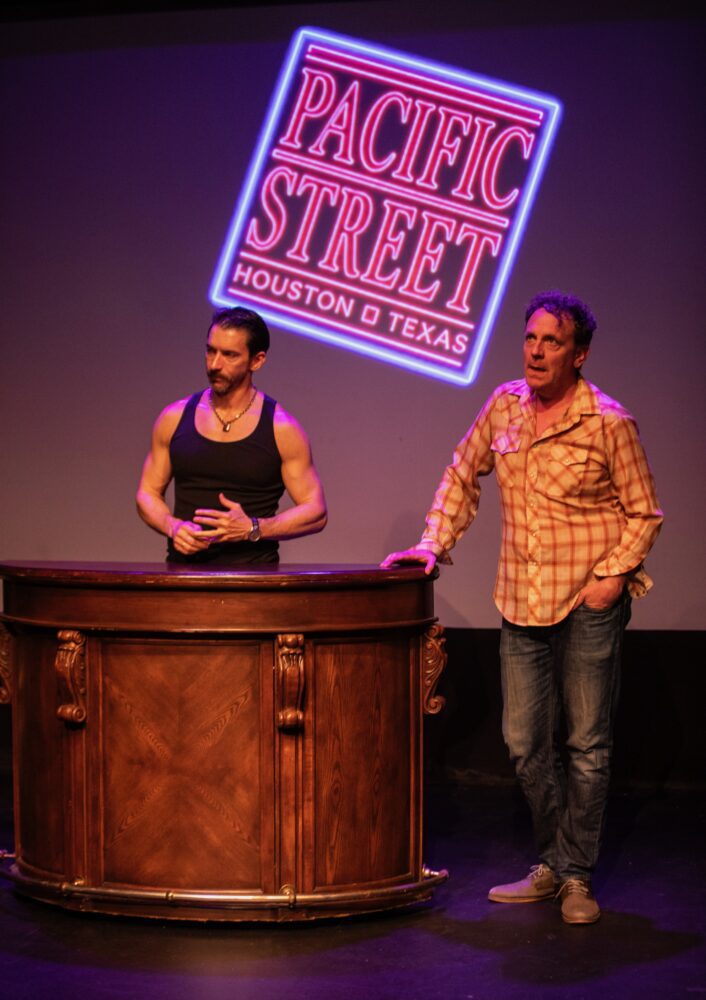
As Lane Lewis, the Houston bartender and LGBTQ+ activist who recognizes the potential importance of the arrests, Matt McConkey provides the connective tissue that holds the story together. He keeps the case moving and the defendants in check through years of legal obstacles, personal setbacks, and procedural complications.
Taking a case to the United States Supreme Court requires enormous patience and perseverance. Keeping the process moving is even more difficult when the individuals at its center are struggling with addiction, trauma, and unpredictable personal circumstances.
McConkey captures the determination and frustration of an activist who understands the struggle’s historical significance yet remains painfully aware of the fragile human beings on whom its success depends. His Lane Lewis serves as an emotional anchor, continually working to keep an increasingly complex enterprise from collapsing under its own weight.
Although the entire ensemble deserves recognition, Celeste Pechous is especially impressive in a series of sharply contrasting roles. As Jackie Rosenthal, a Lambda Legal team member, she embodies the intelligence, compassion, and determination required to advance a groundbreaking civil rights case. Later in the play, she also moves just as convincingly into the role of an angry, conservative family member who reflects the period’s deeply entrenched prejudices.
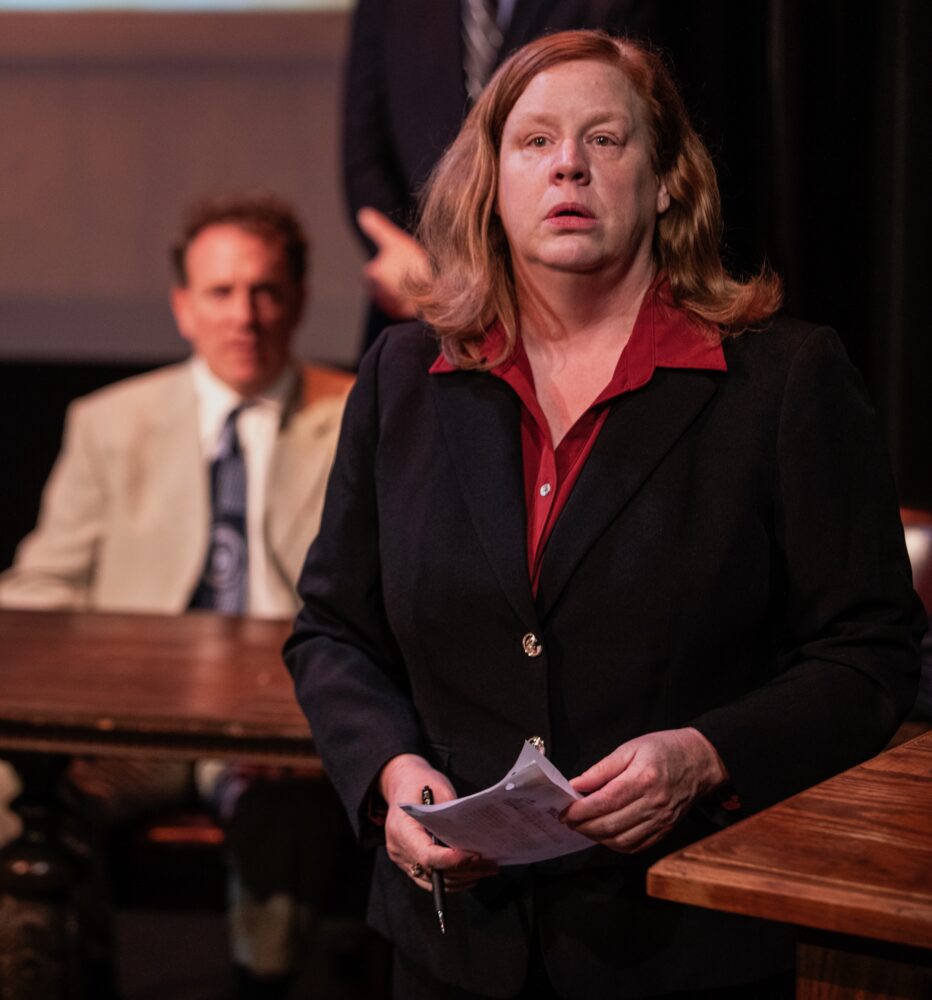
The emotional distance between these characters is enormous, yet Pechous navigates the transitions with exceptional skill. Rather than presenting simplistic heroes and villains, she finds recognizable humanity in characters representing dramatically different perspectives.
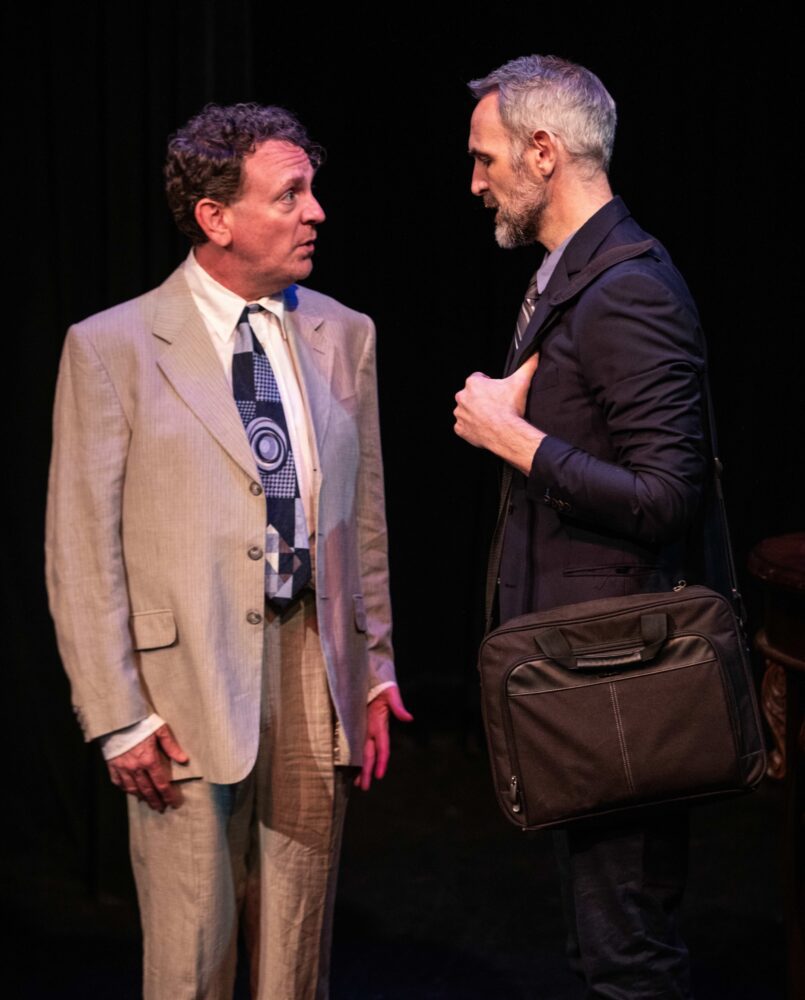
The supporting ensemble, including Dylan Vox, Tom Trudgeon, and Aaron Tone, contributes to the production’s remarkable continuity as the narrative moves among Houston’s gay community, private confrontations, legal offices, and the nation’s highest court. Tone’s portrayal of Supreme Court attorney Paul M. Smith underscores the rigorous constitutional reasoning and dedicated advocacy that led to the eventual victory.
Another effective element is the deceptively simple scenic design by Charlie Harris and Dusti Cunningham. When discussing the production, Skora explained that budgetary constraints shaped certain staging decisions, including using the same physical structure to represent both a gay bar and the courtroom bar separating participants.
However, this practical compromise becomes one of the production’s most significant symbols. The courtroom symbolizes the struggle for constitutional recognition, while the neighborhood gay bar offers something no less essential: refuge, belonging, and temporary relief from daily discrimination.
As Skora emphasized, both kinds of bars played essential roles in the case’s eventual success. The gay bars offered community and safety to men living under constant social pressure, while the legal bar represented the institutional system they ultimately had to confront to secure their freedom.
As he told the Hollywood Times, “One bar offered the possibility of justice, while the other provided the sanctuary needed to survive long enough to pursue it.”
The production’s defining message is captured in its promotional tagline: #KNOWYOURHISTORY.
Understanding civil rights history means recognizing that progress does not happen automatically. People now regard certain rights as fundamental, but they were secured through years of sacrifice, legal uncertainty, personal suffering, and extraordinary persistence.
Nor did polished public figures necessarily achieve those victories by meeting society’s expectations of heroism. Sometimes history advances because flawed, traumatized, deeply human people find themselves in circumstances that demand more of them than they ever imagined they could give.
With Texas Sodomy, Howard Skora has created something genuinely special: a politically significant work of theater that succeeds first and foremost as compelling human drama. The production never loses sight of the individuals behind the constitutional arguments, nor does it allow its historical weight to overshadow its humor and humanity.
At a time when hard-won civil rights remain the subject of national debate, this production celebrates historical progress while reminding us that such progress should never be taken for granted.
The law may have changed in 2003, but the human struggle that made that change possible deserves remembrance.
Texas Sodomy: The Incredible True Story of Lawrence v. Texas continues at the Whitefire Theatre, 13500 Ventura Boulevard, Sherman Oaks, through October 24, 2026, with final performances on Friday, October 23, and Saturday, October 24, at 8 p.m.
Information moving forward: TexasSodomy.com


