Opening on Saturday, October 17 at the Los Angeles Theatre Centre on Spring Street in downtown L.A. – Luis Alfaro’s new play Speaking in Tongues. Luis Alfaro continues the MacArthur Foundation “Genius Grant” recipient’s funny, poignant exploration of life in the small, predominantly Mexican-American agricultural towns of California’s San Joaquin Valley. The setting is a Pentecostal church on the edge of a cornfield in Earlimart, a California town off Highway 99 in Tulare County. Hermana Romie (Evagellina Fernández), Hermana Cubby (Lucy Rodríguez), Hermano Mando (Sal López) and Hermano Tico (Geoffrey Rivas) share chisme, food, and their devotion to the Apostolic faith. A Chicano playwright born and raised in L.A., Alfaro is the son of farmworkers from the San Joaquin Valley and drew on his experiences of growing up there to write this play.
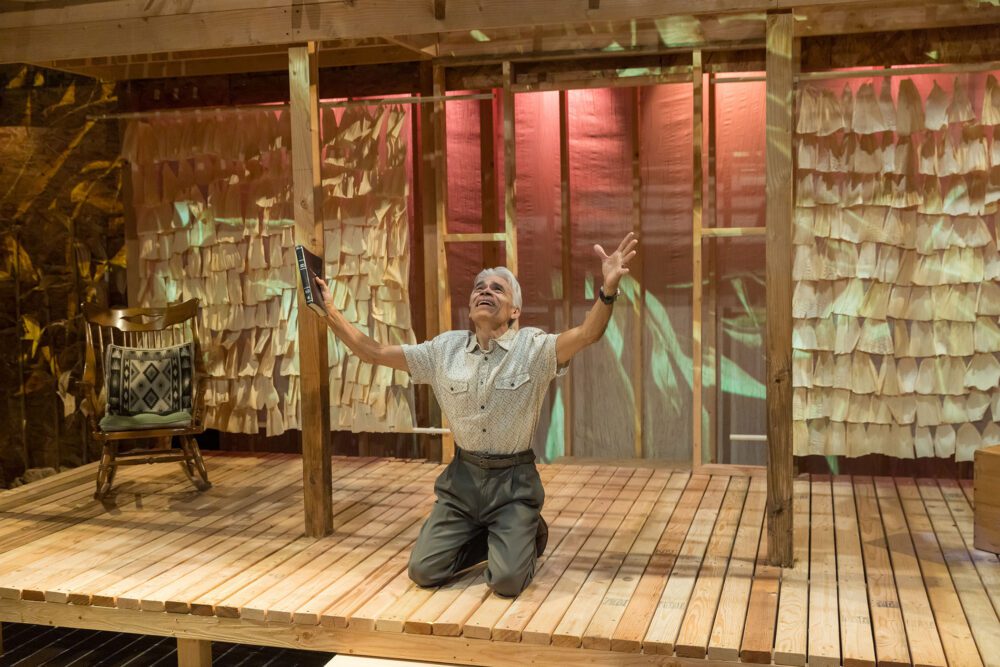
Speaking in Tongues is part of a body of geographically inspired plays by Alfaro that explore the nature of identity, community, labor, immigration and the relationship of these people originally from Mexico to the land on which they have lived for close to a century. Central California’s Pentecostal history grew directly out of the 1906 Azusa Street Revival in Los Angeles, spreading rapidly through the Central Valley and establishing deep roots across both Trinitarian and Oneness denominations. The message of Spirit baptism, divine healing, and speaking in tongues radiated up through the state, drawing rural and urban communities alike into the new movement.
As Central California transitioned into a massive agricultural powerhouse through the 1930s–1960s, Pentecostal churches became vital cultural and spiritual anchors for migrant and resident farmworkers. During the Dust Bowl migration of the 1930s, displaced white agrarian workers brought expressive, holiness-rooted Pentecostal traditions into towns like Bakersfield, Fresno, and Modesto. In subsequent decades, vibrant Spanish-language and multi-ethnic Pentecostal congregations grew rapidly alongside Hispanic agricultural communities. For laborers working grueling hours in Central Valley fields, the Pentecostal church provided an emotional and communal sanctuary, transforming daily toil into a spiritual narrative where the agricultural fields were viewed as personal mission fields.
Services in Pentecostal churches feature high-energy worship, raised hands, emotional prayer, spontaneous singing, and corporate participation rather than rigid liturgical programs.Central tenets include baptism in the Holy Spirit, physical healing, prophecy, and “glossolalia” (speaking in tongues) as the initial physical sign of Spirit baptism. In its wilder practices, it included emergence of supposed “afflicted” or “possessed” individuals in a pit of snakes.
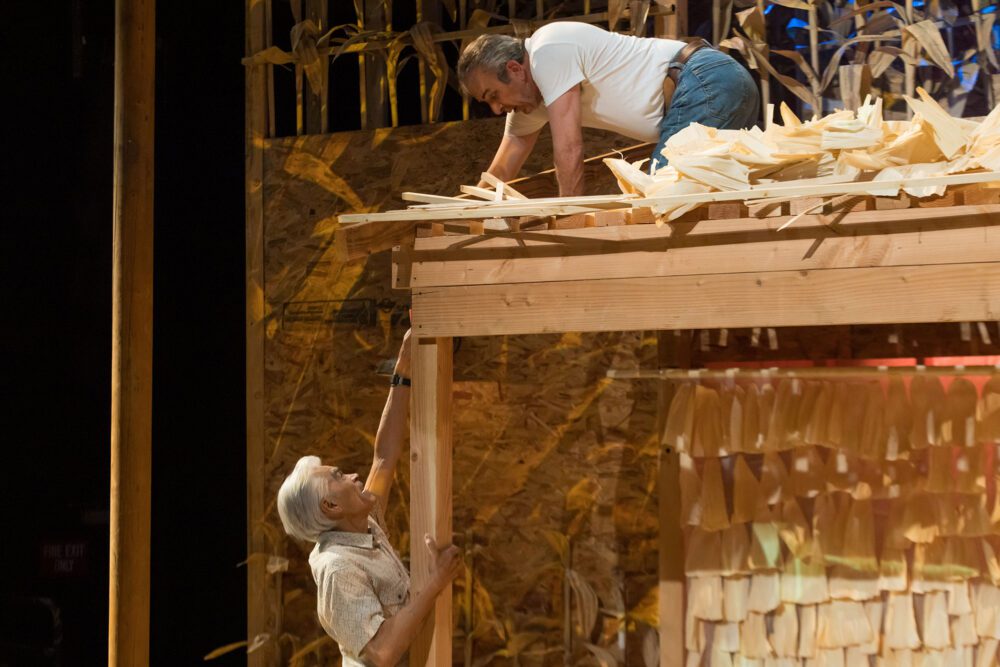
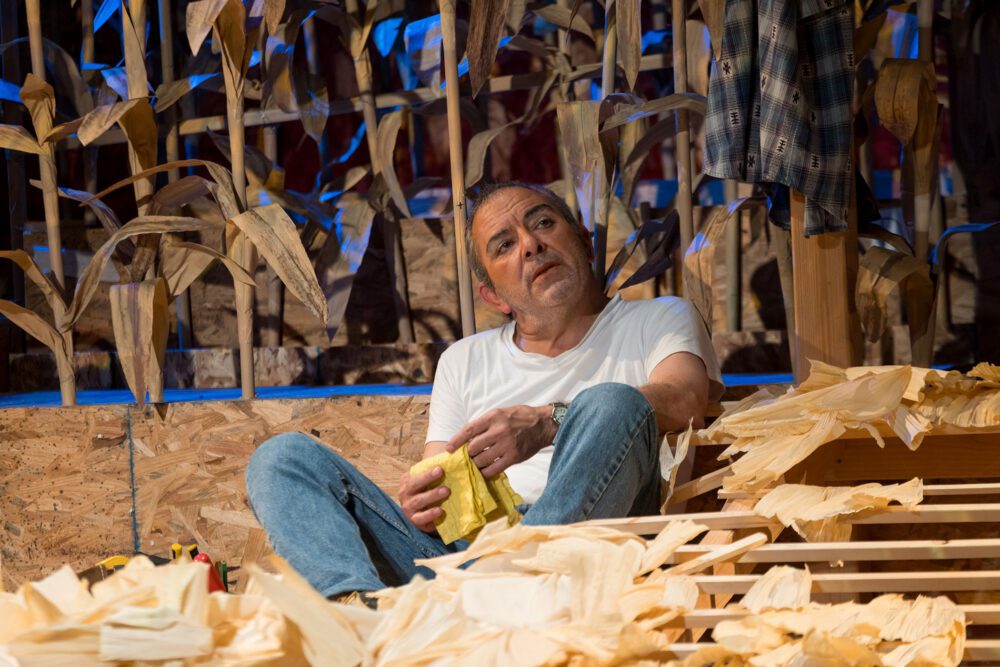
Alfaro’s play takes a different approach to the Pentecostal view of things in this small group of Mexican-American residents of the town of Earlimart in the Central Valley of California. In the first act, he sets the stage with Hermano Mando (Sal López) setting up a table and chair and looking for Hermano Tico (Geoffrey Rivas) who had been sleeping up on the roof of the house where he had been working on the roof tiles the previous day. On the upper level of the stage, a woman named Hermana Romie, looking disheveled, is wandering around the corn fields and muttering while a mysterious angelic voice (that of Esperanza América) sings a hymn in English. We soon learn from Hermano Mando that Romie is the wife of the Pentecostal preacher who disappeared 8 weeks before.
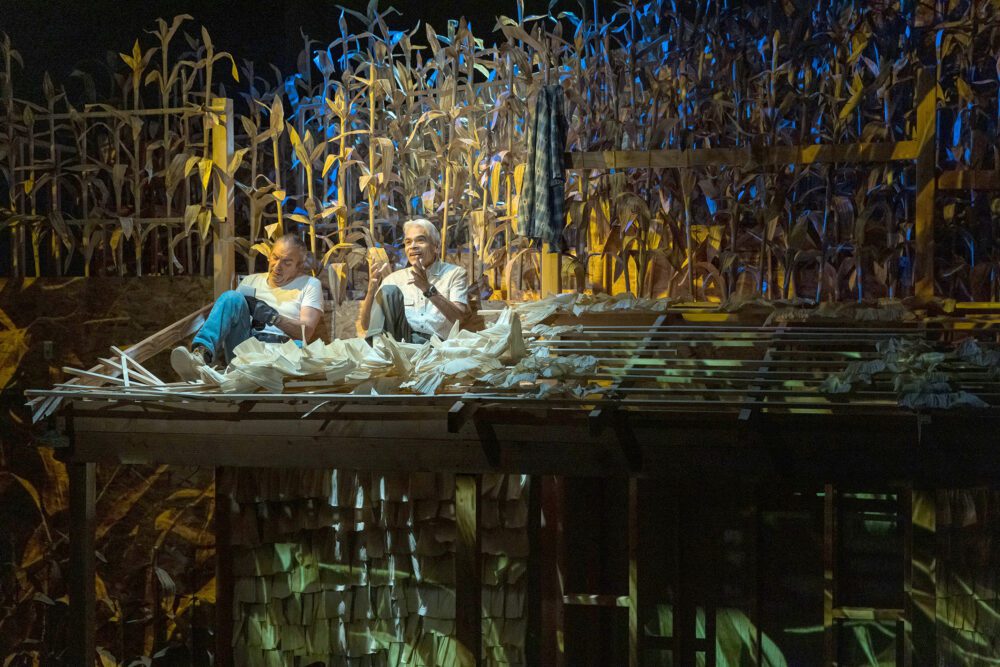
With much comic repartee, the two men talk about ordinary stuff but politely parsed with “Praise the Lord” and “Amen” to every sentence uttered. Hermano Mando complains about making potato salad for any upcoming community dinner but Hermano Tico reminds him it is his wife’s signature recipe. The two discuss things that have been doing and wondering how much, if anything, constitutes a sin. Tico mentions Tiktok, but rather violent image on it; Mando prefers watching 48 Hours”where investigators try to solve crimes. His penchant for “true crime” stories leads him to believe that the missing husband of Hermana Romie may have been murdered and by none other than Romie herself.
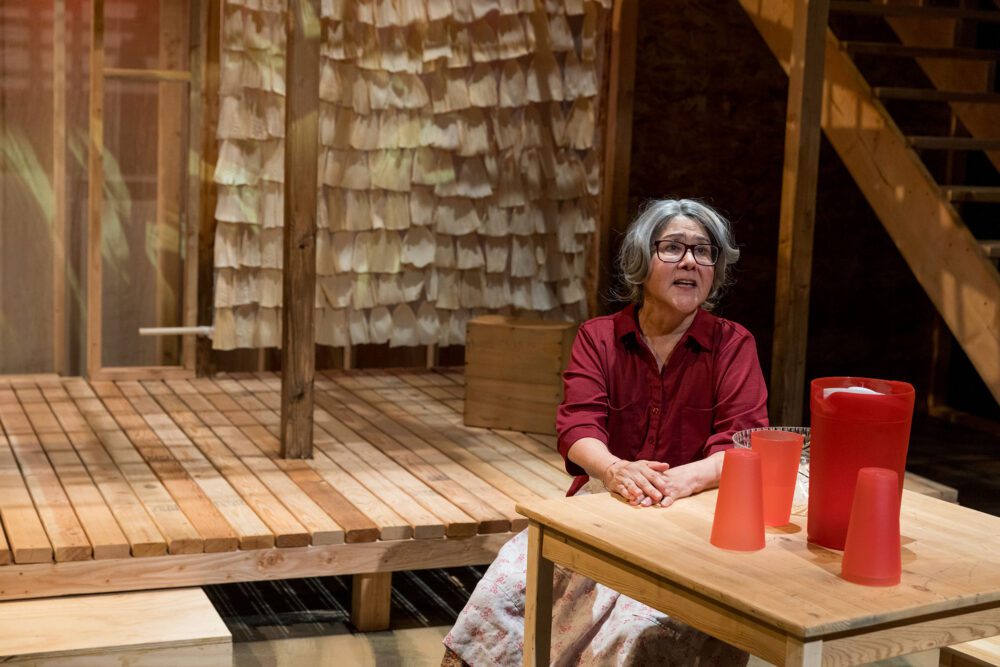
Eventually, Mando reveals that he is filing divorce papers against his wife, but Tico reminds him that divorce is not permitted in the Pentecostal faith. Mando is worried that he was supposed to provide chicken wings and not just potato salad. At this moment enters from the house Hermana Cubby (Lucy Rodríguez) who with her sharp tongue and defiant personality sets the two men straight about what is important for the upcoming dinner. She goes into a long-winded diatribe about tamales and how, in the old days, the women used make 800 or a thousand for an event.
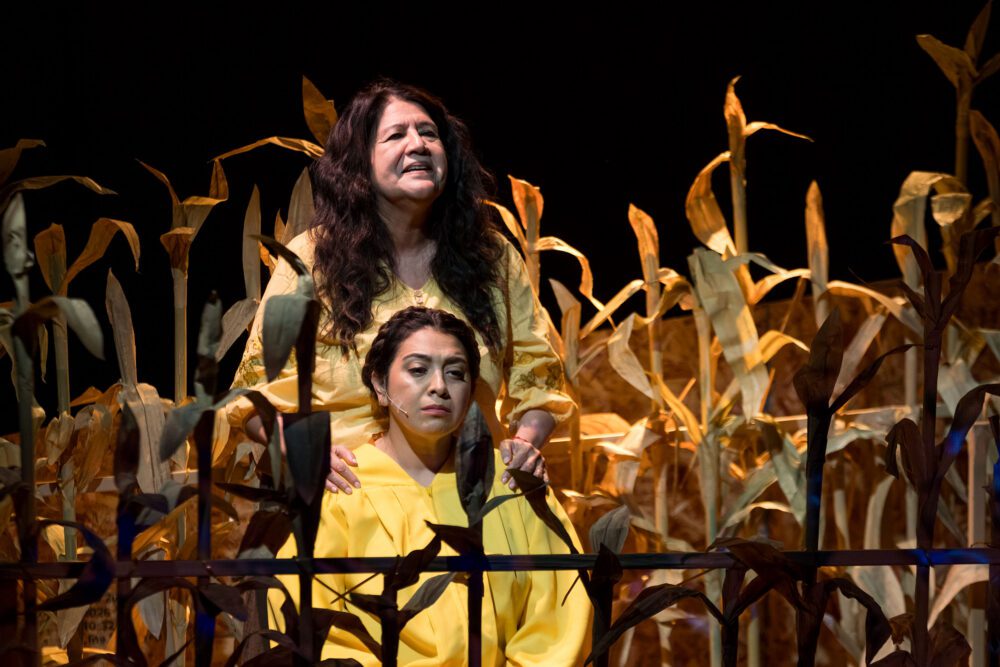
The scene comes to life with her arrival and the men try to dance verbally around her strong presence. When Hermana Romie comes back down from the cornfields, she offers her own take on the situation, but confuses the others with her talk about needing a new church in the fields. She has no idea where her husband the pastor has gone. In a way, Romie seems like a mad woman, but eventually we come to understand that she knows much more than the others.
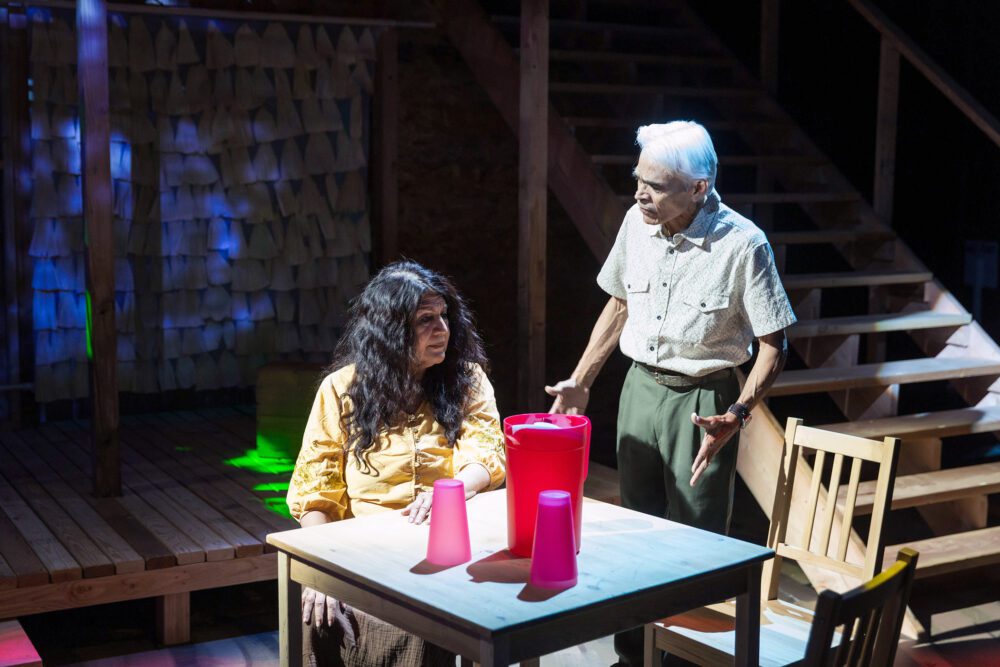
Since food gets mixed with religious belief, the entire first half of the play is quite funny. We even learn that Mando’s biggest sin was to buy a red Ford Mustang and then give it to his always nagging wife. We get a sense that these Central Valley Mexican Americans have lived in this town for most of their lives, having been born in Earlimart and never left. They feel obligated to carry on the traditions of their own elders who are approaching 90. They are themselves retired from working in the fields and seem to have accumulated enough money to buy the latest appliances for their homes as well as cars and the ability to send their own children to college. Of course, the world of their own children is not the same because their children see the limitation of life in small-town Central Valley communities drenched in Pentecostal religious practices that seem outdated and isolated.
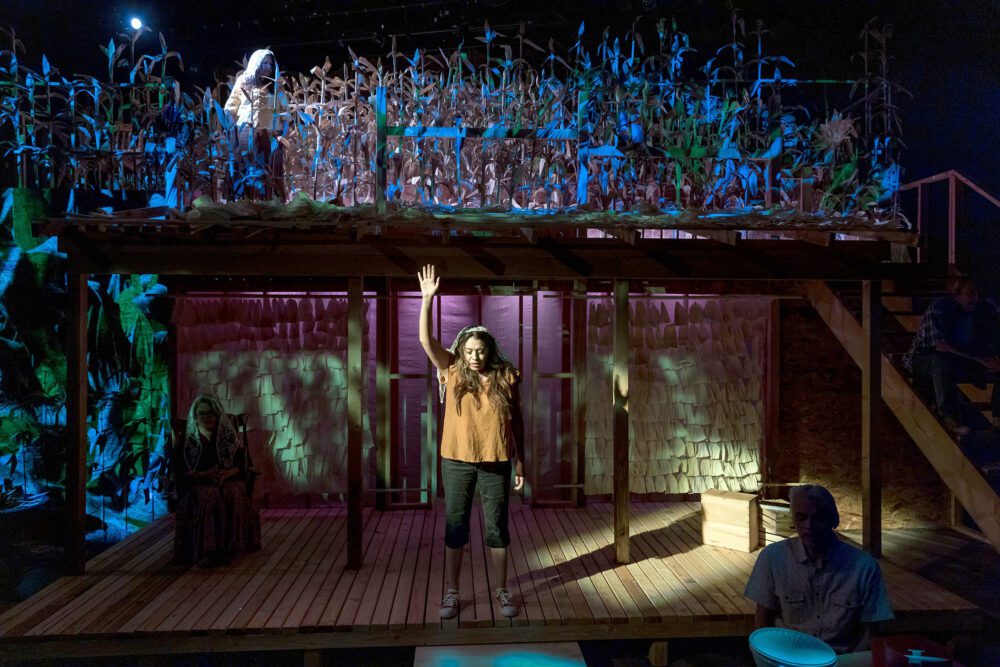
There are moments when the Spirit seems to enter the play and that is in frozen time experienced by Hermana Romie, when the action suddenly stops and she is bathed in a red glow of light. Whether or not one shares in any Pentecostal beliefs, we get a sense that Romie has a special gift – that will be explained later. What I prefer to see as the second act of this 90-minute play is the emergence of Romie as a spiritual force that coincides with the arrival of Romie’s daughter Hermana Tiri (Esperanze América) at the Sunday dinner. Tiri no longer lives in Earlilmart but moved to Porterville and hopes to go to Los Angeles. She represents the younger generation who no longer believe in the Pentecostal religion but is practical, modern, and also brings the missing chicken wings which she refers to as “protein.” The traditions of the community do not seem all that important or useful to Tiri, and she makes her viewpoint clear.
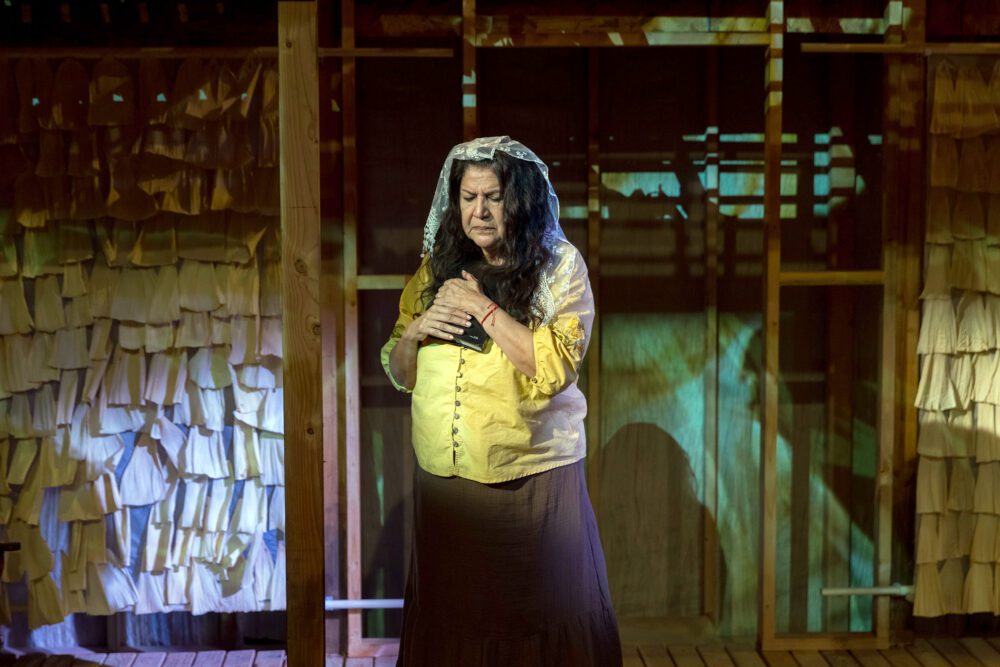
Romie goes on about needing a new church, while the other wonder who among the younger generation will maintain the local church that has lost its pastor. This builds to a crescendo when Romie lets out all the pent-up frustration she has been feeling for years and explains that it is she has been the sermon writer for the parish and has kept up the illusion that men are properly equipped to run a church where the women are the regular churchgoers and purveyors of the community traditions. In subtle ways, Mando and Rico acknowledge that the women are the real backbone of the community. Lucy seems to already know that and her youthful independence is a reflection of that knowledge. Hermana Romie explains that the new church is needed that is not just a building, but rather a sentiment in the heart that joins believers together. It is at this point, the concept of faith moves in mysterious ways to the ending of the play.

Alfaro’s play is both a loving testament to the traditions of the Mexican American community of farm workers in the Central Valley but also a critique of the soul-crushing aspects of Pentecostal religious beliefs in that community. There is resilience in the communal bonds that even young Tiri feels that. She joins in the religious singing at the end because that is her tradition too, although she knows she cannot stay in it. This play, infused with Alfaro’s trademark Chicano humor, returns us to the world of California’s Central Valley migrant farmworkers and their spiritual quests in a societal landscape transforming faster than anyone can keep up.
Under the excellent direction of Jose Luis Valenzuela, the superb cast makes Speaking in Tongues”reveal the heart and soul of a community in the Central Valley which is fast disappearing. The weave of Bible citations and everyday life makes for great comedy but the need for sustaining faith remains behind the crazy antics of the characters. The strength of the women overshadows the limitations of patriarchal traditions, as the missing male pastor proves to be a sign of the times. Alfaro, who is also a professor at USC, has written a number of plays including The Travelers, which was produced by the Latino Theater Company in 2023. In this new insightful play, Alfaro has shown us a group of individuals and their lives that might change our perspective of what Central Valley California is really like.
Performances of “Speaking in Tongues” is on stage at the Los Angeles Theatre Center from October 17 through November 15, on Thursdays, Fridays, and Saturday at 8 pm, and on Sundays at 2 pm. The Los Angeles Theatre Center is located at 514 S. Spring Street in Los Angeles. Ticket prices at $10 to $48; students, seniors, and veterans and LAUSD teacher $24 with a valid ID. For tickets, call (213) 489-0994 or go to: latinotheaterco.org.