With surprise guests, costumed fans, and seismic trap beats, the underground artist transformed a packed theater into a world entirely his own.
By Griffin Topolski
Los Angeles, CA (The Hollywood Times) 8-24-2026
By the time Slayr took the stage at the Belasco Theatre on August 6, the crowd was already chanting his name.
The venue was packed, visibly animated, and primed for the show. A few audience members had even arrived in costume, while the stage was built around Slayr’s familiar visual language: strobes, smoke bursts, looping graphics, and a large, stylized eye suspended on the left.
Opener Egobreak stepped into a room already eager to move. He paced the stage, pushed the audience to get louder, and opened the pits well before the headliner appeared. By the time he left, the Belasco was considerably hotter, and its crowd even more energized.
Then Slayer’s world took over. Before he appeared, Gaia—the central character on the cover of his 2025 release, Half Blood—starred in a playful safety video. The instructions were simple: Don’t throw things. Help people in the crowd. Have fun. And sing every word you can.
Slayr emerged with enormous energy, yelling, screaming, and hurling himself into the room’s atmosphere. His performance favored momentum and interaction. He constantly fed off the audience, then sent its energy surging back.
His more melodic songs translated particularly well. “Holding” became one of the night’s strongest moments, with the crowd singing so loudly that the song seemed to expand beyond the recording. “Toxic” hit with similar force, while the candy-sweet melodies of “Love Blur” sounded especially striking amid the smoke, strobes, and anthemic production.
The transitions between songs were just as important. Slayr’s music often features long, theatrical buildups, which have become a defining feature of the live set. Low, metallic guitars, screeching leads, and acoustic drum sounds built anticipation before abruptly collapsing into trap beats. Instead of simply moving from one track to the next, each song arrived with its own fanfare. The crowd had time to recognize what was coming—and then explode when the beat finally dropped.
About halfway through the set, Slayr hinted that he had “something special” planned. The surprise was Lucy Bedroque, an artist whose growing presence in the underground had already endeared them to much of the audience. Bedroque felt less like an unexpected guest and more like someone many fans had been hoping to see. They joined Slayr for “Daytona,” drawing one of the night’s strongest reactions.
Another familiar face followed: Tiffany Day, whose digicore- and hyperpop-influenced sound sits comfortably beside the more melodic side of Slayr’s music. She first performed her own song, “START OVER,” before Slayr joined her for their collaboration, “CONSTANTLY.” The day was especially strong live. Her bright, Auto-Tuned vocals offered a welcome change in texture while remaining entirely at home within the show. Engaged with the audience throughout, she made the two-song appearance feel like a complete moment rather than a quick guest spot.
Together, the appearances created a genuine peak. Both guests were clearly familiar to the audience, and the crowd’s response made the collaborations feel like a natural extension of the world Slayr had built.
One of the biggest moments came later with “Sloppy Joe,” Slayr’s most popular song and one of the clearest expressions of his sound. After another extended, atmospheric buildup, the beat hit and the Belasco erupted. Nearly everyone seemed to know every word, and the production sounded enormous in the theater. Afterward, Slayr stopped the show and invited several costumed audience members onstage. He arranged them along the front edge and performed “Brain Fog” behind them.
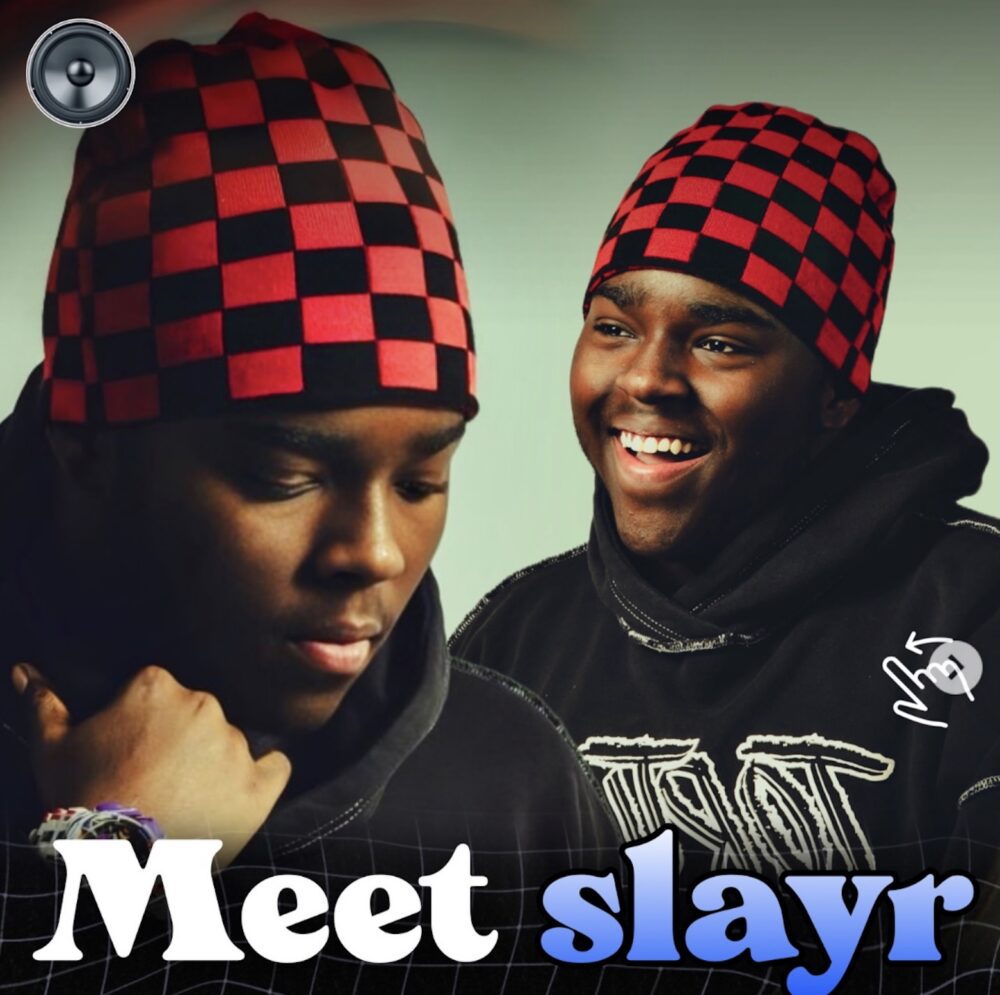
It became one of the night’s most revealing images. Onstage stood SpongeBob, Spider-Man, Mario and Luigi, Monkey D. Luffy, and the Cat in the Hat—a collection of characters with little obvious connection. Yet the assortment made perfect sense within Slayr’s aesthetic, where anime, cartoons, metal, video games, and underground rap occupy the same space, free of older restrictions that once separated subcultures. The audience did not find the combination strange. They understood it instinctively.
Even Slayr’s name invites a question. It carries an obvious association with one of metal’s most recognizable bands, yet he belongs to a very different generation and scene. The connection feels less like imitation than a reflection of how contemporary artists freely blend once-separate influences.
After the final stretch, Slayr left the stage, seemingly bringing the show to a close. The crowd had other plans. Fans immediately began chanting for one more song, eventually stomping in rhythm with each demand. He returned for a second performance of “Sloppy Joe.” Somehow, the reaction was even bigger the second time.
What mattered most at the Belasco was the environment Slayr created: theatrical, chaotic, participatory, and completely in sync with the audience. The songs provided the foundation, but the buildups, imagery, surprise guests, costumes, and sheer enthusiasm transformed them into something larger. The collision of influences surrounding his music was not merely decorative.
By the end of the night, it was the force holding the entire experience together.