

By Robert St. Martin
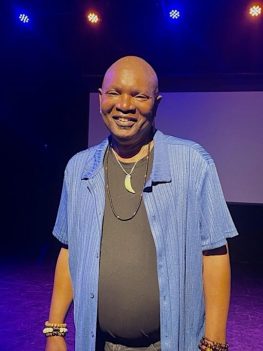 Hollywood, CA (The Hollywood Times) 6/12/23 – Sunday night at the Broadwater Main Stage Theatre off Santa Monica Boulevard in Hollywood was the first of several production of Levy Lee Simon’s one-man theater piece, Odyssey: Race and Racism. As part of the 2023 Hollywood Fringe Festival, Simon’s play is one of over 40 shows being presented in the month of June in small theatrical venues in Hollywood. A critically lauded L.A.-based playwright, Levy Lee Simon takes the stage as the actor in this one-man show performing the script which he wrote with an episodic structure that moves between straight narrative and spoken-word performance. The 75-minute-long is chunked out into 9 parts, beginning with memoirs from his childhood in Harlem and visits to his grandparents in small-town South Carolina. The stories about the encounters with his grandparents and his own mother’s stories about them are infused with a wide-eyed child’s view of the segregated American South in the 1950s where white racist attitudes shaped the experience of all black folks. The story about his well-off always impeccably dressed Grandfather Moot and the power and influence he had as one of the few Black men who actually owned his own acreage (and not a sharecropper) and made a small fortune in bootlegged liquor during the Prohibition is a gem.
 Growing up in an all-black neighborhood in Harlem, young Levy knew little about white people except when his mother occasionally took him downtown into Manhattan to Macy’s. His mother worked and his early school-age experiences with racism were those of an insensitive white substitute teacher Mrs. Eastern in the fourth grade and of the New York City police who used excessive force on black people and viewed all black people through white racist lenses. By the time he was 12, he experienced the first of several incidents of young black men being shot to death on suspicion of some minor infraction by white policemen in New York. This practice, of course, in the early 1960s, in still prevalent today – as we know from recent cases, including ….
In his autobiographical narrative, Simon mentioned his attending an all-black college and graduating. In his early 20s, Simon tried interviewing for a job and ended up in Lower Manhattan applying at an employment firm named Blaine Stevens. It turns out that the owner Blaine Stevens offered him a job to work for the firm and he worked there for a while. At Blaine Stevens, he experienced a different aspect of racism and it had to do with coded language used to determine what kind of employment was best suited to people of color. This was a more subtle force of racial discrimination and eventually he saw through it and realized that the world of work was dominated by white people who sometimes pretended to be non-racist but did not know engrained in them was racist thinking and attitudes.
Then follows an episodic account of a black detective named Sif, who harbors a deep fear and of young black men and seem to be on a mission of revenge. This story is told from the point of view of Sif, who stalks the neighborhood with a gun in his pocket waiting for a chance incident that would make for gunning down some young black men. But Sif happens upon a situation that makes him connect to some poor black people in a different way and discover the common humanity of us all.
Afterwards, we journey into the night with an episodic about a black police unit in another city (I think it was San Francisco) that encounters some seemingly suspicious young black men and ends up with the same racial blindness of “men in blue” as white officers. They end up shooting to death a young black men point blank on the street and seem to feel that it is just another day’s work. I found this piece a little harder to follow but it served as a rejoinder to one of the dominant themes of Levy Lee Simon’s “Odyssey” – that of the continuing racist attitudes of law-enforcement through the United States. We are asked to recall all the recent deaths of black people gunned down by police across this country. With the police arrest and shooting of Rodney King in the 1990s in Los Angeles, there followed major urban riots. Why is there almost nothing said or done now about the never-ending list of police killings where the officers are seldom, if ever, held accountable.
Levy Lee Simon closes his performance with spoken-word set pieced that he had written a few years ago and performed elsewhere – entitled “I Am.” This well-written historical piece reflects about America’s Original Sin of racism related to the experience of African slavery in this country. But it segues to a celebration of Black Excellence – with an impressive gathering together of the name of so many Black people who have contributed to American culture. In syncopated poetic delivery, Simon names Black people from music, theatre, sports, literature, religion, political movements and the biggest leaders of the Black communities across America. Simon asks us to consider why after having our first black president with Barack Obama, racism continues to rear its ugly head in our society. The long list grows until he ends up on the very end with his own place in that enormous tapestry – saying “I am a Black Men. See me, hear me, touch me, taste me. I am a Black man. I am.”
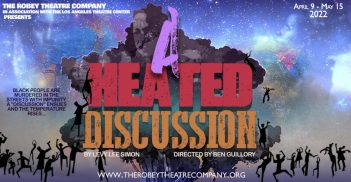 Levy Lee Simon has written some 20 plays. His previous works for the stage include The Magnificent Dunbar Hotel (L.A. Times Critic’s Choice), For the Love of Freedom: The Haitian Trilogy (L.A. Times Critic’s Choice), The Bow Wow Club (Lorraine Hansberry Award), The Guest at Central Park West (Audelo Award), Gentrified: Metaphor of the Drums, A Heated Discussion (staged last year the L.A. Theater Center), and its follow-up A Heated Discussion – Revisited. His film The Last Revolutionary can be seen at Amazon Prime. A Harlem native, Levy Lee Simon received his MFA at the University of Iowa Playwrights Workshop.
Juliette Jeffers directs the play. She is a prominent Caribbean-American director, writer, and actor. She penned Batman and Robin in the Boogie Down (Drama Desk nomination). She is a recurring guest star on The Residency, a Shondaland series headed for Netflix. She has also been in Tulsa King, Lone Star, and Organized Crime.
This opening performance of Odyssey: Race and Racism at the Broadway was well-attended and well-received. There will be two more performances: Saturday, June 17, at 6:00 pm; Sunday, June 18, at 2:00 pm. Tickets are $20. To purchase a ticket to this show or any of the many other plays at this 2023 Hollywood Fringe Festival, go to: http://hollywoodfringer.or/projects/9824.


