By Valerie Milano
Los Angeles, CA (The Hollywood Times / Aspiring Magazine) 7/2/26 –
As America inches toward its 250th birthday, Netflix’s The American Experiment arrives at exactly the right time, which is to say, a time when many of us are looking around and wondering whether the Founding Fathers would be impressed, horrified, or asking for a very strong cocktail.
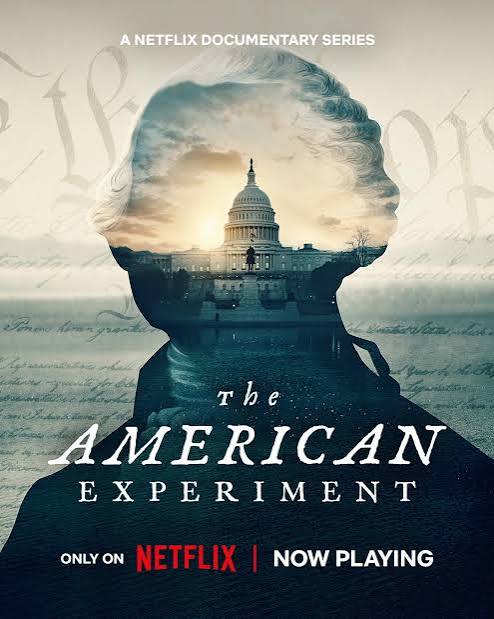
Now streaming on Netflix, The American Experiment is a five-part documentary series from Luminant Media and Tom Hanks and Gary Goetzman’s Playtone, directed by Brian Knappenberger. The series, released June 24, takes on one of the biggest questions in American history: can a people truly govern themselves?

I had the pleasure of speaking with Knappenberger by Zoom for The Hollywood Times and Aspiring Magazine, and our conversation quickly made clear that this is not a dusty textbook version of America’s founding. This is a thoughtful, wide-ranging look at the ideals, contradictions, failures, arguments, and stubborn hopes that have defined this country from the beginning.
“As America approaches its 250th anniversary,” I asked him, “what felt urgent to you about revisiting the founding of the country right now?”
 Knappenberger said the milestone itself demanded reflection. “We’re at a pretty remarkable moment,” he told me, pointing back to the 250-year anniversary of the signing of the Declaration of Independence and the document’s extraordinary opening ideals. He described the founding as the beginning of “a 250-year experiment in self-governance” and said the central question remains whether people can be governed by “reflection and choice rather than by accident and force,” echoing Alexander Hamilton’s famous framing.
That question may sound like something from a civics class, but in Knappenberger’s hands, it feels urgent, emotional, and very much alive. He explained that many of the country’s “basic founding principles seem to be challenged in all sorts of new ways,” making this anniversary a moment to ask how those principles are holding up now.
I then asked him whether the series’ huge question, can a people govern themselves? – felt different to him when he finished the project than when he began it.
“Yes, in a way I didn’t anticipate,” he said.

Knappenberger acknowledged that America is in a deeply divided moment, with basic ideas about power and democracy being tested by politics, technology, social media, and even artificial intelligence. But he also found that studying history made him more hopeful, not less. “There’s something about history that makes you understand that we’ve been through difficult times before,” he said. Looking at moments when American values were challenged, and seeing that the country found ways to get through them, left him “a little bit more optimistic” than when he started.
That is one of the strengths of The American Experiment. It does not ask viewers to choose between loving America and telling the truth about America. Instead, it argues that honest history is not unpatriotic. In fact, it may be the only kind of patriotism worth having.

Knappenberger pushed back against the idea that examining the hardest parts of American history makes people appreciate the country less. “I disagree,” he told me. “I don’t think it could be farther from the truth.” In his view, looking at history honestly often leaves people with more optimism, because it reveals how difficult the struggle has always been, and how much work has gone into keeping the experiment alive.
Executive produced by Knappenberger, Sarah Huisenga, Tom Hanks, and Gary Goetzman, the series brings cinematic scope to a story that still shapes our daily lives. Goetzman has said he and Hanks appreciated Knappenberger’s work and welcomed the chance to collaborate with him on a series exploring the Constitution at such a pivotal moment in the country’s history.

The series gathers an impressive and intentionally broad range of voices, including Al Gore, Mike Pence, Hillary Clinton, Ted Cruz, Kamala Harris, Stephen Breyer, Nancy Pelosi, historians, legal scholars, tribal leaders, military experts, civic thinkers, and others. The participant list includes figures from across public life and scholarship, including Lonnie G. Bunch III, Ron Chernow, Jill Lepore, Joanne Freeman, H.R. McMaster, Jamie Raskin, Rand Paul, Jeffrey Rosen, Danielle Allen, Chuck Hoskin Jr., and many more.

When I asked how difficult it was to create a conversation that felt wide-ranging but still cohesive, Knappenberger said that bipartisanship was part of the mission from the beginning.
“One way of looking at it,” he said, “is what if we had a constitutional convention today? What kind of voices would be there? Whose voices should be there?”
That framing gives the series much of its power. Rather than simply lining up a Republican and a Democrat for balance, The American Experiment imagines a broader civic room: historians, elected officials, legal thinkers, tribal leaders, military voices, and citizens wrestling with the same founding question from different directions.
The documentary also addresses the founding story’s deepest contradictions. I asked Knappenberger how he balanced reverence for the founding documents with honesty about failures built into the system, especially slavery, liberty, power, and representation.

“Because there were failures and contradictions from the very beginning,” he said. “If there’s anything powerful and resilient about our system, it’s that it can change.” He added that the country set “lofty ideals” that it has spent centuries trying to live up to.
The contradiction could not be starker. As Knappenberger noted in our interview, when Thomas Jefferson wrote the words “all men are created equal,” Robert Hemmings, who was enslaved by Jefferson, was in the room with him. For Knappenberger, that contradiction is not something to blink at or smooth over. It is central to understanding America.
“The challenge and the experiment of America,” he said, “is to live up to some of those highest ideals.”
 The documentary also finds a beautiful and creative way to deal with a practical filmmaking problem: there is no archival footage from the founding era. No one was exactly live streaming from Independence Hall. So Knappenberger and his team relied on written words, letters, diaries, speeches, documents, and brought them to life through voice casting.
I especially wanted to ask him about that, because my friend Christine Cavalieri, Founder of Real2Reel Casting, worked on casting these “ordinary extraordinary” voices, people with backgrounds in service, education, civic life, philanthropy, and history, rather than only traditional voice-over actors.
 Knappenberger explained that so much of the founding story survives through writing: letters, diaries, formal documents, and fragments of people’s lives. “We are created by words on paper,” he said. “We’re the only country ever that was like that in the history of the world up until that point.” America, he explained, was not formed around one religion, creed, or ethnicity, but around written ideals.
While Martin Sheen voices George Washington, many of the founding-era words are read by what Knappenberger called “ordinary extraordinary Americans”: people who may not be household names, but who represent service, citizenship, education, philanthropy, public life, and civic commitment.

@ShakaSenghor
appears in the new docuseries “The American Experiment,” streaming on #Netflix
The voice cast includes Paralympic medalist Blake Leeper, United Nations spokesperson Stéphane Dujarric, former U.S. Capitol Police Sergeant Aquilino Gonell, labor and civil rights icon Dolores Huerta, former NASA astronaut Cady Coleman, 2025 National Teacher of the Year Ashlie Crosson, and a new generation of civic leaders, educators, veterans, students, and public servants from programs including YMCA Youth & Government, We the People, Boys Nation, and the American Legion Oratorical Contest.
Knappenberger said putting the words of the founding “in the voices of ordinary Americans” added a sense of citizenry to the series. He wanted the voice performances to remind viewers that democracy is not only the story of famous leaders. It is also the story of everyday people who keep believing in the system and participating in it.
 “Our system is still pretty fragile,” he told me. “There are some guardrails, and there’s some rules, and there’s a Constitution, and it’s all mapped out. But it really works because we believe in it. If we stop believing in it, then none of this matters.”
The series is especially strong when it shows how fragile this whole experiment has always been. Knappenberger talked about how nearly everything in the founding era could have gone differently. The Revolution, the Constitution, the early republic — none of it was guaranteed. The American story was not a clean march toward greatness. It was a series of close calls, competing motives, high ideals, selfish interests, and people trying to build something that had never been built before.
That fragility feels very familiar right now.
 One of the most fascinating parts of our conversation centered on the bipartisan thread that runs through the series. I asked whether there was a moment when he realized that very different political figures were circling the same founding fears or ideals.
Knappenberger pointed to Mike Pence’s reflection on January 6 as one of the most powerful examples. Pence, facing his constitutional duty to certify the 2020 electoral vote, recalled being moved by Al Gore’s actions in 2000, when Gore certified the election results that ended his own presidential hopes.
“He was sort of powerfully remembering Al Gore,” Knappenberger said of Pence. “To have Mike Pence say he’s powerfully moved by this figure on the other side of the political spectrum, and that that was an inspiration to him, it says a lot about what’s actually probably most important here.”

In a time when political division can feel like a national sport with terrible uniforms, that moment stands out as a reminder that constitutional duty can still rise above party loyalty.
Knappenberger also connects the founding generation’s fears to our current moment. George Washington, in his farewell address, warned against “extreme factionalism,” the founders’ version of what we now call partisanship. Washington worried that division could tear the union apart. Watching The American Experiment, one gets the sense that Washington’s warning has not exactly expired. If anything, it may need to be printed on a coffee mug and handed out in Congress.
 As a filmmaker, Knappenberger said this project challenged him in both practical and emotional ways. Practically, he had to find ways to visualize a period with no footage. More deeply, he had to cut through the “competing partisan bickering” and heated rhetoric of the moment to ask what the original intention of the country was, and what is still worth saving.
“So much power,” he noted, has moved into the executive branch and away from Congress, where people have more control. That concern runs through the series without turning it into a lecture. Instead, The American Experiment asks viewers to consider what made the country work in the first place and what might still be repaired.
Finally, I asked Knappenberger whether, after spending so much time inside the founding era and its echoes today, he was more worried about the American experiment or more hopeful.
 “I’m worried about it,” he said plainly. “I’m definitely worried about it. But I understand that that’s actually a good thing.”
For Knappenberger, worry is a sign of care. It means people still believe there is something worth preserving and something broken that can be fixed. That may be one of the most unexpectedly hopeful ideas in the series: concern itself can be patriotic.
Near the end of our conversation, he made one of the most memorable observations of the interview. He contrasted America’s national anthem with those of other countries. England’s anthem asks God to save the king. France’s anthem celebrates national greatness. America’s anthem, Knappenberger noted, is about barely making it through one night.
“That’s who we are,” he said. “We are constantly saving ourselves.”

That may be the perfect description of the American experiment. We are not a country with a simple story. We are a country that keeps surviving the night, then waking up and arguing about what the morning should look like.
The American Experiment is a timely, intelligent, and emotionally resonant series that asks viewers to look backward not to escape the present, but to understand it. It challenges us to see history not as something frozen in a textbook, but as something still breathing, still fighting, and yes, still arguing with us.
As I told Knappenberger, he helps us look at history not as something frozen in a textbook, but as something still very much alive, and apparently still arguing with us.
And perhaps that is the point. America has always been unfinished. The question is whether we still have the courage, honesty, and civic imagination to keep working on it.
 The American Experiment is now streaming on Netflix.
The American Experiment Trailer- 250 Anniversary – Netflix Tudum