Older gay men are rarely given such visibility in the movies. A moving and upbeat exception is Maspalomas, a Spanish queer drama film directed by Aitor Arregi and José Marí Goenaga. Maspalomas was featured in the weekend’s array of new LGBTQ films at Outfest Next on Sunday, July 26, at the Renberg Theatre of the LGBT Community Center in Hollywood. The film opens as a real dazzler in the gay enclave of Maspalomas on the island of Gran Canaria, Spain. The directors dive in deep, with sex scenes, full frontal nudity, a popular nude beach and main character profiles. The result is a refreshing and thought-provoking film that addresses the question: Do gay men have a problem with getting old?

That is an interesting question. So often gay men in their 40s and 50s say, “I’m past it.” In truth, you are never “past it” unless you convince yourself that is the case. However, it is also true that we live in a world where youth and beauty reign supreme, and many gay men fear that older age will push them back into the closet that they fought to escape. It is also true that gay men don’t help themselves or each other in perpetuating those fears.

Vicente, played by the Spanish actor José Ramón Soroiz, is in his 70s, and for the first half of his life, he was confined to a closet. Like many in his generation, he hid his sexuality and married, and when he came out, his relationship with his wife and young daughter ended, as did his life in San Sebastian. Vicente married again, but this time it was to a younger man named Esteban, and for many years, he was happy as they lived the ultimate gay life in the party capital of Maspalomas. Vicente is now a 76-year-old man who, at 50, who abandoned his wife and family to live openly as a Gay man. For 25 years, he built a life of freedom and joy in the sunny paradise of Maspalomas, Gran Canaria.
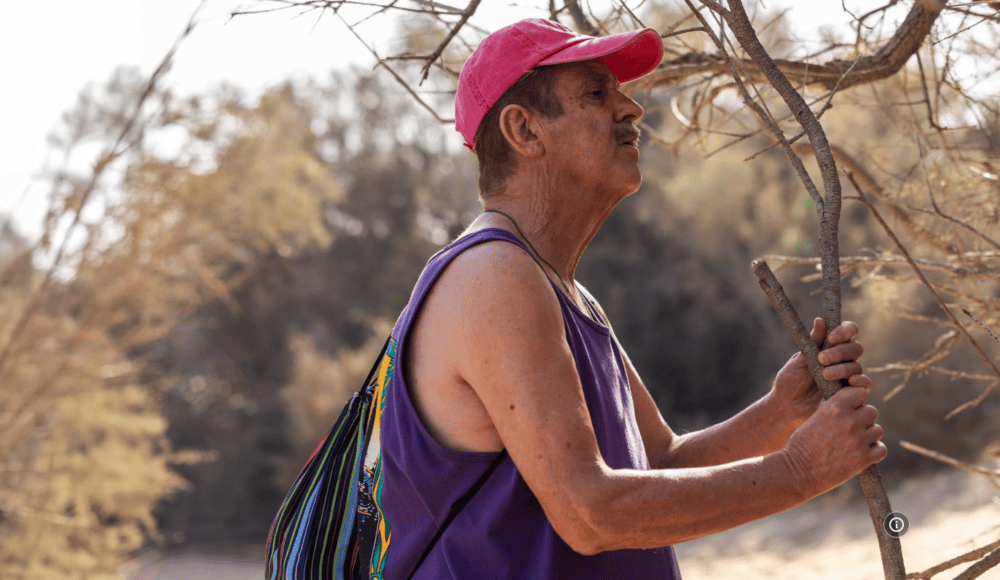
However, his marriage to Esteban is now over, Vicente is thrust back into the lively hedonist gay scene while living on Gran Canaria. Vicente has no intention of holding back in his search for fun and possibly more, encouraged by his closest friend Ramón (Zorion Eguileor), also in his seventies. We first see Vicente wandering through the brush of the famous sand dunes peering at younger gay men having sex and then he finds himself approached by a good-looking younger man – providing some proof that he “still has it.” Later he wanders back down to the gay nude beach at Maspalomas, where there is plenty of frontal nudity but it all part of the perks of being in Maspalomas.

Vicente finds his friend Ramón and they head back into the main part of town to Ramón’s apartment which is conveniently situated along the parade route of the raucous annual Gay Pride Parade. Ramón wants Vicente to stay on in his apartment as friend and that seems heartfelt.

By day he hangs out on the beach and cruises in the dunes, and at night parties in the infamous Yumbo Centre making the most of its sex positivity. We see Vicente, in a happy partying mood wander through the gay bars and into the dark sex rooms which are a feature of some bars. Then suddenly he suffers a stroke and everything changes.

Unable to afford private rehabilitation and unwilling to look after him at home, his estranged daughter Nerea (Nagore Aranburu) arranges for him to move into a state-run care home back in San Sebastian in the Basque county of northern Spain. They haven’t spoken for twenty-five years since Vicente came out as gay at age fifty and began a relationship with Esteban, his wealthy ex, leaving his family adrift.
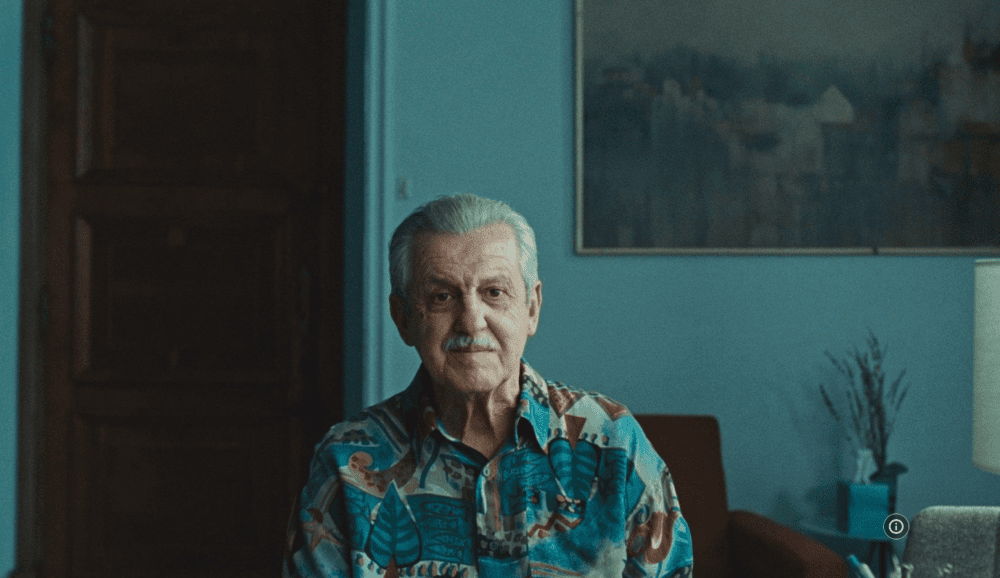
Vicente enters the care home a shadow of his former self. Dishevelled, in a wheelchair and partly paralyzed from the stroke, he is unable to do many of the simplest tasks for himself. He loses his mojo and retreats back into the closet. His room-mate in the nursing home is Xanti (Kandido Uranga) – who seems to be the opposite, bright, energetic and seemingly without any health issues. He’s pretty macho and right-wing though and this reinforces Vicente’s commitment to keep his sexuality a secret.

Vicente was assigned an attractive, chatty male caregiver named Iñaki (Kepa Errasti) but he begins to panic when he sees that Iñaki is on Grindr and has his own active sex life beyond nursing. So, Vicente asks to change to a female caregiver instead. Life in the care home is not much fun and he has to do daily physical therapy to try to recover his motor skills. The nursing home, with its rigid routines and conservative atmosphere, stands in stark contrast to the vibrant freedom Vicente once enjoyed in Maspalomas. Stripped of his independence and surrounded by unfamiliar faces, he begins to withdraw, ultimately making the decision to hide his sexuality. He cuts off his old friend Ramón in Maspalomas and deletes all his messages. Being in this nursing home puts Vicente literally back in the closet takes him back to the first fifty years of his life. Things are not looking good for Vicente. How will he navigate his life?

As Vicente’s road to recovery begins, the man he initially thought would be his nemesis, Xanti (his roommate), becomes his closest friend, aiding his recovery with his indomitable spirit. Yet Vicente remains firmly in the closet, much to the confusion of his daughter Nerea, who is slowly getting to know her father again. The film doesn’t shy away from the complexities of Vicente’s past. Through his strained relationship with Nerea, we witness the emotional fallout of his decision to leave his family. Her perspective adds a powerful layer to the story as the plot delves into themes of regret, forgiveness, and the lasting impact of choices made decades earlier. It’s a raw, honest portrayal of how one person’s pursuit of authenticity can ripple through the lives of those around them.

As Vicente slowly becomes ambulatory, he ventures outside the nursing home with his new friend Xanti and even goes to see a movie in a local theatre. He begins to think about attractive men again. In town, he sees a young boy with a dog that seems identical to the dog he had while living in Gran Canaria – and that chance encounter with Nerea’s son who he has never met is a catalyst into greater connection to his lost family.

In one moving scene, Vicente goes into a gay bar in the afternoon and meets the owner at the virtually empty bar. He is confounded by the fact that there is no one there. The bar owner remembers Vicente from years past and explains that younger gay men seldom frequent bars the way they did 25 years beforehand. They hook up online and sadly the privileged gay spaces of gay bars no longer have the same vibe as in the past. This makes Vicente wonder why he should stay on in the nursing home much longer and perhaps return to Maspalomas, where the rules are different and he might reach out to his old friend Ramón again.

José Ramón Soroiz delivers a deeply moving performance as Vicente, capturing his vulnerability and quiet strength with incredible nuance. His portrayal earned him the Goya Award for Best Actor, Spain’s equivalent of the Academy Award. Soroiz beautifully captures the inner turmoil, sadness, and uncertainty of Vicente’s sudden and jarring loss of independence as he steps back into the San Sebastian closet from which he escaped years before. Vicente’s relationship with Xanti takes center stage, as an unlikely bond of support and platonic love emerges between both men, one that ultimately saves Vicente and aids his emergence from the cocoon to which he has confined himself. Like Todd Stephens’ 2021 film Swan Song (starring Udo Kier), Maspalomas is a delight as it explores older gay life and the challenges of maintaining one’s identity and soul when faced with a sudden change that renders one vulnerable.