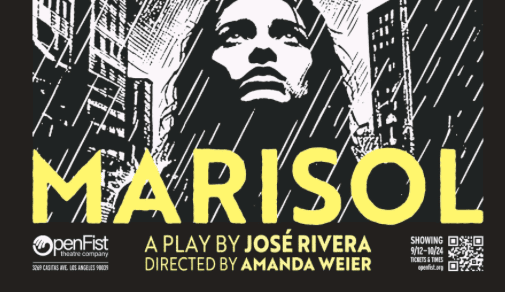
Marisol is an Obie Award-winning play by Puerto Rican playwright José Rivera that was first staged in the 1990s and seems as relevant today in its new production by the Open Fist Theatre company at the Atwater Village Theatres in Los Angeles. Marisol is a surrealist play that has been staged by many different theatre groups over the years. Marisol’s story is that of a young Puerto Rican woman navigating her very existence in a violent, crumbling dystopian New York City on the end of the new millennium.
This new production by the Open Fist Theatre Company directed by Amanda Weier takes place in a 1990s New York where homelessness and street violence abound, especially in the Bronx. But this situation is the backdrop for darkly funny, apocalyptic fable about survival, faith, and hope. There is intense physical action and vibrant sardonic dialogue. Given its absurdist premise, it turns out that Brooklyn is not much better as a refuge for the frightening times that Marisol experiences.
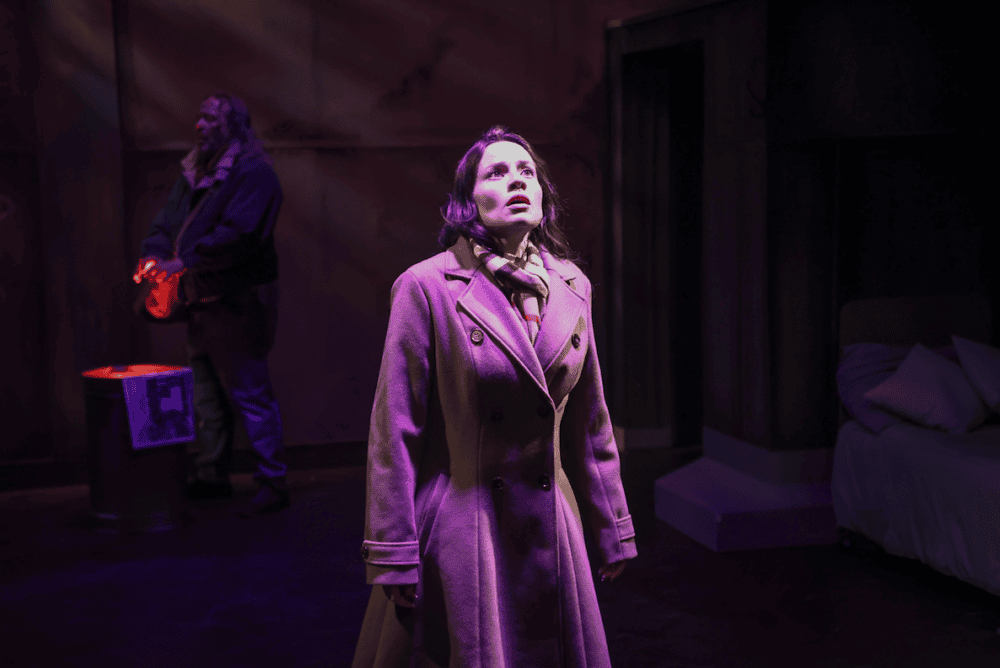
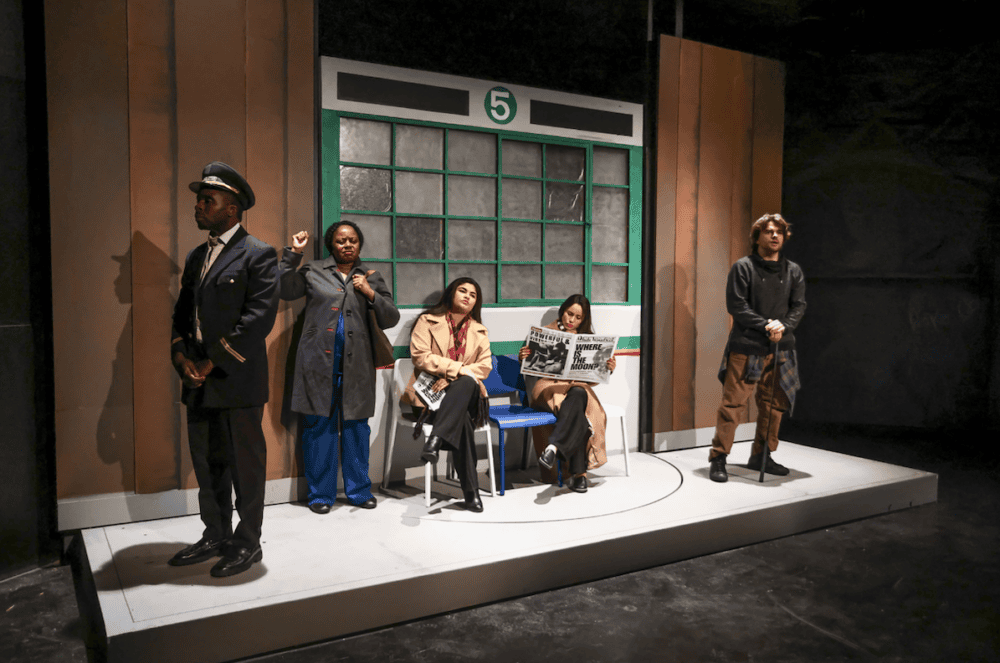
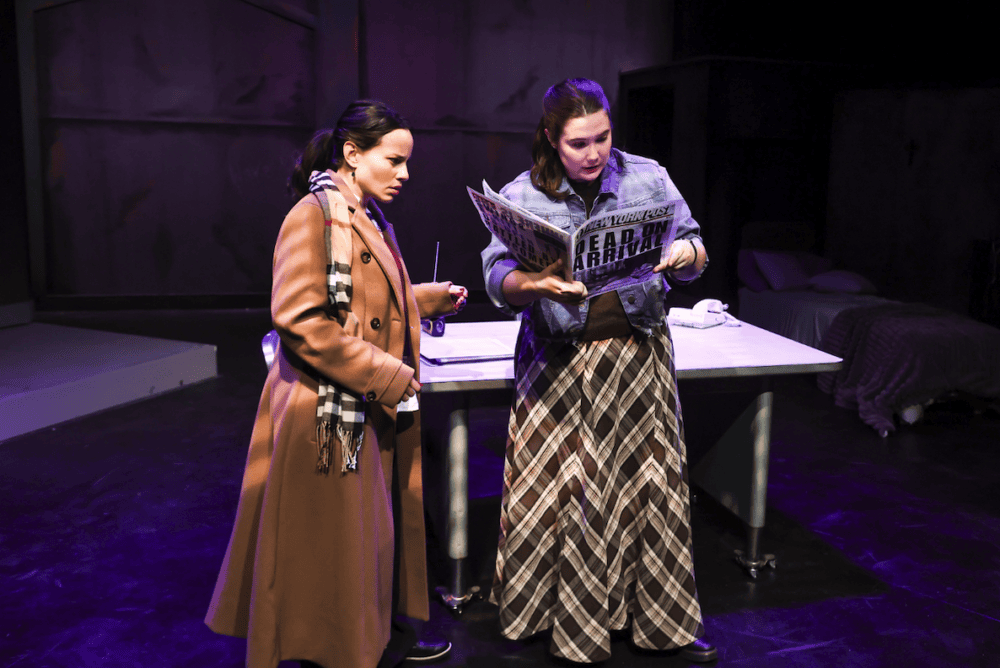
Rivera’s short play has two acts – the first being Marisol Pérez’s subway ride from her job as a copy editor in Manhattan back to her run-down apartment in the Bronx. On the subway, we see Marisol (played by Jade Santana) reading a newspaper with a huge headline about the moon having disappeared from the night sky. At a subway stop, a crazy man (Matthew Goodrich) wielding a golf club boards the train and confronts her in a violent attack. Somehow, she seems to get off in time to return, completely frazzled, to her one-room apartment in an obviously crowded and noisy building where a woman is shouting loudly much of the night at her son or brother. Marisol, being a good Catholic, says her prayers before sleeping. But she finds it almost impossible to sleep amidst the din.
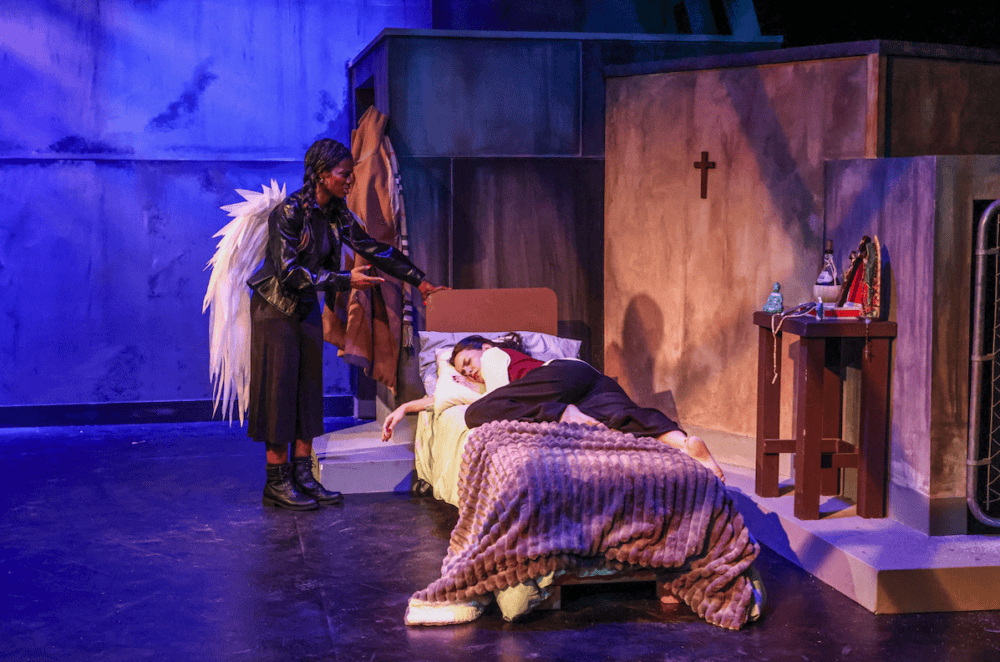
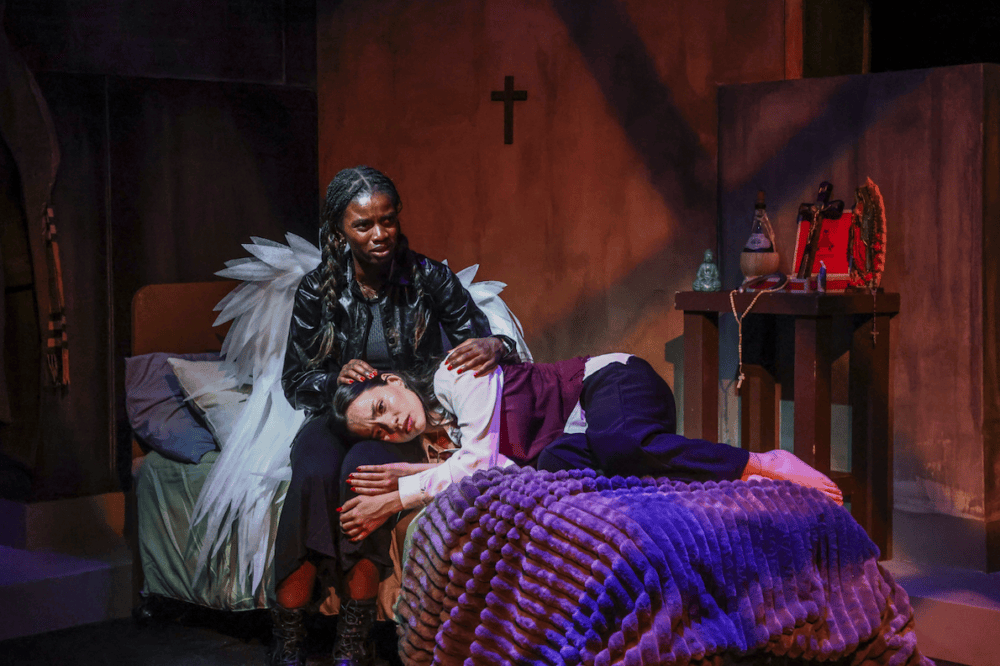
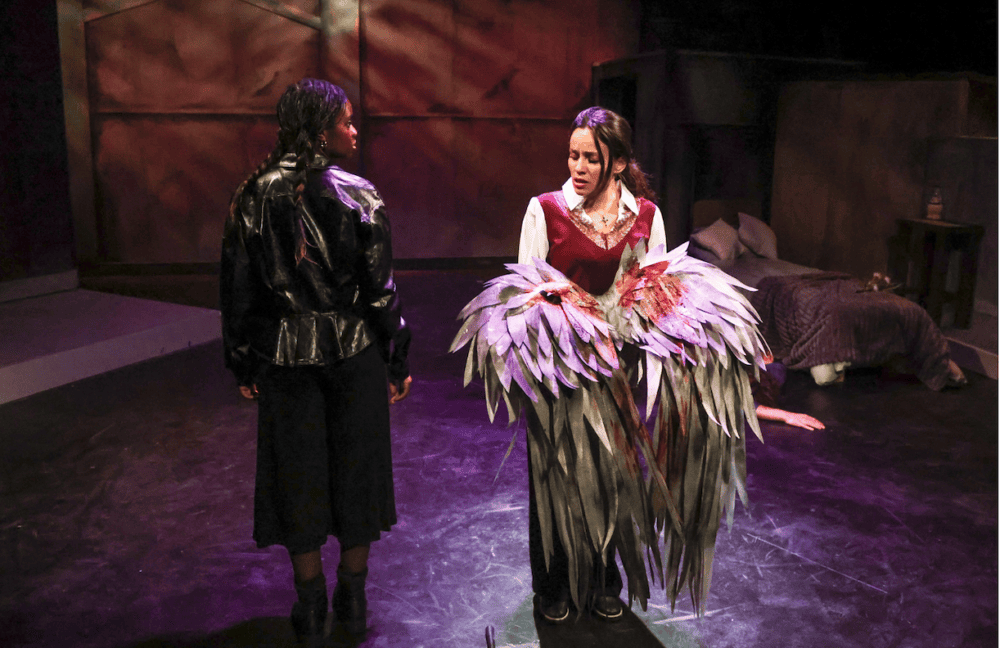
Mysteriously she finds herself awakened by her guardian angel (Taylor Scott). Marisol is not sure if what she sees is real or a dream. The guardian angel explains that she has intervened in many human crises in New York, including the near-death of Marisol on the streetcar as well as many other interventions to save people from violent ends. But New York City has been a dystopian disaster where no place is safe from marauding, violent psychopaths. The guardian angel provides an element of magical realism to the absurd premise of Marisol’s story. The guardian angel announces that she is abandoning Marisol to join the celestial battle against a senile God who is dying and “taking the rest of the universe with him.” The war in heaven spills over into New York City, reducing it to a smoldering urban wasteland where giant fires send noxious smoke to darken the skies. The moon has not been seen in months. Food has been turned to salt and water is had to come by. Marisol Pérez will be left to deal with an unraveling world on her own.
“Marisol feels astonishingly relevant,” says director Amanda Weier. “Though Rivera wrote the play in the pre-millennium ’90s, during that period of profound uncertainty, it asks questions that resonate just as powerfully today.” Because Rivera’s handling of the fable is also quite funny, he provides “a balance of absurdity and compassion.” The next morning, Marisol gets up and heads back to Manhattan to her job as a copy editor. Along the way she encounters a woman (Barbara Lee Bragg) beaten for exceeding her credit limit and a homeless burn victim (Hutchins Foster) in a wheelchair looking for his lost skin.
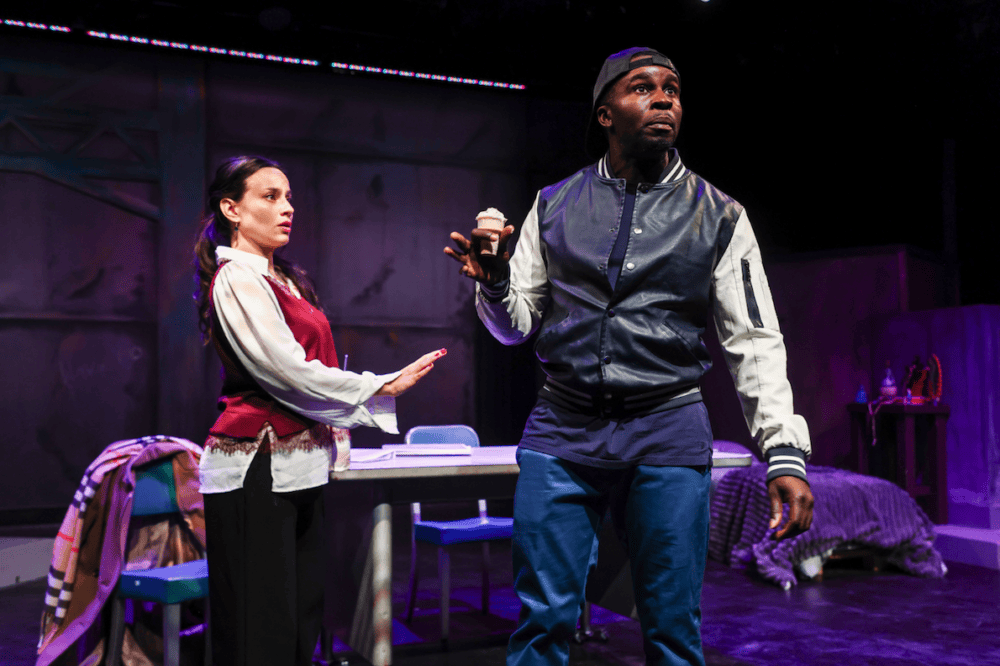
There bursts in the office a man (Chima Rok) with an ice cream cone. He demands back pay for his extra work on the movie Taxi Driver. He lunges toward her with the ice cream cone and chases her around the office until her work partner June (Grace Soens) arrives and intervenes, calling security. June is amazed to find that the Marisol Perez she knows is not the same woman described in the morning newspaper as bludgeoned to death by a golf club. Marisol attempts to explain about the guardian angel, but she, like June, is inclined to dismiss it as a dream.
This second act begins in Manhattan where June attempts to protect Marisol from what seems to be a new warzone. Marisol asks about the windowless building across the street where people are incarcerated for credit card debt and apparently burnt to death. There are many signs that an apocalypse is under way and one of these is the attire of her guardian angel which resembles a leather motorcycle jacket: The wings will be traded in for weapons. As the action in the streets below worsen, June suggests that the two of them head to June’s apartment in Brooklyn – in the belief that it might be safer. The masses of homeless and displaced people in the city seem to be joining the cause of the rebel angels in the larger war.
Once Marisol and June arrive at June’s Brooklyn apartment, June tries to make her feel comfortable. There is one caveat: June’s brother Lenny (Jack Sharpe) lives there too and we soon discover that he is a mental case who is unemployed and incapable of holding a real job. His personality has violent outbursts as well as uncontrolled libido. He considers himself an artist and offer Marisol a strange figurine that he has cobbled together. Then Lenny shows Marisol a manuscript of a book he has been writing that he asks her to read. He tries to use his “charm” to seduce Marisol but June threatens him and sends him back to his room. Eventually she decides to kick out altogether and we see him exit with a few belongings and, of all things, a golf bag filled with clubs.
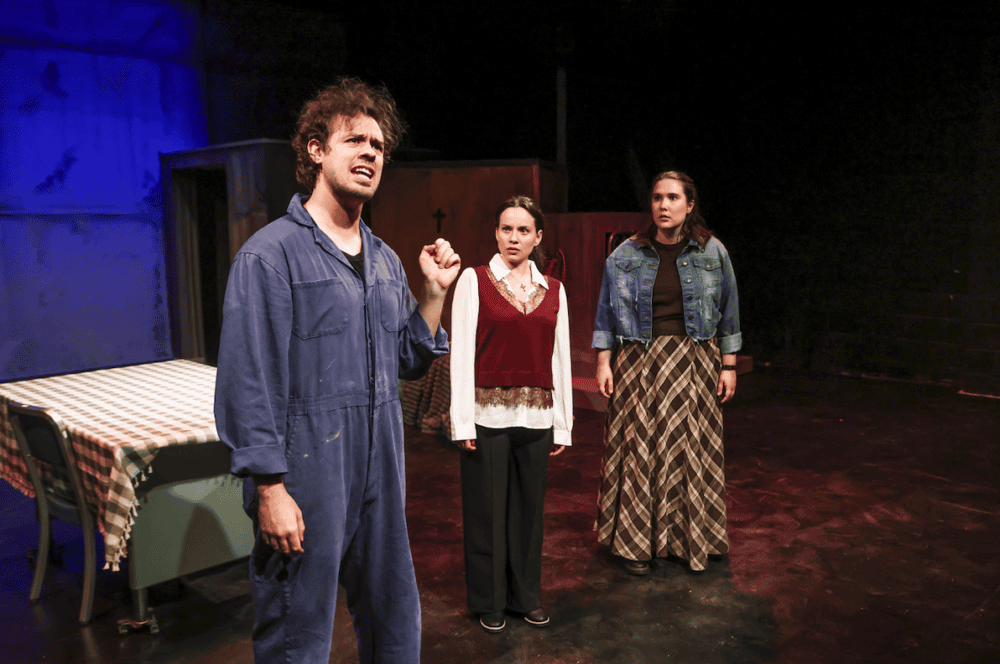
June is tired to taking care of dysfunctional Lenny like a child and offers his former room to Marisol. All this seems promising, but as Marisol leaves to return to the Bronx to pack up her belonging and move into June’s apartment, June is overwhelmed by guilt at disowning Lenny and goes off to try to find him in the beleaguered city. Rivera’s fable doubles back on itself in a way reminiscent of the stories of Gabriel Garcia Marquez. As soon as Marisol arrives back in her lonely apartment in the Bronx, she begins to pack up her treasured items – some being religious icons and a book.
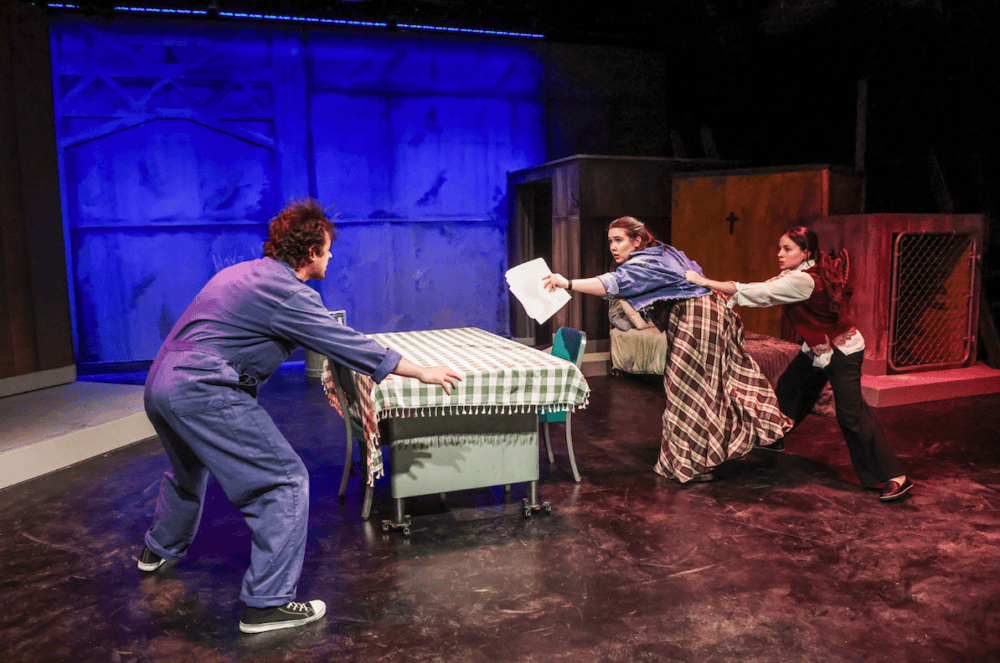
As she is ready to depart, suddenly Lenny, the unstable brother of June, shows up at her front door. He insists that he is there for her – posturing love with a bouquet of flowers and then reveals he has a golf club. As Marisol rejects his advances, he grows violent and threatens to strike her. When Marisol asks what happened to June, his response is frightening. At this point in the play, Marisol must act to save herself, as no guardian angel is there to “save” her again.
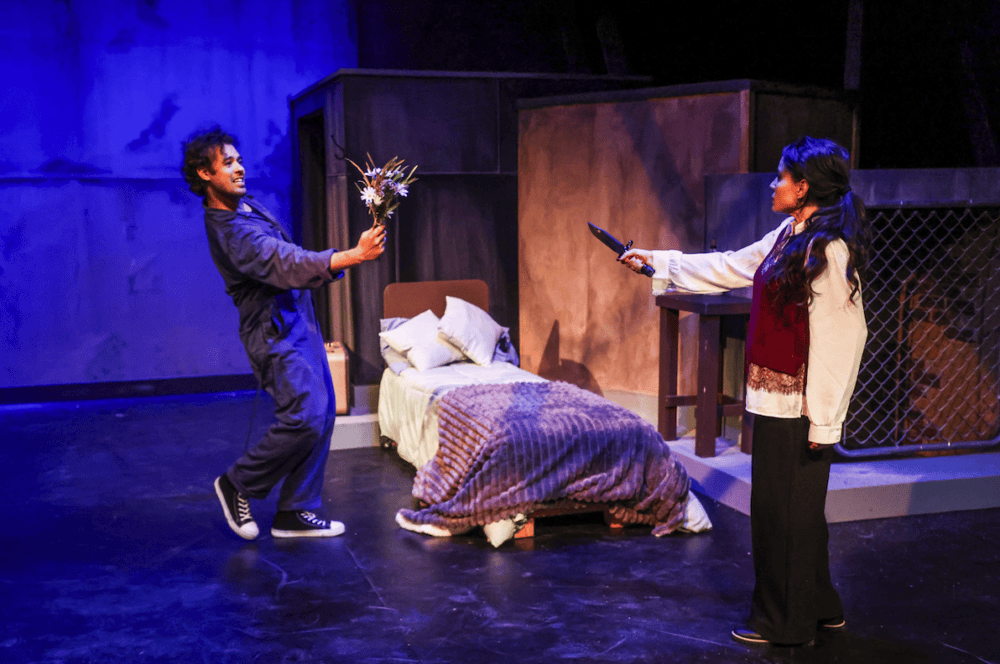
This is where the seemingly realistic events intertwine with dreams and fantasy. Ultimately, Marisol is a tale about one woman’s struggle to retain hope and sanity in the midst of devastation. The play ends with the figure of the guardian angel viewing Marisol’s attempt to save herself in a crumbling universe. This relatively short play covers a lot of ground in its 60-minutes but provides a bold statement about the triumph of the human spirit in a world where divine protection and social order disappear.
The acting of Jade Santana as Marisol and Grace as June carry the play. The excessive and often comedic behaviors of Lenny are masterfully handled by Jack Sharpe. The ice cream cone man, and the madman with the golf club provide fine cameos for Matthew Goodrich and Chima Rok. As Marisol’s guardian angel, Taylor Scott fills that role with magical poetry about the war in heaven matched by the disorder on earth. The stage design Brad Bentz is flexible with Marisol’s Bronx apartment being a center of several scenes. Most prominent in the production is the language of Rivera who brings these characters to life in their strange predicaments.
Born in Puerto Rico and growing up in New York, José Rivera first came to prominence with his play The House of Ramon Iglesia, which was later shown on PBS. Marisol, his fourth play, earned Rivera his first Obie Award for Playwriting in 1993. It has been pointed out that Rivera’s tone and narrative structure is much indebted to Jean Genet’s The Balcony. Among his best-known plays are Cloud Tectonics and References to Salvador Dalí Make Me Hot, which earned him a second Obie Award. He became the first Puerto Rican writer to receive an Academy Award nomination for Best Adapted Screenplay for The Motorcycle Diaries.
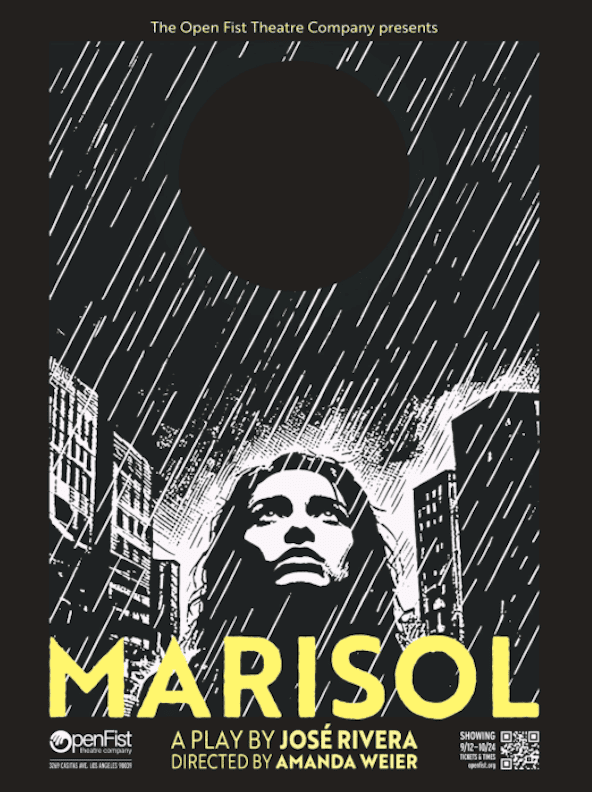
Performances of Marisol run September 12 through October 24, with performances Fridays and Saturdays at 8 pm and Sundays at 4 pm (no performance Saturday, October 3). An additional performance will be held Monday, Oct. 5 at 8 p.m. Tickets range from $26 to $40. Atwater Village Theatre is located at 3269 Casitas Ave., Los Angeles, CA 90039. Free parking is available. For tickets: https://openfisttheatre.my.salesforce-sites.com/ticket#/