By Valerie Milano
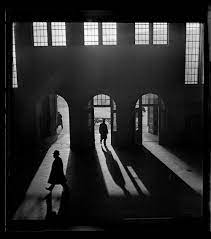
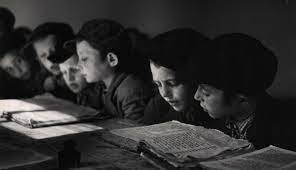
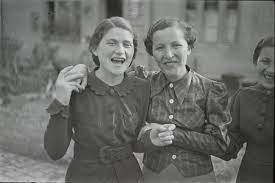
Los Angeles, CA (The Hollywood Times) 2/2/24 – From 1935 through 1938, Roman Vishniac took thousands of photos of Jewish life around Eastern Europe, without a clue at the time that his work would become an important chronicle of the Holocaust to come at the hands of Adolph Hitler and the Nazis.
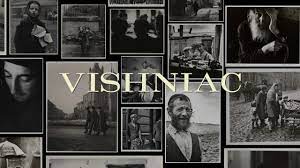 Vishniac’s iconic photographs would provide the last visual records of an entire world that in a span of 10 short years would be wiped out by the unmitigated hatred of the 20th Century’s infamous dictator. Through his photographs, we see Jewish life – in Eastern European shtetls and in Weimar-era Berlin – and witness the Nazi rise to power.
After the war, his documentation continued with photographs of Berlin in ruins and Jewish children in Displaced Persons camps.
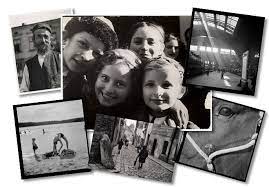 All of Visniac’s work – including his considerable contribution to scientific inquiry through the use of microscopic photography – are on display in “Vishniac” from award-winning documentary filmmaker Laura Bialis, which makes its West Coast premiere tonight in two Los Angeles locations.
For Bialis, the film truly has been a passion for many years. She talked about the film and her drive to make it with The Hollywood Times in an exclusive interview earlier this week.
Click below for our interview:
“I had been both passionate about this era of history and also passionate about black and white photography, Modernist photography, as a college student,” said Bialis, who graduated from Stanford University with a degree in history.
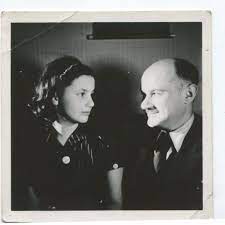
And a serendipitous meeting shortly after graduating from Stanford set her on the path that eventually led her to make this remarkable film: A mutual friend introduced her to Mara Vishniac Kohn, the photographer’s daughter.
“(She) lived in my hometown of Santa Barbara and spent the last 40 years of her life here,” Bialis said. “A mutual friend of ours introduced us, and I now look back and I think she (our mutual friend) knew that we were meant to be connected in some way.”
The first meeting between the two women was at a lecture by Elie Wiesel, the Romanian-born American writer, professor, political activist, Nobel laureate, and Holocaust survivor.
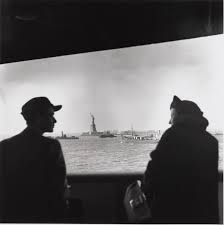
 “We were waiting for Elie Wiesel to come to the podium, and we were sitting in the first row of this auditorium, and she’s telling me the story of her family’s escape from Europe at, really, the 11th hour. “It was December of 1940, and being really familiar with that history and having read a lot about the Nazi period in Germany, I couldn’t believe how they escaped. It was sort of like an edge-of-my-seat experience.”
Two women formed what would become a strong bond at that initial meeting, Bialis said.
“She was an amazing storyteller and a really wonderful person, so I became enthralled with her,” she said, admitting she was not aware at that time who her father was. But when Vishniac Kohn invited Bialis and her parents to her home, the connection came into fine focus.
“Her father’s photos were all over the walls,” Bialis said. “It was another world, a throwback to 20th Century Europe.”
 Bialis said among the photos she spotted Roman Vishniac’s most famous book, “A Vanished World.”
“I said, ‘Dad you have this in your library’,” she said. “But I didn’t connect it to all the Modernist photographers that I had been studying. (Vishniac) was relegated to different groups. ‘Oh, he’s the Jewish photographer’ or ‘he’s the science photographer,’ even thought he was a contemporary (of the Modernists).”
The seed was planted, Bialas said, for this amazing documentary.
“This was sort of a story that was in the back of head for a very long time that I felt like needed to be told,” she said. “And it was a while before I had the time, and it was in the right time and place to tell the story. It was an amazing experience.”
Once she undertook the project, it took six years to complete, a process that was delayed two years by the COVID-19 Pandemic. Bialis and her production team sifted through 23,000 files that featured multiple frames of the same images and thousands of distinct images to cobble together this film which features interviews with Vishniac’s daughter, who serves as the film’s narrator despite passing away in 2018, not long after the project began.
Vishniac’s grandchildren are also interviewed, and the film includes some dramatic scenes to portray the young photographer and his family as they trekked across Europe looking for a better life.
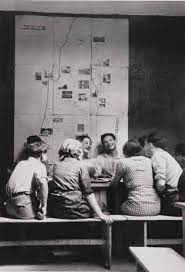 “His work is rather breathtaking, and it was mind blowing to me how many options there were and how many hard choices we had to make,” Bialis said of the editing process. “There were so many amazing photographs that got left on the cutting room floor. But I have to say I had the most amazing team I have ever worked with so I cannot take all the creative credit.”
Bialis was joined in the production of the film by producers Nancy Spielberg and Roberta Grossman, and the creative team of film editor Chris Collister and writer Sophie Sartain. The latter duo joined Bialis in sifting through the mountain of photos, she said.
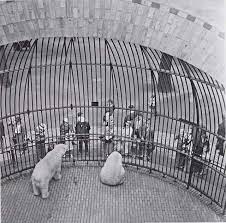 “The three of us sat in the editing room day after day, say in and day out, and really worked through the story, the interviews, and the photos,” she said. “And then these dramatic scenes that we also shot … It was a real collaboration, and I think it may be the most rewarding collaboration that I have ever experienced.”
“Vishniac” opens tonight at the Laemmle Royal Theatre, 11523 Santa Monica Blvd., in West Los Angeles, and the Laemmle Town Center Theatre, 17200 Ventura Blvd., in Encino.