

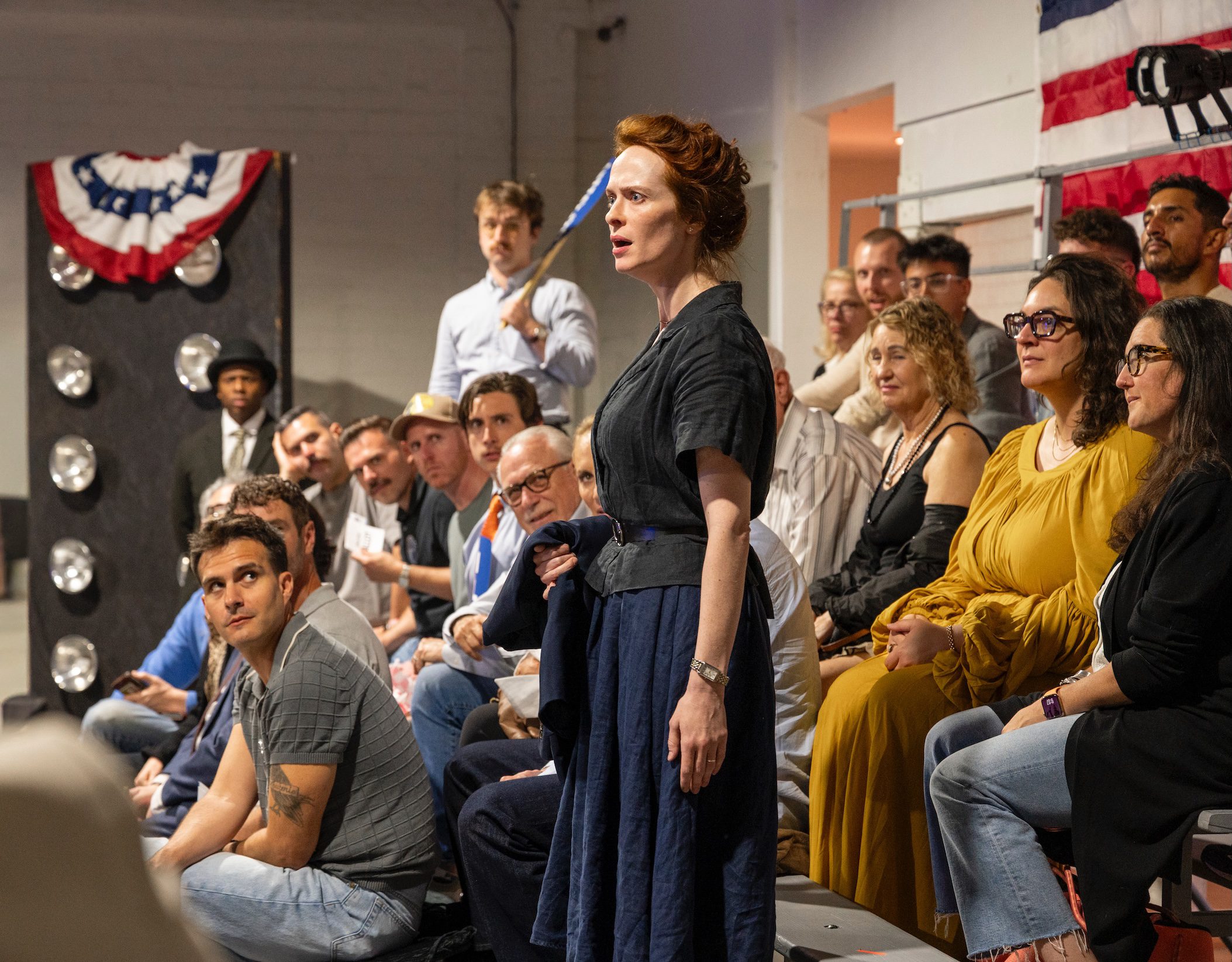
Danny Rocco’s immersive production transformed spectators into political insiders, revealing how artistic preparation can make history feel immediate and vibrant.
By John Lavitt
Los Angeles, CA (The Hollywood Times) 11-03-2026
On Election Night, November 3, I entered The Industry Loft not simply as a theater critic but as Frank Murphy, Associate Justice of the United States Supreme Court and a potential contender for the Democratic vice-presidential nomination. An advance letter had welcomed me to the 1944 Democratic National Convention and identified my political allies. Before the evening even began, the Convention had given me a place in history.
What followed was a marvelous theatrical contradiction: I experienced both nothing and everything at once.
A Different Convention for Every Spectator
Precisely written and directed by Danny Rocco, Convention recreates the fierce political maneuvering surrounding President Franklin D. Roosevelt’s bid for a fourth term. But this is no conventional historical drama in which audiences sit quietly as the important scenes unfold.
Instead, nearly 50 performers inhabit a living, breathing political gathering. Conversations unfold across the room, beside you, and just beyond your hearing. One exchange might reveal a private ambition; another, competing loyalties or an emerging alliance. No single vantage point lets you experience the entire production. As in real life, you will always miss something.
The experience depends on where you look, whom you listen to, and how you interact. Follow one conversation, and another slips away. Turn toward a familiar political figure, and you might miss something more revealing from a lesser-known delegate.
Even the choice to remain silent becomes a form of participation. The result is fascinating because it makes spectators responsible for their own attention. Nobody witnesses quite the same play, and nobody can see everything.
When the Critic Becomes a Candidate
My assigned identity as Justice Murphy gave the experience an especially compelling dimension. Murphy was not merely a name on a program. He was a Supreme Court justice with progressive credentials, strong labor ties, and political relevance at a convention deciding the country’s future.
The personalized invitation described him as a serious vice-presidential prospect and included a map of potential friends and rivals. It also referenced his condemnation of Japanese American internment and his leadership in the historic Flint sit-down strike. Suddenly, I was not merely watching people pursue influence. I had been invited to imagine what influence might feel like from inside the room.
That imaginative shift is among Rocco’s finest achievements. The production does not pretend that audience members can rewrite history. Instead, it allows them to experience uncertainty while surrounded by people who act as though the future remains undecided.
It is a subtle distinction, but an exhilarating one.
A Decade in the Making
In an exclusive interview after the performance, Rocco revealed that the origins of Convention date back nearly a decade to the political upheaval surrounding the 2016 presidential election.
“After Trump was elected in 2016, I dove back into our history to better understand how our civics work,” he explained.
Watching the Democratic Party navigate the rise of Bernie Sanders, Hillary Clinton’s nomination, and Donald Trump’s eventual victory prompted Rocco to examine an earlier moment when competing visions of the party’s future collided. At the time, he was living in New York and maintaining a writing and teaching residency at the Atlantic Theater Company, where he developed new work alongside graduating student actors.
The first workshop of the Convention took place in 2017, followed by additional development that fall. Those early efforts helped secure investor support for full production in Brooklyn in 2019.
Between 2019 and the Los Angeles premiere, Rocco and Lead Producer Justin Brock Schantz assembled a dedicated group of investors and collaborators. Four additional workshops, beginning in September 2025 and continuing through April 2026, helped shape the enormous undertaking into its present form.
The journey was anything but conventional.
“It took that whole time to develop, nurture and expand the current script and ensemble to what you saw on Tuesday,” Rocco told me. Perhaps the production’s most impressive accomplishment is how effortless its complexity appears.
What appears to be spontaneous political chaos is actually an extraordinary feat of coordination, demanding rigorous preparation from an enormous ensemble.
“Every single word is scripted,” Rocco emphasized.
That revelation fundamentally changes how one appreciates the production. The overlapping conversations, shifting alliances, and seemingly incidental exchanges are not improvisational accidents but carefully constructed components of an intricate dramatic composition.
Rocco believes the enterprise’s difficulties and hardships help sustain his performers’ enthusiasm. “The show is inherently a blast to work on, precisely because of its challenge. It requires a high degree of listening and precision.”
Remarkably, he reports that the company maintained about 90% cast retention from one developmental iteration to the next. Some performers have been involved since the earliest Atlantic Theater workshops.
The commitment is understandable. In a theatrical environment where actors often struggle to find substantial opportunities, Convention offers something unusual: the chance to contribute meaningfully to a complex artistic endeavor.
Through the painstaking footwork during the writing process and rehearsals, Rocco and his extraordinary ensemble created the freedom for everything to feel immediate, present, and powerful. The more rigorously they constructed the world, the more naturally the audience could inhabit it.
What appears chaotic is actually the product of discipline, and what feels like improvisation emerges from years of preparation.
Writing a Play Like a Musical Score
Rocco’s fascination with conversation also inspired an unusual approach to writing the production. “I’m also deeply fascinated by conversation, by the way people speak,” he explained.
He developed a script format resembling sheet music, designed to accommodate simultaneous dialogue and the complex interactions essential to the production. It is a fascinating concept. Rather than imagining dramatic conversations as a succession of individual speeches, Rocco treats them as interdependent elements of a larger composition.
The result resembles an orchestral performance in which dozens of musicians contribute to a single work, even when the listener can focus on only certain instruments. For the spectator, this produces both exhilaration and occasional frustration. Important moments inevitably escape attention. Yet that limitation becomes part of the experience’s meaning.
Political history is rarely experienced with the benefit of omniscience. Most people understand the events shaping their lives through incomplete conversations, selective information, and competing interpretations. Rocco transforms that universal limitation into a theatrical language.
A Shakespearean Struggle for Power
At the heart of Convention is a political decision with extraordinary historical consequences.
In 1944, Roosevelt’s declining health made the selection of his running mate especially consequential. Incumbent Vice President Henry A. Wallace embodied a progressive vision that emphasized racial and gender equality, expanded healthcare, and an ambitious future for American democracy.
But competing interests within the Democratic Party were determined to influence the succession. “The 1944 DNC is Shakespearean: it’s about succession at a time of tremendous stakes,” Rocco observed.
For the playwright, however, the convention represents something more personal than a mere examination of political intrigue. As he explains, “The 1944 Democrats are poised with the difficult choice of choosing between a leader that is ahead of his time, or choosing someone ‘who is right for the here and now.'”
That tension between immediate advantage and enduring principle has become central to his understanding of leadership. As he explained, the decisions he faces in his own life often involve choosing between short-term expediency and the person he ultimately hopes to become.
This personal dimension helps illuminate why Rocco has remained so committed to the production. The historical material is not simply something he researches. He uses it to interrogate his own beliefs, responsibilities, and aspirations.
The Human Beings Behind the Political Machinery
Another revealing aspect of Rocco’s artistic philosophy concerns the distance between our idealized perceptions of political leaders and their unavoidable human limitations.
He is fascinated by how people transform politicians into symbols of larger ideals, only to become disappointed when those individuals reveal ordinary ambitions and shortcomings.
Rocco describes this challenge: “In Convention, across the space, every politician makes a personal decision – mostly for their job placement – that has a tremendous impact on the group.” That observation helps explain the production’s extraordinary attention to detail.
The politicians around us are not merely historical figures delivering ideological positions. They are human beings navigating ambition, uncertainty, loyalty, and self-interest.
Some aspire to transform the country. Others care far more about securing their next position. Often, those motivations coexist within the same individual. The effect is both amusing and unsettling, particularly when one recognizes how consequential decisions can arise from such thoroughly human considerations.
Election Night and the Unfinished American Experiment
Experiencing Convention on November 3, 2026, the final night of its Los Angeles engagement, added another layer of resonance to the production. While Americans participated in contemporary elections, Rocco’s ensemble transported audiences to an earlier political crossroads, where competing Democratic factions vied to determine the country’s direction.
For Rocco, the parallels are unmistakable.
“I think the modern Democratic Party – a tremendous tent – faces a unique challenge. At its most inspirational, it is about the future – about progress. But it constantly has to balance that with solving the problems of now.”
He believes the conflict between progressive aspirations and establishment pragmatism remains as relevant today as it was in 1944. Yet Convention is more than a political argument. It is an audacious theatrical experiment that recognizes the impossibility of reducing history to a single narrative or perspective.
The nearly 50 performers deserve considerable recognition for sustaining that illusion. Their collective achievement allows spectators to surrender to the experience rather than focus on the extraordinary machinery required to make it work.
Rocco and his collaborators have created something genuinely unusual: a theatrical world that feels larger than any single person can grasp. By the end, I realized that my incomplete view was not a shortcoming. It was the point.
Democracy, like immersive theater, is shaped by the conversations we enter into, the voices we ignore, and the choices we make without ever seeing the whole picture.


