Venice, CA (The Hollywood Times) August 17, 2026
Robert Lesser is driving the 80 miles home from Venice, where he’s just finished a matinee performance of Out with a Bang at the Pacific Resident Theatre. The reception on his cell phone is cutting in and out but, he says, “There’s a glorious sunset right in front of me on our beautiful Pacific Coast Highway.”
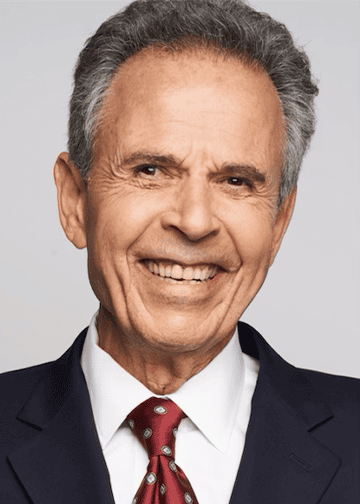
Eighty miles round trip to perform in a play is a lot of miles for anyone, but Bobby (as he’s known) is, in his own words, “north of 80,” so for him it’s a true commitment to the company he calls his theatre home.
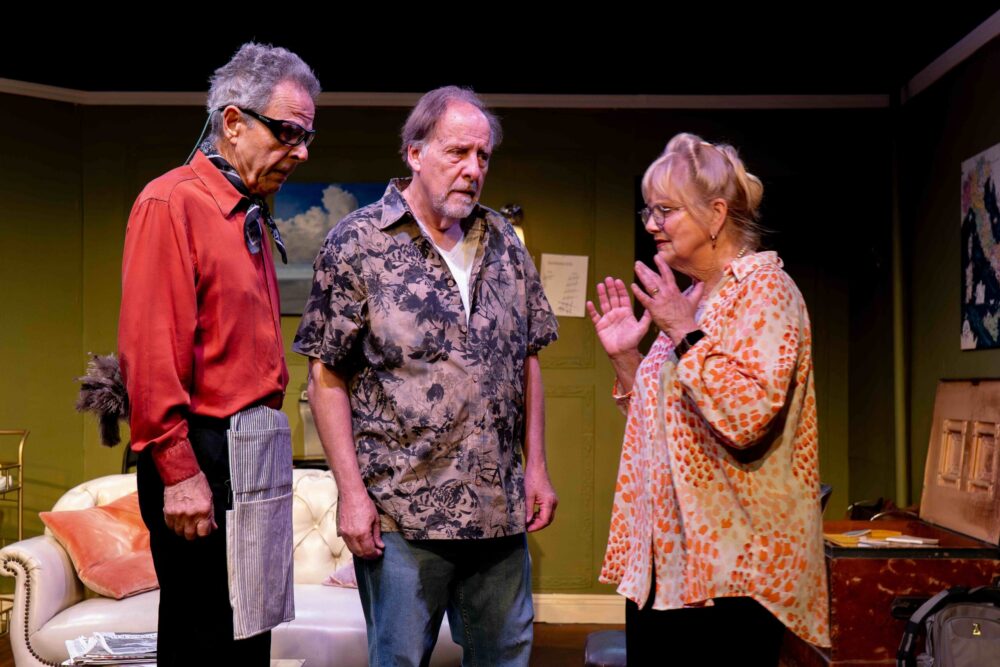
In this comedy, Bobby plays Daniel, a “professional mourner,” who “keens” for a living, wailing over strangers’ coffins for money. He’s the next-door neighbor and best friend of Eddie (actor/playwright Tony Pasqualini), whose ex-wife Betty (and real life spouse Sarah Brooke) has come to him for help seeking revenge on the neighbor she blames for killing their dog, Patsy (she kept custody after the divorce). Eddie and Danny compete with a handwritten scoreboard of sexual conquests, but Danny is beating him by a mile (his profession helps). Eddie’s never gotten over losing Betty, and now that she’s a widow, he recruits Danny to help him with the revenge plot in hopes of winning her back.
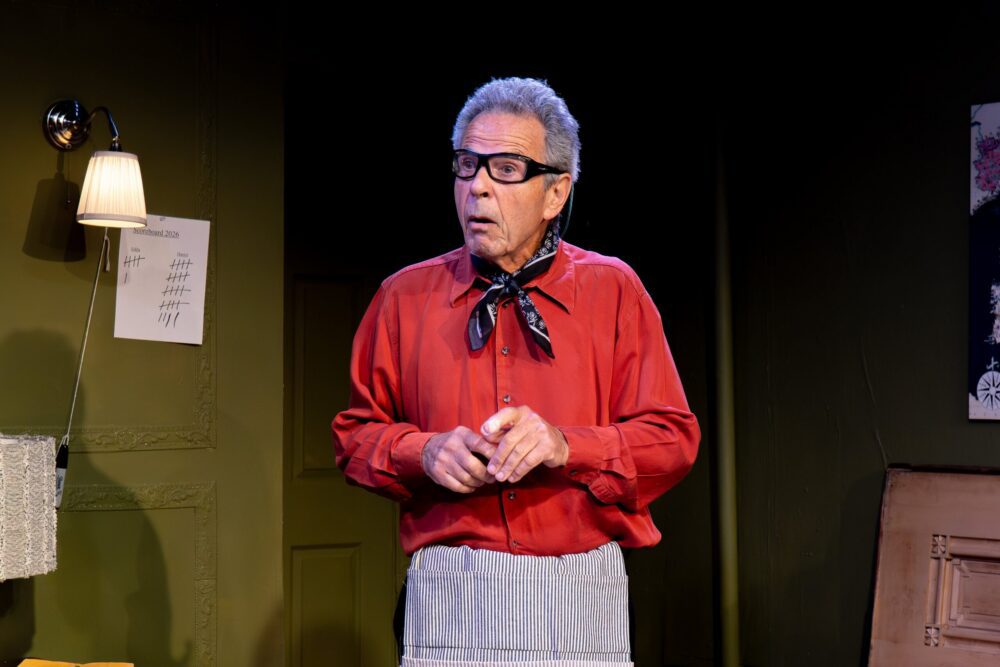
Bobby’s rehearsal routine includes practicing a traditional form of vocal lamentation in many cultures called “keening.” How much of what he does is improvisation, and how much is scripted is where the magic between playwright, actor and director (Andy Weyman) comes in.
The script’s stage direction for Bobby’s keening scene (which he demonstrates at Betty’s request) was a single unbroken line of text— some 40 typewritten letters, E’s and I’s strung together with no further instruction, no punctuation, no phrasing, no clue as to pitch or rhythm. Bobby researched Jewish mourning traditions, listened for what distinguished them from Arab ululation, and built the sound himself. It’s a very funny performance.
“We don’t ululate the same way,” he says, “but there are similarities.” The text calls for 20 minutes of full-throated keening; his cast mates, he says, have had to physically restrain him from going the distance. He has also found that his own losses surface while in the role — he lost someone close to him recently, and the keening has become, unexpectedly, “a way of reminding me to try and connect with them.”
Bobby started acting at around age 13, at New York’s Camp Taconic, where he played Emile de Becque in South Pacific — the role Ezio Pinza originated — using what he describes as an “unaccountable continental accent.” He comes from a musical family: two younger brothers became working musicians, one a club performer for 35 years, the other a producer and director for children’s television; an older brother, Larry, devoted his life to the foreign service and “would’ve been on track to be an ambassador, if he hadn’t distracted himself doing Gilbert and Sullivan musicals during his postings abroad.” Bobby was the one who stayed in the business.
He has, since then, accumulated a resume that runs from Lincoln Center to Hollywood. He began in the Public Theater’s production of Richard III, worked with Alan Arkin on Broadway, and starred in the original New York production of Sam Shepard’s Geography of a Horse Dreamer at the Manhattan Theatre Club. He has been a member of Actors’ Equity for more than 50 years.
On film, some of his better known roles include the opening scene of the original Die Hard, as the fellow air passenger who tells a nervous Bruce Willis to beat jet lag by making fists with his toes against his hotel’s carpet. He appeared in Jim McBride’s New Orleans noir The Big Easy alongside Dennis Quaid and Ellen Barkin. And in Hester Street, with Carol Kane, “we had a lovely, lovely scene together,” he says with affection, “where I was negotiating the terms of a divorce. I had all the dialogue in that beautiful scene, yet she got nominated for the Academy Award. just for listening.” But he says it’s one of the best scenes he’s ever had.
For years he did looping work with a group called Loopers Anonymous, adding background voices for many episodes of the Law & Order franchise. Steady, if not star making, it’s work he credits with helping support his family.
His theatrical home for the last several years has been Pacific Resident Theatre, where he arrived by way of My Antonia, a co-production with Ventura’s Rubicon Theatre that found, in his telling, an even better fit once it transferred to PRT’s main stage.
He has played “the resident Jew” (my term) at PRT more than once, noting he has also played the resident Italian, and enough other ethnicities that he doesn’t consider himself typecast.
Before Out With A Bang, Bobby received accolades for his performance in The Bespoke Overcoat, a rarely staged 1950s play adapted from the short film that won the first Academy Award ever given in its category — a run he remembers as one of the highlights of his time with the company.
Out With A Bang exists because of a unique structure at PRT: a co-op system that lets company members initiate projects outside the theater’s four-show main stage subscription season.
Members pitch ideas, a small budget covers essentials like a stage manager, and if a show catches on with audiences, it earns a longer life on the calendar — which is exactly what happened here, an unadvertised three-week venture that sold out and got asked back “by popular demand,” word of mouth doing what a marketing budget can’t.
He notes the pressures on theaters like PRT, operating in what used to be called 99-seat houses, and the friction that’s come, over his 50-plus years in Actors’ Equity, from union rules not always built for houses that size.
Still, he says, the company keeps finding ways to bring in new actors and honor writing “in a way that film doesn’t.” Offstage, Lesser plays tennis — singles and doubles, weekly, “playing to win” — and has more recently taken up pickleball, which he credits partly for a social life he clearly enjoys describing. He also writes, occasionally: a piece about his youthful romantic friendship with Diane Keaton, whom he met at the Neighborhood Playhouse, was published in The Wrap.
Asked what it means being of the age to play a character confronting the indignities of old age, Bobby doesn’t reach for anything easy. The play, he says, is “about friendship and about love” — about resisting the limitations that come with aging without pretending they aren’t there.
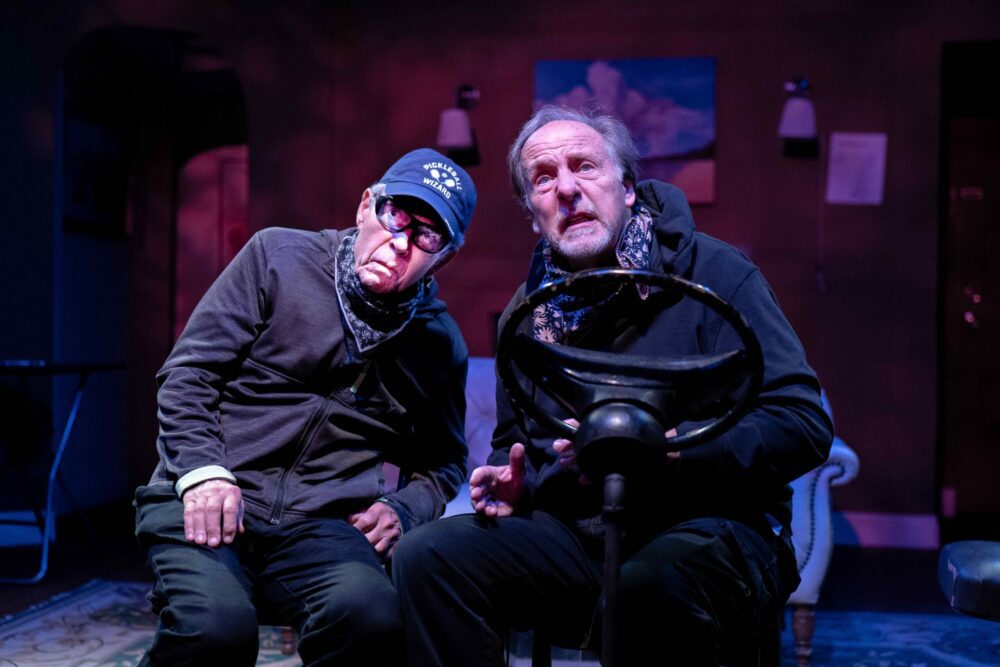
Eddie’s late-life reawakening with an old flame, he says, is one of the more affecting things in the script, even inside a comedy that doesn’t linger long enough to make room for real grief. What keeps the losses of getting older from becoming tragedy, he says, is a short list: “Camaraderie, love, friendship, and gratitude for all of it.”
But Bobby has to get off the phone now. His wife, the journalist extraordinaire, Ann Louise Bardach, is buzzing to ask how far he is from home. He’s about half-way, still on PCH, the ocean somewhere to his left. He signs off mid-thought, and like his acting career, is unwilling to let anything bring him to a full stop.
Out with a Bang is onstage at Pacific Resident Theatre, 705 1/2 Venice Blvd., Venice CA 90291, 8 pm Saturdays, 3 pm Sundays, through September 6. Reservations: (310) 822-8392. https://pacificresidenttheatre.org/