From Celestial Yearning to Cosmic Fire, the powerful contrast of Claude Debussy and Alexander Scriabin sheds light on the role of a chorus in classical music.
By John Lavitt
Los Angeles, CA (The Hollywood Times) 01-16-2025
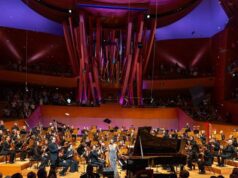
When Esa-Pekka Salonen returned to the podium at Walt Disney Concert Hall for the second half of the LA Phil’s Body and Sound festival, the programming itself became the argument. By placing Claude Debussy’s La damoiselle élue beside Alexander Scriabin’s Prometheus, Poem of Fire, Salonen framed the evening as a study in how the human voice can function at opposite ends of the expressive spectrum. Indeed, the two pieces covered expansive territory from an inward yearning to an elemental force.
Heard together, the contrast sharpened the ear. In Debussy, the chorus remains intimate and atmospheric, shaped by restraint. In Scriabin, the same chorus emerges as a pure elemental force. The effect on the audience is nothing less than overwhelming.
In La damoiselle élue, the women of the Los Angeles Master Chorale provided the piece’s quiet foundation. Based on Dante Gabriel Rossetti’s poem, the score calls for a sense of translucence. Holding back the desire to project, the chorale responded with tone and control. Under Grant Gershon and Jenny Wong, the voices blended seamlessly into Debussy’s orchestration, hovering above the strings and woodwinds rather than competing with them.
The chorus functioned less as a dramatic agent than as a shared consciousness, shaping the work’s emotional space. This restraint proved effective, creating an ideal setting for Liv Redpath’s soprano. Her vocal line floated with warmth above the ensemble, illuminating character and enhancing a mythic storyline.
Moving onward, Scriabin’s Prometheus upended that world almost immediately. Where Debussy whispers, Scriabin insists. The chorus, silent for much of the piece, enters only at the climax, and when it does, the impact is unmistakable. Stripped of text, the voices become a transcendent power, joining orchestra and piano in a single, blazing surge of sound. The Master Chorale delivered a sustained wall of sound, almost physical in its intensity.
The shift from Debussy’s delicate textures to Scriabin’s power was striking. With Salonen conducting, the pairing felt purposeful. Whether serving as an ethereal presence or an elemental force, the chorus proved central to both works. It reminded us that the human voice, even in the most ambitious orchestral settings, remains one of classical music’s most potent instruments.