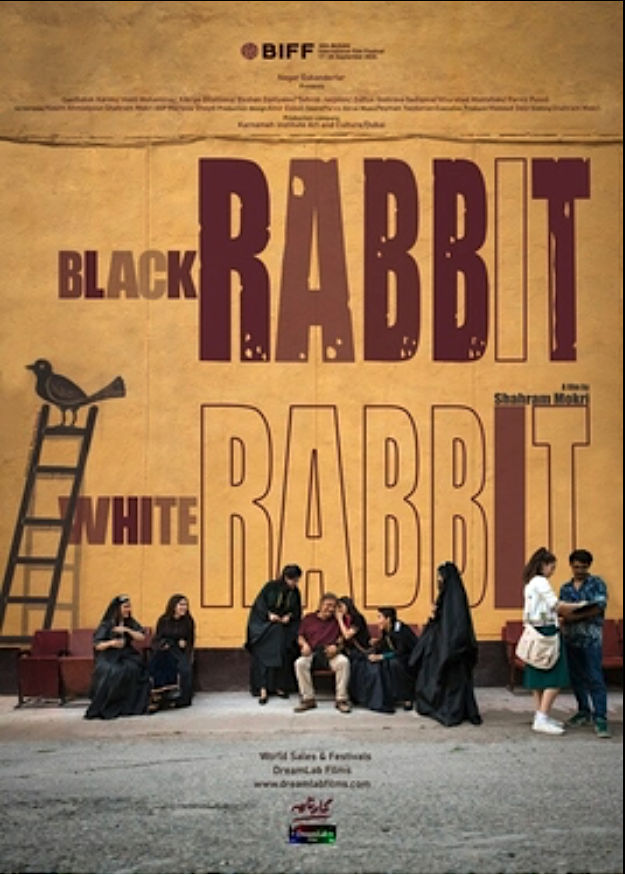
Last Friday evening at the Billy Wilder Theatre of the UCLA Hammer Museum was a screening of a film from Iran – Black Rabbit, White Rabbit (2025). This mystery drama by Iranian filmmaker Shahram Mokri is an elaborate puzzle piece of a film that weaves together three narratives that all take place in a movie lot in Dushanbe, Tajikistan. It might seem a bit odd that an Iranian filmmaker chose to make his film in Tajikistan and uses an all-Tajik cast for an Iranian film with an Iranian crew. But one reason is perhaps that Tajikistan shares the common Farsi language with Iran and northern Afghanistan (albeit with dialect differences). Another reason is that in Tajikistan, there is no requirement that women cover their heads. Aside from this is the opportunity to use a film lot as a location that might not have been possible in Tehran.
The film utilizes four languages in its complex structure: Persian Farsi, Tajik Farsi, English and Italian. Because Tajikistan is not known for its film production, it comes as a surprise that a major Iranian filmmaker chose to shoot his film in Tajikistan and Tajikistan, in turn, submitted Black Rabbit, White Rabbit as their Osar submission for Best International Film at the 98th Academy Awards (but was not accepted but Academy).
The narrative of the film explores fear and fragility within a society shaped by human imperfection. At the film’s opening, a man dies during an illegal gun deal at an antique shop, triggering a chain of interconnected events involving various individuals. The gun that is being sold to the antique dealer has a piece missing from its trigger, supposedly rendering it useless for firing. However, we soon hear a gunshot form the antiques shop and a man dies. This is one of the most elaborate cinematic gags of Chekhov’s gun principle. So, the gun is cursed and sets everything in motion. Then we move to movie lot where a film director remaking a classic Iranian film in Tajikistan and a props manager is very concerned about a gun on set. We meet an aspiring actress defying her mother and trying to get into the industry, but also we begin a day with a wealthy woman feeling trapped in her marriage.
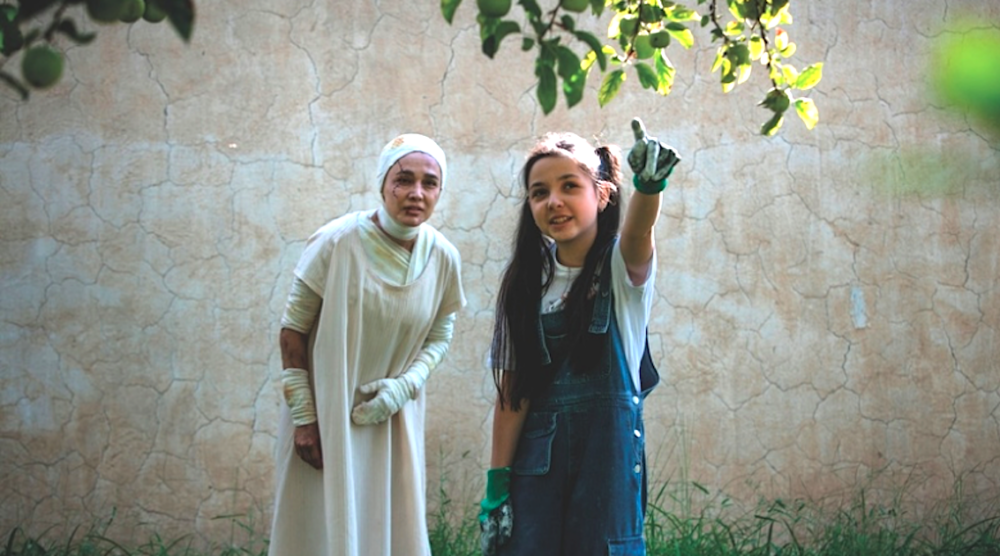
In the first part of the film, we are focused on a woman named Sara (Hasti Mohammai) who is married to a successful businessman and lives in a beautiful urban residence. Her husband Bezham (Bezhan Davluyatov) cannot stand to be near her because he says her bandages stink. Sara was recently involved in a near fatal car crash which she survived but is bandaged from head to foot from wounds inflicted in the serious automobile accident. She bears an ugly scar on one side of her face. She wanders downstairs from her palatial house to see her badly damaged car in the parking garage and she refuses to let her husband get rid of it.
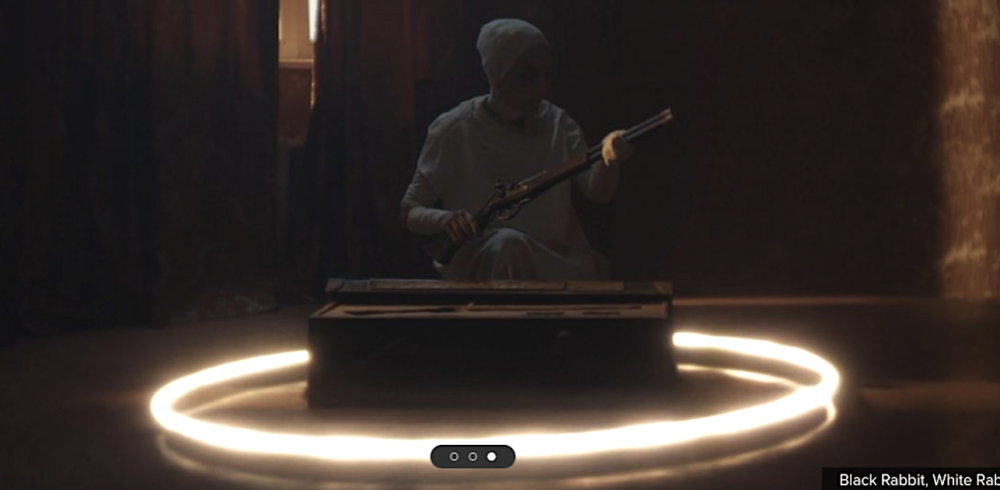
Sara has a daughter who lives in the house and with her shares a new-found extra-sensory power after the accident. Sara discovers that she has a protective circle of light around her now. She does not trust her grey-haired, very unpleasant and grumpy husband is about to leave for work in the morning, refusing the tea she offers him. He has recently installed CCTV cameras all over the residence to observe whatever goes on.
This scene like so many others in the film will double back later in the film – the film is structured around repetition and doubling. She goes down to let in an insurance adjuster who has come to look at her badly damaged car. He examines the tires which are fine and notices the brake fluid lines are cut – causing the brakes to not work and probably causing the near-fatal accident. As her husband gets in his own car to leave the compound, there arrives at the front gate, there is a person at the front gate. He has come to deliver an antique box which Sara claims she never ordered and could not have purchased, as her husband has taken away all her credit cards. The situation gets out of hand with Sarah’s denial and the delivery man’s insistence on leaving the antique box. He gets into a fight with Sara’s husband and is punched in the face and falls on the ground.
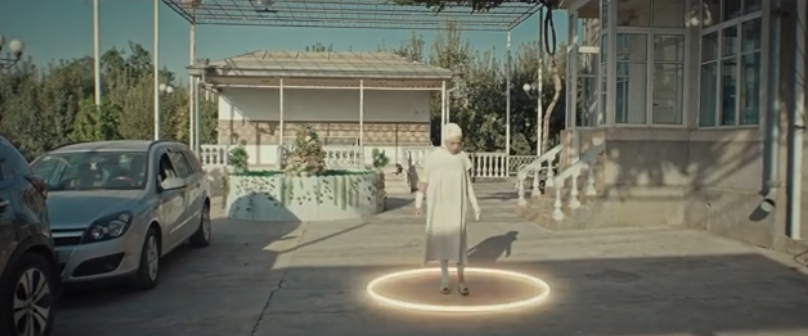
Sarah’s husband furiously drives off and Sarah is unsure what to do – so she invites the delivery man inside the house to put ice on his swollen face and offer him a drink of vodka. Eventually he recovers a bit and goes to leave in his truck. But checking on the CCTV monitor in the house, Sara notices that an antique box has been left at the front gate. She goes down to the street to ask a neighboring workman to help her drag the antique box into the house. This mysterious box is similar to the one we saw in the opening scene of the film.
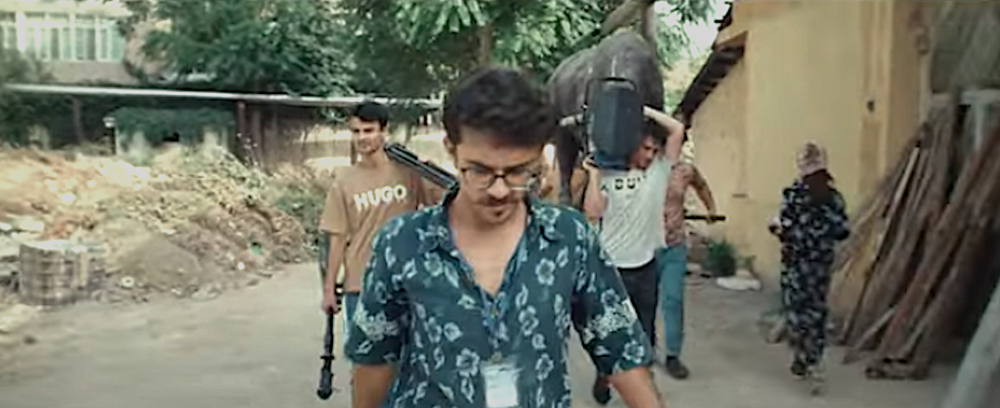
And now we move onto Act 2 which is a busy movie studio backlot where several film or television directors – all young and looking interchangeably similar are running around with their film crews to shooting locations within the studio. Here we encounter the props specialist or “armorer” named Babak (played by Mokri’s frequent collaborator Babak Karimi), who is hoping this will be his fortieth production in his studio career. He is there is inspect a gun for use in a film that is being shot in the studio – a meticulous remake of an old Iranian classic film. The director is ready to shoot a big crowd scene where a politician is standing in front a crowd to give a speech challenging the government and, in that scene, he will be assassinated. A reminder: Babak Karimi is a well-known Czech-Iranian actor who starred in A Separation.
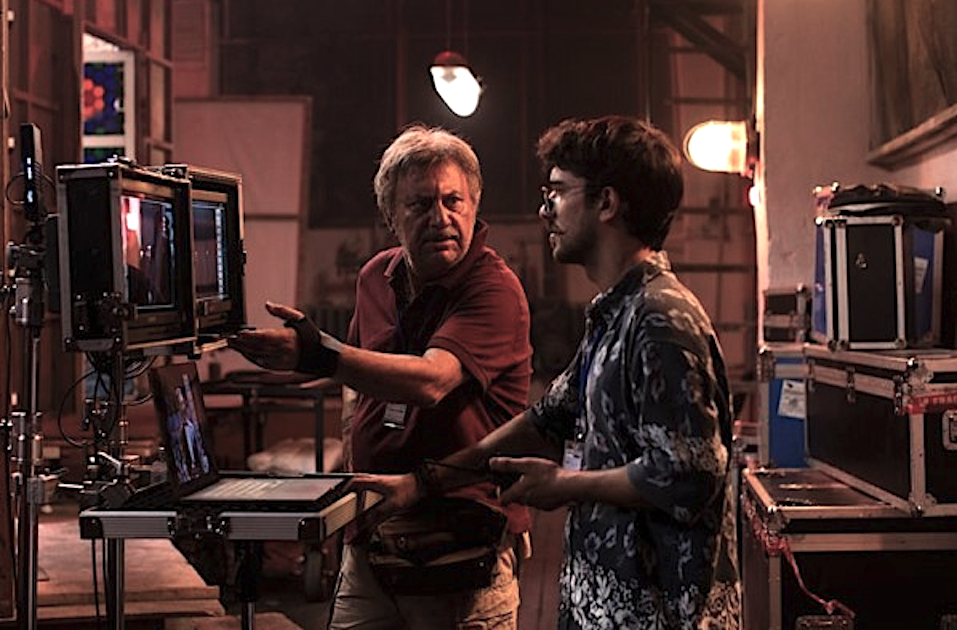
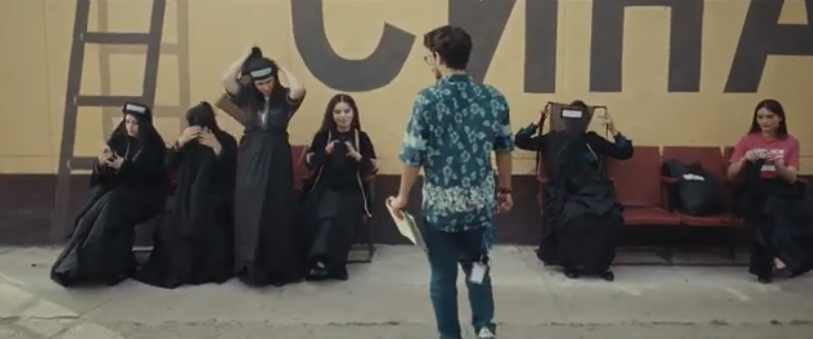
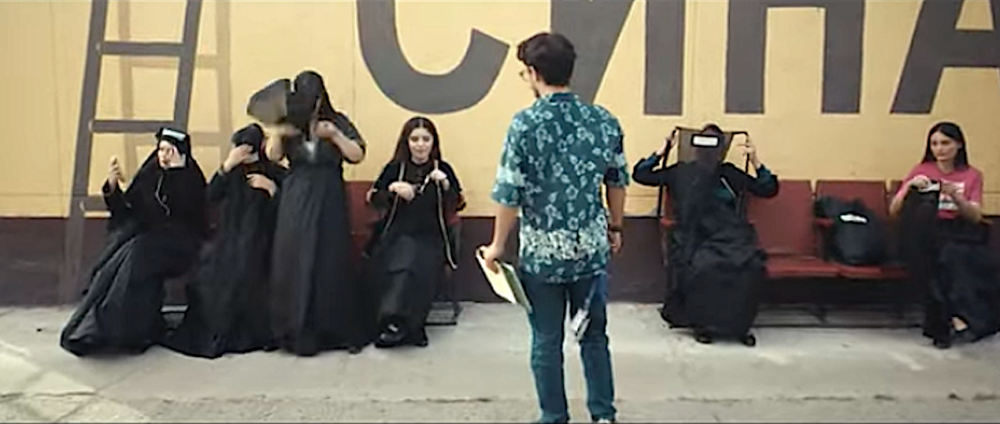
Babak is trying to speak with the young director but he is distracted. There are supposed to be a group of eight Tajik young women as extras for Iranian women in the remake. They are chatting outside, all dressed in black burkas with complete face covering for the scene. They are the extras for that scene, but Babak only sees seven. One is missing. The director is concerned that he needs eight for the scene and asks Donya (Kibriuo Dilyogova), the extras coordinator where is the missing one. Donya is an aspiring actress who wants to audition for a part in a film but whose mother forbids her to have anything to do with acting or films. Donya sees Babak and assumes that he has connections that will help her get an audition with a director there.
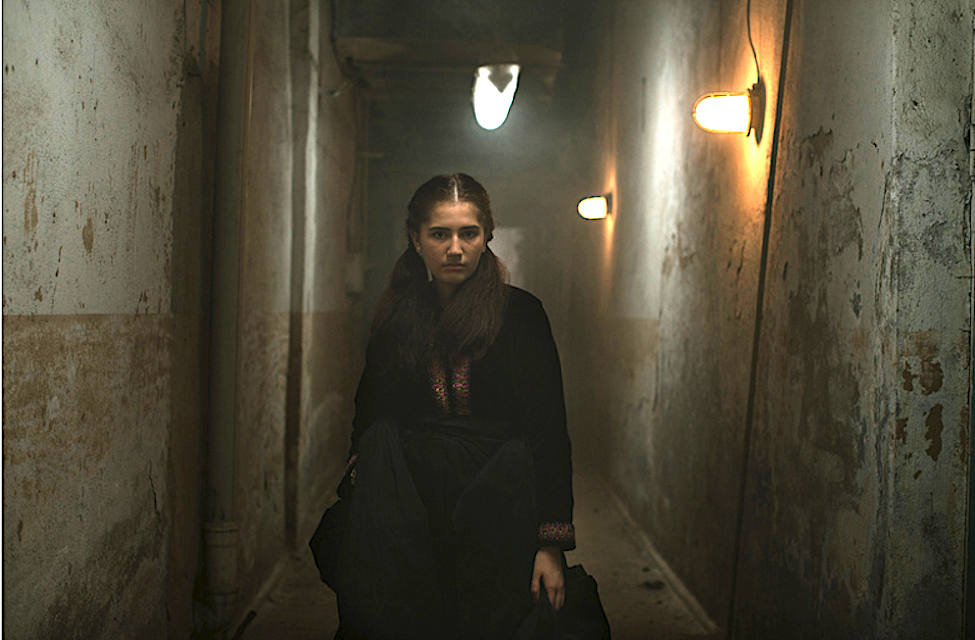
Meanwhile Babak has a larger concern: He is supposed to be in charge of checking all guns used on set to make sure that they are not loaded and dangerous. He is rushing around trying to get his photo ID to gain entrance to the studio sound stage, but security won’t let him inside without the ID. This is Babak’s conundrum for most of the rest of the movie. Donya finally finds a director who says he is willing to let her audition, although she has no CV and assumes she is so talented that she doesn’t need one. She finally gets a chance to audition and, instead of performing a scene from a play or film, she does a magic trick with hats and two rabbits that she suddenly makes appear – one black rabbit and one white rabbit. This is echoed by the props from the prop room and costumes worn by two actors seen walking down the street in the studio lot. The audition is a failure but Donya is not willing to give up so easily.
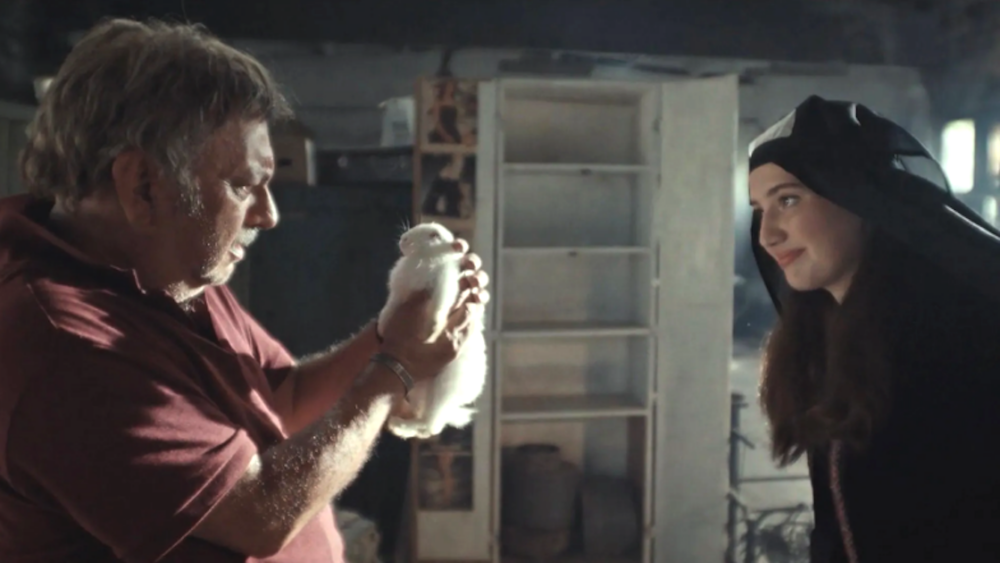
By the third act, we become aware that the house in which Sara lives is just a stage set as its walls open and Donya even wanders inside as does Babak. Sara is revealed to be a a famous actress playing the role of the woman covered with bandages like a embalmed mummy. Donya gets a role as the eighth women in a burka for the scene in the remake of an Iranian period film, and she struggles with the make-up lady and the costumer with her burka attire. Babak eventually gets his security clearance to go on the set to check the gun to be used. Sitting in a prop room, he happens upon a famous Italian actor who resembles him in age and appearance. This actor tells him a tale about a duel between two Italian gentlemen in the 19th century, each with a different brand of pistols from the same gun manufacturer. Of course, this is the gun that is supposed to be used for an assassination in the remake of the Iranian period film.
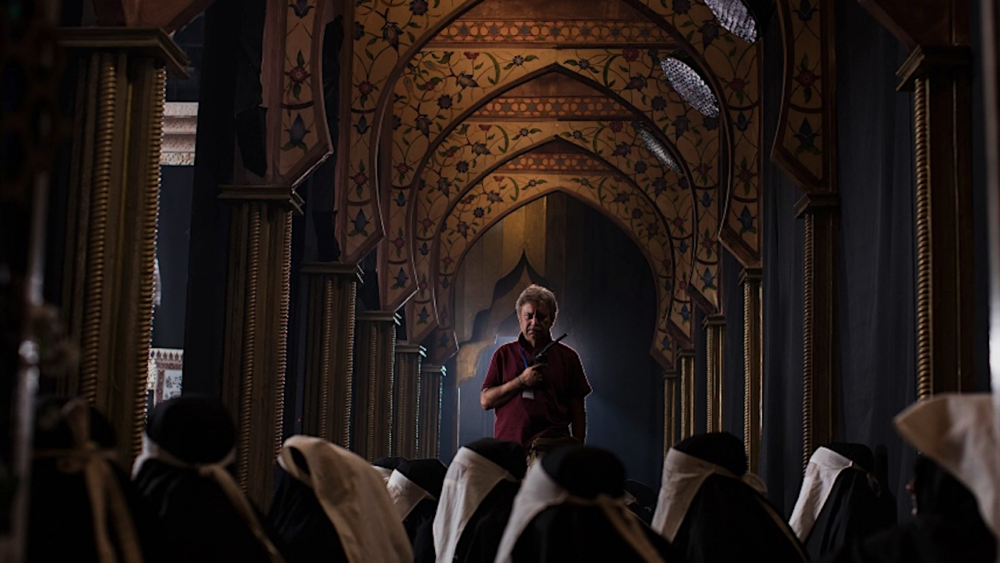
Based on this odd piece of enlightenment about antique pistols, Babak realizes that the prop pistol to be in the scene must be checked to make sure that the actor uses a gun that does not fire a bullet. He has in the back of his mind the recent event in American filmmaking where actor Alec Baldwin accidentally killed an assistant director on the set of a film with gun that was not supposed to be loaded. Babak is in the sound stage checking on the antique gun to be used “for authenticity” in the group scene – only to panic over which prop gun will be used. Eventually Sara comes to the realization that the cut brake fluid lines in her ruined car was done intentionally and she begins to suspect her husband. She decides to open the antique box and what is inside and her discovery leads the final scenes of the film where she carefully prepares the table for tea for her husband returning in the evening.
This is a film that defies description. It is a complicated film about filmmaking that is in constant motion, continually interweaving parts of itself that overlap, repeat, and playfully repeat again. This is a great film for those who like to think about and talk about a movie and care about that “experience” above and beyond the experience of watching it. However, it may very well be a bit of a bore, first time through. The title may suggest David Lynch, and two giant rabbits do appear toward the end off in the distance, but this is Lynchian without quite having the distinctive Lynchian style or texture. There haven’t been many filmmakers who have gone to so much trouble to develop so many interwoven themes through dialogue and movement all on a series of large sound stages.
The default mode is for the camera to follow one person around as he looks for some other person or wanders into people. One of the best transitional devices is for the camera to focus on the back of one character, then seamlessly slip onto the back of another, going in a different direction, pursuing a different goal, at a different time. The effect of the film studio setting is to create a film where cast and crew are continually waiting around for their moment, waiting for the shoot to begin. Sometimes they do begin to shoot or instructions are shouted to everyone on set.
The three storylines interweave through the intricate narrative and formal structures that have come to define Mokri’s filmmaking. Since Fish & Cat (2013), he has developed a distinctive approach centered on manipulating time, genre, and cinematic form. That earlier work, presented in a single continuous take, expanded the slasher framework into a looping, disorienting narrative. Invasion (2017) furthered this formal experiment, combining the single-shot technique with elements of procedural drama and hints of vampirism. With Careless Crime (2020). Mokri abandoned the continuous-shot device in favor of vertically layered storytelling, blending historical reconstruction with meta-textual reflection to revisit the 1978 Cinema Rex fire.
Black Rabbit, White Rabbit extends the formal experimentation of Careless Crime, abandoning the single-take structure while retaining Mokri’s signature long takes that intertwine across space and time. The result is a network of overlapping Möbius strips, each folding back into the others. Set within the Tajik film industry yet directed by one of Iran’s most distinctive formalists, the film functions simultaneously as a meta-mystery and a study in cinematic illusion. In Mokri’s storytelling, the boundaries between reality and fiction remain porous, each seeping into and reshaping the other with a faintly surreal undertone. Moving towards magical realism in the final chapter of the film, the doubling of characters and guns carries us into a Lynchian world, where the motif of rabbits carries a broader symbolic function. There is an Alice in Wonderland aspect to the young character of Donya, as aspiring to be a great actress like Sara and seems transformed to occupy here gold circle of light at the end of the film. The young woman crosses between the temporal and spatial moments at key junctures in the film.
Those familiar with the settings of the films of Sergei Parajanov will notice how folklore and ritual intermingle within the film’s intricate mosaic. Unlike Parajanov’s static, painterly tableaux, Mokri’s camera, guided by cinematographer Morteza Gheidi, glides seamlessly through different scenes and realities despite the film being cut into several chapters. Of course, one thing’s of Sakharov’s “The Russia Ark.” Still, the set design of the remake within the film recalls Parajanov’s ornamental sensibility, adding a tactile richness to Mokri’s conceptual framework. Beneath its intricate structure lies a reflection on the uneasy boundaries between representation and reality in addition to a variety of other motifs. While its intellectual design may challenge conventional viewing habits, Mokri balances genre storytelling with the multi-dimensional time-loop extravaganza in a manner that does not alienate viewers