Author Laurence Maslon Interviewed by Jimmy Steinfeldt
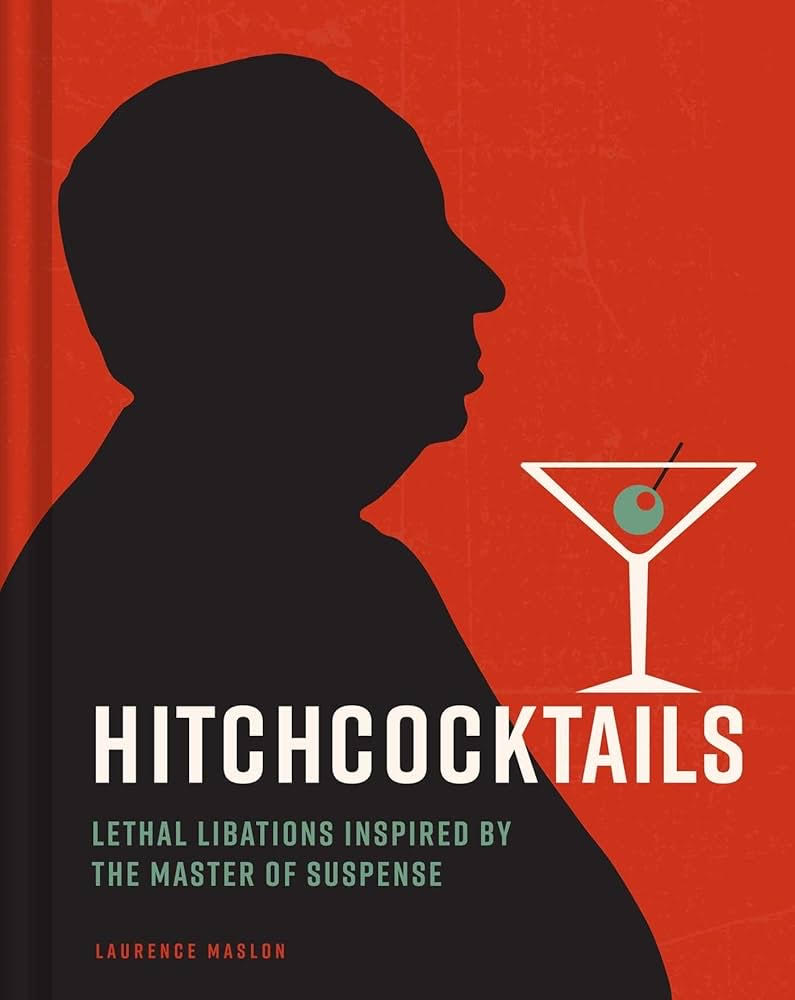
Jimmy Steinfeldt: Hitchcocktails: Lethal Libations Inspired by the
Master of Suspense. How did the idea for your new book arise?
Laurence Maslon: I had already done a book called I’ll Drink to
That!: Broadway’s Legendary Stars, Classic Shows, and the
Cocktails They Inspired which is a line from Sondheim’s
Company. It included about three dozen drinks. Drinking is a big
part of Broadway both on- and off-stage. One day I was just
walking down the street and the idea “Hitchcocktails” came
into my mind! I called my editor and I said I have a one-word
pitch for you. She said she needed a written proposal. I said just
let me say the word. “Hitchcocktails”! She got it immediately.
We were surprised to learn no one had thought of it before.
Currently there is a revival of interest in Hitchcock and a revival
of interest in craft cocktails.
JS: Did you come up with the names for all the cocktails?
LM: Yes. First I came up with names like “The Trouble With
Sherry” or “The Man Who Drank Too Much”. But then I
sequentially watched his major films and realized this doesn’t
need to be a jokebook. Drinking appears in all his films as either
a plot point or a poisoning or in some scene. I decided I owed it
to Hitchcock fans and cineastes to examine why he included
drinking in all his films.
JS: What are some of your favorite “Hitchcocktails”?
LM: The Gabriel Valley. It’s a clue in Spellbound. It’s a ski resort.
Gregory Peck plays a psychiatrist with amnesia and anytime he
sees three lines he goes into a psychotic state. His character’s
name is Ballentine and that’s an old label for Scotch. So, one of
these “Hitchcocktails” uses Ballentine with foam and three lines
of icing floating on top. I also like the Cocopirinha which is a
Brazilian drink. Rio is the setting for Notorious. For some of the
films we have two or three different cocktails including North
by Northwest and Rebecca.
By the way when I watched all these movies I was surprised
that I could often guess what’s coming next. But that’s only
because I had seen these types of scenarios from later films
made by other directors who were imitating Hitchcock.
Hitchcock had invented this type of storytelling long before.
Audiences would not have seen what’s coming next when these
films were originally released. No one had used suspense and
camera and acting in this way before. I had to remind myself
that many of his films were made even before television. I
needed to look at his films in context with the time they were
made. He was extraordinary.
JS: Gin is a popular ingredient in many of the “Hitchcocktails”.
LM: Hitchcock was British and many of his films are set in
England. Gin was a liquor of choice. Hitchcock himself liked the
White Lady cocktail. It was his personal favorite.
JS: I myself like the Topaz. Not only because it’s my birthstone
but because I like liqueurs. I also like Criss Cross, both the
cocktail and the movie scene.
LM: In Strangers on a Train there’s drinking in the train’s club
car, which was elegantly done.
JS: Cary Grant has a Gibson on the train in North by Northwest.
Some of the great scenes in the movie occur on Long Island.
You grew up there. Share a little about your background for our
readers.
LM: There’s a George M. Cohan song “Forty-five Minutes from
Broadway.” I grew up forty-five minutes from Broadway. In a
little midwestern-like town located on Long Island called
Malverne. My dad commuted to New York City everyday so it
was easy to go into town to see a Broadway show or movie. We
also would often go to Old Westbury Gardens which has a long
fence and a garden and a mansion. That’s where Hitchcock
filmed scenes from North By Northwest.
JS: You mentioned attending lots of musicals. Did you ever
meet Miles Kreuger?
LM: Did I ever! I co-wrote the six-hour documentary for PBS
Broadway: The American Musical. Miles was one of the first
people we interviewed. He’s one of the people who takes the
musical seriously and has probably the world’s greatest archive
on the subject. He also wrote the definitive book on Show Boat.
He said you can divide the American musical into two eras:
Everything before Show Boat and everything after Show Boat.
JS: I’ve been to Miles home which is like a museum. He’s a
legendary person in the history of the theatre. You’ve met so
many people associated with Hitchcock’s films have you ever
met Kim Novak?
LM: We interviewed her for the documentary on Sammy Davis
Jr.
JS: I loved your documentary on Sammy Davis Jr. I
photographed Prince for 14 years and he was influenced by
Sammy Davis Jr.
LM: In 2018 we did a concert at the 92nd St. Y when the
documentary came out. At the end we did a montage of the
many people for whom Sammy opened the door, including
Diahann Carroll and Prince.
JS: I’ve met some of the people at Insight Editions. What has it
been like working with them on this book?
LM: My editor is Karyn Gerhard. She’s the best editor in the
world. The amazing photographs in the book are done by Joan
Marcus the preeminent theatrical photographer for New York.
She created wonderful and witty photographs for the book.
JS: Tell me about your role at the NYU Tisch School of the Arts.
LM: I’ve taught there for 32 years. I teach in the graduate acting
program and the graduate theater writing program. I teach
theater history and literature and context. I also teach the
history of acting on film. Notorious is the first film I show my
students because it’s such a unique collaboration. Hitchcock
didn’t just photograph actors as they moved, he carefully
worked out every aspect of the director’s art: Costume, Sound
Lighting, Script, etc. The story he tells about Ingrid Bergman in
Notorious is a real collaboration between actor and director.
JS: Speaking of film history did you ever meet Forrest J.
Ackerman?
LM: Forry Ackerman! As a youth every month I got my copy of
Famous Monsters of Filmland. I have a t-shirt with a Basil Gogos
painting on it. I never met Forrest Ackerman but he was a hero
for me.
JS: I would attend the meetings at his home for film fans or
cineastes as you say. I’ll never forget those meetings where he
would regale us with stories about his friends Karloff, Lugosi,
Chaney and others. Laurence, in one of your previous
interviews you talked about Rowan & Martin’s Laugh-In. I have
photographed the show’s producer George Schlatter several
times.
LM: There was summer stock on Long Island called Westbury
Music Fair and people like Jack Benny or the Supremes would
come through. In 1968 Laugh-In did a tab version there. Dan
Rowan, Dick Martin, Henry Gibson, Jo Anne Worley, Dave
Madden, and Ruth Buzzi did a 90-minute version of Laugh-In. I
was a little kid and loved the show and asked my dad if he
could get us tickets. He did, and when we arrived at night we
were told our tickets were for the 2pm matinee and we missed
it. We waited for hours until the late evening performance.
When the show ended at 1am we waited backstage. Ruth Buzzi
came up to me and said “Oh my goodness, what are you doing
up so late, a young man like you?” I said I stayed up to see you
Ms. Buzzi. She tousled my hair and signed my program. By the
way we interviewed George Schlatter for the Sammy Davis Jr.
documentary.
JS: I interviewed Mel Brooks for my forthcoming book
Hitchcock’s Shadow-Conversations with The Great Directors.
LM: There’s a Mel Brooks anecdote in my book. When
Hitchcock saw the Mel Brooks film High Anxiety he didn’t say
much and Mel was beside himself. Later Hitchcock sent him a
case of very expensive wine as a tribute and said “Have no
anxiety about this movie”
Link to Laurence Maslon book Hitchcocktails: Lethal Libations
Inspired by the Master of Suspense
https://www.amazon.com/Hitchcocktails-Lethal-Libations-Inspired-Suspense/dp/B0DMVWZWCD/ref=sr_1_2?crid=1EJV6CB6HI66U&&dib=eyJ2IjoiMSJ9.cvHJVrJzIwjSrJ7iZwZIUg.iKO1hnyEF49wDG_bo2cYexCNYAQPx0qEoDTacnrg7k8&&dib_tag=se&&keywords=hitchcocktails&&qid=1748819900&&sprefix=Hitchcocktai%2Caps%2C97&&sr=8-2
Link to Laurence Maslon weekly radio show on NPR:
https://www.wliw.org/radio/programs/broadway-to-main-street/