Sophocles’ tragic play Antigone is one of the best known and frequently performed ancient Greek plays. It has been exciting to find a new approach to the play offered in September 2026 by the Latino Theater Company at none other than the beautiful Getty Villa in Malibu. Each fall for the past 20 years, the Getty Villa’s Outdoor Classical Theater series has brought a dramatic work to life in the museum’s outdoor, ancient-Greece-style amphitheater. This time around, the Latino Theater Company has taken on the tale of the heroine Antigone – setting Sophocles’ story in the pre-Columbian imperial city of Tenochtitlan, Mexico, and incorporating Aztec mythology into the script.
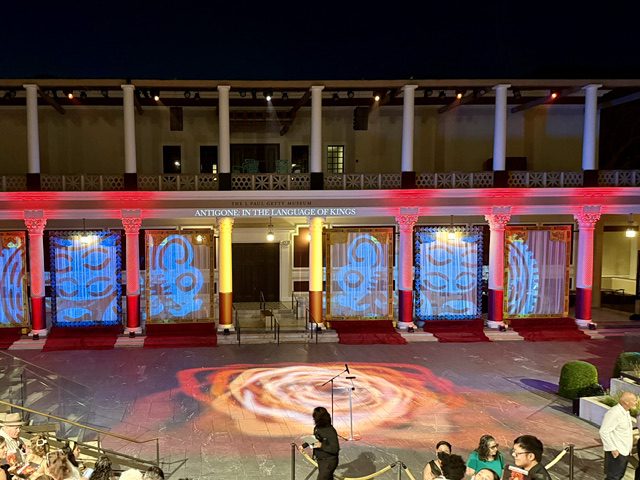
Adapted by Evelina Fernández and directed by Jose Luis Valenzuela, this reimagining of Sophocles’ tragedy of royal authority and divine law seems far away from ancient Greece but I find it amazing true to the ritualistic aspects of ancient Greek theatre. The performance weaves pre-Hispanic poetry, indigenous music, and Aztec mythology directly into the classical narrative. With stunning period Aztec costumes and mask-like facial make-up, we move away from contemporary naturalistic theatre into the highly ritualistic art form of ancient Greek stagecraft.
This brilliantly staged outdoor production tells a familiar tale that seems all the more powerful in the setting of the capital of the Aztec empire at Tenochtitlan. Antigone is a timeless story of resistance, conscience and the struggle for justice,” said Jose Luis Valenzuela, artistic director of Latino Theater Company. “Set in pre-conquest Mesoamerica, Evelina Fernandez’s adaptation draws upon the rich Nahuatl language and mythology to explore universal themes of faith, power and moral duty.”
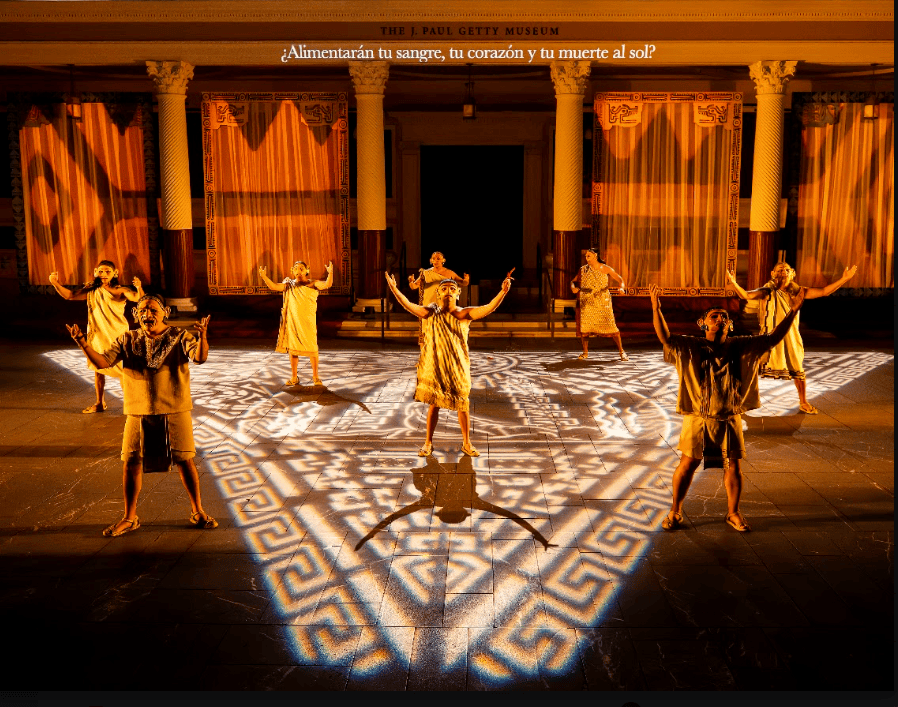
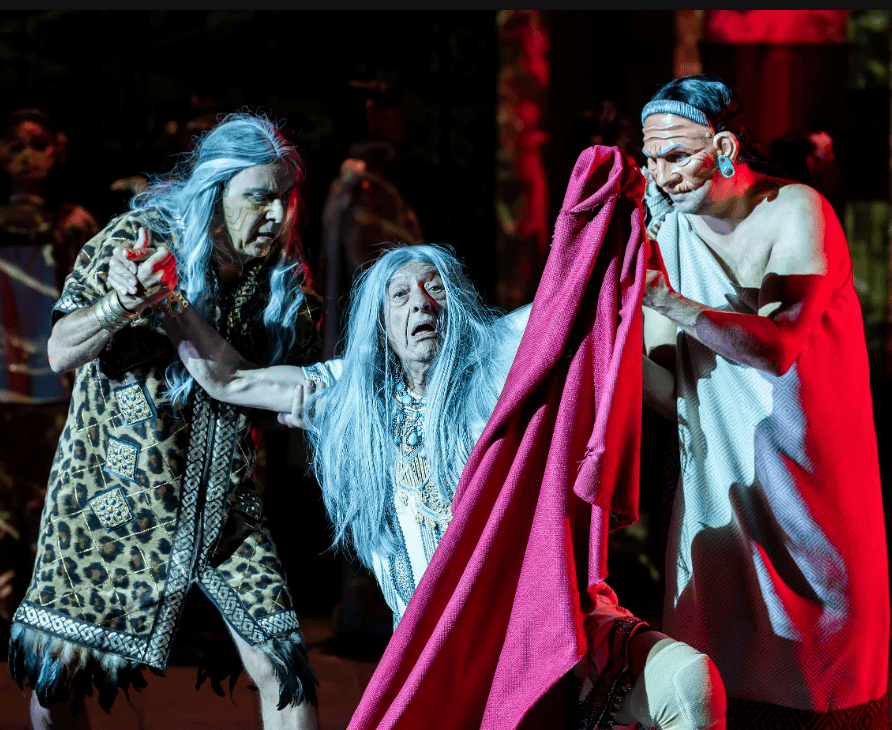
The large orchestra of the Greek stage is the center of the action for most of the play with the two-story “skene” or columned stage serving as the royal palace of Thebes for grand entrances and also Theban tombs. This production has an excellent cast, many of whom have appeared regularly in productions of the LATC but seem almost unrecognizable in Aztec attire and masks along with ritualistic face-painting. The costume designer Maria Catarina Copelli has created credible Aztec clothing and armor complete with feathered headdresses and ritual masks that would have been worn in that era in pre-Conquest Tenochtitlan.
Composer Christopher Garcia has created music and songs in Nahuatl and English for the Chorus to perform. The work of Urbanie Lucero as choreographer has shaped the movements of the battle scene, the funeral, and the choral dances. “We want to share the beauty of ancient Aztec literature, culture and rituals that most modern audiences are not familiar with,” added Evelina Fernández, associate artistic director of Latino Theater Company. “These traditions carry a profound poetry and wisdom that still speak to the human experience across centuries.”
“We want to share the beauty of ancient Aztec literature, culture and rituals that most modern audiences are not familiar with,” added Evelina Fernández. “These traditions carry a profound poetry and wisdom that still speak to the human experience across centuries.” The play is performed in English, Spanish, and Nahuatl, with English and Spanish supertitles available throughout the performance. Dates: Sept. 10–Oct. 3, Thursday through Saturday, 8 p.m. at the Getty Villa Outdoor Classical Theater, Pacific Palisades. Thursdays $45 ($40 for students/seniors); Fridays $50; Saturdays $60. To purchase tickets, go to: https://tickets.getty.edu/
In Sophocles’ famous triad of Theban plays, Antigone serves as the titular protagonist and central focus of the final play. Antigone is the daughter (and half-sister) of the cursed king Oedipus, who unknowingly killed his own father and married his own mother. Blinding himself as a punishment for his own failure of insight into his origins, Oedipus goes into exile. In Sophocles’ Oedipus at Colonus, we find Antigone loyally guiding her blind, exiled father Oedipus until his death.
The story continues in the third play Antigone when she decides to return to Thebes. Oedipus had two sons, Eteocles and Polynices, and two daughters, Antigone and Ixmene. Oedipus’s sons, Eteocles and Polynices, had shared rule jointly until they quarreled, and Eteocles expelled his brother. In Sophocles’ account, the two brothers agreed to alternate rule each year, but Eteocles decided not to share power with his brother after his tenure expired. Polynices left the kingdom, gathered an army and attacked the city of Thebes in the ensuing civil war Both brothers were killed in the battle.
Creon becomes the undisputed king of Thebes by right of succession as the closest surviving adult male blood relative of the royal house after Eteocles and Polyneices kill each other.Creon decrees that Eteocles is to be given an honorable burial but Polynices is not to be buried or even mourned, on pain of death by stoning. Antigone, the sister of the dead men, chooses to obey divine law over human law and buries Polynices anyway.
This is the situation at the opening of Sophocles’ Antigone. We see the battle between the armies of Eteocles and Polynices and their deaths on the battlefield. Creon assumes the throne and issues a harsh decree to provide Eteocles an honorable burial but leaves Polynices unburied as a traitor, making it a crime punishable by death to bury him.
In this fine LATC production of Antigone: In the Language of Kings, the Theban cycle of Sophocles is recast against am inter-dynastic struggle for royal control of Tenochtitlan and the Aztec Empire in pre-Columbian times.
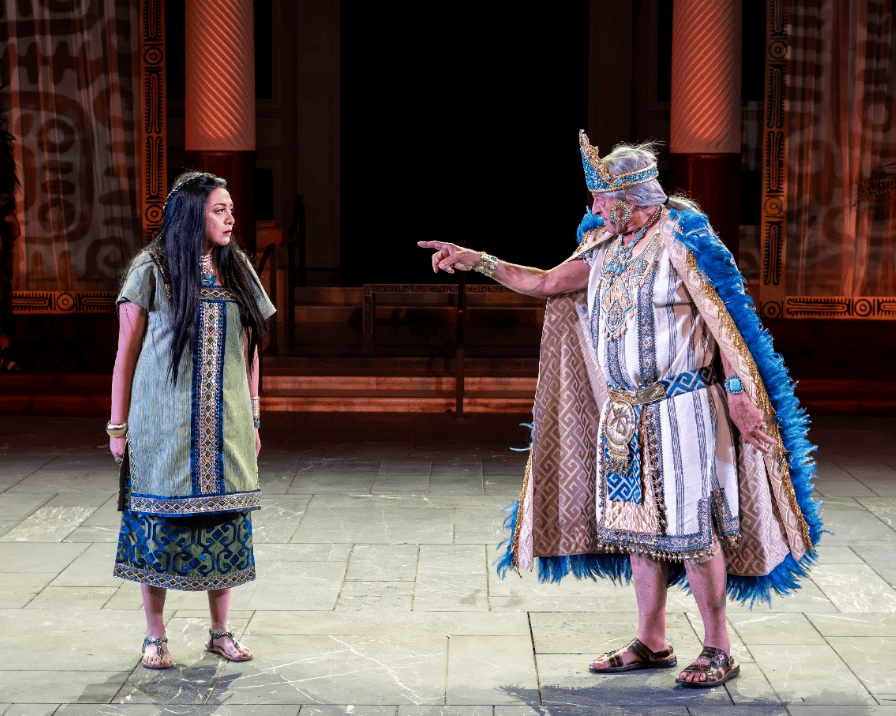
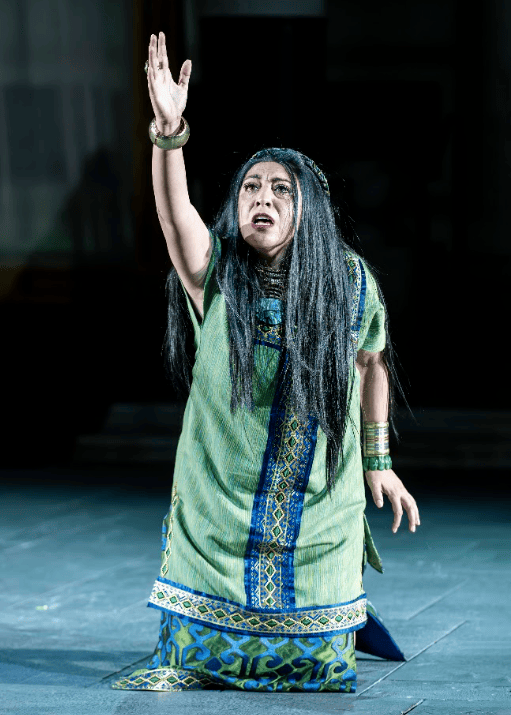
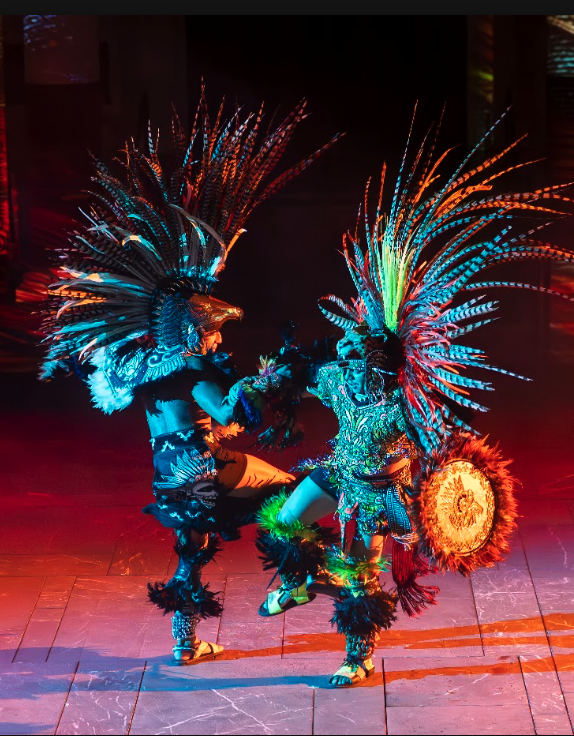
Antigone is Antikona, played brilliantly by Esperanza América and King Creon becomes Tlahtoani Klion (played by Cástulo Guerra), ruler of Thebes. We see the battle between the armies of Eteocles and Polynices with a number of Aztec warriors fighting on stage. Finally, the focus is on the two warring brothers (performed by Kevin Ortiz and Pollo) who fight deck out in bronze armor and plumed helmets in a highly fast-paced synchronized Los Machetes dance– with their legs seemingly bound together as they stomp, kick, and spin without falling over.
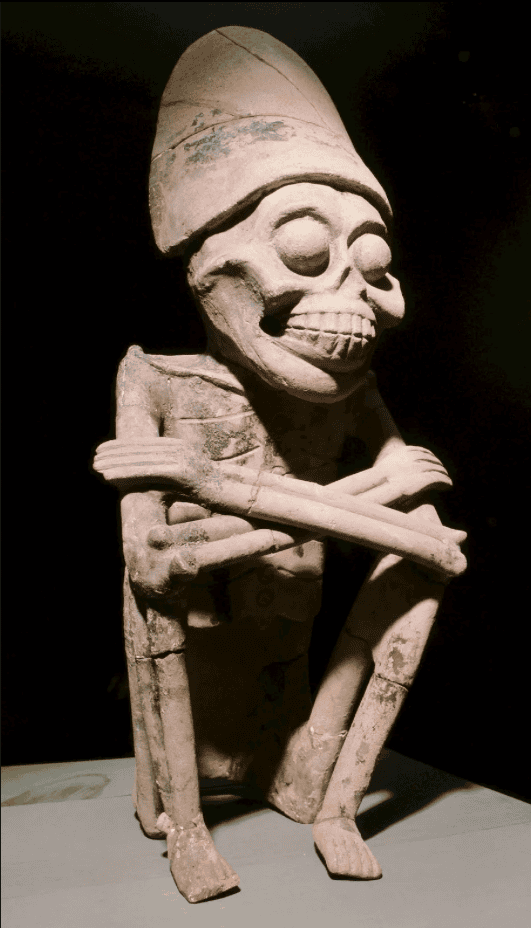
As they fall to their imminent deaths, a very tall figure of Mizuizrli (Death) appears all in black with an enormous cape that covers the battle field as she moves across the orchestra of the stage. Mizulzrli (performed by Tiffany Bonita Litz) is a giant figure with the face of skull and standing ten feet high in flowing black robes under stilts. While the Aztecs had elaborate masked dances, giant puppets, and professional jesters or acrobats, historical records and codices only suggest stilted figures in Mayan culture. Mizulzrli sweeps across the large stage gathering up the slain bodies under her endless black cape.
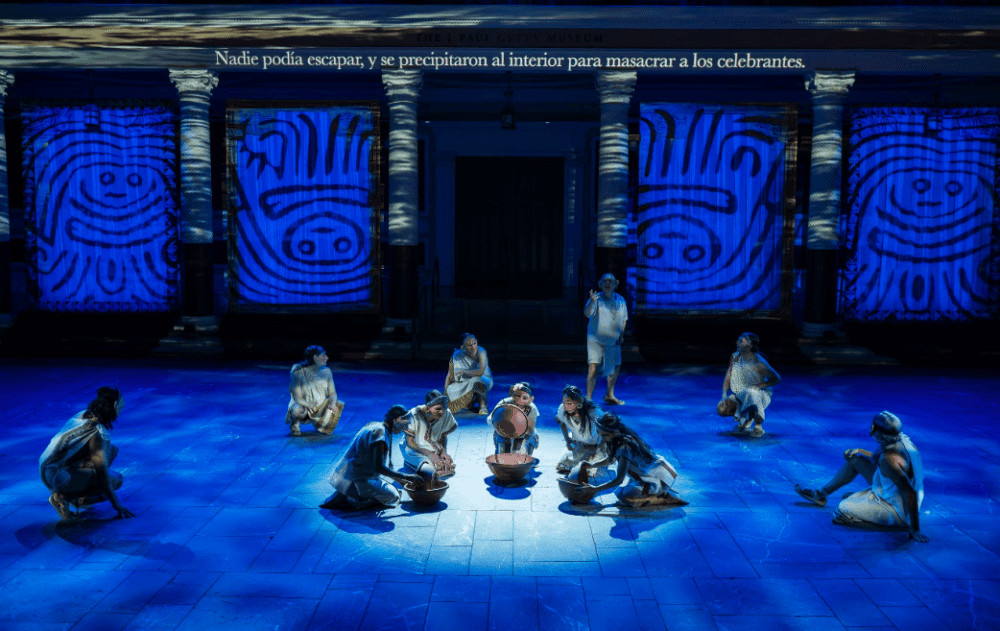
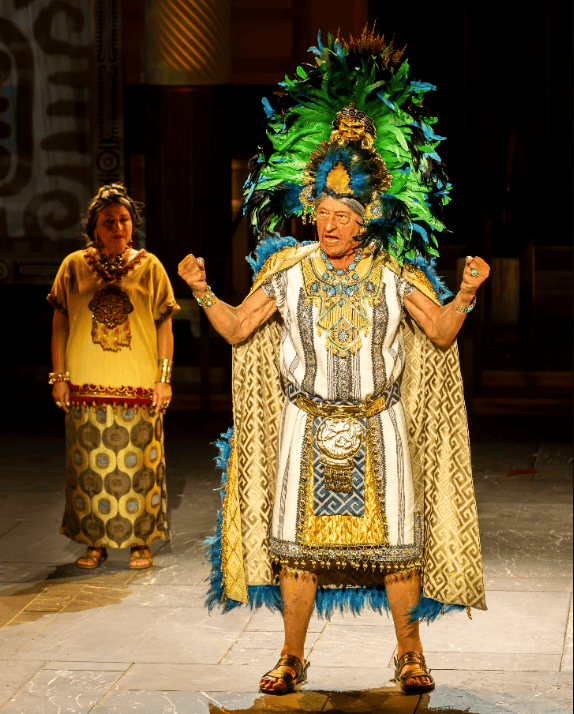
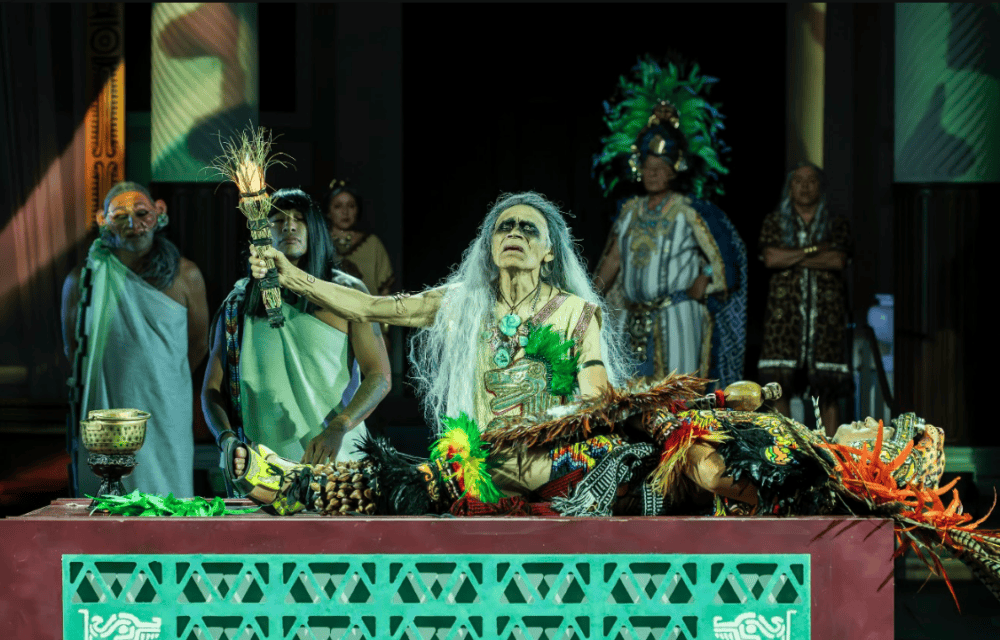
Then King Creon as Tiahtoani Klion (Cástulo Guerra) enters from the large wooden doors of the royal palace at Thebes, accompanied by his wife Queen Euridice (here Cihuatlahtoani), played by Zilah Mendoza. They are joined by Creon’s trusted advisor Ixtlamatl (Geoffrey Rivas). At this point, King Creon (Tiahtoani Klon) issues his decree, ordering Eteocleas an honorable burial ceremony and forbidding any burial of the corpse of his dead brother Polynices. We see and hear the Chorus (Koro) chanting their approval of Creon’s decree. What follows is the funeral of Eteocleas, whose body is carried in by soldiers and placed on an elaborate sarcophagus that emerges in the center of the stage. An Aztec priest of Death (Sal López) arrives to officiate over the burial rites.
The Chorus sings a choral Ode to Man, which praises human ingenuity while warning against dangerous hubris and lawlessness. In Sophocles’ play Antigone, the chorus represents the elder citizens of Thebes, acting as a collective voice that comments on the action, guides the audience’s emotions. They also, at times, interacts with the main characters – Creon and Antigone. This function of the Chorus (Koro) in this ancient Aztec setting retains the same purpose. Like the Chorus in Sophocles’ plays, the Koro group in this production consists of about 12 actors, who sing, dance, recite in unison.
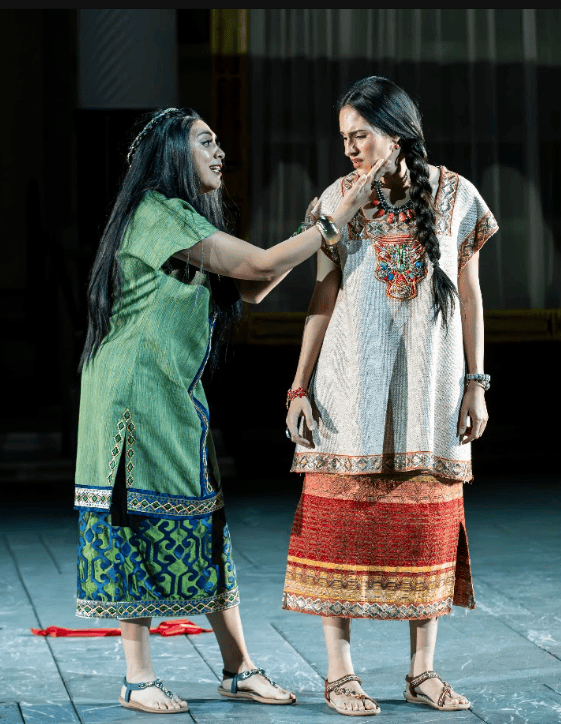
The scene shifts to the Theban princess Antigone (given the name Antikona, played by Esperanza América) with her sister Ixmene (Alexis B. Santiago), both distraught over the deaths of their brothers. Antigone is determined to go to the battlefield and retrieve the body of Polynices, despite the royal decree of King Creon. She explains to Ixmene that she must follow divine law and provide Polynices with a respectable burial. Ixmene tries to warn her of the possible consequences of defying the King’s order. Antigone goes ahead and finds the body of Polynices and begins a proper burial but she is soon caught in the deed and arrested by the King’s guards.
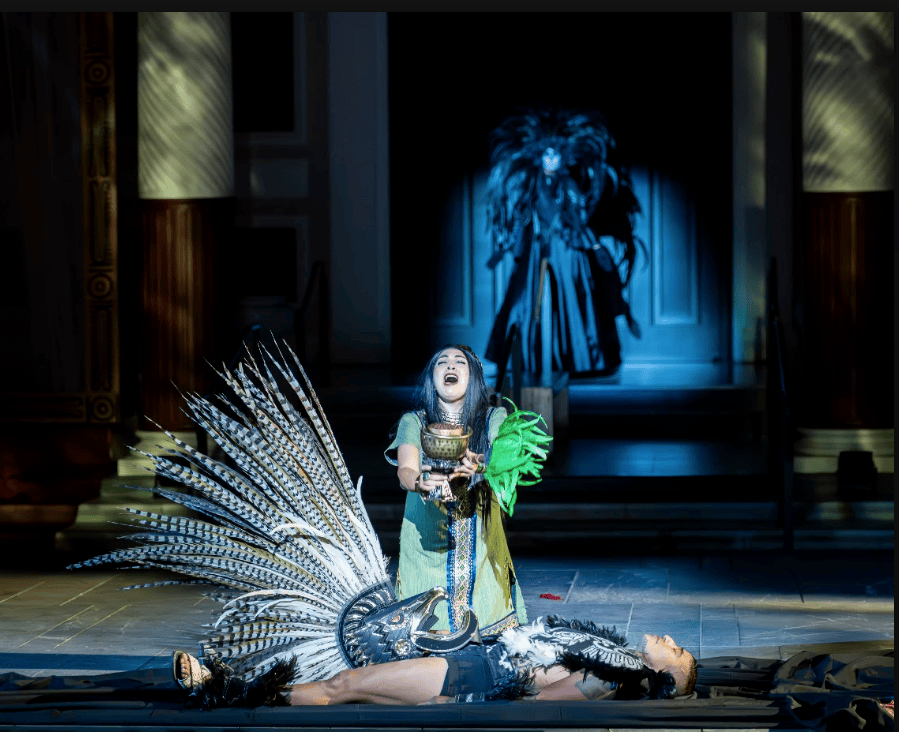
Creon is holding court when two guards (Richard Azurdia and Randy Vásquez) show up in a rather comic scene where they try to explain that the corpse of Polycides is no longer out on the battlefield. They are afraid of being punished and reluctantly reveal who took the body. Antigone is arrested and brought before Creon, confessing her crime and foreknowledge of the king’s edict that Polynices neither be buried nor mourned, claiming the superiority of divine law to human law. Antigone’s self-defense in defiance of Creon is passionate, courageous and determined. Creon orders Antigone buried alive in a tomb.
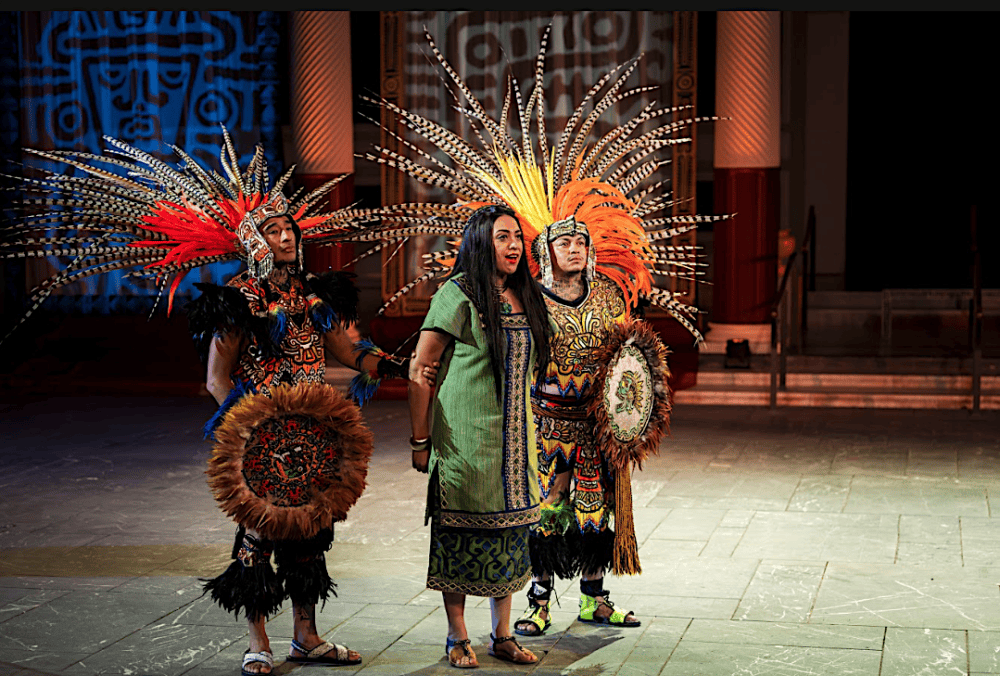
Creon’s son Haemon (José Eduardo Moreno) was engaged to marry Antigone. When he finds out that Antigone has been arrested and sentenced to death, Haemon pleads with his father for mercy, but to no avail. At the point, the Chorus (Koro) which previously mouthed words of support for Creon shifts to the defense of Antigone, who they see as a victim of Creon’s tyrannical acts. They have come to understand the misrule of Creon and reflect the community’s shifting fears, sympathies, and doubts, moving deep concern over his rigid decrees.

All the action to this point has taken place on the large stage. But suddenly the light shines on the upper balcony of the skene or proskenion where Antigone is imprisoned. There we hear her last words and she makes a noose from cloth with which to hang herself. This tragic end of Antigone is her ultimate defiance of Creon. When Haemon arrived to check on Antigone, he witnesses her dead body and in despair kills himself with a sword.
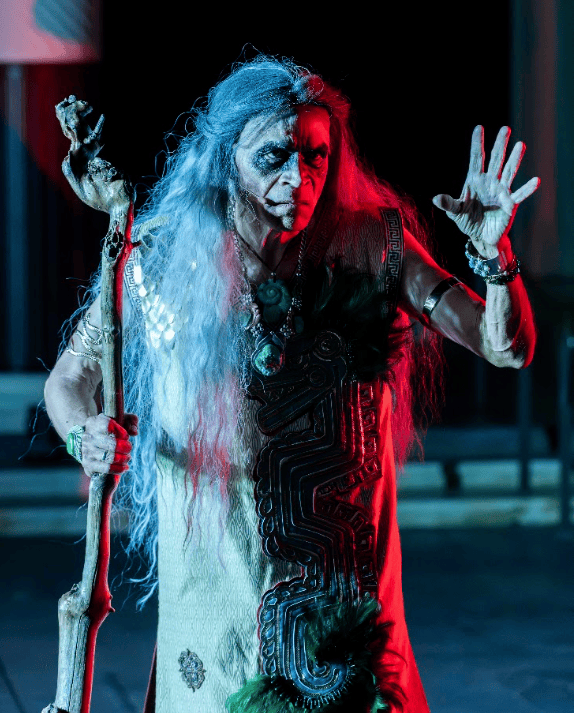
Creon finally has a change of heart – due to a visit from blind soothsayer Tiresias (here named Tetzahuitl and played by Sal López). Creon tries to release Antigone, but it is too late. She has already hung herself. When Queen Euridice (Cihuatahtoatl) learns of the death of her son Haemon, she delivers an impassioned diatribe against her husband, accusing him to misrule and misunderstanding.
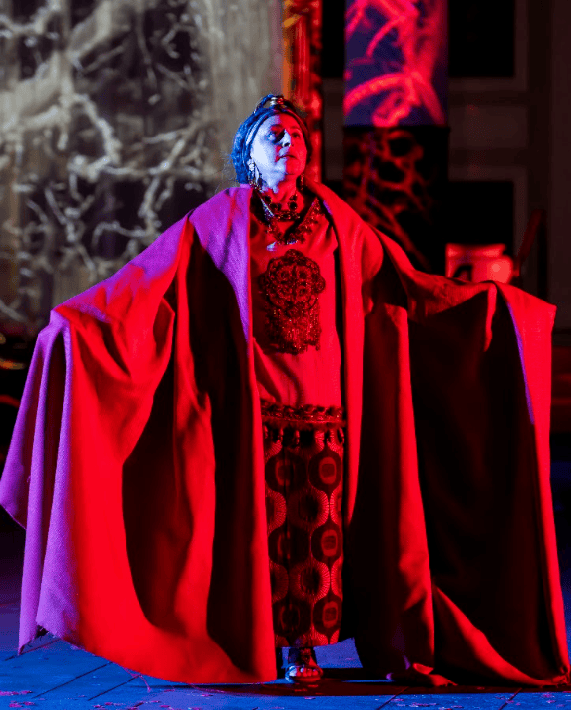
In despair, she kills herself, thus ending the House of Atreus in the blackest of tragedies. All that remains is the final verdict of the Chorus (Koro) that bemoans the causes of all these deaths. By the end of the tragedy, as Creon faces total ruin, the chorus underscores the play’s ultimate lesson: that pride brings punishment and only through suffering do we attain wisdom.