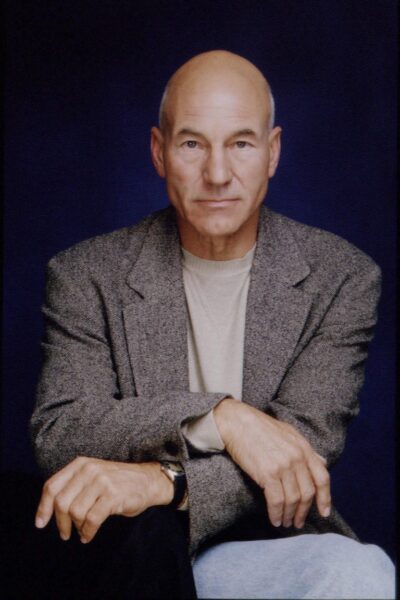
There have been quite a few notable deaths this year. Each one brought a tear to many. This, however, is a truly devastating loss. We say goodbye to an actor who personified dignity and grace through his career.
Sir Patrick Stewart has died at 86, at his Los Angeles home, leaving behind a body of work that felt immeasurable while also somehow intimate. Performances that made distant stories feel present, and characters both grand and human. His passing was met with a kind of quiet astonishment, in part because he did not disclose that he was living with Alzheimer’s disease and Lewy Body Dementia. Even in this, his private life remained, as it often was, guarded and deliberate. Yet what he gave the world was anything but private: he offered his voice, his intelligence, and his craft, repeatedly, until they became part of public memory.
Stewart was born in July 1940, during the beginning of World War II, when the world seemed to be holding its breath. His father, Albert, served as an officer in the British Army’s Parachute Regiment. In the years that followed, that history returned in painful ways. Stewart later spoke about the abuse he suffered after the war—linked, he said, to what his father experienced in combat, later understood as PTSD. From that hard beginning, he did not retreat into bitterness; he turned toward expression. If his early life taught him anything, it was the fragility of dignity—and the power of reclaiming it through art.
© lya S. Savenok/Getty
The turning point came not in the spotlight, but in a classroom. A teacher, Stewart credited, put a copy of Shakespeare in his hands. That simple act—paper, ink, and insistence—opened a door he would not close. When he left school, he worked in a furniture store so he could attend rehearsals. It’s a detail that carries a particular reverence: ambition sustained by ordinary hours, by persistence rather than privilege. From there, he earned the West Riding grant for theatre work, the first recipient who had not attended either Cambridge or Oxford—an early sign that he would never accept limitations as fate.
In the late 1950s and 1960s, he spent much of his time in live theatre, joining the Royal Shakespeare Company. This was where he built the engine of his career: the disciplined intensity of rehearsal rooms, the discipline of language, the responsibility of bringing text to life in front of others. He worked alongside actors such as Ian Richardson and Ben Kingsley—collaborators who, like him, understood that performance is both craft and risk. In theatre, Stewart seemed to find not only roles, but a kind of steady purpose.
His breakthrough into major recognition came in 1979, when he won his first of two Laurence Olivier Awards for best actor. He also appeared in British television, including Shakespeare plays—work that broadened his audience and, in ways he likely couldn’t have predicted, paved the way for the screen. Films soon followed, including Excalibur, Lifeforce, and Lady Jane. Even then, you could feel what would become a hallmark: his voice didn’t merely deliver lines; it inhabited meaning.
© Aaron Rapoport
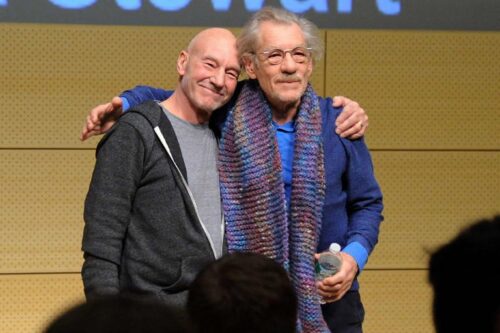
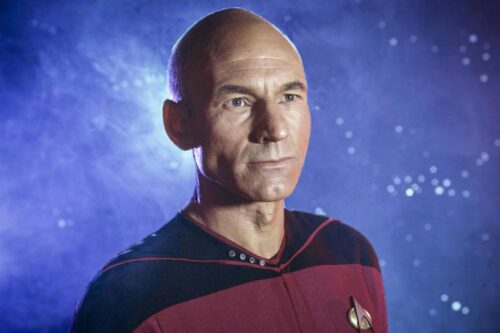
Yet for all the variety in his career, Stewart’s international fame arrived through a genre he once admitted he never cared for: science fiction. In 1987, he agreed to read for Star Trek: The Next Generation. He told the story as something he hesitated over for months, but ultimately, he took the chance. His friend Ian McKellen urged him not to dismiss it, emphasizing that Stewart’s stage experience could only raise the bar for the role. He played Captain Jean-Luc Picard for seven seasons, returning for sequels and movies in which the character remained steady even as the universe around him expanded. The Screen Actors Guild recognized his work through a nomination, and Stewart later said Picard changed everything for him.
What does that mean, “changed everything”? In Stewart’s case, it suggests more than success. It points to a particular alignment: the ability to bring gravitas, restraint, and moral clarity to a story often dismissed as formula. Picard became, for many viewers, a compass—someone who held complexity without surrendering decency. Stewart’s performance gave science fiction its seriousness, not by stripping it of wonder, but by grounding its questions in character.
Everett
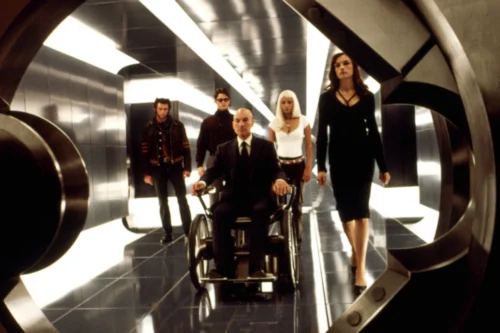
For Stewart, however, one chapter never closed the next. While he missed theatre—and he did—he still stepped into film with the same commitment. In 2000, he played Doctor Charles Xavier in the first X-Men movie. He described the role as akin to Picard: a leading figure at the center of a team, a mentor whose power is measured not only by what he can do, but by what he chooses to protect. His Xavier would appear in seven films in the franchise, with a cameo in Doctor Strange in the Multiverse Madness, and he was set to reprise the character again in Avengers: Doomsday, scheduled for release in December of this year.
Over the decades, Stewart played a wide spectrum of figures—on stage, on television, and in film. On stage alone, his repertoire carried the weight of classics: Captain Ahad from Moby-Dick, Scrooge from A Christmas Carol, Prospero from The Tempest, and the full storm of Shakespeare—Hamlet, Romeo, Richard III, Othello, Macbeth. He even lent his voice to an animated Animal Farm, portraying Napoleon the pig, proving that his command of presence could translate into any medium.
His awards and nominations reflected this range: Tonys, Grammys, and Emmys among them. And in June 2010, he was knighted by Queen Elizabeth II—an honor that recognized both the longevity of his career and the steadiness of his excellence.
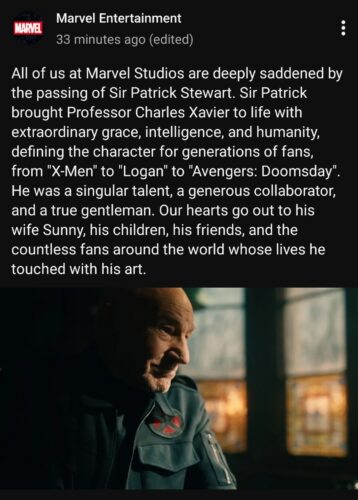
Sir Patrick Stewart’s death brings an end to a remarkable era of performances. Yet what he left behind does not diminish with time. It persists in the cadence of Picard’s calm authority, in the emotional clarity he brought to Shakespeare, in the way he could make even a fictional universe feel like a place where moral choices matter. In remembering him, we are reminded that a life can be both grand in its public achievements and quietly restrained in its private pain.
He never asked to be reduced to roles or titles. He simply kept giving his talent to the stories—and the people—who needed them. And now, in grief, we can still celebrate the gift that remained: a voice that will not be forgotten.