Santa Monica, CA (The Hollywood Times) June 23, 2026
Ian McRae has written many plays, including 10-character dramas and two-handers. But his latest, Painted Ponies, now onstage at the Ruskin Group Theatre’s black box Audre Stage, is something else. It’s 75 minutes long, one actress, with an iPhone on a tripod and the action simply the recording of a video.
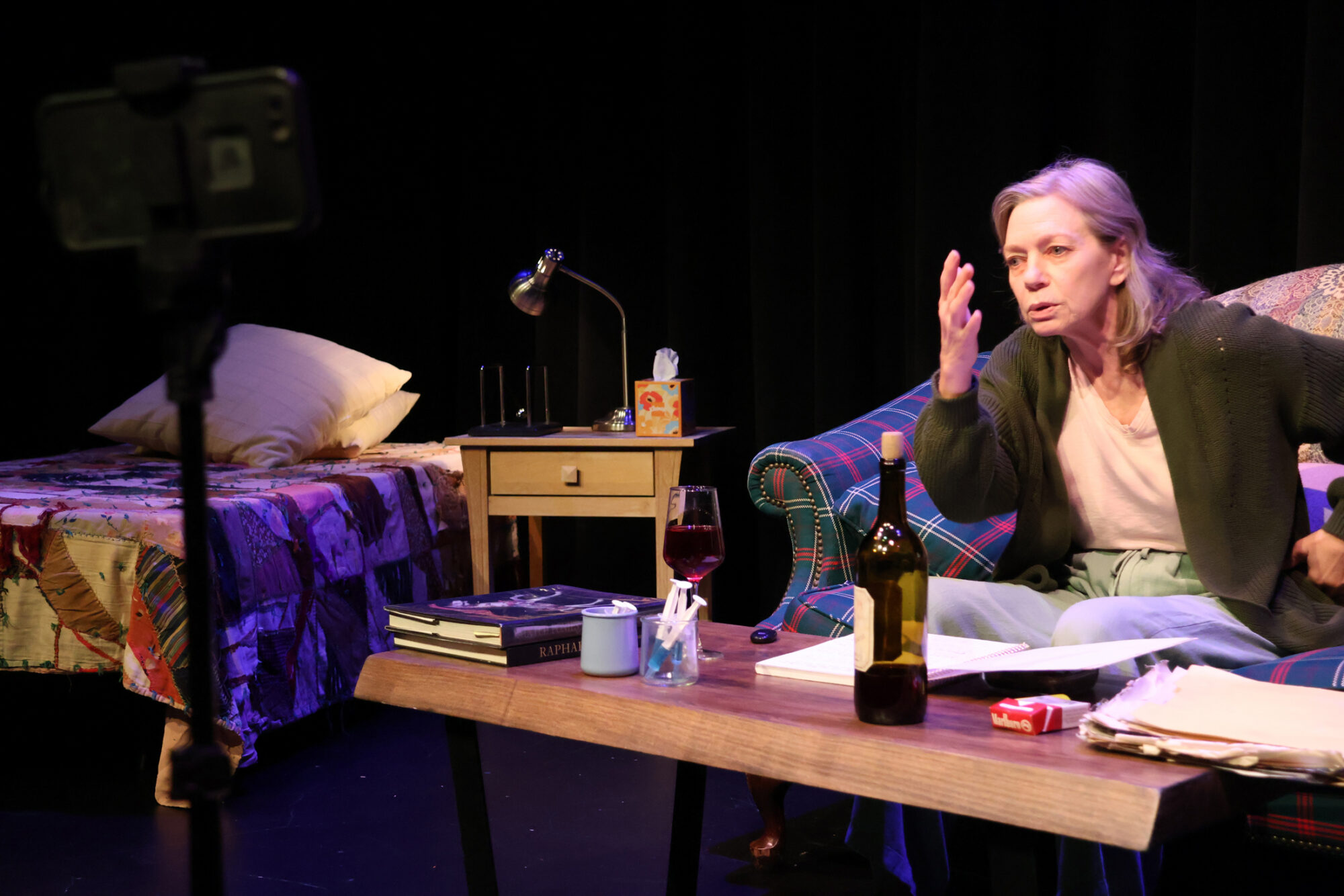
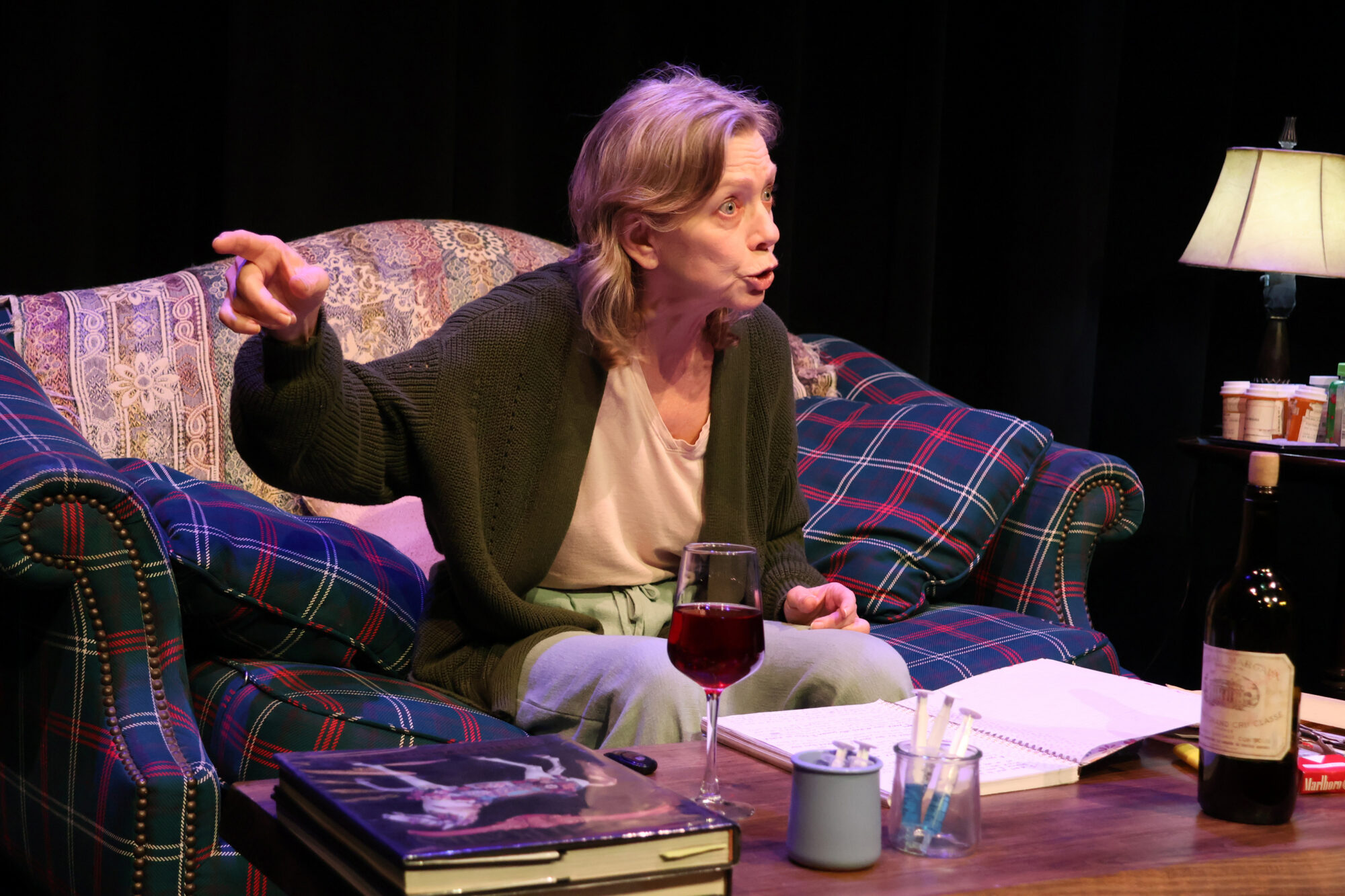
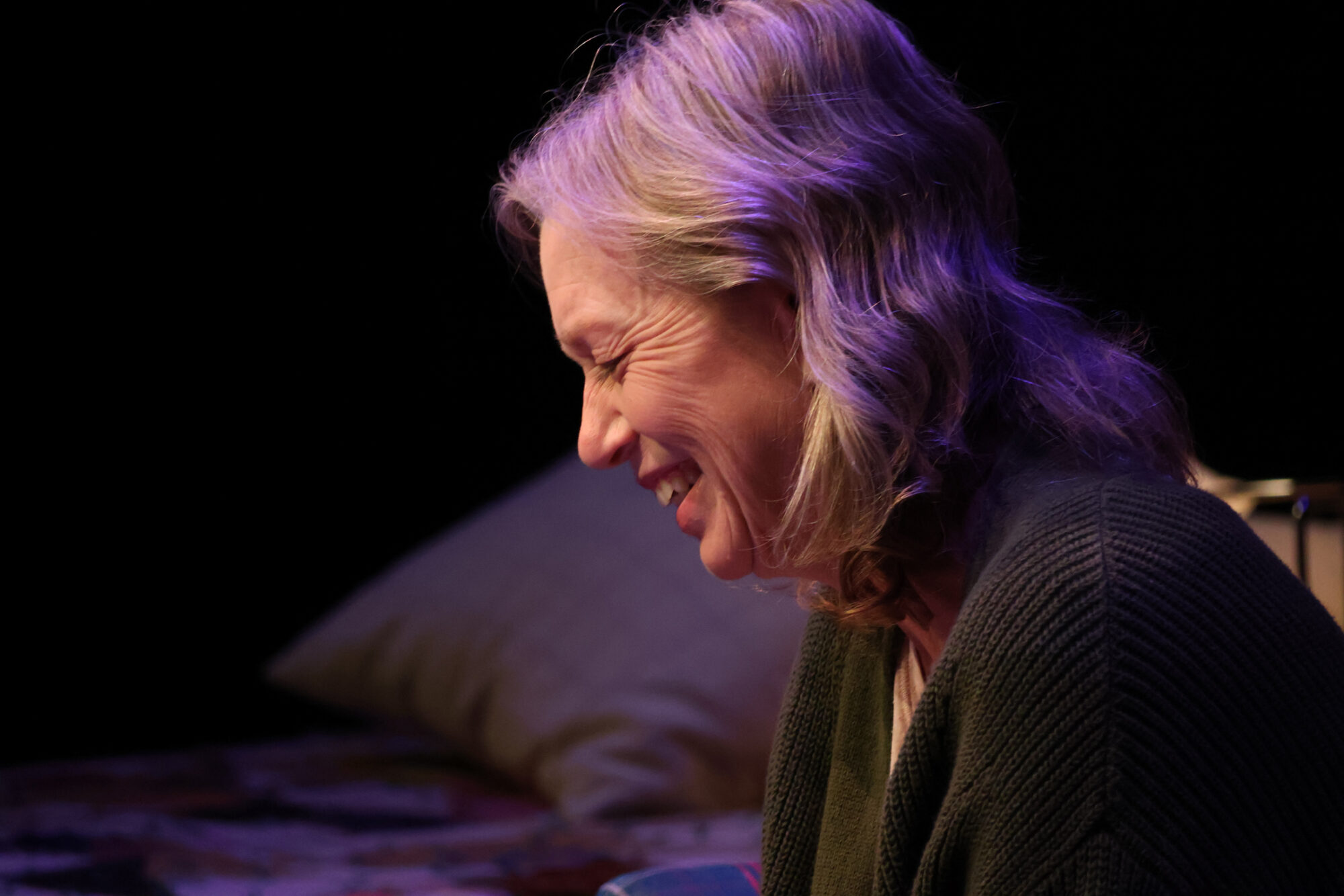
She’s on a couch with a bottle of wine and a full glass in front of her, a single bed to her right, and a side table with a lamp and multiple pill bottles to her left. The set up may be simple, but her story is anything but.
Asked what Painted Ponies is about, McRae says, “A woman dying of cancer whose son went missing years ago and what her life has been like ever since. It’s not an easy sell,” McRae admits. “You can’t say too much about it or you give away the plot.” The rest he’d rather you discover in the dark of the theater, the way audiences are doing, then talking about it afterwards.
This is McRae’s third production at The Ruskin Group Theatre and he’s known John Ruskin since the two met in Sanford Meisner’s New York acting school in 1985. The others are The Alamo, set in a blue collar Bay Ridge Brooklyn bar, and The Joy Wheel, about a lifelong couple being pulled in different directions that takes a “prepper” turn. Painted Ponies is a one-woman monologue.
“A 10-character play has its challenges,” McRae says, “but a one-person play, when it’s just so intimate, it takes a director with a very deft hand.”
The hand belongs to Elina de Santos, whom McRae calls the hardest-working director in Los Angeles. While getting Painted Ponies ready, she had two other productions running. “She never stops,” he says. “She still sees every performance.”
De Santos had to create a private relationship between the character, Pam and a son named Michael who is absent from the stage but never from the play. He’s invisible but, “He’s not imaginary to Pam,” McRae says, “because he lived; he was her son, and is still her son.” De Santos’s job, as he describes it, was to stay close enough to shape that relationship without ever becoming a third voice in it.
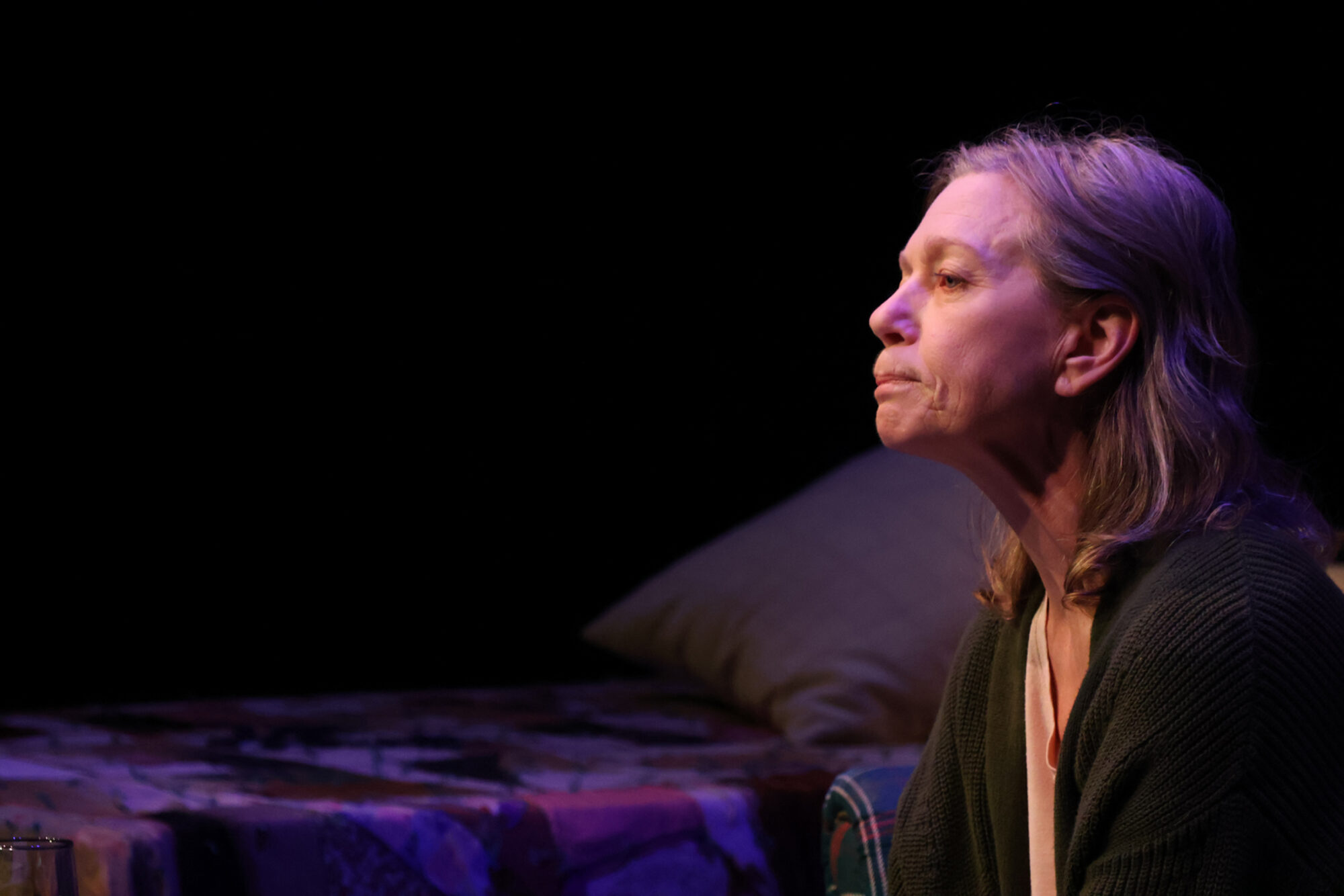
Actress Rachel Sorsa made an early decision that surprised McRae: she would memorize the entire 75- minute script, and not use the prop notebook (in this case, a scrapbook built into the staging) as a safety net. “She just worked and worked,” McRae says.
To prepare, Sorsa spent time at the Santa Monica Pier carousel, whose creator Charles Looff also built the carousel that helped shape McRae’s own childhood in Santa Cruz.
Painted Ponies started as a ten-minute piece, written during the pandemic after McRae read about a writer who’d taken on the challenge of writing a one-woman monologue, and thought he’d try the form himself. He grew up the only boy among four sisters, raised largely by women — his father wasn’t around — which he offers as the closest thing to an explanation for why a woman’s voice came to him so naturally.
The inspiration for the play in part was McRae’s best friend from high school, who was diagnosed with terminal cancer. With no family of his own, he moved into the studio apartment behind McRae’s house in Santa Cruz and lived out his final year there.
The friend requested medical aid in dying. Two doctors signed off; the medication arrived by mail and sat, untouched, on the back porch for months. “I certainly didn’t want to try to influence him any way,” McRae says, “but he had to be cognizant enough to know he has to do it on his own. He has to pour it down his own throat.” In the end, his friend never took it. He died in his sleep.
“It did get to me afterward,” McRae says. “A couple of months after he died, I really kind of fell into this depression.”
Sitting with a dying man for a year raises the kind of questions that don’t resolve easily: what’s on the other side, what it means to choose your own ending, how a life adds up to what it became. Those questions became Pam’s questions.
But how does a man’s death by illness become a play about a woman’s loss of a child? McRae doesn’t fully know. “When I sit there and watch that play, it’s like the mystery of the muse.”
Some real reported tragedies about parents losing their children became part of Pam’s monologue. A woman whose car stalled on railroad tracks, got out with her children still in the car, running down the tracks to flag the train to stop. It didn’t and they perished. McRae thinks he still has the clipping somewhere.
Other stories, gathered over years the way a writer collects things without quite knowing why, are included as Pam justifies her one mistake, being on the phone when her son was on the carousel, comparing them to others. A child who climbed onto a fence at a zoo exhibit and fell in, only to be mauled to death by the animals. Another carried off in a bouncy house that came loose in the wind. McRae says, “That just happened again a month or so ago, in Canada,” he says. A father who forgot to drop off his kids on his way to work, later found dead in the back seat.
“Those are all true,” McRae says. “And one will lead to another, to another — how does this happen? You start looking into it. Wondering about chance and fate.”
Other details are autobiographical, lightly disguised. Pam names her son Michael after a neighbor who later attended West Point and became a general. That was McRae’s actual neighbor. The carousel from which Michael disappears is the one McRae grew up riding, in a town his family has called home for five generations.
He says his sisters have all come to see the play, and that more of their lives is folded into it than he’s willing to itemize for the record. But he does acknowledge that “There’s a lot of alcohol in my family,” he says, “as well as a lot of recovery.” Pam is coming off of years of sobriety.
The play’s title echoes Joni Mitchell’s “The Circle Game” (And the seasons, they go round and round and the painted ponies go up and down). He’d hoped to include it in the production, but “We tried it, and it didn’t work in the end,” McRae says simply.
In the opening minutes, Pam reviews her history with her son, and then says: “On Saturday, May 25th 1998, I put you on the Merry-Go-Round at the amusement park down at the Boardwalk here, and I never saw you again. That was 24 years ago. You were six years old.”
McRae says that’s the moment the audience sits up. It’s also, he says, the moment that tends to start the conversations people have walking out to their cars afterward — about fate, about how little separates one version of a life from another, about how a single second, a red light, a missed phone call, can change the course of everything.
McRae is disciplined about writing every day for three to four hours. He doesn’t pretend to fully understand how he found Pam’s voice. He just knows he kept sitting down at the desk until it arrived. And we’re here to witness the result, the story of a parent who is haunted by past mistakes. While making peace with regret, this fiercely determined mother becomes an affecting portrait of a woman who tried her best to be human in an inhumane world, refusing to let loss have the final word.
Painted Ponies is onstage at the Ruskin Group Theatre, 2800 Airport Avenue in Santa Monica, through July 19th, with performances at 5 pm on Saturdays and 4 pm Sundays (except July 4th weekend). http://www.ruskingrouptheatre.com or call (310) 397-3244