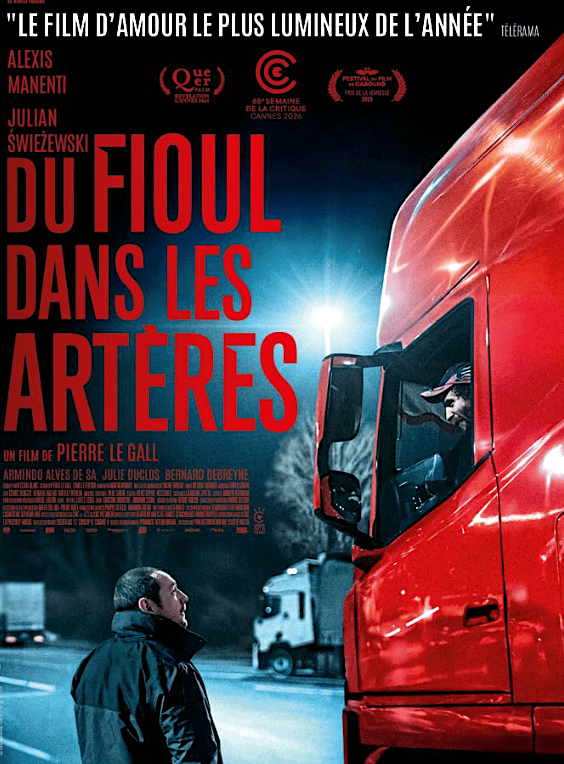
One pleasant surprise at this year’s AFI FEST was a French film directed by Pierre Le Gall and co-written with Camille Perton – FLESH AND FUEL (Du fioul dans les artères, which translates as: ”Heating Oil in the Arteries”). A lonely French truck driver’s routine life on the road takes an unexpected turn when he encounters a Polish driver at a truck stop on the busy highways that crisscross Europe. This is a queer romance with men approaching age 40. The taut 90-minute story, told with bracing ease, initially follows a quiet Étienne (Alexis Manenti) living a repetitive life: Hauling goods to the same cities, cleaning himself with baby wipes in the same rest-stop bathrooms, and continually checking in with his dutiful dispatcher. He’s not married, but does have a sister and a nephew. He’s also deeply professional, chastising a new, young hire when he notices the younger man lacks care and precision.
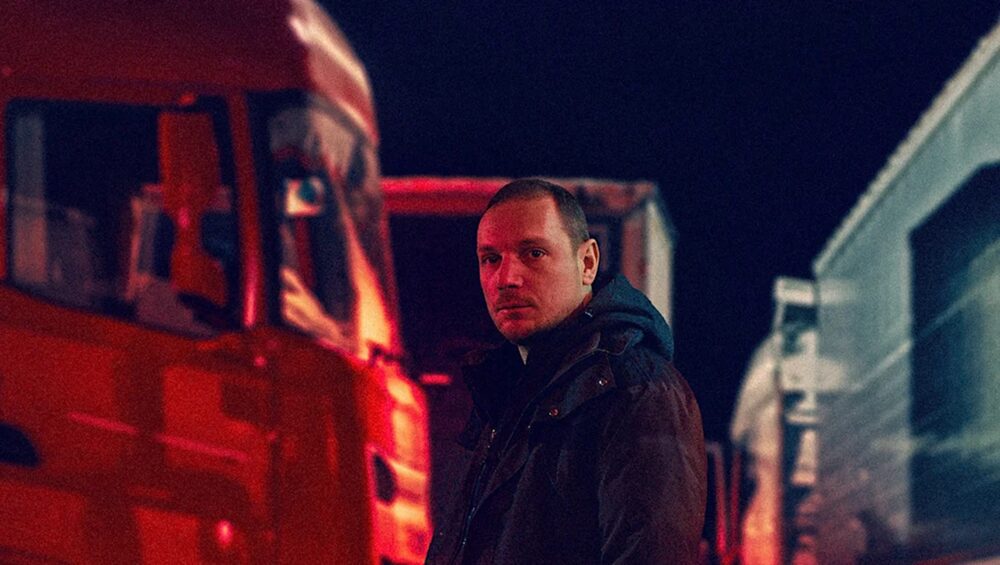
Initially, there doesn’t appear to be much happening under Étienne’s stoic exterior. That is, until he goes cruising through the woods. There, he happens upon the Polish immigrant and fellow long-haul trucker Bartosz (Julian Swiezewski), beginning a relationship whose rapturous intensity is often separated by speed and distance. What is unexpected is the way Étienne finds that interpersonal connection is as important, if not more so, than his work.
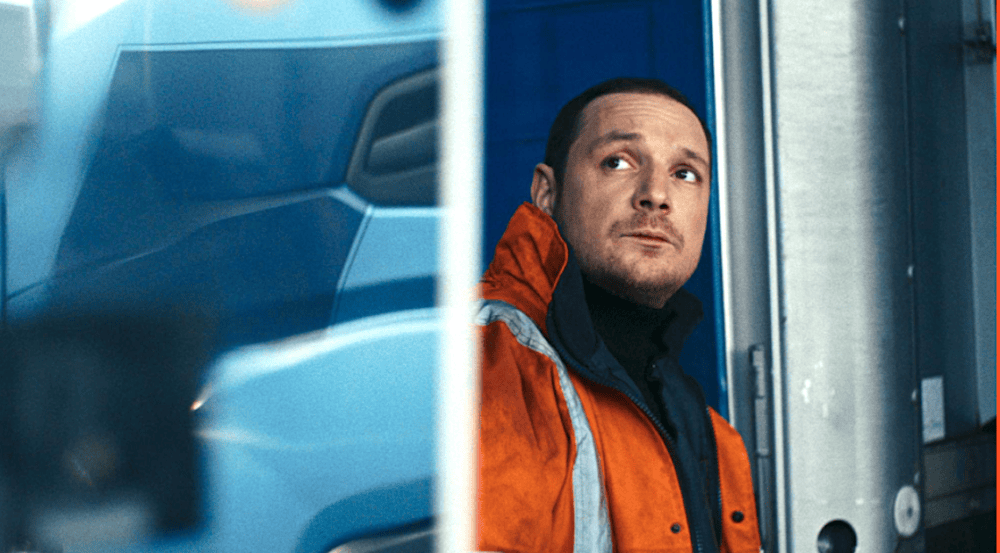
Flesh and Fuel isn’t concerned much with violence and so contrasts significantly with the Mexican film En el camino (2025), where the life of long-distance truckers is fraught with brutality, drugs, homophobia and sex for money. Flesh and Fuel does not resort to leaning on emotionally and physically traumatic violence. However, there is one cruising in the woods near a truck stop where the two men happen upon each in a place where public sex goes on at night. They manage to run from the scene, award that a one-year jail sentence and a large fine could result, if they are caught in the act. That particular scene is about risk but it also shows Bartosz’ ability to use his Polish identity to cover for Étienne, as well as making the first move towards their interest in each other.

Bartosz and Étienne only reveal each other’s names to one another before they part for the first time in Flesh and Fuel, as if everything about their first romantic encounter happens in reverse. Both long-haul truckers with certain needs, they find each other in the woods off the road that has a reputation for its anonymous sexual encounters and would have no reason to exchange any information to each other after connecting on a far more intimate level. When the police break up the cruising scene, the two men actually have to start talking.
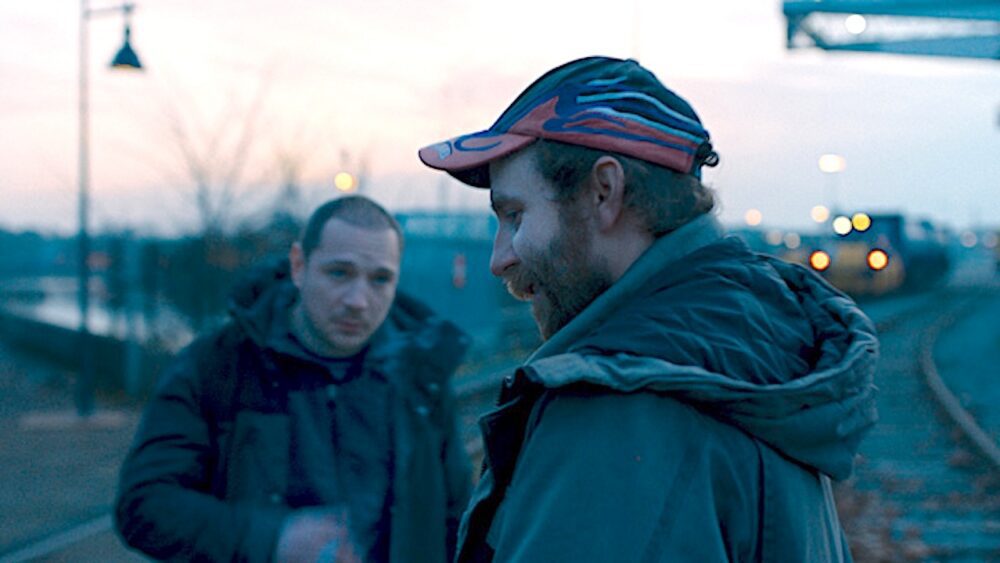
Flesh and Fuel is not a coming-out story. Both men are approaching 40 and burly, despite their awkwardness. Étienne and Bartosz’s families are quite open and supportive of their gayness. Instead, the film provides a refreshingly simple picture of two men who desire to be together, despite the challenges of their jobs and their lack of the emotional tools to fully commit to one another.

Flesh and Fuel does deploy Étienne and Bartosz’s fitful romance to explore other subjects. Étienne’s company, for instance, is deemed “too expensive” by many European companies. The drivers of 18-wheelers in Étienne’s company are properly paid and given requisite time off. Étienne must shift toward hauling goods to England, which will take him further away from Bartosz. That route requires putting the rig on a railroad car and traveling through the tunnel under the English Channel. By contrast, Bartosz, an immigrant working for an exploitative company, requires him to drive far longer distances for significantly less pay. His routes cover more of Europe. The strain in their routes causes their harmonious relationship to buckle.

In the Q&A after the screening at the AFI FEST, director Pierre Le Gall talked at length about the life of long-distance truckers and how he developed his story around the loneliness and desire of gay men who are also in this line of work. In the film, we see migrant workers in the factories where Étienne stops to deliver and pick up cargo pallets. The difference between the working conditions of unionized workers in France and free-lance worker in much of Eastern Europe is woven in scenes in the film. Étienne can afford to stay in truck stop motels and eat well in restaurants, whereas that option is not available for Bartosz.
It is interesting that in the long-haul trucking world, queerness is not uncommon and there seems to an understanding that that is normal in that world. Étienne eventually manages to overcome an early reticence towards articulating what both men are really feeling towards one another. The two pass each other on different sides of a busy highway, honking a greeting like strangers in the night. Étienne, who definitely doesn’t wear his emotions on his sleeve, has had his interest piqued by Bartosz. He starts keeping an eye out for Bartosz’s big red truck at various depots. Even after the two begin developing a deeper relationship than casual sexual rendezvouses, a real relationship proves elusive when they are pulled in opposite directions by their work. Bartosz has to drive all over Europe with his work. French-born Étienne, a second-generation trucker with union protections can keep his routes short within his own country.
The two are out on the road so long that the thought of any permanent attachment has become foreign, but after a misunderstanding Bartosz cuts off phone connection with Étienne at Christmas time. Talking to his sister in France during the holiday, Étienne begins to wonder if there will be any future love in his life. But something clicks after talking to his sister and he asks for time off from his job to try to find Bartosz wherever he might be. He is resolved to make the connection he felt happen.
Flesh and Fuel captures the gritty aesthetic of a typical working-class drama, and director Pierre Le Gall spent much time researching the lives of long-haul drivers. in spite of signs of a general acceptance of his sexuality to those who pick up on it, Étienne himself carries outdated ideas about what he can and can’t do as a gay man, still feeling it’s necessary to tuck into the dark of night to hook up and a conventional domestic life with a family of his own seems slightly out of reach at least psychologically if not practically.)
As Étienne surprises himself with the feelings he has for the man he met so casually. Flesh and Fuel is disarmingly familiar yet completely original, given its milieu and its unusual romantic leads who have to recognize that their connection is something worth fighting for. Both tender and funny, the film radiates warmth throughout that Étienne and Bartosz struggle with showing how they feel to each another.
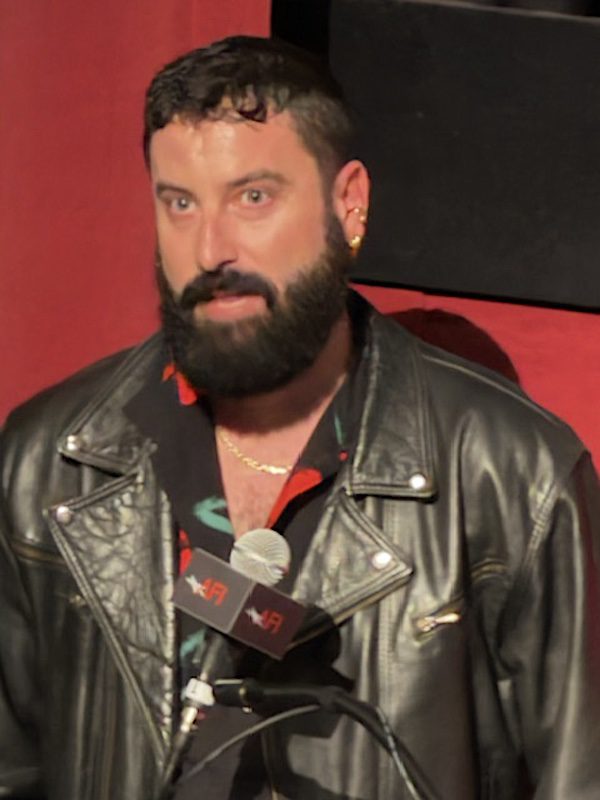
A self-described “wayward photographer” influenced by Henri Cartier-Bresson, French writer/director Pierre Le Gall unleashes a vulnerable, semi-autobiographical take on experiencing an all-consuming love in Flesh and Fuel. Previously working on short films which also dealt with characters building to a confrontation with their emotional realities despite employing self-defense mechanisms to avoid them, Le Gall mines the innate loneliness of truck drivers, a specific occupational experience further exacerbated by queerness. Le Gall’s film brought him the Queer Palm Revelation Award at Cannes this year.
The film is a stand-out role for Alexis Manenti, who has cut his teeth on various masculine characterizations. A musical interlude set to “Down in Mexico” by The Coasters (most iconically utilized in Tarantino’s Death Proof (2006), suggests a progression of attitudes and potential permissiveness available to Etienne within his milieu. The film has been picked up for distribution by Strand Pictures and will hit art houses soon.