
Sweeping, passionate, and highly ambitious, La Boca Negra (The Black Ball) is Javier Calvo and Javier Ambrossi’s film that was a sensation at Cannes where it took the Best Director Award and is being distributed in the USA by Netflix. La Bola Negra weaves three connected stories, each shot in different film registers, chronicling the travails and legacy of Spain’s gay experience in 1932, 1937 during the Spanish Civil War, and 2017. It picks up on the first four pages in an unfinished novel by legendary poet-playwright Federico García Lorca plus some of his nearly last poems. A bold tapestry spanning nearly a century of Spanish history, La Bola Negra tells the story of three generations of men whose lives are intimately connected through desire, pain, and love. The Spanish poet and playwright Federico García Lorca is the subject of The Black Ball, but we never see him until its finale. He lingers over proceedings as a guiding spirit, reminding all involved of his and others’ sacrifices in the heat of the Spanish Civil War.

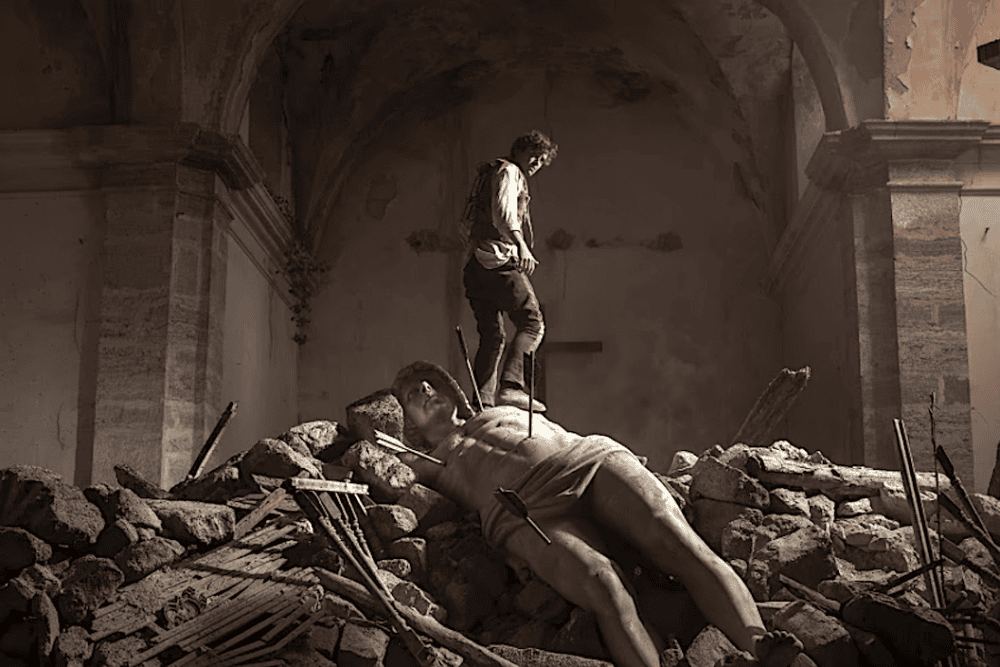
Set to the tune of Vera Lynn’s “We’ll Meet Again,” we dive into the aching sense of longing that describes this film. Javier Calvo and Javier Ambrossi, known as “Los Javis,” let us recreate the experience time in a small-town Spanish casino in the 1930s, the height of the Spanish Civil War, and the more relaxed Spain of contemporary times. Like the tripartite structure of the film, La Bola Negra is about ruptures. In 1937, in a small Andalusian village, pro-nationalist locals have gathered to celebrate the arrival of their Italian allies. But revelry quickly turns to tragedy when Benito Mussolini’s fascist planes fire on the villagers, an unfortunate accident that will forever change the course of the life of young trumpet player Sebastián (Guitarricadelafuente). By the time Sebastián is glimpsed scrambling over the rubble of a bombed-out church, using the arrows lodged in a Saint Sebastian statue to hoist himself to safety as lambs scurry about, the film has already bound together multiple strands of martyrdom and sacrifice.
Adapted by Calvo, Ambrossi, and Alberto Conejero from Conejero’s play of the same name, La Bola Negra feels most alive when it revels in this tension between the real and the seemingly imagined. Sebastián is conscripted into the fascist forces in the middle of the Spanish Civil War and charged with tending to a Republican prisoner, Rafael Rodríguez Rapún (Miguel Bernardeau), at a hospital. In another, set five years earlier, a young Granadan man, Carlos (Milo Quifes), mopes around after being excluded from the casino his father belongs to. Then, in 2017, a historian, Alberto (Carlos González), living in Madrid inherits more than he could have imagined after learning of the death of a grandfather he didn’t know he had.

Sebastián, Carlos, and Alberto are gay, and the film’s quietest rupture is the rather maudlin depiction of Sebastián’s sexual awakening. As played by Guitarricadelafuente, Sebastián is a fragile innocent, who retreats into isolation and plays his trumpet whenever he’s at his most frayed. From the moment Sebastián stands over the corpse of his mother (Chelo Calvo, Guitarricadelafuente’s real-life mother), the actor struggles to give dimension to his character’s agony. Rafael (Miguel Bernardeau) is a volunteer in the Republican forces and captured by the Spanish Nationalists.

Wounded in the hospital, Rafael is fated for execution although he has been useful as an informant. Sebastían is assigned to guard him and finds himself drawn to him, but discovers that Rafael is committed to another person. As Sebastián leans over a cot where the strapping Rafael) sleeps, he tremulously traces the air above the prisoner’s body. It is hard not to feel that he’s simply acting out the idea of an awakening. Sebastián seems unable to recognize his feelings as desire.

As the film opens, Sebastián is practicing his trumpet for a concert in a crowded square in his small village. What the villagers think is a celebration of the arrival of their incoming allies from Italy, the scene turns into strafing gunfire and explosions. He is whisked away from the chaos, thrown on a truck, handed a gun, and conscripted into the Spanish army, sent to an outpost of men who seem similarly lost.
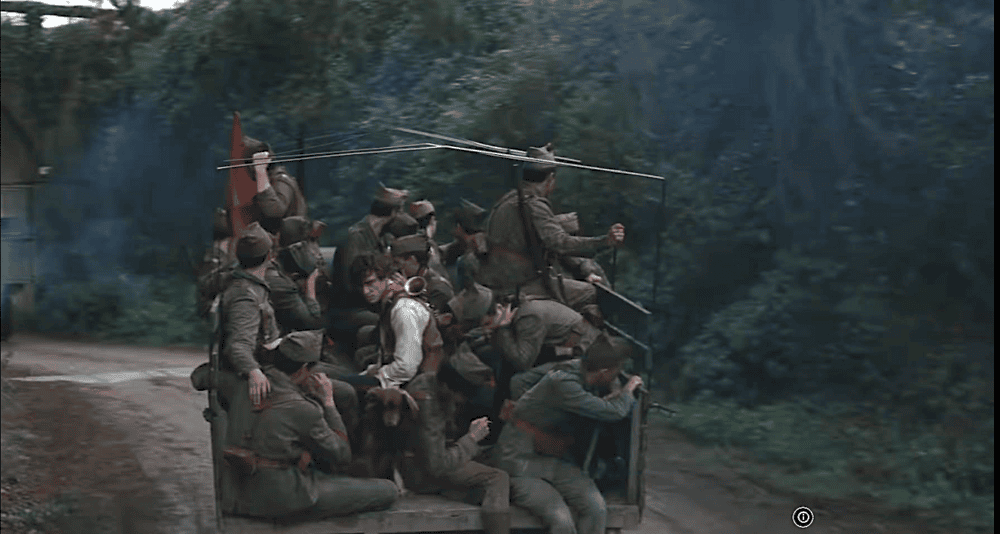
There are several scenes of young men sitting around, running across the beach, or just walking around the outpost, smiling in the moment of male comradery but seemingly as unmoored from the rest of the world as Sebastian. It during this time that we see Nené Romero (played by Penelópe Cruz), a “cuplé” singer who entertains soldiers during the war.

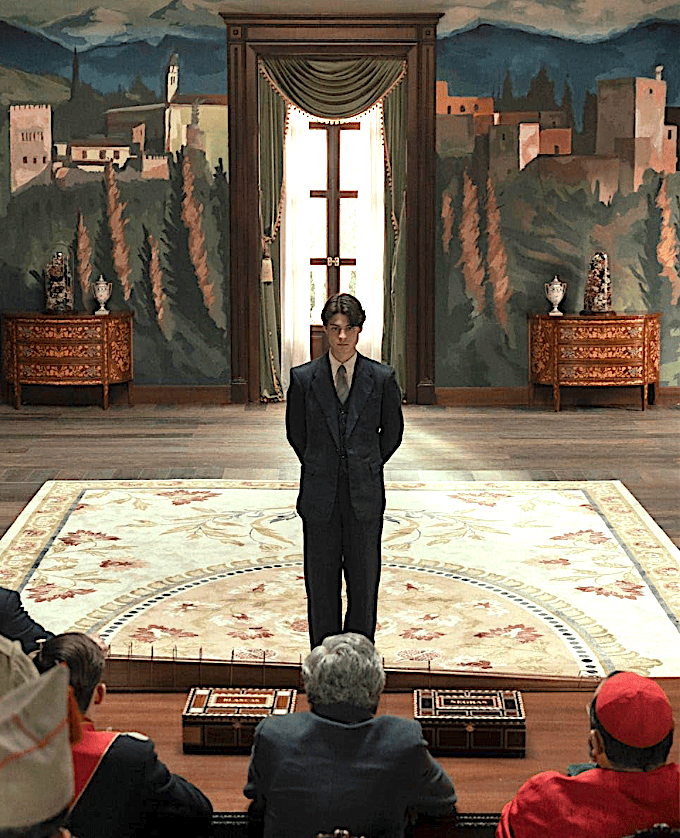
The film then cuts back five years to the early 1930s to introduce us to the impossibly handsome Carlos (Milo Quifes), a young man who desperately wants to belong, which means joining a casino or social club, the height of prestige in the community. The approval process includes dropping white balls for yes and black balls for no (the origin of the term blackballing), which turns out to be the majority vote for Carlos due to rumors around town about his homosexuality, unacceptable in that time and place.

Under pressure from his father, Carlos will hide his true self to belong with people who don’t want him to be who he really is. A gay man having to reconsider how he behaves to get ahead in the world is not a subtle metaphor, but the world of that time in recent history. As Carlos’ vote reaches a crescendo, the scene is interrupted by something completely surreal – a Grindr notification.
Carlos’ experiences in Granada mirror those of the poet and playwright Frederico García Lorca, who grew up in Granada in a well-to-do Spanish family. Lorca was part of the Generation of ’27, the avant-garde surrealist group that included Salvador Dali and Luis Buñuel. Juan Ramírez de Lucas was a Spanish writer and art critic who was Lorca’s final male love interest in 1935. Lorca dedicated his final collection of poems, Sonetos de amor oscuro (Sonnets of Dark Love), to him and planned to flee with him to Mexico before the outbreak of the Spanish Civil War. Their relationship was unknown until 2010, when Ramírez de Lucas died.

Carlos’ mental anguish over his homosexuality takes on dream-like wandering when the casino is overrun by students and protestors in Granada, leaving the building in ruins. We see Carlos climbing up a snow-covered mountain where its very whiteness pulls him up to a mystical moment prefiguring death, accompanied by the ominous voice of an old woman (Mona Martínez) whose son has been murdered for being a homosexual and “lost in the snow.”

In the third facet of this story, we jump to 2017, when a writer named Alberto Azcuna (Carlos González) learns that his estranged grandfather has just passed away, leaving him something in his will. This being 2017, Alberto has a gay partner Juan Pablo (Julio Torres) who is quite supportive. While his mother (Lola Dueñas) insists that he leave the papers of his grandfather alone, Alberto travels to a remote region of Spain to learn not about his inheritance, but that journey connects this younger historian to the other two tales in this triptych.
Alberto’s journey represents a window into the difference between how queer people experience alienation is way very different from the 1930s. Alberto provides a contemporary point of view, uncovering the truth about Sebastian and Carlos’s stories along with us. He is apprehensive about digging into the love stories buried under his family tree, but he knows their importance to both the history of his country and queer representation.

While La Bola Negra (The Black Ball) deftly jumps in and out of each timeline, Sebastian’s arc becomes the center of the piece, the one that ties the other two together. Unwittingly, he falls in love with a prisoner named Rafael (Miguel Bernardeau), who everyone knows will be executed once he’s run out of information to give his fascist captors. The two men become stand-ins for so many doomed romances, but this is not a simple story of broken love or sexual awakening. The traumatic story of Sebastian and Rafael alone makes for riveting cinema, but more importantly it anchors the other two other stories that turns this into such an exceptional piece of writing.

Rafael Rodríguez Rapún is the only major character in La Bola Negra based on a real-life figure, that the film is a tribute to Spanish poet and playwright Federico García Lorca. Calvo, Ambrossi, and Conejero are smembers of a younger generation resentful of Spain’s culture of silence around the atrocities of the Franco regime. The filmmakers attempt to reclaim Lorca’s legacy with surrealist gestures about Spain’s torturous past.

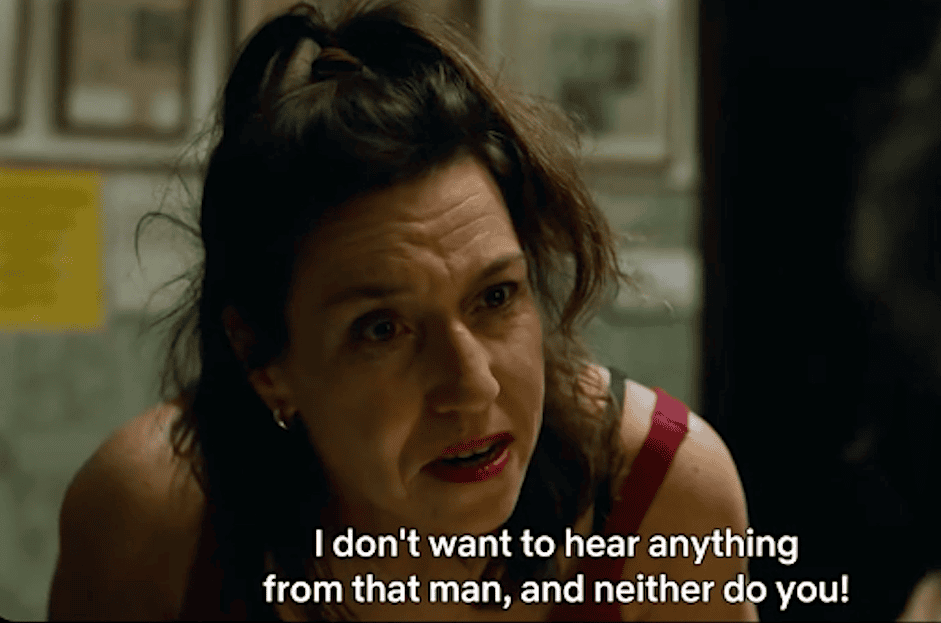
Alberto’s segment takes place in 2017. Alberto is contacted about an inheritance from his grandfather during the time of the Spanish Civil War. His mother Teresa (Lola Dueñas) does not wish to discuss them. She rages about Alberto and seems out of control until we learn that her anger stems from being abandoned by her own father. She represents the rubble of the nation after the Franco regime ended and her anger the collective guilt of a nation. As Alberto digs into his family history, he learns more with help from an American scholar of Spanish history and a Lorca expert, Isabelle Durant (played by Glenn Close). Not only was his grandfather in the Spanish Civil War and but there is a deeper story to be discovered.

La Bola Negra is more concerned with queerness as a definition of separation, rather than an inherent part of the characters’ selves. Of course, wartime prevents everyone from seeking their happiness, but the gay characters can’t help but take on allegorical roles much of the time. Alberto wants to help his late grandfather, who had to live his life as a gay man in secret, but he’s dead now. The Black Ball wants to recontextualize the lives and loves of times past, even those lives cannot be altered. La Bola Negra is a complex and demanding film, painted on a broad and intimate canvas.

The craftsmanship is impeccable and the enriched by the moving score by Raul Refree. The cinematography of Gris Jordana makes so many scenes truly memorable. The masterful editing of Alberto Gutiérrez makes the three narratives build toward the final reveal. No wonder La Bola Negra is Spain’s submission for the Best International Feature Film at the 99th Academy Awards.