
Directed by David Figueroa García and Mauro Mueller, and written by Aleluya Rivera, El Conserje is the story of just one man, Ricardo, and how he faces the challenges in his life, the directors have outlined the failures of the Mexican state to honor their hard-working citizens, cynically ignoring their needs and casting them aside like discarded rubbish when they get old – this is a universal theme that applies to older people in the United State as well. “El Conserje” screened at the Hola Mexico Film Festival at the Regal Cinema L.A. Live on Thursday and Friday. The film is dedicated to Humberto Yáñez (who plays Ricardo), who was 80-years-old during filming but, very sadly, died aged 83. That he managed to see the finished film was gratifying for the directors. Yáñez had had a long successful career as a support actor, mostly in theatre, and had never had the opportunity to play a lead. It was particularly fitting therefore, that this chance to play the protagonist, that had always eluded him, should be his swan song.
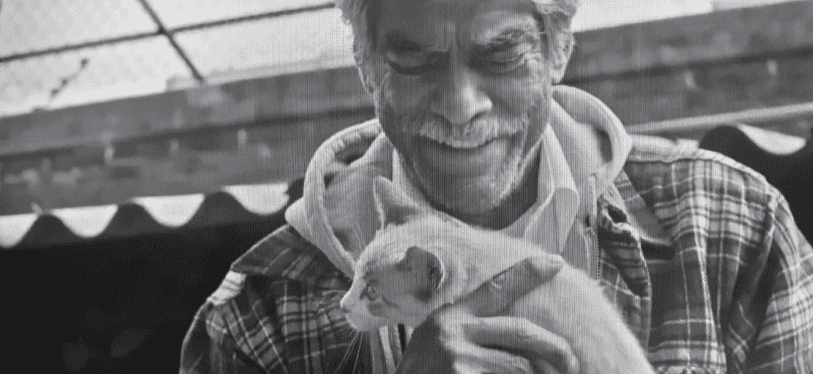
At 75 years of age, Ricardo has problems balancing his job as a janitor at an elementary school and caring for his crippled wife Ana. He lives in a cramped room on the school grounds where he is the “concierge” and main janitor. His wife Ana (Luisa Huertas) who needs round-the-clock care and Ricardo struggles to get her into a wheelchair every morning. Humberto Yáñez’s performance as Ricardo is subtle, minimalist and nuanced. You feel the weight of life on his shoulders as he patiently and lovingly cares for his ailing wife.
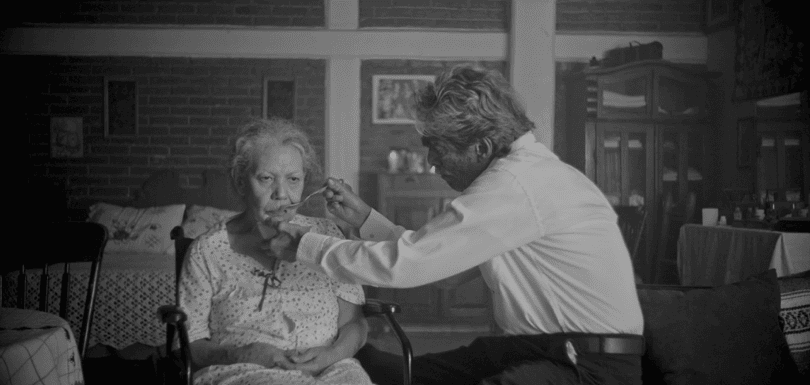
There is a warmth and a refusal to be bitter at his situation or his superior’s arbitrary demands. He just goes about his mundane tasks, be it sweeping the courtyard at ungodly hours on the darkest dawns or scrubbing the toilets of the messes left by the uncaring pupils (who, supposedly, come from good homes). These boys display a profound disrespect for the janitor and wander about with a sense of entitlements and even elitism, but, as the film progresses, a darker side to those very same families is slowly revealed. Some of boys, especially Camilo (Luis Ángel Macías) and Daniel (Donovan Said Martínez Pérez) continually tag the school bathrooms with lewd depictions of male and female genitalia, using indelible markers.
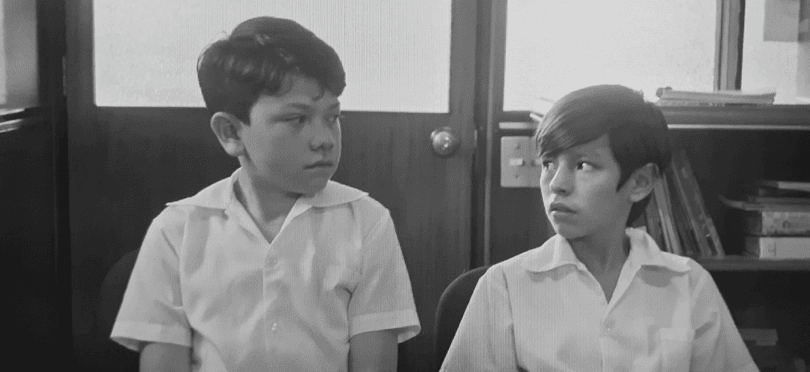
“El Conserje” portrays the social divide between school staff and the parents and students—such as when Don Ricardo tries to bar a late-arriving child from entering, despite the father’s objections, or when he must confront two students whose dangerous antics lead to a complicated situation for the caretaker himself. The idea for El Conserje (The Janitor) was based on a real person. The screenwriter, Aleluya Rivera attended a private school and was struck by the precarious living conditions, in the school ground, of the school janitor, who was the father of one of her classmates. After some discussions, they realized that this kernel could be developed into their first feature film.
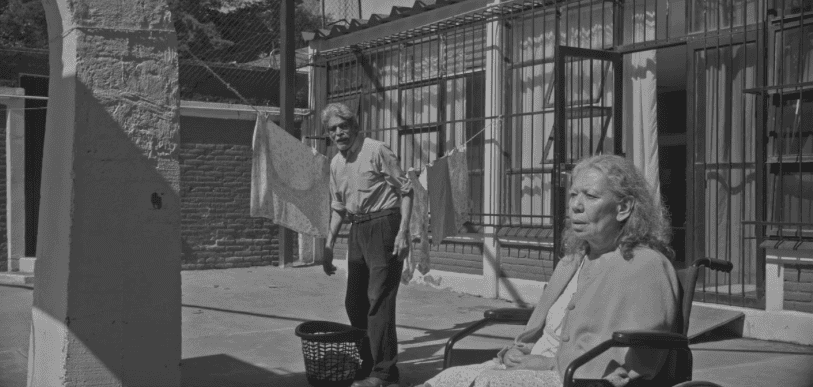
For thirty years, Don Ricardo (Humberto Yáñez) has lived his life within the school where he works as a caretaker, putting off retirement despite having reached the age of 80 (“even though it’s hard at times, I can keep working”). In reality, it is a necessity; the pension he would receive would barely be enough to support his wife, Ana (Luisa Huertas), who is incapacitated and requires increasingly intensive care. Don Ricardo tends to a school where students and some parents treat him with disdain or, quite simply, as if he were a shadow unworthy of notice. Constantly moving chairs and tables or scrubbing away the obscene graffiti that appears in the restrooms and stairwells with growing frequency, Don Ricardo’s life unfolds slowly and routinely.
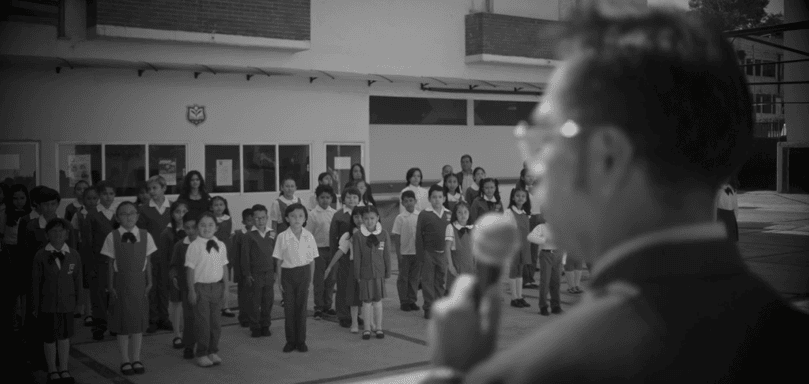
The film captures this existence through black-and-white cinematography of Juan Munive that reflects the drab, colorless path of a man invisible to others—a life that finds a single moment of color in one specific scene. When he announces to his three colleagues that he has decided not to retire, the news is not met with much solidarity; for Claudia (Mercedes Hernández), Pepe (José Antonio Becerril), and Luis (Leonardo Alonso), his decision represents more of a burden than a help – especially since Luis had hoped to take over the caretaker role himself.
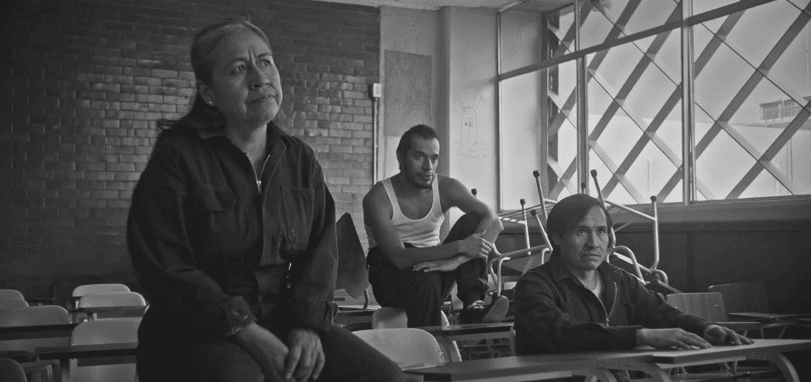
Their portrayal of the character Ricardo is imbued with profound humanity, even when he appears overly stubborn—such as when he insists on working after an accident, or when he clashes with school bureaucracy by arguing that painting over graffiti is the best solution, only to be told there is no budget for it. These subtle contrasts emerge in wordless scenes – like when a fellow custodian dances to a modern song, injecting a splash of color – which stand in stark opposition to the moments when Ricardo dances to old tunes, yet finds not a single ray of hope in his own life.
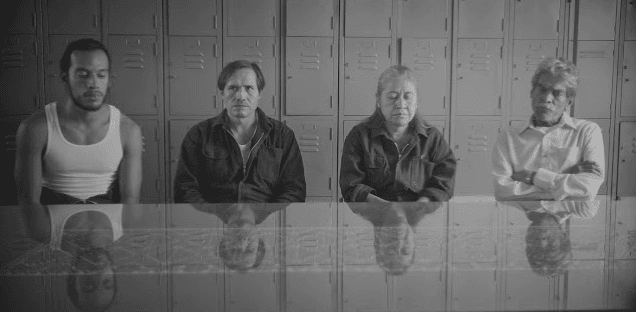
While there are many things that Aleluya Rivera’s writing highlights with The Janitor, one of them is certainly the danger of what happens when children realize the power they have to get adults into all sorts of trouble. It’s a growing theme both in real life and in film and television, having an awareness of public image and the harsh consequences which can come from even a vague implication, no matter whether true or not, of inappropriate behavior, so they stop caring about rules and manners. Added to having zero respect for authority and no concept of the damaging results of their actions.

This film brings to mind other socially-motivated films, like Ken Loach’s Kes (1969) and Cathy Come Home (1966), or Robert Bresson’s Mouchette (1967). These films were not minimalist and feel almost like documentaries, not as melodramatically intense or violent as typical “kitchen sink” realism dramas that emphasized tough social issues such as Look Back in Anger (1959) or Saturday Night and Sunday Morning (1960). Non-typically commercial films like those of Ken Loach and Robert Bresson remain with the viewer at a deeper level – and the same could be said of El Conserje (The Janitor). As Mauro Mueller emphasizes, the hope is that someone is moved by the issues illustrated and that some changes in society might follow from their films.

Swiss-Mexican director Mauro Mueller explained: “We want people to take home the experience of seeing how the janitor lived. To understand Ricardo. He is no hero, but he is good-natured and in particular he is very noble. He worked all his life and we should be aware that there are so many more people like him. We want to shine a light on these [invisible] people.” The great performance of Humberto Yáñez is what makes the film so powerful and haunting. His character is understated and only in the final scenes do we see how a strong man reacts when he is pushed to the edge of his tether.