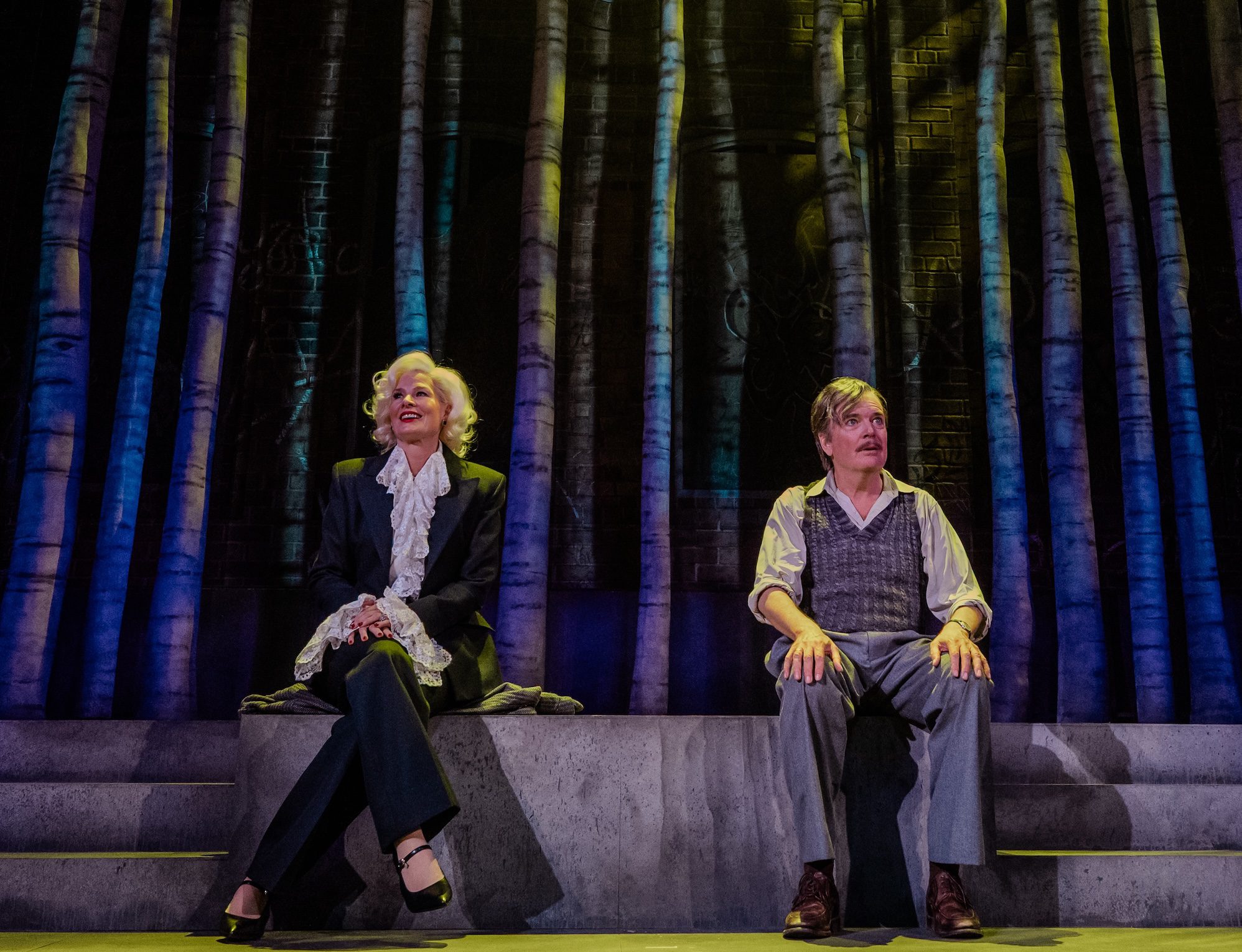
In a dark journey into the fractured soul of today’s world, Friedrich Dürrenmatt’s parable reveals how ordinary people will sacrifice another human being for cold, hard cash.
By John Lavitt
Pasadena, CA (The Hollywood Times) 09-16-2026
Money does not merely talk in The Visit. It controls the narrative. Friedrich Dürrenmatt’s dark comedy, adapted by Maurice Valency and directed with stark theatricality by Darko Tresnjak, arrives at the Pasadena Playhouse as a parable for 21st century America. In this modern world, greed is celebrated, desperation becomes leverage, and billionaires set the terms, wielding the power to redefine morality, manufacture consent, and make surrender seem reasonable.
Tony Award-winning Jefferson Mays stars as Anton Schill, a shopkeeper in the town of Güllen with a dark romantic past. The young woman he once loved and abandoned has become a powerful force in the global economy. When billionaire Claire Zachanassian returns home, she offers the community one billion dollars, but with one condition.
Her heartbreak must be avenged, and his betrayal punished. The only way the town gets the money is if Anton is killed. He stripped her of her dignity and good name in her youth, denied paternity, and turned innocence into a vicious struggle for survival. Before demanding his death, she tours their former haunts, relishing long-buried memories. Still, in the stillness of her dark heart, she does not overcome her trauma. She preserves it, weaponizes it, and demands that an entire community validate her vengeance.
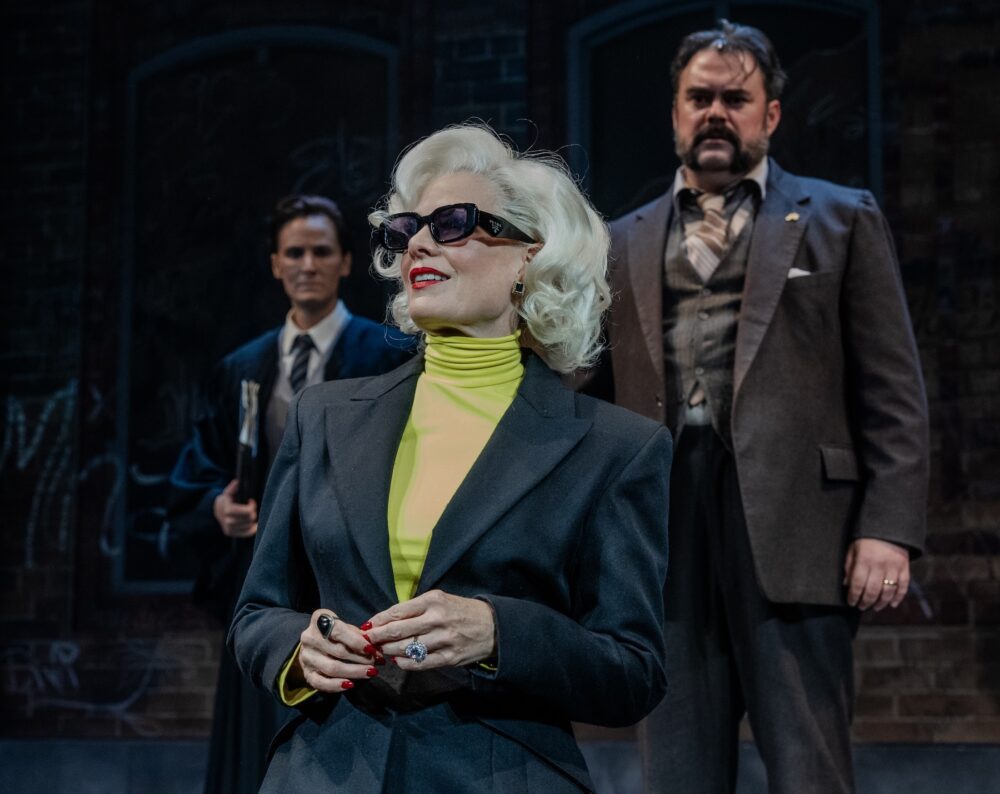
Melinda Page Hamilton gives Claire a blend of elegant entitlement, devious amusement, and glacial control. She never needs to assert the character’s authority; the town reorganizes itself around her. Hamilton makes Claire’s patient silence more threatening than rage. Rather than seeking healing, Claire preserves her wounds as evidence and has waited until she could afford the verdict she now demands. She knows money’s power cannot be resisted for long.
As the designated sacrifice, Mays supplies the production’s emotional center. Anton begins with the confidence of a protected citizen, certain that friendship and communal memory will shield him. As his neighbors buy luxuries on credit, his assurance gives way to terror. Mays charts that disintegration with precision, humor, and aching humanity.
The play feels like Bertolt Brecht catapulting into the 21st century to confront Donald Trump’s billionaire-dominated world. Claire does more than buy cooperation. She creates a new narrative in which greed becomes progress, cowardice becomes justice, and murder becomes a moral necessity. The townspeople initially reject her proposal. Yet each new purchase, fueled by greed and desire, reveals that they have already accepted her version of reality. Each pair of bright yellow shoes becomes another vote for Anton’s death.
Dürrenmatt’s ideological machinery proves more effective than his character development. Like figures in a Brechtian parable, the citizens primarily serve the argument. Their moral descent is clear but seldom surprising, and the dramatic texture remains largely unchanged. The ideas accumulate more effectively than the emotions. We never fully connect with the characters because they remain instruments of Dürrenmatt’s political argument.
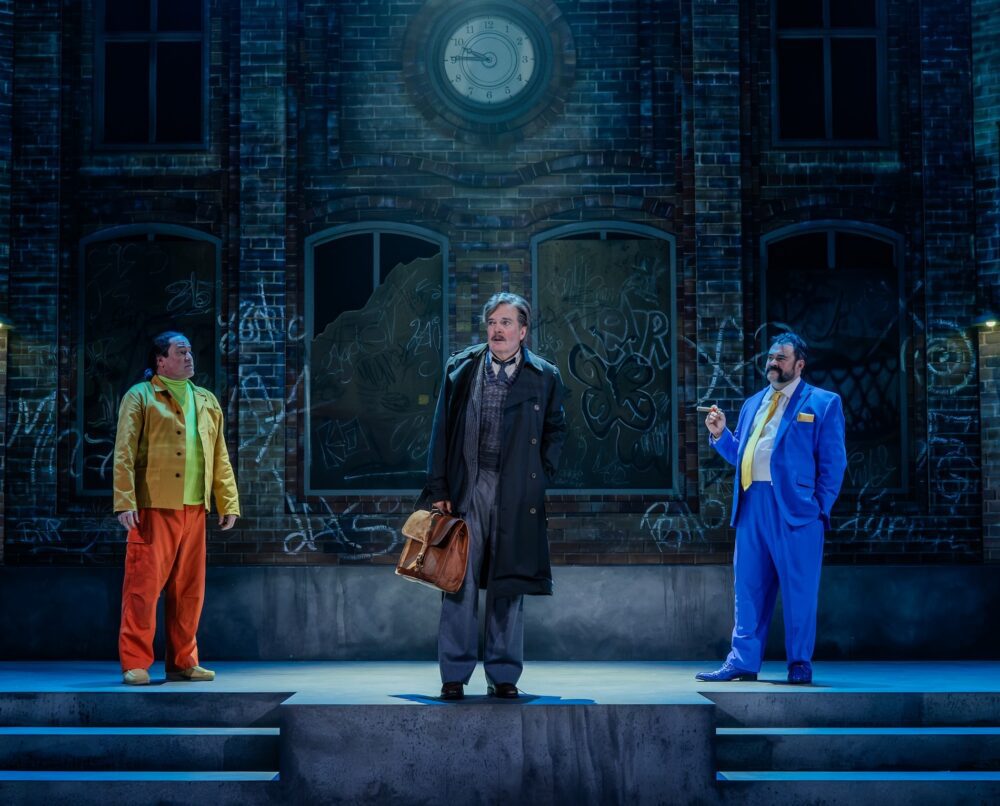
Tresnjak nevertheless turns that limitation into muscular, mordant theater. The outstanding company embraces the grotesque comedy without sacrificing its menace. Christian Barillas, Jennifer Chang, Ricardo Chavira, Matthew Patrick Davis, John Lavelle, and the ensemble create a community whose collective corruption becomes the evening’s most disturbing character.
Alexander Dodge’s imposing scenic design, Charlotte Devaux Shields’ colorful costumes, Matthew Richards’ modulated lighting, and Aaron Rhyne’s projections lend the production a seductive, decaying grandeur. The visual world keeps evolving even when the writing does not.
From the beginning to the end, The Visit keeps its characters at an intentional distance, but Pasadena Playhouse closes that gap through performance and design. The result is a polished, darkly entertaining warning for an age when billionaires no longer simply dominate the marketplace. They increasingly decide which story everyone else must live inside.