Los Angeles, CA (The Hollywood Times) 4-17-26
Jimmy Steinfeldt: Mr. Schiller, may I call you Larry?
Lawrence Schiller: Of course.
JS: Larry, how often do you clean your lens?
LS: Number one I haven’t taken photographs since 1976. The last was the ‘Thrilla in Manila’ with Muhammad Ali. How often did I clean my lens? The lens was never exposed. I always had a filter which protected the lens from getting scratched. It’s easier and less expensive to change a filter than a lens. How often did I clean the filter? Every morning or when I’d go out on assignment.
JS: You and I have something in common. In your book I saw a picture of you as a cub scout. I was a boy scout.
LS: That was taken in San Diego. Cub Scouts was my introduction to having to get along with other people. Finding a way to accomplish something myself that others didn’t see, or were ready to see. I was adventurous as cub scout.
JS: What photographers influenced you?
LS: The most important was W. Eugene Smith when I was high school and started taking pictures more seriously. Eventually I got very close to Gene and published his books later in his life. I remember his photo essay “Country Doctor” in Life magazine. I had to analyze why all the pictures together made a story. I had never seen something like that before. The total number of pictures could be like reading a book. This was important to me because I was highly dyslexic. We didn’t have that word at that time. I couldn’t read and couldn’t spell very well. I realized I could read by looking at something. Yousef Karsh of Canada influenced me a lot about lighting. In high school as a photographer, I had to do a lot of portraits of teachers and student body leaders. Later I would meet Karsh and then later after college he would use my studio at 7403 Sunset Blvd in Los Angeles.
JS: Who are some others who influenced your photography?
LS: It’s something you would never think of. When I was about fourteen years old trying to take pictures, my father said to me “If you can earn half the money to pay for a car I’ll pay for the other half when you’re sixteen.” I had a bicycle and lived in Pacific Beach, California. In those days the police radio band was at the end of the FM channel. I could listen to great music like Mahalia Jackson or Bessie Smith but I could also listen to the police radio. If there was an automobile accident, I would ride my bicycle to the accident. Nine out of ten times when I got there the cars had been towed away, the police were gone and if someone were injured, they were gone.
What do you think was left? Skid marks! That’s how I learned lighting. Depending on the time of day; sunrise, sunset, high noon. The light reflected off the oil and skid marks differently. Each picture was different. I learned about cross lighting, back lighting. How do I make the skid mark look the best. What did I do with these pictures? I sold them to insurance companies. That’s how I got half the money to pay for my first car which was a Ford.
JS: What was your first camera?
LS: One my father gave me for my Bar Mitzvah. A used Rolleiflex. Later he gave me an East German camera called an Exakta. Very few people knew about that camera then. A very famous photographer David Douglas Duncan gave me a 180mm F2 Sonar lens to put on this camera. That allowed me to look at things differently than the usual 35 or 50mm lens.
JS: What camera were you using later in your career?
LS: I moved from the Exakta to Leica when I got the money. I had three M2 Leica’s. A 21mm lens, one with a 35mm lens and one with a 90mm lens. In newsreel footage you can see me with those three cameras during the time of the JFK assassination.
JS: Tell me about that period of time. The JFK assassination, Lee Harvey Oswald, Jack Ruby.
LS: I wrote about it. I call the 60s the Wild, Wild West of America. It starts with the assassination of JFK, to the social unrest of 1965 with the Watts riots and the tragic death of Bobby Kennedy and I was one of his photographers when he died in L.A. when I did pictures at the Ambassador Hotel.
JS: I’m a Leica ambassador and I have attended so many of the great gallery events at the Los Angeles Leica gallery.
LS: All my early work was with Leica. When I started getting more sport’s assignments. I had an F2 Nikon. The biggest problem with Leica was when you had to move the lever to the next frame the camera moved slightly away from your eye. You always had to move the camera back. To make a short story long around this time photographer Jay Eyerman was working for Life magazine. He was famous and about 20 years older than me. We had our cameras serviced by either Norm Goldberg in Wisconsin or Irving Jacobson on Vine St. in Hollywood. I went to Irving’s shop, and Jay was there, and I said to Irving I was having trouble with my Leica it was slow and maybe dirty inside. Jay said “Why don’t we see if we can make a motor like a Nikon” Me and Jay hired Irving to make the first motor for Leica. Leica was so enthused they gave us the base plates for free so the motors would perfectly fit the camera. We designed and manufactured the first motors. The Nikon motor was large and we saw that the motor Irving made for Leica was small so we had Irving along with Norm Goldberg make a smaller motor for Nikon. We sold these motors under our company called TPI located in Burbank. Eventually we sold the patents to Leica and Nikon.
JS: I love the photo of you at the San Diego Country Fair with your grandmother.
LS: Yes, I was selling film at a little booth. It’s an early picture of me.
JS: I worked at the Minnesota State Fair as a teenager and I have a photo of me with my grandmother visiting me at my booth. You photographed and directed for TV and Film. Were you in the Cinematographers union and the Directors union?
LS: I had a friend who was a very Avant-garde filmmaker by the name of L.M. Kit Carson. Around this time, I met Dennis Hopper. We also had something to do with the Walker Art Center.
JS: In my hometown Minneapolis.
LS: Yes. To make a short story long Kit Carson and I decided we should make a documentary on Dennis Hopper in Taos, New Mexico. We had to convince Dennis because he had already made Easy Rider and been married a couple times including one time for eight days. We go to Taos and he’s living in the Mabel Dodge house and we made the film called American Dreamer. It’s a film about an actor playing an actor. It’s a documentary of him playing himself. It was very successful. It won film festivals. Then I made another documentary about Patricia Neal and Raold Dahl who was a very controversial writer. That documentary started to win film festivals. Besides the experience giving me a big head, I was still photographing motion pictures to earn money. I was being hired by the motion picture studios to plant the pictures in magazines. I had photographed five movies of Paul Newman. Paul was a gracious person and he and his wife Joanne were friends. I’m good friends with their daughter.
When we were doing Butch Cassidy and the Sundance Kid I said “I’m really getting tired Paul.” He asked what I was getting tired of? I said “I’m photographing the same heads on different bodies.” He said “That’s really interesting. You’re fired!” I said “You’re firing me?” He said “Yeh, you said you didn’t want to photograph the same heads on the different bodies so why should I let you photograph me. You’re fired!” I said “What am I gonna do?” He then threw me the script and said “Find five minutes in here and you are going to direct it and I’ll tell George Roy Hill.” That’s how I started in feature films.
I read the screenplay and I told Paul I couldn’t find the scene in it but I found a mistake in it and maybe I could do a scene that would correct the mistake. Paul said “What’s the mistake?” I said you got them in the West and they throw the bicycle down and the wheel just turns and the next thing you do you have them getting on a ship in New York to go to Bolivia. How did they get from the West to New York. You’re missing that scene. We have to do a transition. Paul goes to George Roy Hill and they introduce me to a sketch artist. I work with the sketch artist and work out what the scene should look like. Paul takes the sketches to Darryl F. Zanuck and they budget it at ¼ of a million dollars. They gotta build sets or perhaps steal from the Hello Dolly set. Also, they have to get the actors to be in the scenes. The only available time was between Christmas and New Year’s when the company was off.
I don’t know a lot about shooting movies, I’m a photographer. To show you how stupid I was I gotta get a still camera that shoots 24 frames per second like a movie camera. This was so stupid yet I found one it’s called a 70mm Hulcher sports camera. They drag it out from the Associated Press for me. Everyone agrees to come back. Redford came back with a broken leg from skiing. The sets were built and I put some of the actors on a treadmill and kept them walking to get body movement and then super-imposed them into photographs. I get all this together and my idea is to do a montage of all the images I shot with the Hulcher. Then I think it’s not gonna work.
I worried I fucked up this job. My first chance. But I got all these great pictures. We used the Peyton Place set for the Coney Island pictures. Everything on Fox’s lot we used. How am I gonna put this all together? This is 1968/1969 and I remembered in 1962 at the Seattle World’s Fair I saw an exhibition by a designer/ architect named Charles Eames.
JS: The furniture designer?
LS: Yes, but the display at the world’s fair was a montage of still photographs. They had animated the photographs. I now have to find the editor who did that for Charles Eames. We got a hold of the Eames studio and we got to the animator. He came down and we start to map out what becomes the still montage where they go from the West to Bolivia. That was the first time that stills had ever been used in a motion picture as part of moving the story forward. Telling the story without dialog. We cut the thing together and Paul Nash the producer loved it and he took it to George Roy Hill. It was originally seven minutes long and it was cut back to five and half minutes.
The London Times comes out with a story about this incredible montage made of photos which they say had never been done before. At the premiere of the film in London I went up to George Roy Hill to thank him for letting the montage go into the film. I put out my hand to shake and he said “I’m not going to shake your hand I’d lose my fingers!” I then realize all this publicity was going to this thing that I had done and for that moment, in light of the publicity, George Roy Hill wasn’t the star.
People at that time didn’t understand how it was done. They thought it was made up of movie footage, they didn’t realize it was from still photos. Paramount saw the movie and Bob Evans called me. He got my name from Fox. He said we have a movie we’d like you to see, maybe you can do something with it. I went to Paramount with my production manager Eddie Sierra and I watch this movie which they told me was a little long. It was four and a half hours long. I knew exactly how to bring it down to two hours. The producer wouldn’t cut the film, the star wouldn’t cut the film. Nobody would cut it.
They took me to the producer and he has a desk up on a platform. Behind him is a young boy combing his hair which turned out to be his son. Eddie says “Alright Laurence tell them what you thought of the film.” I look up at the man high above at his desk and I say “Mr. Gordy there are a lot of orgasms but I don’t see any foreplay” He said “What do you mean?” I said “Diana is incredible in the film but you go from one great scene to another great scene and the critiques are going to rip you apart because you got a white guy turning on a black singer and you haven’t set that up properly.” I then worked on the film for a year and a half at $1500 a week, which was a lot of money in those days. Directing new scenes, cutting, taking the film out on the road with BG (Berry Gordy) to see what the audiences liked and didn’t like. That film propelled me into making my own films.
I got a call from Howard Koch Sr. who was making a film with Elaine May called A New Leaf. He invites me to lunch and asks me when am I gonna stop taking picture and start making films. What you did for Butch Cassidy and what you are doing for me with A New Leaf you should start directing films. I had no dramatic or theatrical background, nothing, I’m just a person that deals in reality.
He said I should start making movies for television because they want true life stories. Take some of your stories and turn them into movies. The first one I did I took from Life magazine about a Mormon preacher in the Yukon with a Jewish girl. It’s with Ed Asner and Sally Struthers. I wanted Jeannie Berlin for the role and they gave me Sally Struthers. The movie was Hey, I’m Alive.
JS: I worked on a movie with Ed Asner called Senior Entourage. His co-star was my friend Mark Rydell.
LS: Of Course, I know Mark.
JS: During those years you are in the DGA?
LS: Yes, you have to join immediately.
JS: Were you in the Cinematographers Guild?
LS: No, I gave up all the money I was paid to hire the world’s greatest Vittorio Storaro who did Apocalypse Now. His fee was very high for a TV movie but I told him we’d release it theatrically in Europe so it would be worth it. He shot my first three pictures. Later I hired Stradling.
JS: Harry?
LS: His son.
JS: Tell me about doing a book.
LS: First question is who’s your audience? Second, what size book would they like? Will they use it as a coffee table book or for education. To make a short story long there are many steps you have to go through before you even think about making it. Is there text needed to lay a foundation for the photographs or will the book be only images? I did some early important photographic books. For Eugene Smith I made Minamata. Nobody would publish it but I got it published. I hired the designer. I hired John Poppy to Interview Eugene and write the text in his voice.
I did books without photographs very early on. My first was with Timothy Leary and Dick Alpert on L.S.D. I thought who’s the audience for this book? It’s not gonna be Acid heads in San Francisco. It’s gonna be for people who want to know what it’s all about. I came up with 50 questions about acid and gave them to Timothy Leary, Dick Alpert and Sidney Cohen at the V.A. hospital. They answered the questions without seeing the other people’s answers. I also did a book which showed the pros and cons of acid. That book sold 600,000 copies. It was called LSD and the New American Library published it for me. It sold for $1.95
With Eugene Smith he was known for being very difficult as a photographer, designer for Life magazine. He wouldn’t allow anyone to lay out his pictures. He lived in a small fishing village in Minamata Japan. The Japanese industrial plants on the other side of the island were dumping mercury into the water and the fish on the other side of the island were swallowing it. The Japanese were eating the fish and their children were born deformed. Eugene had all these incredible photographs but no one would publish the book. I met with him in New York and he said no one will publish my book. I said I knew how to publish it. “I’m going to pay for the printing!” I knew a guy from high school who was now an editor at Henry Holt. I took the book to him and it cost me $40,000 and that’s how Minamata was first published and of course I earned the money back and Gene and I became good friends. I bult a darkroom in my apartment here in L.A. so Gene could make the prints for the book.
JS: In your book you photographed governor Goodwin Knight. I bought his car.
LS: Oh, you did! Goodwin J. Knight. I photographed him when I was in high school. He came to give a speech and I was the school photographer. Those were the days I idolized Yousuf Karsh. I made a portrait of governor Knight. I sent the photo to Sacramento and they asked to use it as one of their official photographs.
JS: Have you been a member of the ASMP? I was for many years.
LS: Yes, it was the American Society of Magazine Photographers and is now the American Society of Media Photographers. I was an early member.
JS: Can you share a story about some of these? Marilyn Monroe, Bette Davis, Buster Keaton, Muhammad Ali.
LS: I met Marilyn in 1960. I was to photograph Yves Montand for Look magazine. My assignment wasn’t Marilyn Monroe it was Yves who knew Maurice Chevalier in Paris. He was making a movie called Let’s Make Love. Johnny Cook the PR guy took me to the sound stage. Marilyn walked up the steps to her dressing room and Johnny said you better meet Marilyn. He then says “Hey Marilyn this is Larry Schiller, Look magazine.” Marilyn swings around and puts out her hand and says “I’m Marilyn” I didn’t know what to do. She’s on steps up above me and I said “Oh I’m Larry the big bad wolf.” It just came out of me. She said to me “Oh you don’t look so bad, but when you grow up, you’re really going to be bad.”
She then goes into her dressing room sits down in front of her mirror and I start taking photographs of her from outside the dressing room She sees me and says “You’re not going to get a good picture there, come up here and sit in the corner and I’ll show you a good picture.” Marilyn looks at me over her shoulder and here’s one of the first photos of Marilyn. She knew more about photography and light than I would ever know. She’d been photographed so many times. These are her X’s killing those pictures. She had approval.
JS: You photographed my favorite actress Bette Davis.
LS: Bettie was really something. She was moving into her house in Beverly Hills. I followed her from her apartment to Beverly Hills and she sat on the step and said “You’re kinda young, aren’t you?” I said “I’m doing well.” She then said “The tips of your finger are gonna be more important than your cock when you grow up.” I then photographed her smoking cigarettes and so forth and they were very nice photographs.
I had the same question for her as I did for Buster Keaton. I wanted to get a certain type of feeling in the picture and I thought this question would do it. They are the only two people I ever asked this question as I was getting ready to take their picture. “What’s your earliest memory of death?” I got great expressions from asking that question.
JS: I may have to use that one.
LS: You may.
JS: I book marked the page with Buster Keaton in this book. I’ve had this book since I was a teenager. You did the last pictures of Buster Keaton.
LS: I shot pictures of Buster on the set of his last movie. Do you know where he watched his old movies? He’d sit in his garage with a projector and screen it there.
JS: Have you a story about Muhammad Ali?
LS: Muhammad Ali was a sports assignment. There was a pack of photographers. The great photographer of Ali was Neil Leifer. I photographed Ali the first time he fought Floyd Patterson in Las Vegas. Then I went with Ali on another assignment for the ‘Thrilla in Manila’ towards the end of his career.
JS: You must have a story about Hugh Hefner.
LS: Hef was very interesting because as a young photographer Hef was interested in tits and ass. I wanted to find a Playmate because you made good money, $10,000 for shooting a Playmate in those days. The first young lady I submitted was a lady of the night but I didn’t even know it. He accepted her but I was under age so they had to have a photographer over the age of 21 be there. The other was Marianne Gaba. Photographer Ron Vogel had to come with me to both shoots. Hef and I built a relationship because I discovered the magazine was not about tits and ass. It was about literature, fiction and so forth. I sold him the most expensive Playboy interview I think he ever paid for. That was my interviews with Gary Gilmore.
JS: The man executed in Utah by a firing squad?
LS: Yes, and Mailer wrote the book The Executioner’s Song from my interviews. When Mailer wrote the book, I got $125,000 for a chapter of the book. Hef and I had a very good business relationship. I knew what he wanted, good literature, good editing
JS: Tell me about my friend and yours Melissa Morgan.
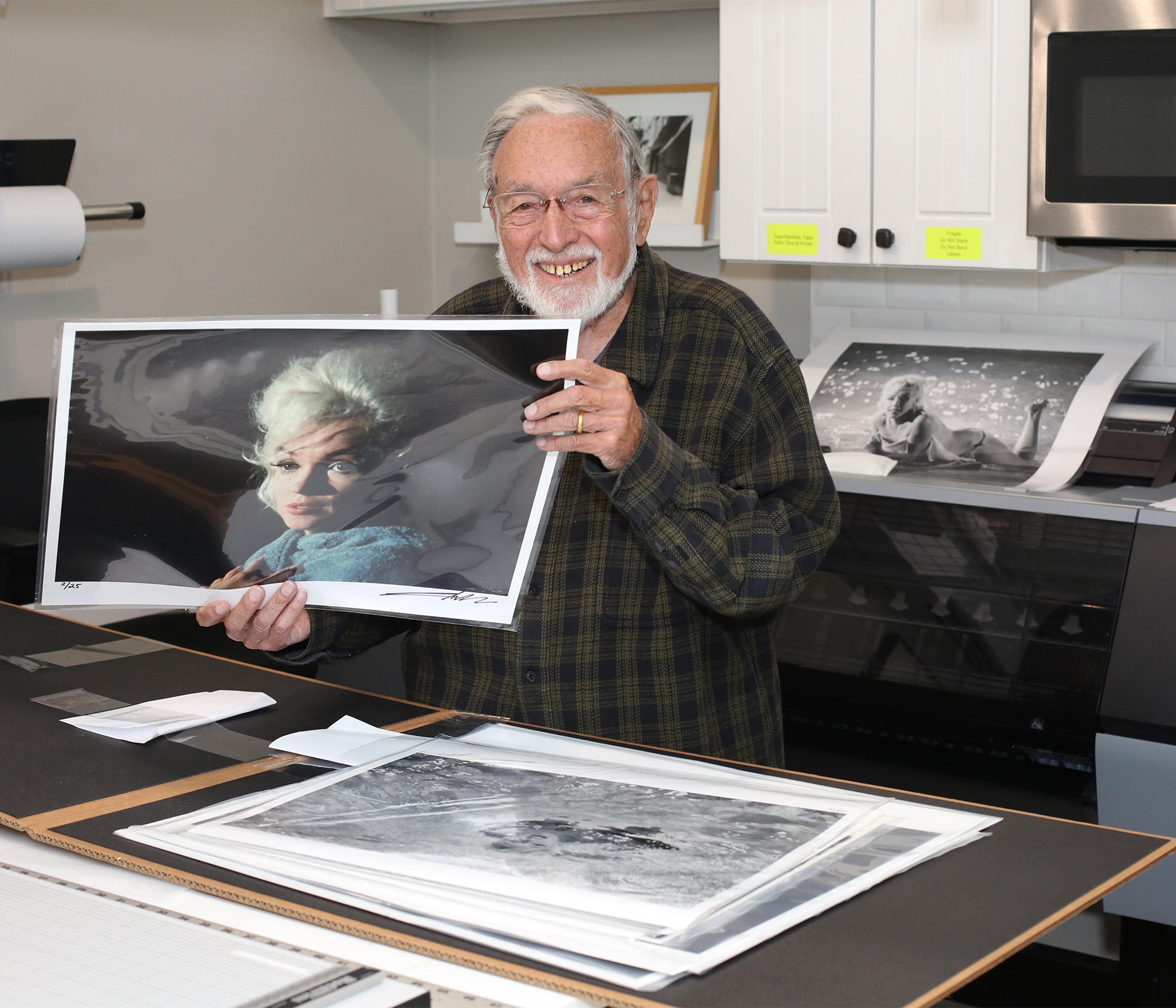
LS: I just shipped another print to the Melissa Morgan Gallery yesterday. Her gallery was recommended to me and I stayed at a hotel across the street. I walked in there and she liked my pictures. She’s done very well with my photography. I only do Dye-Sublimation prints, 30×40 to 40×60. The one they’ve sold the most of is of Paul Newman and Robert Redford playing ping-pong. Melissa Morgan Gallery is probably my 2nd best-selling gallery with Holden Luntz Gallery in Miami being the top selling gallery for my photography.
JS: I photographed the crowd outside the L.A. courthouse the very moment the O.J. Simpson verdict was announced.
LS: I was inside the courtroom. O.J. was very interesting because I met him through the Kardashians. To make a short story long Robert Kardashian and I were business partners. My kids grew up with their kids, they went to school together. In the old days when you went to a movie theater there were five or ten minutes between movies when people would leave and others would come in. The theater played music then. We had a deal with the record companies in which we got music free from the record companies and we made CDs and gave them to the theaters.
They would play the music, giving advertising to the record companies. What was unusual and made it a big business was we understood the demographics. We distributed different music for Watts than for Beverly Hills. Different music for Chicago than for Brooklyn. We had a big business for about three or four years and we were paid by the record companies.
JS: who are some of the presidents you’ve photographed?
LS: The first president I photographed when he was campaigning against JFK was Richard Nixon. I did the picture of him and Pat at the Ambassador Hotel with a big smile on Nixon’ face and a tear dropping down Pat’s face. That ran in Paris Match and other magazines. I photographed Nixon several other times.
JS: I photographed three presidents Clinton, Obama and Trump. What’s next for Larry Schiller?
LS: I’m going to be 90 this year. My photography has been donated to the Briscoe Center at the University of Texas. It’s now just a matter of monetizing my signed-edition prints so I don’t have worry about money to live on.
For more info: https://lawrenceschiller.com/