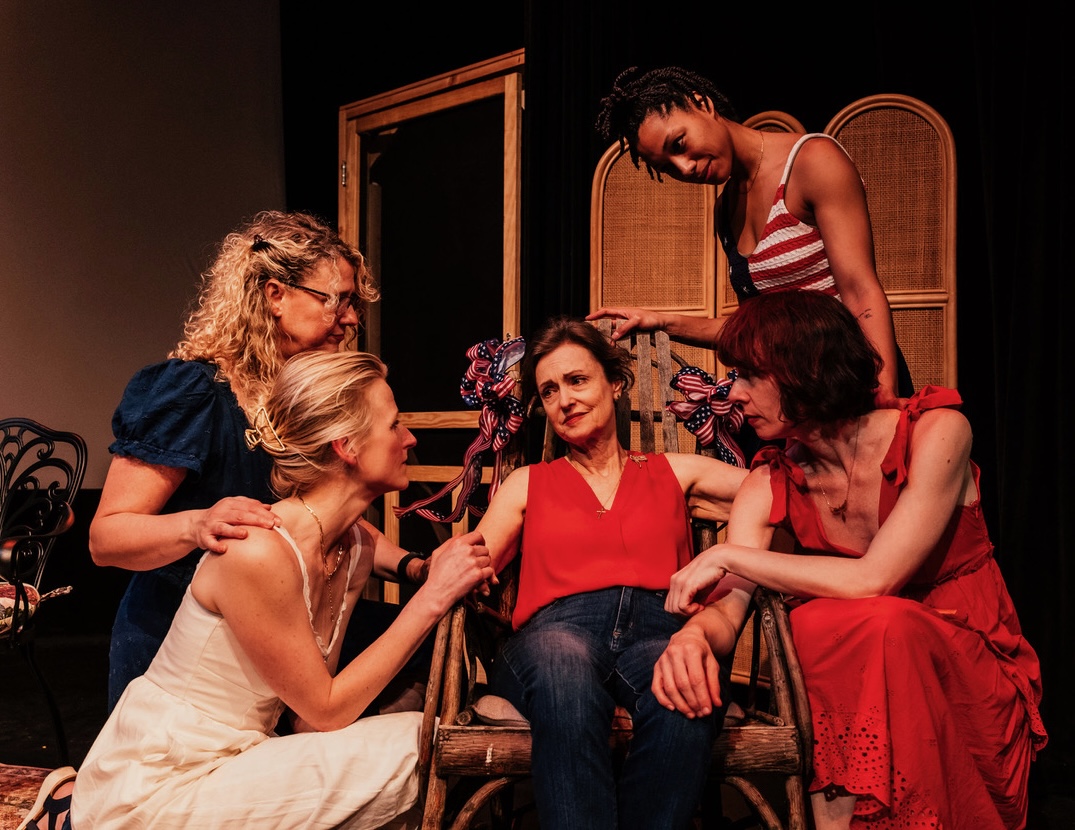
At the Whitefire Theatre, this modern Southern Gothic play allows humor and pacing to rescue the audience from a building storm of traumatic revelations and resentment.
By John Lavitt
Sherman Oaks, CA (The Hollywood Times) 04-09-2026
Director Daniel O’Brien and playwright Julie Shavers form a forceful husband-and-wife duo who managed to resurrect the sharp Southern spirit of Flannery O’Connor at the Whitefire Theatre in Sherman Oaks. In “The Baptist Witches of Shelbyville,” presented by Black Rocking Chair Productions, humor plays a crucial role in navigating the deep wells of trauma within the Moon family. Indeed, the name of the production company is perfect, given that a black rocking chair often can symbolize generational, repetitive trauma within a family unit.
Centered on the summer visit of their sister in exile in Los Angeles, Lucinda Moon (Mamie Gummer), the play explores family dynamics during a long and not terribly enjoyable 4th of July weekend. To clarify, however, the weekend is not terribly fun for the family members. For the audience, it’s a hoot that oscillates between jarring and tragically insightful.
As Birdie Moon, one of the three sisters, Julie Shavers bears the burden of being the family’s black sheep, struggling with tumultuous relationships with questionable men and health crises worsened by poor choices. The emotional core of the play is the rollercoaster of sisterhood between Birdie and Lucinda. Birdie feels resentful for never escaping the Southern Gothic madness of their family, while Lucinda feels like an exile banished from her one true home.

Ashley Ward plays Kitty Moon, the third sister who tries to be a steadying beam for the other two to balance on. However, like many real-life balancing beams, she ends up sinking into victimhood. Thank God she is smart enough to always wear a life preserver. As Mama Moon, Gigi Bermingham is not someone you want to mess with unless you know what you are doing and are ready to duck a Biblical barrage. As Lottie Walker, Angelie Simone represents how trauma affects the next generation.
When you get down to brass tacks, which feels like what many of the characters are walking on during the two acts of the play, “The Baptist Witches of Shelbyville” is about family trauma. There is no escaping the weight of the past within a family if that trauma is not revealed and, at the very least, partially resolved. Watching the play, the audience’s laughter is often uneasy because the jokes serve to deflect the characters’ hidden and not-so-hidden pain.
In the end, almost every family has a black rocking chair lurking in their past, symbolizing a dark secret like a predator who broke into the chicken coop, traumatizing family members but remaining unspoken. The question for the Moon family is not whether they love each other. Actually, their love is clearly evident throughout the play. Instead, the real question is whether that love will be enough to survive the rough waters of historical trauma and bring them safely to shore.
Photos Courtesy of Bryan Rasmussen and The Whitefire Theatre