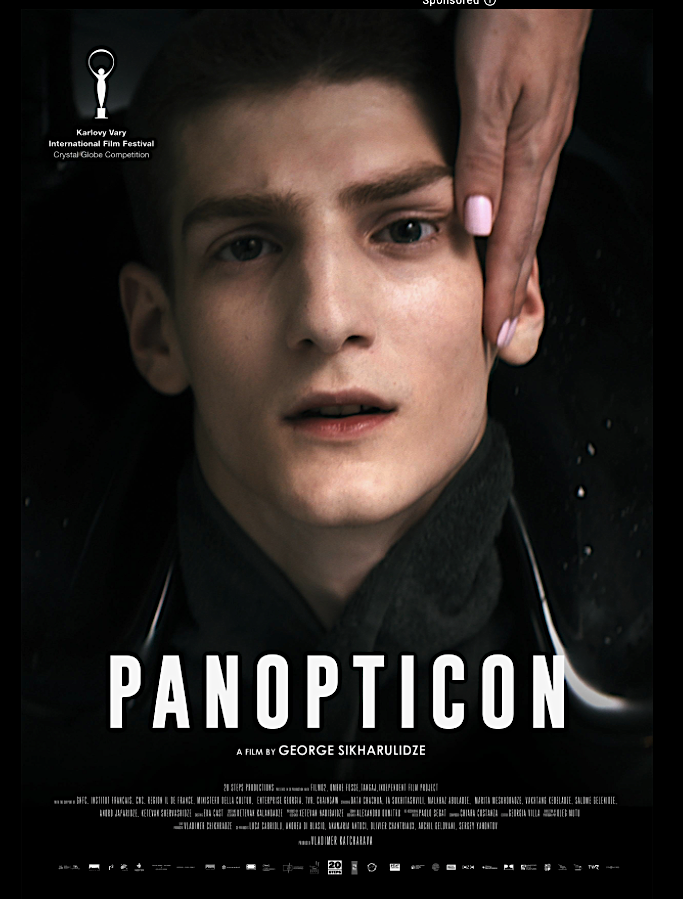
On Thursday evening at the Asian World Film Festival in Culver City was a screening of George Sikharulidze’s Panopticon”(2025), a coming-of-age tale about a quiet 18-year-old loner. This teenage boy Sandro (played by Data Chachua) is trying to deal with his raging hormones but unsure how to relate to women. This is the Republic of Georgia back in the 1990s during a period of political instability, a coup, and a war that resulted in the widespread displacement and a breakdown of central authority. Sikharulidze’s screenplay deepens and complicates the characterization of Sandro, making him quietly emblematic of the masculinity crisis being navigated by Georgia’s younger generation, in which modern, progressive values do battle with sexism, right-wing ideology and a strain of ancient religious hypocrisy that leaches like a toxin into the bloodstream of the body social. This is Sikharulidze’s first feature film and was selected as the Republic of Georgia’s official submission for Best International Feature Film at the 2026 Academy Awards.
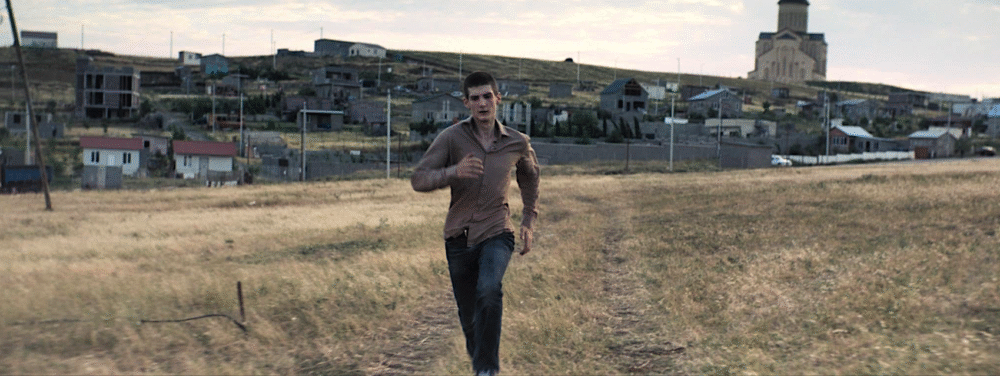
The story takes place in the Republic of Georgia, mainly in Tbilisi – the capital city of the Republic of Georgia back in the 1990s, shortly after Georgia marked its independence from the Soviet Union. That was time of a violence and civil war, followed by the eruption of ethnic conflicts in Abkhazia and South Ossetia after the collapse of the Soviet Union in 1991. The main character Sandro was raised in a traditional Georgian household by very religious Georgian father (Malkhaz Abuladze) who has left the family apartment to enter a monastery for Georgian Orthodox monks.
At home, Sandro lives under a different all-seeing eye: that of the icon of Jesus that adorns the wall shrine in the apartment he shares with his disapproving, atheist maternal grandmother and his insufferably pious, frequently absent father (Malkhaz Abuladze). Dad clearly regards his own relationship with God as far more important than anything as banal as his earthly relationship with Sandro. Sandro looks after his aged, ailing grandmother (Ketevan Shervashidze), and relies on money sent by his mother who left the country to work in the United States in New York City. His mother (Maiko Gelovani) in America is awaiting papers that may never come Without a mother or father, Sandro feels very alone and is weary of looking after his grandmother so much.
Being 18, Sandro has some curiosity about girls, but lacks the social skills for approaching them. In the film’s opening scene, Sandro uses his proximity to a girl sitting on the bus to feel her up. Later he cops a feel on girls’ butts in packed crowds. These creepy, immature dalliances are made worse because of Sandro’s environment. Timid and full of anxiety about religious prohibitions as practiced by the Georgian Orthodox Church, Sandro suppresses his sexual urges, The religious beliefs with which he was raise made him presume that women must be chaste.
Sandro seems deprived of real affection but like other high-school-age young men in Georgia, he has a girlfriend (Salome Gelenidze), who he likes but really but actually it is more that she likes him. He seems so repressed that one is uncertain of his future prospects with the opposite sex. Tall and super lean, Sandro is athletic and plays soccer with young men. One of his soccer teammates Lasha (Vakhtang Kedeladze) becomes a fairly good friend and Sandro starts hanging out with him more. Sandro finds a USB stick that one of his teammates, Lasha has lost at soccer practice and discovers it contains both porn and a seemingly innocent clip of Lasha’s hairdresser mother Natalia (Ia Sukhitashvili) celebrating her son’s birthday. Sandro’s sexual confusion has him turning to the Jesus picture to the wall and masturbating.
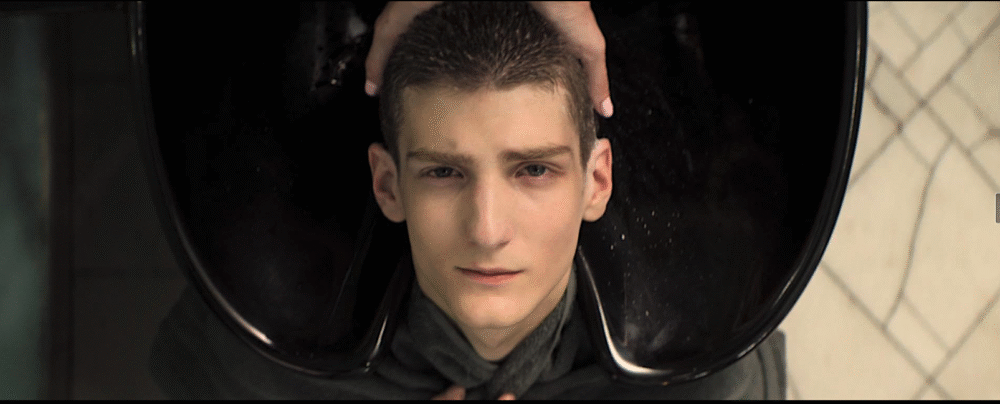
He visits Lasha’s apartment where Lasha’s mother Natalia (Iamze Sukhitashvili) takes a liking to the teenager. She suggests that it is alright for Sandro to stay overnight at their apartment before soccer practice the next day. Natalia is a hair dresser and runs a shop of her own. She is a vivacious creature who gives Sandro some attention that he never gets at home. Since Sandro has a mop of hair on his head, Natalia offers to cut his hair and the physical touch by this kind woman obviously awakening some uncharted sexual instinct.
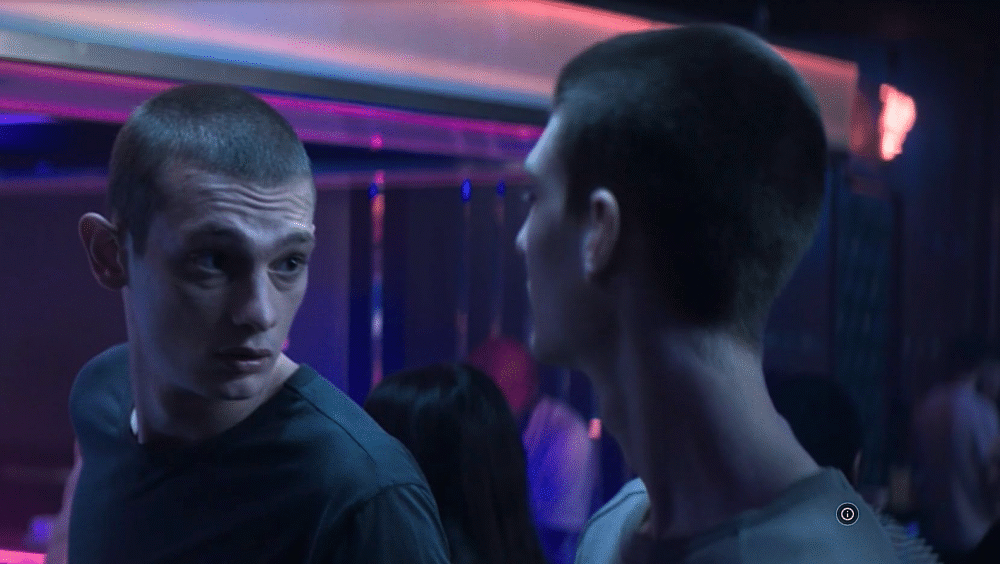
The next morning Sandro wakes up with his new buzz haircut (akin to that of Lasha and other young Georgian teenagers). He declines the offer of breakfast and feels guilty that he was not at home looking after his grandmother. He spends part of the day with Lasha and his buddies. He is talked by Lasha into visiting a seedy “Arab” night club. Too young to order drinks, he sees a young woman on stage dancing erotically to the blasting music. When he realizes that the girl is a fellow student and related to his supposed girlfriend, he leaves the club immediately – believing that the girl has prostituted herself and, in his mind, she is a whore. Sandro’s mind can only handle the virgin/whore dichotomy common to societal misogyny in Georgia. So, Sandro’s opinion of women is now in the tank and he slut-shames his own girlfriend.
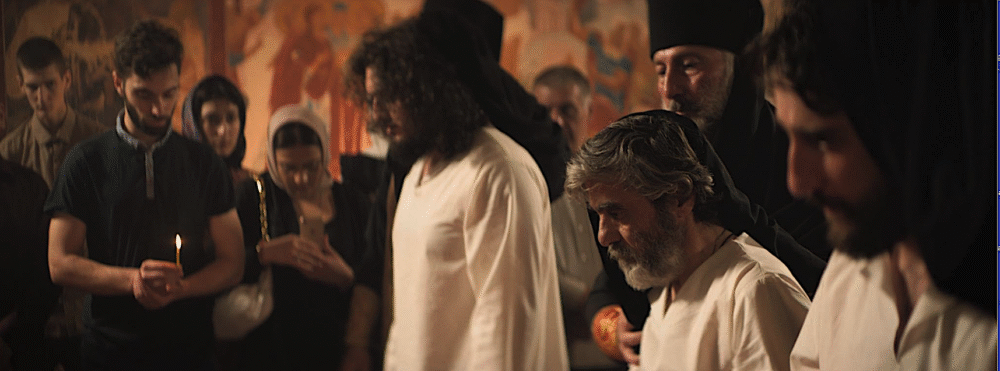
Later he runs into his ultra-religious father who is planning to join a Georgian Orthodox monastery as a monk taking the vow of silence. His father seems quite dissociated from reality and passed out in a field while talking to Sandro about his future plans. Now, Sandro feels fully abandoned by his father. During Soviet times, the Republic of Georgia suppressed formal religion and that only served to intensify Georgian belief in that their religion and their churches were part of their identity as Georgians. We do see in the films the edges of political resistance to the new Georgian government in the1990s – not fully comprehending that their main interests is in right-wing dangerous xenophobic nationalist politics.
Especially among Georgian youth, street protests began to emerge regularly. As has been explained by Giorgi Maisuradze in his study of young Georgians in the 1990s: “We were born at rallies and were molded as a generation whose primary mode of articulation, expression of one’s opinion, political will, or passions is through rallies. Our way of thinking, forms of communication, and behavior, even our manner of speaking, adopted the characteristics of rallies. Soon, these ‘symptoms’ of this ‘condition’ spread throughout Georgia and became the defining feature of the national identity as the people embarked on the path of self-determination.”
The film ambitiously tries to incorporate many aspects of life in 1990s Georgia. There were roving street gangs of young men and often these were associated with right wing beliefs about ultra-nationalism and hatred of foreigners. Sandro’ friend Lasha gravitates toward these street thugs and ends up trying to the trash the very “Arab” nightclub that he had previously visited. The ensuing fight ends him up badly injured in the hospital and an eye half shut from stitches to the eyebrow.
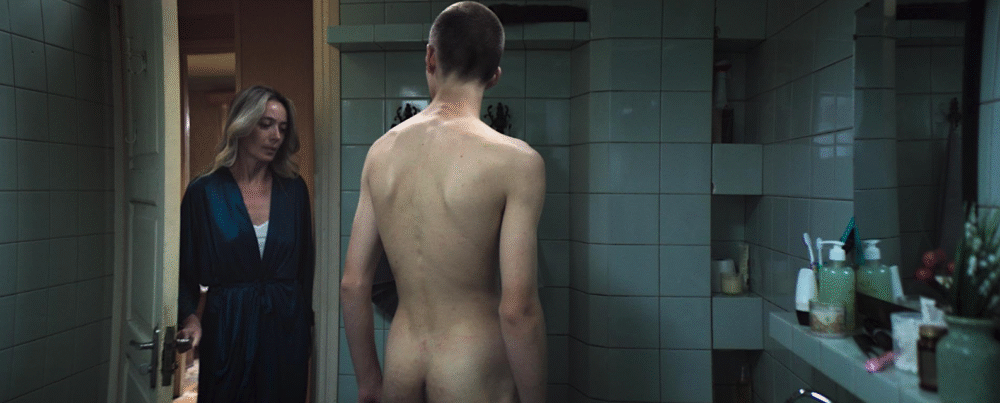
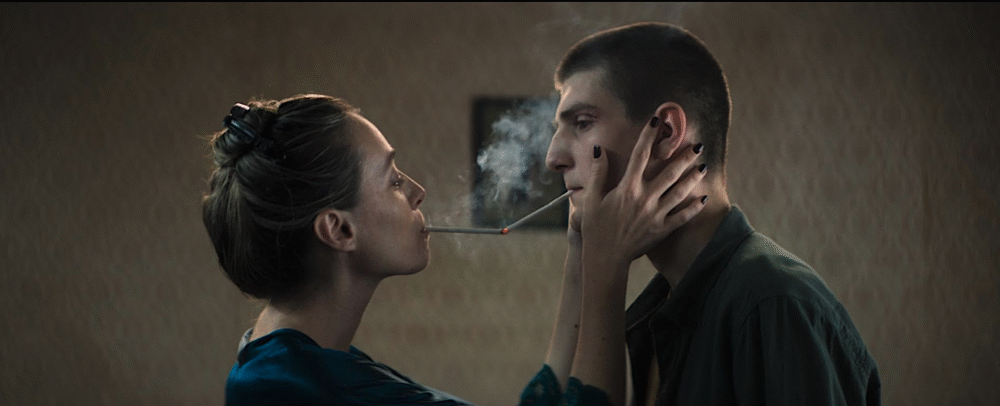
The hospital stay breaks the chain of events for Sandro: He comes back to find his grandmother has just passed away. He tries to visit his father at the monastery where he not resides with a strict vow of silence: He get embraced and then abandoned once again. He goes to visit his friend Lasha and encounters Lasha’s mother Natalia only to be half-seduced by her kindness and physical warmth. The attraction is obviously in Freudian territory and Sandro pulls away, full of guilt.
Sandro’s mystifying behaviors provide few clues about his true ethical sense. He goes through motions a bit like Meursault in Camus’ The Stranger. The main problem with the film is not the character of Sandro played by Data Chachua but a clumsy screenplay with its unbelievable character developments. Sandro might be ethically dubious but there is certainly some goodness in him. Nonetheless, the film’s reliance on female characters to show him the grace and courtesy he never bothered to give them in the first place. The whole tale reeks of male privilege and I don’t know that is a fair assessment of Georgian young people today.
The mise en scene has promises in many places, but the sloppy script and odd transitions are not saved by a fine Romanian cinematographer Oleg Mutu. The story’s moral murkiness is reflected in a palette rich in drear and damp. Backdropped by mottled walls and faded wallpapers, Ketevan Nadibaidze’s muted production design makes the most of both domestic spaces and coldly impersonal institutional interiors: locker rooms, classrooms, the dingy monastery to which Sandro’s father absconds after he decides to become a monk.
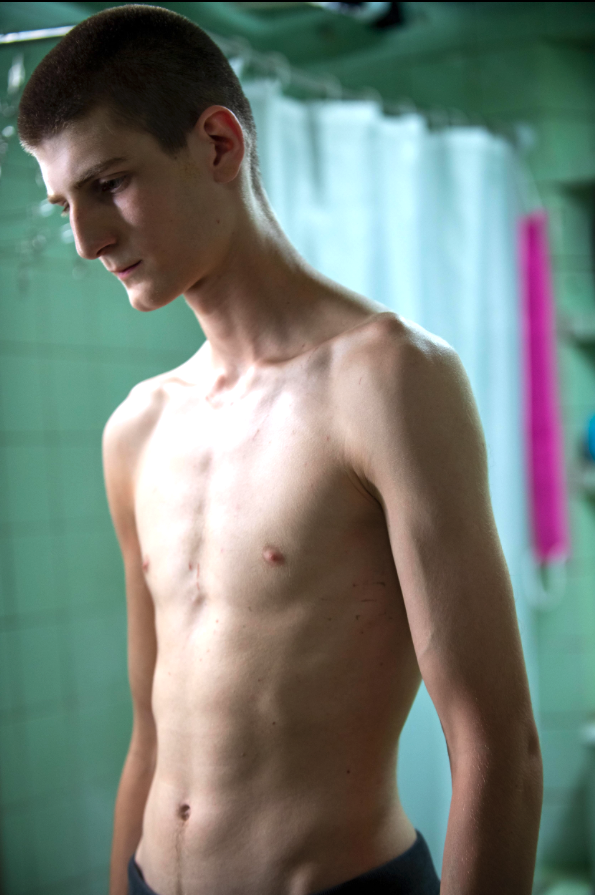
At the film’s ends, we find Sandro willing to take a job as a painter’s model for an art professor – a most curious choice given his former slut-shaming of his girlfriend’s cousin who likes to dance erotically in the “Arab” nightclub. His own rejection of his girlfriend when she gets too physical suggests that he is ultimately sexually unavailable. What one makes of the film’s closing scene is puzzling – a 180-degree spin that is a bit hard to belief. One begins to wonder if perhaps Sandro’s sexual orientation might be other or at least an incel who is still full of self-loathing.
That brings us back the film’s title Panopticon, which is even explained in an odd way by the artist professor in the last scene of the film, as he references Michel Foucault’s Discipline and Punish: The Birth of the Prison (1975). A “panopticon” is a prison design proposed by Jeremy Bentham in the 18th century, featuring a central observation tower surrounded by cells. The term was been expanded by philosophers like Michel Foucault to represent a broader metaphor for modern surveillance and control in other institutions, such as schools and workplaces. The core principle is that the uncertainty of being observed leads to self-discipline and the internalization of control, making inmates police their own behavior. Obviously, traditional Georgian social norms exert a form of self-surveillance. The metaphoric eye of Jesus can only constrain so much. But the film does effectively capture the masculinity crisis of Sandro and Georgia’s younger generation,