
By Sarah A. Spitz
Los Angeles, CA (The Hollywood Times) 6/22/25 – “He lived both at the right time and the wrong time,” says Brigit Grant, writer and creator of Midas Man, a bio-pic about Brian Epstein, aka the “Fifth Beatle,” the manager who launched The Beatles to superstardom. The Los Angeles premiere takes place at the Red-Carpet Gala Opening of the Los Angeles Jewish Film Festival, Thursday, June 26 at the Saban Theatre in Beverly Hills. The Valley premiere screens at 4 pm, Sunday, June 29 at Laemmle’s Town Center 5 in Encino.
Epstein was both gay and Jewish at a time in England when homosexuality was illegal and being Jewish was still frowned upon. It didn’t stop him from becoming a legend, and like many legends, he died tragically young. But not before taking those scruffy Liverpool boys from playing in local clubs (and occasionally Germany) to stratospheric heights of success as the band that changed music history in the 1960s, and whose influence still resonates today.
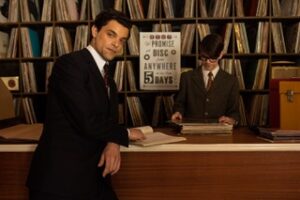
Grant said the offer to write the film came to her out of left field. Producers she had previously worked with know she’s Executive Editor of Jewish News and that she had edited Gay Pride in the U.S. “So, I had all of the bases covered. But when I started to read and learn more about Brian and then speak to surviving members of his family, it just became a complete obsession. He became like part of my family.
“He was an extraordinary, passionate, driven person who lived both at the right time and the wrong time. The right time because of what he gave the world musically. But the wrong time, because if he were living now, he’d probably have a partner and a baby.”
Martin Lewis felt an early affection for Brian Epstein. He first discovered that Epstein was Jewish when he was still in school. “Of course, The Beatles were talked about. There were no British Jewish pop stars. America had Dylan, Simon and Garfunkel, and others, but Britain didn’t have Jewish pop stars. So, when I discovered that the Beatles’ manager was Jewish, that gave me something of pride to talk about at school.”
Lewis will moderate the post-screening Q&A with Brigit Grant, director Joe Stephenson and Jonah Lees, who plays John Lennon in the film (who will also perform as John). He’s long been associated with The Beatles, having been mentored by their publicist Derek Taylor, who chose him to be the U.S. marketing strategist for Live at the BBC and The Beatles Anthology.

But Lewis has also made sure that Epstein’s legacy doesn’t hide in the shadows of The Fab Four. He was instrumental in getting Epstein’s 1964 autobiography, A Cellarful of Noise, re-printed in 1998. And at Taylor’s urging, he spent 16 years spearheading a campaign to get Epstein inducted into the Rock and Roll Hall of Fame. It finally happened in 2014.
Lewis recalled, “In 1997, Derek Taylor was diagnosed with cancer, and he knew he was going to die. In our last phone conversation, he said, ‘You have an obligation now, Martin. There’s no one left to speak up for Brian Epstein. There’s no one that cares. This is your mission.’ And I realized that Brian was an under-sung hero. The public needs to understand that if you’re a Beatles fan, and especially if you don’t have a favorable attitude towards Jews or gay people, you wouldn’t be able to enjoy the Beatles, were it not for this wonderful Jewish guy who was gay.”
“Rightly or wrongly,” he explained, managers suffer a questionable reputation—think Colonel Tom Parker and Elvis Presley. “A lot of managers ripped off their artists. But Brian was impeccably honest, brilliantly successful and his instincts were great. Most managers would just say, keep the formula, guys. Don’t change, but not Brian. He believed in their creativity and their artistry.”
He had a sense of “elan,” and helped give The Beatles their look, got them onto the most popular program on U.S. television, The Ed Sullivan Show, which skyrocketed Beatlemania across the country and the globe. But music was their realm, he never interfered at the level of their art, the music was all theirs.
When asked to have The Beatles represent England in a first-ever satellite feed featuring musicians around the world live from their own countries, Epstein didn’t see it as an opportunity to promote their latest album, Sgt. Pepper’s Lonely Hearts Club Band. Instead, Lewis says, he told them, “Why don’t you do something that’s a message about the state of the world in 1967. John took that idea and flew with it, and it became All You Need is Love. His instinct was not to make money, but to do what was best for the Beatles. That was so typical of Brian.”
The film’s production didn’t come easy, with three directors and more than a few re-writes. Asked why she chose to make Brian Epstein the narrator of his own story. Grant explained, “The film opens with Epstein’s death, and when Joe Stephenson came on board, he felt it wasn’t right, that we should feel he’s with us. The screenplay went through many incarnations. We had started prior to Covid, then there was a two-year period where things were uncertain, and when we came back to it, obviously, the longer something goes on, the more money you spend. Two changes of director each with a different vision, and because it’s The Beatles, everyone’s an expert, and you’re kind of at the mercy of whoever’s in charge.”

And there was the complication of the music. The actors in Midas Man are all musicians. You won’t be hearing music performed by The Beatles. Blake Richardson had never acted before, but he learned how to play bass left-handed to embody Paul McCartney. And Jonah Lees had always been told how much he resembles John Lennon, who he plays in the film, capturing all the cheeky charm and attitude he exuded. Grant recalls, “When they were on set, they joked and laughed and they behaved exactly like them and really performed as them.”

But, she says, “Nobody but nobody gets The Beatles’ music. And of course, now we know that Sam Mendes is going to be directing not one but four films about them, there’s no way they’re giving us that music. It’ll be interesting to see how Brian is treated in these films.”
Midas Man has taken some critical hits, with complaints about not enough sex, not enough drugs being shown on screen. But Brigit Grant believes that focus dishonors Epstein’s memory. She ran drafts of the script by Basil Hyman, Brian’s first cousin, who told her wonderful stories about sitting on the floor with Brian, listening to “Love Me, Do” and about family gatherings. But “The stigma about being gay still touches the family even in the 21st century, almost as if his death and his sexuality are still a little bit of a tarnish on the family.”
Being Jewish didn’t define Epstein but it had an impact on his life. “When he moved from Liverpool to London, his father Harry suggested he might want to change his last name, but because of the family’s success in business, Brian thought it would help him. The family was very involved with the synagogue, and they had Friday night (Sabbath) dinners together and raised a lot of money for the temple. Brian was not religious, but he was culturally and spiritually Jewish.”

Despite the critical reception, Brigit Grant believes that Midas Man, “Is a movie that audiences love. It’s not a critics’ film. My daughter, who’s 18, loves it and so do friends her age, and at the other end of the spectrum my husband, who’s 71 and a massive Beatles fan, loves it, too. They are the audience, so I think the critics can go stuff it, frankly!”
Midas Man is not just a film about Brian Epstein; it’s a tribute to a man who changed the music industry while navigating the complexities of his identity. With Brigit Grant’s passion and dedication, the film aims to honor his legacy and inspire future generations.
And why, says Martin Lewis, is Brian Epstein so important? “Very simple. The Beatles changed our world but only after Brian Epstein changed their world.”