I arrived at the Hollywood Film Festival with a clear plan, already knowing what I wanted to see. As I stepped into it I understood the blocks — organized by theme, with each group of films shown together in the same theater, staggered fifteen minutes apart. To stay was to choose, and to choose was to surrender something else. I spent two hours the day before trying to make the best decision. My plan was responding to the situation, the environment, the organization. When the animation block ended and I learned I had missed blocks two and three, I had no regret. Of the sixteen blocks offered, the animation block turned out to be my favorite — I liked every single one of the films.
It was a pleasant surprise to experience the range of animation techniques on screen: traditional hand-drawn 2D work in both black-and-white and color, 3D CGI environments, stop motion using physical objects, and motion graphics layered into the storytelling. Each piece carried its own production method and visual language, shaping the way the story unfolded — and that method was the language. Some reached into a somatic experience. A couple of them really hit me from the center out.
Animation has to create a believable illusion of life through precision, subtle expressions, animated movement, nonverbal cues, visual storytelling techniques, narrative structure, and music for support. It is one of the hardest film art forms to bring heartfelt, sensory connection through — because the work must be more profound and exact for a non-human element to connect with a human watcher. A human actor carries a body into the room and the audience opens to that presence instinctively. Animation does not have that. It must earn what the human form is given. Every expression, every beat of music, every moment of movement must be exact enough to close that distance. When it works, it is remarkable. This block worked.
Before the films began, the creators and producers were brought to the front. There was an energy in that moment — an arrival into something they had worked on for a long time. All of them had made it to this point, to be seen here. The best of the best. The microphone passed between them as an event coordinator provided that opening, and then the space belonged to the people behind the work. They expressed gratitude. They indicated the momentum of their films. When the lights went down, I was immediately absorbed — moving through it mesmerized by the media, the delivery, and the layered therapeutic contact. Time felt fleeting as I held onto every message, every moment, trying to capture each detail and feel the metaphors within the animation, the nonverbal communication, the juxtaposition of the messages. I wanted to catch it all.
———

The Decline and Fall of Holly Dew and Walter Melon
The Decline and Fall of Holly Dew and Walter Melon moves through a stylized animated world. Holly Dew exists as someone who intervenes at the edge, saving people in moments where they are about to fall. Her connection with Walter Melon unfolds alongside an invitation into another woman’s world, where she’s asked to create and participate in something that feels constructed. The movement between these spaces carries a sense of complexity between what is real and what is being shaped around her. She is an artist. They fell in love. The story follows, provoking a place inside of us to recognize where support and attachment show — pressing into something true about what it means to be held and to hold. She lived inside the D of the Hollywood sign, saving and painting for those she touched in their lives. That image stayed.

Tarot
Tarot unfolds through animation and text, relying on unspoken dialogue and imagery as its narrative storytelling, with the main character found in the cards they pick while traveling on a train. The young person receives a text message from their mother asking if they will come home for New Year’s and initially responds that they are too busy. They encounter a tarot reader on the train and are asked to select three cards. Each card reveals lifted moments and internal awareness — past, present, and future context activated in the viewer. By the final card there is a clear realization reflected through the animation itself, as the direction forward becomes known and revealed to both the audience and the main character, who responds back via text, changing direction from moments before.
This was preempted by the creator, who expressed before the show started — mic in hand — that she was making a decision between Chicago and LA and had cards read for her. She said it plainly: while the tarot cards might be a tool, we know from what’s inside of us the decision to make. She already knew. The film understood the same thing.

Forget Me Not
Forget Me Not depicted a grandmother living alone in her apartment during November 2020, at the height of the pandemic. This one hit my chest hard. Not one word spoken from her. She checks off days as she lives in isolation — complete quietness. We get a glimpse of her granddaughter’s picture on the wall, which creates a sound of her granddaughter’s voice in her head, longing for and remembering the connection they had. A voicemail from her daughter says the TV says we need to stay isolated. Another message rings with unavailability. A voice clip says: stop calling, I’ll call you when I’m ready. A carryover in the short film reveals pills in a bowl — returned to several times. We are impacted at the end when we see her body listless on the bed with three bottles open, her phone ringing nonstop, unable to be answered. The pain had gone too deep. The moment was completely lost.
I am familiar with how the elderly were impacted during the pandemic by this very thing — as well as my own recollection of a good friend’s grandmother behind the glass of their assisted living. We stood there waving, knocking, without her being able to say hello, lost inside that glass in her final days. The idea of dying alone in those last moments — not even from disease, but from a complete loss of hope and familial connection — the life that should have been completed with success and fulfillment from the fruit of labor, is heart-wrenching in a way language barely holds.

See You Tomorrow
The short that resonated with me most deeply was See You Tomorrow, a Japanese film that blends 2D and 3D animation into a layered experience in both visual form and cultural tone. I find comfort in the Japanese language, and there was a familiarity that allowed the openness of my heart to feel the story reach me more deeply. The film opens with a young boy searching for his dog — who greeted him year after year in the morning, jumping on his bed — only to discover that the dog has passed. His mother is crying, his father present with her. The story moves through memory: the dog’s life from puppyhood through aging, including the gradual difficulty of climbing the stairs to reach the boy. Children’s drawings on the wall, rendered in 2D, exist alongside the dimensional environment, holding both memory and present time in the same frame.
The father reinforces the boy not to have regret — explicitly explaining that the dog’s last moment was to see the boy, and failed to reach him. He identifies the phases of grief one may feel: not having spent enough time, not being perfect, recognizing the fragility of life. That recognition created a physical response in me. The layering of culture, language, and emotional expression brought a depth of connection I was not prepared for. Nine minutes — from loss to grief to regret to reassurance to love to warmth and comfort — will live rent free in my mind forever.

113 Words for You Today
113 Words for You Today depicted a man leaving for work, getting the last loving moments from his girlfriend in a nature-filled, colorful suburb as he waited for the train — nonverbally connecting as a couple. He boards into another world. It feels like he was an astronaut, but what’s revealed is that this new place is grey and chaotic and mechanical, filled with wind and hectic destruction. We understood quickly that the people in this world only had 138 words they could use a day, tracked by a watch on his wrist, whether used intentionally, by accident, or for emergency — no carry-over. I wondered immediately how I would adapt to such an assignment. I thought I’d have to save them for the end of the day.
After turmoil and the amazement of his survival, remembering who he left behind, he shows up in his sleeping pod towards the end of the day, picks up the phone to connect with his girl back home, and says: I saved 113 words for you today. The call that follows is full of reassurance and love. At that moment the shift in the piece changed and created a renewal of hope for the future — about what we choose to spend ourselves on, and who we spend it on, and what it means to save the best of what we have for the person waiting on the other end of the line.
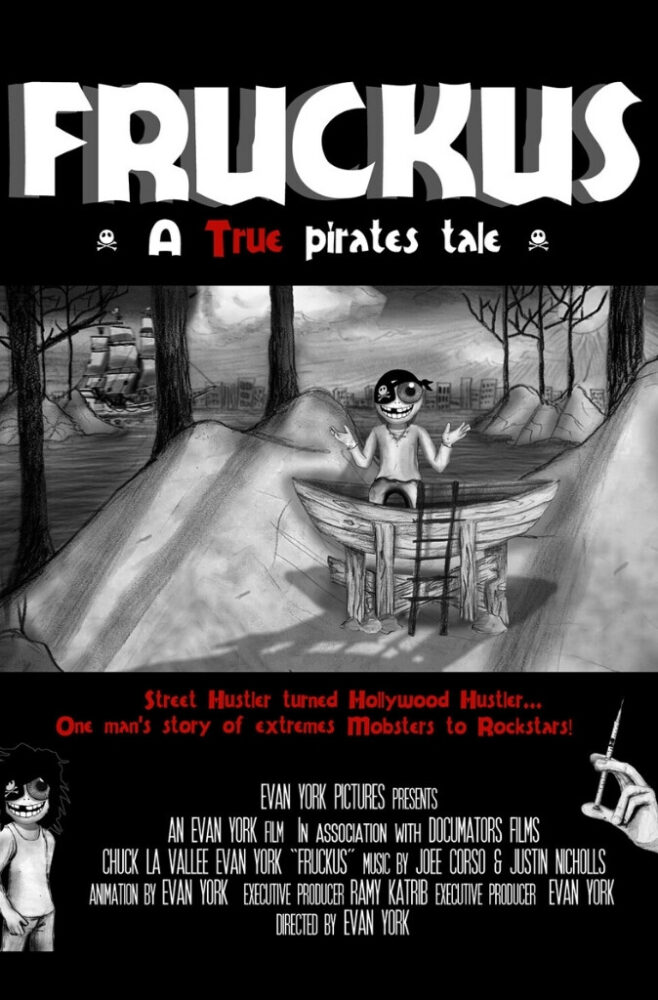
Fruckus
Fruckus was a very elaborate, detailed black-and-white film — the voice of an autobiographical interview, basically. His account of his life is filled with a narrative circumstantial to a horrible childhood: a violent mother, assault, being sent from New York to Los Angeles to live with his father, who was an addict. By preteen he was involved heavily in drugs and liberating automobiles. He laughs the whole time — as a default mechanism, a mask. There are parts he presents humorously but imagine the thickness of a child growing up this way, on the streets independently, covered in heavy trauma, and hearing that depth of story come through an animated character that looks like a pirate. We were captivated by his fast-paced story, wanting to understand how he found success — ended up going to an Ivy League school, got sober, found a wife he was loyal to, and had a son. The arc of his life bent in ways that feel almost impossible until you hear it in his own voice.
The only moment where an emotion outside of humor is revealed is when the pirate figure has two single tears running down his cheek and the voice sounds choked up — explaining his liver and kidneys faulting him for all the drugs and disease he lived through, his desire to be on a waiting list for replacement organs, and his need to make sure his son and his wife were taken care of forever. The humor drops entirely in that space. What remains is a man who had fought every front his entire life, now facing the one fight where the outcome was not his to control — and his grief was not for himself, but for the people he would leave.
In the end, we lost him. I sat with the full weight of what animation had just done — taken a life that could have been a footnote and returned it to its full human dimension. The pirate character, the fast voice, the laughter, the two tears: a complete person. Seen. Honored.
RIP Chuck La Vallee, Bad liver and a broken heart 1962 – 2019
———
Together, these films brought therapeutic content lying in grief, attachment, isolation, identity, survival, love, and the weight of what we carry and what carries us. Animation as a medium — demanding such precision, such intention, such extraordinary effort to create the illusion of life — became the perfect container for the themes these filmmakers were holding. The range of technique on screen was matched by the range of what was being said beneath the surface. These stories understood something about the interior life and brought it forward with craft and care, reaching across the screen to land somewhere real inside the viewer.
That is the work. That is what the animation block gave me. I was mesmerized by the delivery and the layered contact these films created. I stayed for all of them. I would stay again.