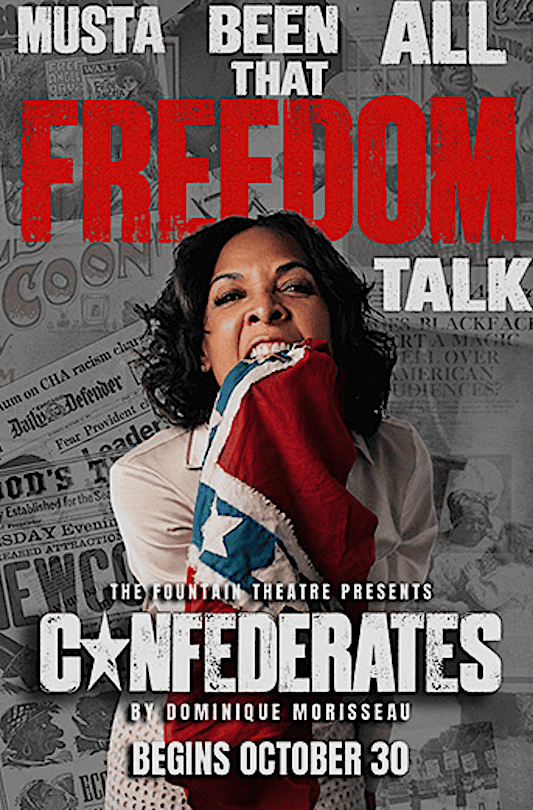
Opening at the Fountain Theatre in Hollywood on Friday, October 30 – Dominique Morisseau’s Confederates – a play about institutional racism as experienced in two different eras by Black women. Such a heavy topic might seem challenging to portray in a play but Morisseau delivers an insightful and humorous satire on the predicaments of the women in both time periods. They are “confederates” in their shared experience of American institutions and Black womanhood. What Confederates illustrates is how slavery on the Southern plantations institutionalized Black oppression as central to American culture and its legacy remains despite the progressive advancement of civil rights. The play originally premiered on Broadway in 2022. This production at the Fountain Theatre in Hollywood is exceptionally well-acted by a cast that inhabits the characters and articulates the issues.
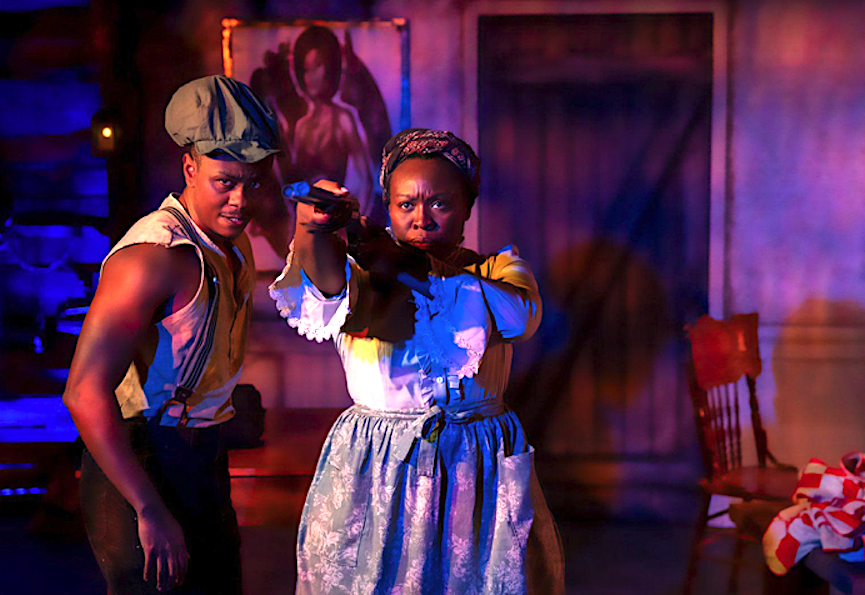
The 90-minute, intermission-free play weaves together two parallel stories separated by more than 150 years: Sara (played by Nedra Ryan Taylor), an enslaved rebel on a Southern plantation who risks eerything to ferry secrets during the American Civil War and act as a spy for the Union. Sandra (played by Sarah Scott Davis), who Is a tenured political science professor at a prestigious, predominantly white private university who faces a targeted racist image and institutional betrayal. The play addresses a number of intertwined issues regarding race, gender, power, and institutional bias.

Raymond O. Caldwell, director of Confederates, points out in the program notes for the production, that a “confederate” is someone who joins together with others for a shared purpose, often as an ally or an accomplice in a task or plan (such as a researcher’s secret helper in a psychology study). This word seems to have been pre-empted by white Southerners in their cause during the American Civil War, where the secessionist states of the Union rebelled in the name of states’ rights to cover their deeper purpose of retaining black chattel slavery. Black slavery was that “peculiar institution” that was enshrined in the Constitution of the United States from the start and, despite the Emancipation Proclamation and the 14th Amendment, the systematic institutionalization of bias and discrimination of Black people in the United States has remained.
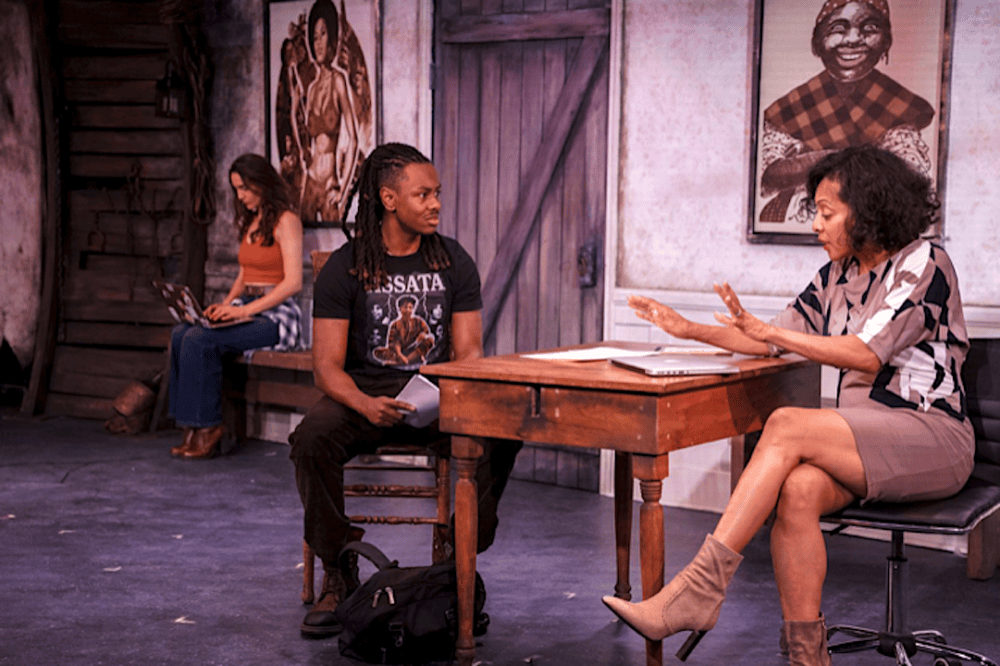
Interestingly, Confederates opens with Sandra, the Black professor of political science at the elite white private university. She lists a litany of books – fictional and biographical – as well as films and television series that have attempted to show the Black experience in America, from slavery to the Reconstruction, on to the Jim Crow laws, segregation, the Civil Rights Movement, and various forms of oppression of Black Americans in history. Humorously, she demurs on one film – Tarratiino’s Djuango. She is an accomplished professor with several publications under her name.
Polished and sharp-witted, she has to deal with one male Black student named Malik (Daks McClettie II) who is upset with getting a “B” on a term paper he wrote on similarities between Black slavery in the South and current limitations still put on Black people today in American society. Out of that conversation, we see that Sandra, the Professor, has higher expectations for him – seemingly because he is the only Black student in that class she teaches. Out of their talk emerges the issue of “white privilege,” which Malik emphasizes as one of his talking points. Sandra asks him to rewrite the term paper by the next day and provide proper documentation for his argument.
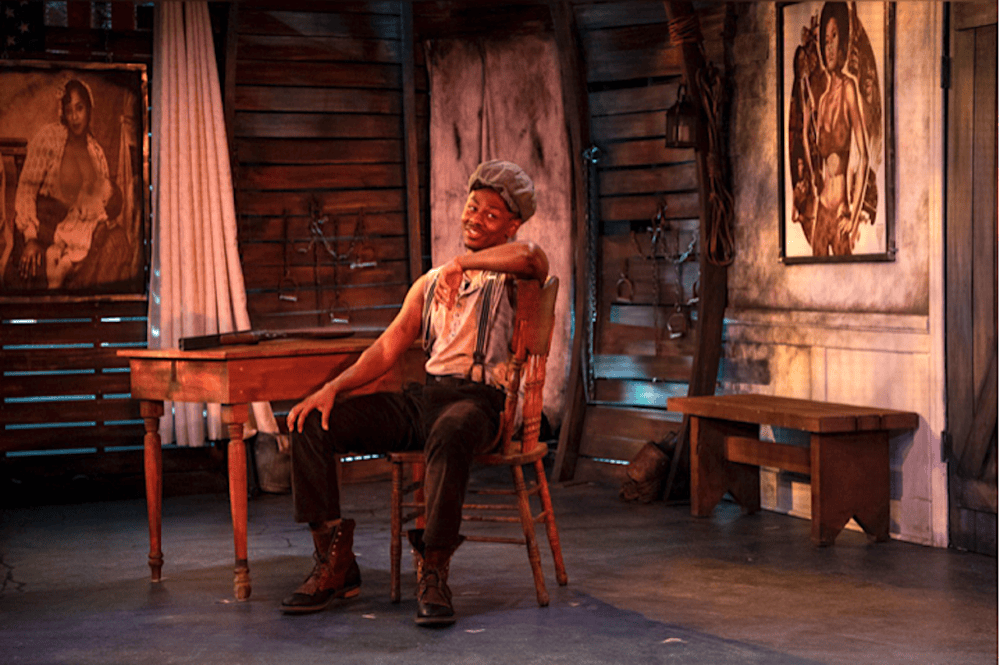
With the brilliant juxtaposition of time periods and situations, the stage switches to the cabin of a Black slave woman named Sara (Nedra Ryan Taylor) on a Southern plantation. She is attempting to stitch up a wound on the back of her brother Abner (played by Daks McClettie II), as he moans with pain. Abner ran away from the plantation a while ago and has joined the Union army to the north as a messenger, reporting on movements of the Confederate Army. Sara is impressed with the gun that Abner has – knowing full-well that slaves are not permitted to have firearms. She asks to hold the gun and imagines herself shooting with it. Sara hides him in her cabin before he sets off again. But he knows that Sara has the ability to read and write – something forbidden to Black slaves. He begs her to help him gather know of the troop movements of the Confederate army because the “Master” of the plantation is cognizant of such information. Sara is a warry of any such ideas, knowing her place as a slave and the potential punishment for any infraction of the rules.
The stories become more complicated quickly. Professor Sandra tried to elicit out of Malik some information about the source of an obnoxious racially-charged poster that was put on the door of her university office the previous night. The poster depicted a female black slave nursing a white infant – but with the face of Sandra clearly visible at the black slave. Malik claims to know nothing about it. He leaves her office, promising to rewrite his paper, after ventilating about white privilege at a university has only a handful of Black students and how much he needs to keep his scholarship to stay there.
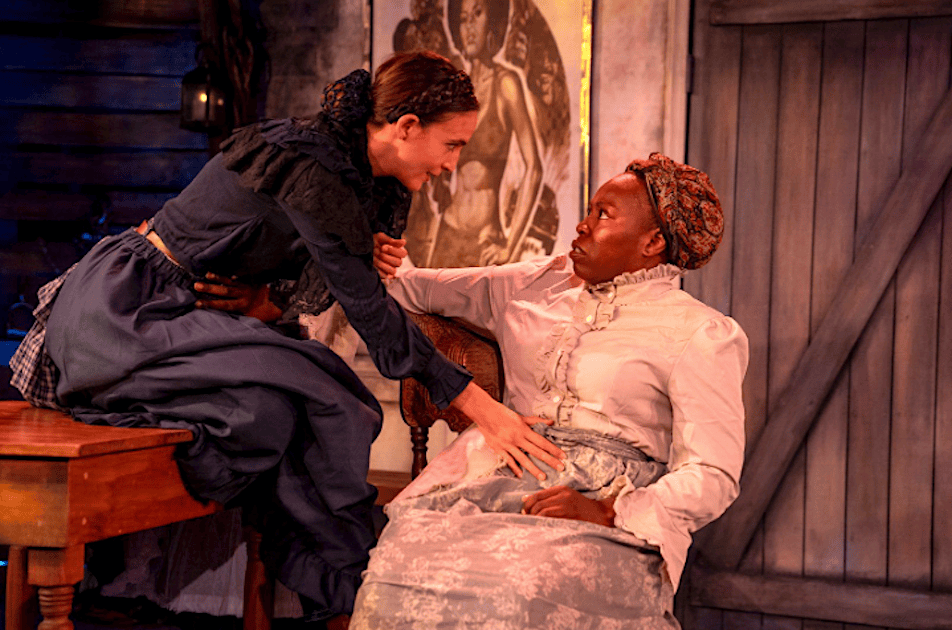
Meanwhile, we return to Sara’s Cabin, where she is visited by Missy Sue (Mara Klein), the daughter of the plantation “Master.” She has returned from a failed marriage to a white Northerner, who treated her badly. But while up North, Missy Sue got a taste of abolitionist talk and has decided the slavery is wrong and she needs to do something about it. Missy Sue loads all this information on Sara, who tries her hardest to remain in her pre-determined subservient role, quoting the “Good Book” and not understanding by Missy Sue is so “patronizing.” She tries to deflect the attention that Missy Sue is showering upon her, wondering if perhaps Missy Sue has some libidinous interest in her.
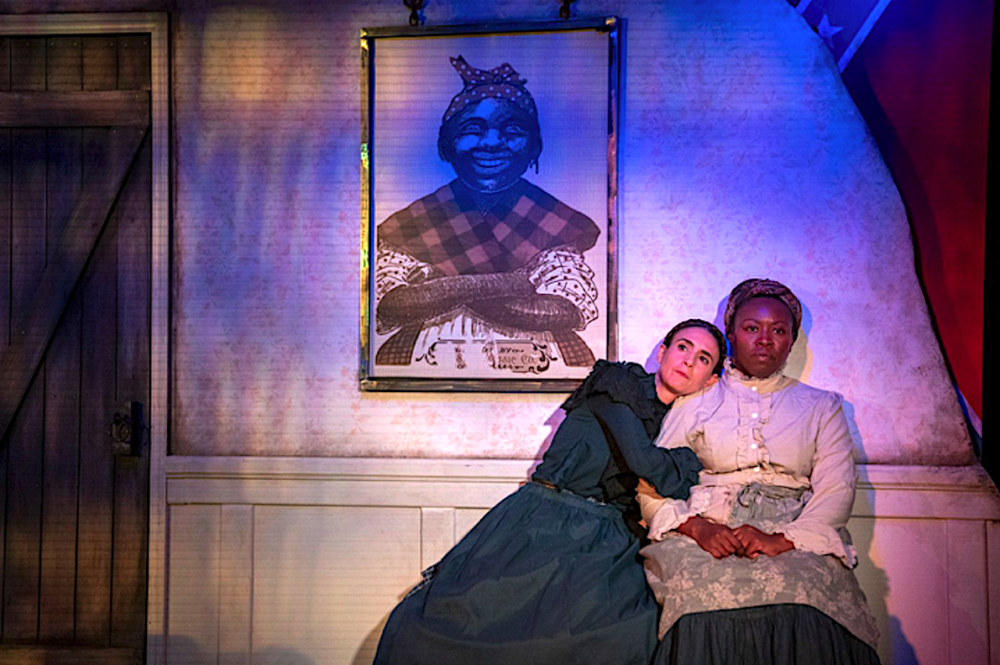
After all, the slaves know that the white plantation “Master” has his time with any black female slave that interests him. It turns out that Missy Sue was the one who secretly taught Sara how to read and write. Since Missy Sue wants to work on the task of “freeing” the slaves, she enlists Sara to help her new cause by moving into the “Big House” as a domestic servant where she can spy on conversations of the “Master” with other Confederate leaders and pass on information via Sara’s brother to the Union Army.
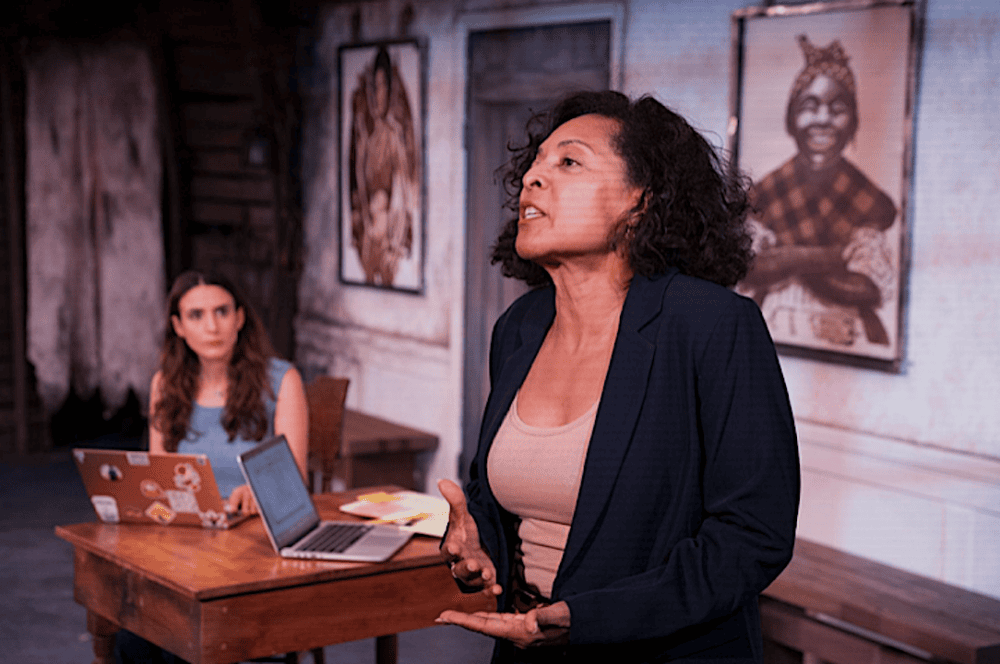
Switching back to Professor Sarah at the university, we meet Candace (also played by Mara Klein), who is the student assistant who helps organize Sandra’s office hours and appointments. In a most humorous scene full of multi-colored Post-its, Candace tries to update Sandra on the meetings she has missed and asks why she has seen Malik, her one Black students, more than any others. Candace introduces the topic of male privilege and attempts to talk woman-to-woman with Sandra, using her own recent break-uo with a boyfriend to ask about Sandra’ recent divorce from her husband. This muddies the waters even more, as Sandra pushes on to ask Candace about the source of the offensive racist poster that was placed on her office door. Sandra whines about needing the teaching assistant job because she has to pay tuition.
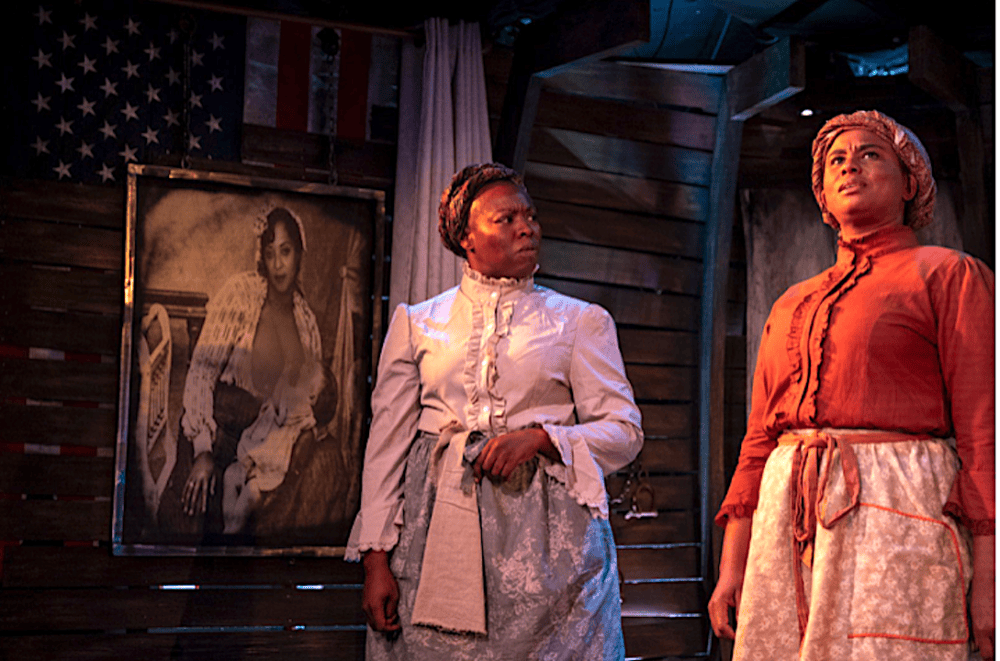
Back to the Civil War days with Sara in her cabin. She receives a knock on her cabin door from Luanne (Cortney Scott Wright) who is a domestic slave in the “Big House.” She has heard things about Sara and that Missy Sue wants her in the “Big House” as well, Luanne has status as a slave because she is currently the favorite of the “Master” in his bed at night. Luanne expresses an interest in Sara’s desire for freedom and questions her about the presence of her brother Abner in the vicinity. She also knows that Sara is much liked by Miss Sue. To buy confidence, Sara promises to teach Luanne to read and write. But she also threatens to kill her if she tells anyone about Abner or her helping Missy Sue. Both Missy Sue and Luanne know of Abner’s presence and his hiding in the cabin.
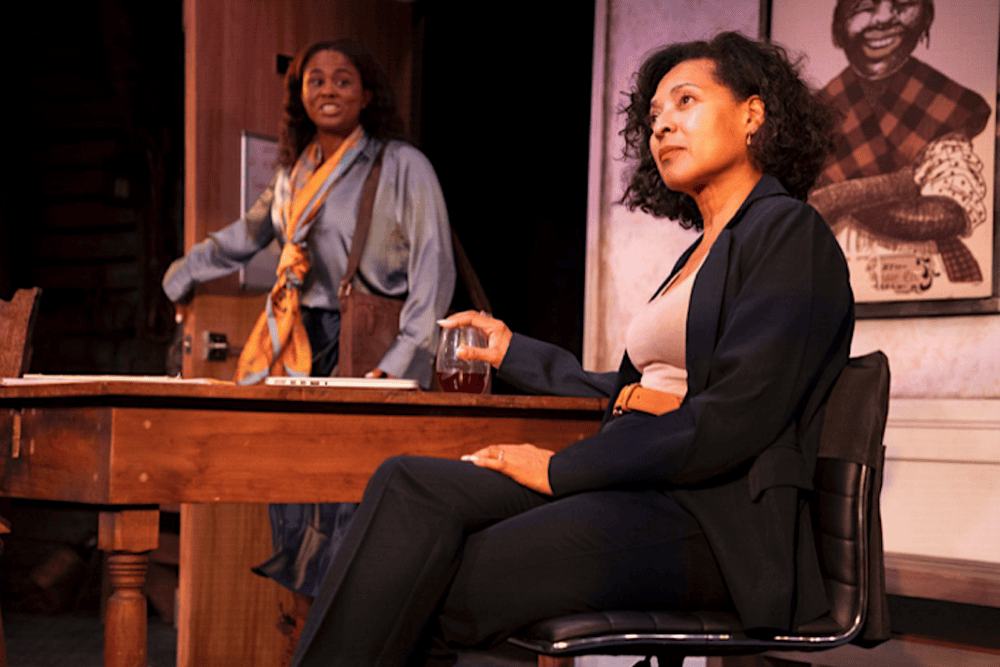
The final character introduced is Jade (also played by Cortney Scott Wright), a fellow professor at the mostly white private university where she teaches in the same department as Sandra. Jade is soon up for tenure consideration and is hoping that Sandra, who on the tenure committee, will recommend her. Sandra seems to be more popular with her students that is Sandra and that is a cause of some friction. Jade points out the issues of white privilege and also white male privilege in hopes of convincing Sandra of the exceptionally high standards required for Black female academics to succeed and the importance of having two Black professors at the university. Their somewhat testy relationship reveals cracks in their sense of professionalism, as Jade questions why Sandra gives more attention to her Black male student Malik.
At this point, the play devolves into a set of similar scenes in Sara’s plantation cabin and Sandra’s university office, as the two main characters grapple with situations over which they have limited control. Sara has to deal with Missy Sue’s cause of spying on the “Master” to add the cause of freedom for Black slaves. Sandra is determined to get to the bottom of the source of the offensive racist poster on her office door. It has something to do with Sandra wearing to a lecture a tee-shirt with the words “Black Lives Matter” that seems to have been interpreted differently by different people.
Perhaps it all comes down to the power of words and written language’s ability to determine meaning. For the Black slave Sara, her literacy is the ticket to freedom. For Sandra the professor, the proper use of language to determine meaning is paramount and she chooses her words with great care. For Malik, the ability to support an position paper requires the use of language that supports his thesis about the commonality of the Black experience in the days of slavery and at the present time. Words do matter, and the true equalizer in a society comes from literacy and the power of language. The stories we tell required that language and how one controls its use.
Starring as the plantation slave Sara is Nedra Ryan Taylor (The First Deep Breath at the Geffen, Clyde’s‘ at the Center Theatre), opposite Sarah Scott Davis, (previously seen at the Fountain in Last Summer at Bluefish Cove as Sandra, the university professor. Also in the cast are Mara Klein (The Pitt), who starred in the Fountain production of Branden Jacobs-Jenkins’ An Octoroon, and Cortney Scott Wright (A Midsummer Night’s Dream at Theatricum Botanicum) seen at the Fountain in Joe Turner’s Come and Gone. Daks McClettie II, whose credits include Destination Procrastination: Break the Bullies, makes his Fountain Theatre debut. The wonderful direction by Fountain Artistic Director Raymond O. Caldwell makes Confederates a must-see play this season.
Confederates opened Friday, Oct. 30, at 8 p.m., with performances on Thursdays, Fridays and Saturdays at 8 p.m. and Sundays at 2 p.m. through Dec. 13.There will be three additional performances on Monday evenings at 8 p.m. on November 16, 23 and 30/ Ticket prices range from $5 to $75. The Fountain Theatre is located at 5060 Fountain Avenue (at Normandie) in Los Angeles. For reservations and information, call (323) 663–1525 or go to FountainTheatre.com.