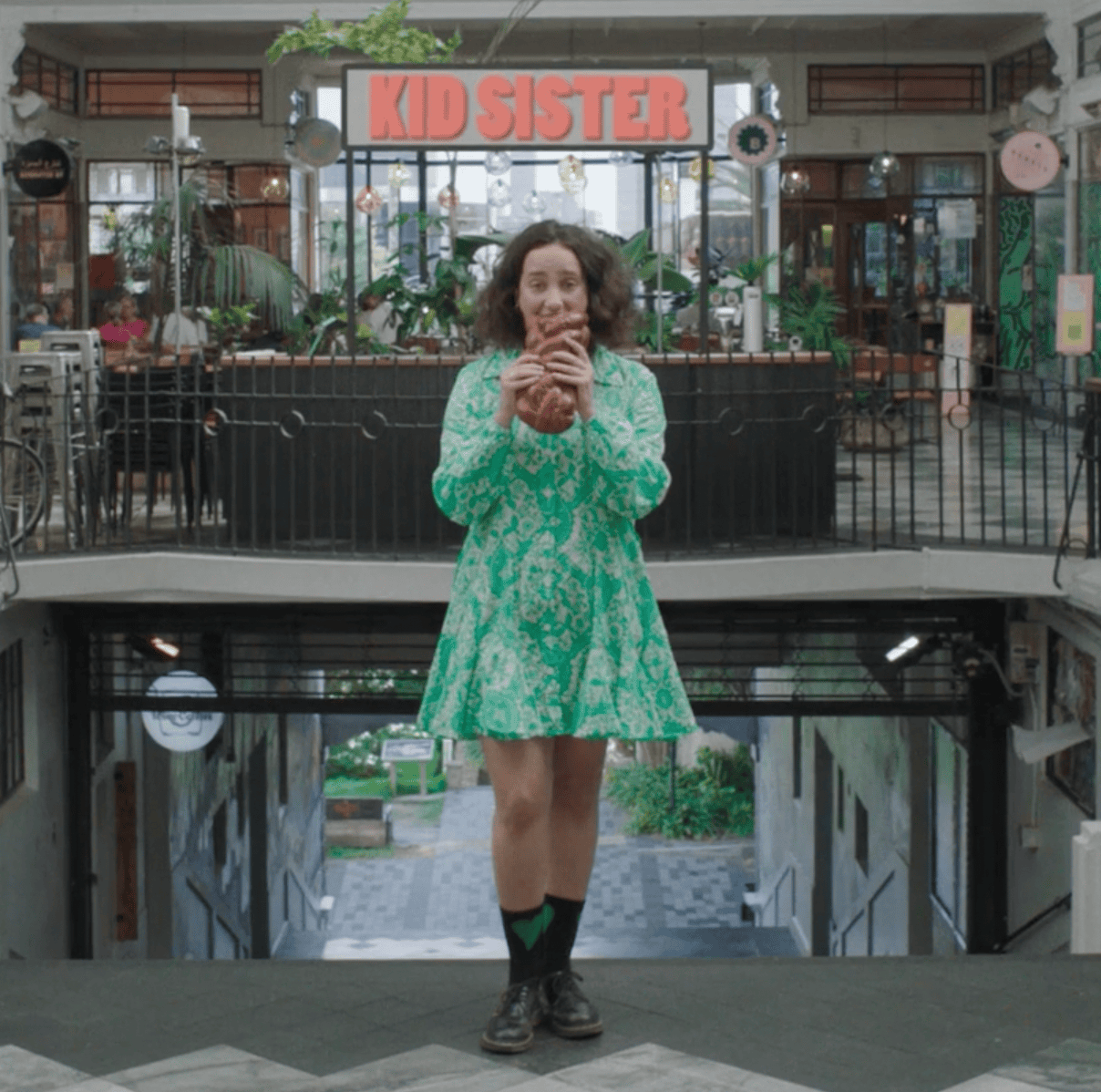
Lulu’s family carries a deeply recognizable form of enmeshment. Boundaries are discussed, negotiated, ignored, laughed at and sometimes outright rejected. In one scene, Lulu tries to explain personal space to her mother in terms of separate bubbles, only to have her mother essentially argue that if Lulu insists on staying in her own bubble, she will be cold and hungry. Later, Lulu reminds her mother about boundaries, and her mother simply answers that she does not like them. The family is not merely crossing boundaries; at times, it is philosophically opposed to them, and the resonance of that reality is deeply funny.
When Lulu says she would rather go hungry than risk upsetting her mother, I laughed and winced at the same time. I know the reflex of anticipating a mother’s reaction before it arrives, of adjusting myself to prevent displeasure, of becoming so practiced at accommodation that it can feel easier to bend than to deal with the emotional fallout. Kid Sister turns that dynamic into comedy, but for some of us, the recognition underneath the joke is very real. It also made me think about how the same habit of managing other people’s feelings can travel into adult relationships. Lulu repeatedly struggles to do what she has already decided she needs to do, and I kept wondering whether a lifetime of learning to preserve attachment through accommodation has made it harder for her to tolerate hurting anyone at all.
The series also understands that family expectations are not always formally taught. Sometimes they are absorbed. An early flashback gives young Lulu blunt lessons about Jewish marriage and continuity, but what interested me was not simply the content of the lesson. It was the way those rules survive inside an adult long after childhood. My own relationship to Jewish continuity was not necessarily taught through neat rules or formal lectures, yet somehow the idea that I should marry a nice Jewish man remained deeply embedded in me. Traditions can soften in practice and still remain powerful in the imagination. Kid Sister understands that very well.
There is also nostalgia woven through the family: old photographs, memories, stories about previous generations, and the persistent sense that everyone’s present life is being measured against what came before. That can be loving, but it can also be constraining. Watching Lulu’s mother invoke an imagined “right” man while another man is physically present stirred an uncomfortable familiarity in me. Families sometimes preserve old romantic narratives long after the people inside them have moved on. The show brought me back to relationships I once imagined as temporary because they did not fit the Jewish future I pictured for myself, and to the realization that intimacy can create permanent ties whether marriage happens or not. What surprised me most was how quickly the series moved beyond recognition into reflection. Its questions about marriage, continuity, family influence and the lives we imagine for ourselves stirred grief, regret, desire and a kind of resignation in me, not only as a daughter, but as a mother and grandmother still carrying an image of how tradition might continue through the next generation.
Jewish ritual is not background decoration here. It is part of the emotional language of the series. We move through mourning, shiva, Kaddish, Shabbos blessings, Sukkot, Chanukkah, synagogue life and keriah, the traditional tearing of a garment in grief. What Kid Sister does particularly well is place inherited ritual beside the way people actually live it. Sometimes the practice is traditional. Sometimes it is adapted. Sometimes the adaptation itself becomes meaningful. One keriah scene brought back a powerful family memory for me. When my grandfather died, my mother needed a garment for the traditional tearing. She had an old shirt from when she was young, something she had later handed down to my daughter. It seemed fitting because it was my mother mourning her own father. What I did not fully anticipate was how upset my daughter would become when the rabbi tore the shirt. Looking back, the symbolism feels extraordinary. The shirt had already traveled across generations before the tear was ever made. Then it became the garment marked by my mother’s grief for her father. The ritual literally tied generations together through an object already carrying family history. Jewish ritual is inherited, but it is never experienced generically. Each family brings its own history into the practice, and sometimes the object meant to carry the ritual already carries generations of meaning before the ritual even begins.
What I appreciated is that the series does not stay at the level of an “issue.” It slowly moves away from the magnetic humor of its early episodes and allows consequences to take up more space. There is a point where the vibration of the show noticeably shifts. The comedy does not disappear, but it stops cushioning every difficult moment. Hurt becomes visible. Disconnection feels serious. And then something equally interesting happens: when connection begins to return, humor returns with it. Humor functions almost like a sign of connection. When Lulu and Ollie are emotionally apart, the comedy seems to recede and the scenes feel heavier. When they find their way back toward one another, humor returns with them. A declaration of love can sit beside a joke about not dehydrating “the worm,” Lulu’s nickname for the embryo, and somehow both moments feel true at once. The series understands something very real about relationships: when people are connected, humor flows; when they are hurt or disconnected, even familiar jokes can lose their footing.
That contrast becomes particularly powerful in synagogue. There is a moment when the Torah service begins and something in me changes. The camera enters the sanctuary, the bimah at its center, and a familiar melody rises. Before I can analyze the scene, I am already singing along. These prayers are memorized somewhere deeper than thought. My heart and soul recognize them before my critical mind does. Then Ollie enters, placing a white kippah on his head, still learning his way into a world that, for me, can be awakened by a few notes. To me, the white kippah reads visually like the kind picked up at the synagogue door, marking him as the newcomer among men whose darker kippot feel more habitual and established. It is a small visual choice, but it says a great deal about belonging.
That is why the season’s final visual callback works so well. Season one returns to one of Lulu’s earliest associations between Jewish ritual and attraction, giving the story a subtle bookend. The repetition creates a satisfying sense of completion, but the meaning has shifted. By the end, he is wearing a black kippah, a visual shift that, to me, suggests greater integration into the family’s religious world. The repeated “ding ding” lands with a different kind of intimacy. What began as a joke now carries the weight of everything the relationship has been through.
There are smaller cultural echoes throughout the series that added to my experience as well. At one point, a joke about a “Jewish mouse” immediately sent my mind in two directions: Art Spiegelman’s Maus, with its devastating Holocaust imagery, and An American Tail, with Fievel and his Russian Jewish immigrant family. Whether or not that association was intended by the writers, it demonstrates what happens when culturally specific language meets a viewer carrying her own library of Jewish memory. The same is true during Sukkot, which I happened to be observing while screening the episode. A throwaway parental warning about untied shoelaces instantly reminded me of my own recent frustration with my son and my fear that an avoidable risk could become a serious injury. I laughed because I recognized myself.
That may be the best way to describe what Kid Sister did to me. The humor does not simply relieve tension. It creates a way into it. It allows discomfort, connection, grief, desire, regret and recognition to sit beside one another without requiring any one of them to disappear. The family can be intrusive and loving, traditional and modern, reverent and irreverent, sometimes all within the same scene. Jewish practice is not presented as a museum piece. It is argued with, adapted, personalized, resisted, loved and carried forward.
By the time the story reaches Chanukkah, acceptance does not mean that everyone has suddenly become the same or that every conflict has disappeared. Instead, the family adjusts to what has changed and then gathers again around familiar ritual, candlelight and Hebrew blessings. That moment warmed my heart because connection is restored without requiring sameness. Even the humor returns differently: softer in places, still sharp in others, but once again part of the family’s shared language.
Kid Sister feels lived-in because, in many ways, it is. Simone Nathan has transformed pieces of her own life, marriage and Jewish world into fiction without simply reproducing them. The result is culturally specific without closing the door on outsiders and deeply personal without becoming inaccessible. For me, it became more than a comedy I was screening. It became a mirror that sometimes made me laugh, sometimes made me remember and sometimes made me sit with the uncomfortable ways family, faith, love and expectation continue to shape us long after we think we have made our own choices.
Kid Sister premieres October 11 on ChaiFlicks. The platform lists two seasons and 10 episodes in total, with episodes running roughly 22 minutes each. It is short enough to binge, but layered enough that I found myself stopping, rewinding and sitting with moments long after the joke had passed.