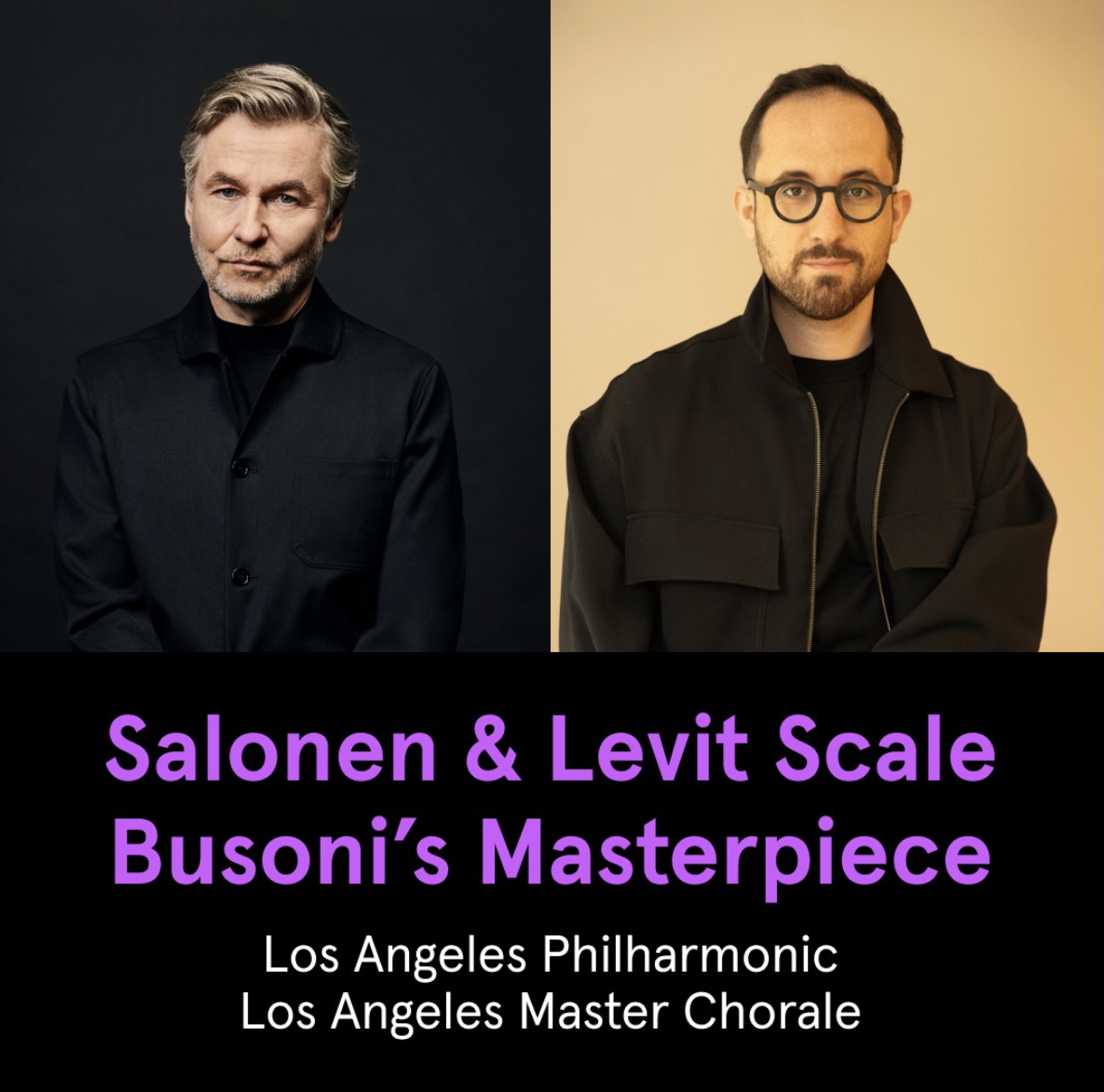
At the Walt Disney Concert Hall, the Conductor Laureate of the LA Phil and the renowned Pianist took on the challenge of the composer’s Herculean Odyssey.
By John Lavitt
Los Angeles, CA (The Hollywood Times) 01-21-2026
In a rare and monumental afternoon at Walt Disney Concert Hall (WDCH), the Los Angeles Philharmonic reunited with Conductor Laureate Esa-Pekka Salonen and pianist Igor Levit to take on Ferruccio Busoni’s Piano Concerto, Op. 39. However, calling such a monumental piece a concerto hardly does it justice.
At five movements and roughly 75 minutes, the work is closer to a symphonic expedition, one that demands staggering endurance from its soloist. At the same time, it requires a philosophical commitment from everyone onstage.
Levit, who once joked that the piece “widens your curse word repertoire,” has long been its most fearless advocate. Here, he reminded us why. From the opening moments, the scale of the undertaking was unmistakable.
With the full weight of the LA Phil surrounding him, the textures were thick, even intimidating. Yet under Salonen’s direction, the sound never blurred. His clarity and his pacing allowed Levit’s relentless, intricately layered playing to be highlighted in a musical spotlight without strain or exaggeration.
Busoni’s concerto unfolds like a utopian vision—grand, eccentric, and unapologetically excessive. The early movements establish their architectural sweep before giving way to the manic energy of the fourth-movement Tarantella. Levit navigated these shifts with a rare balance of force and restraint.
The virtuosity was undeniable, but it was his sense of proportion and dedication that were most evident. Indeed, he knew when to press forward and when to let the music breathe. Busoni’s world can feel “impractically visionary” on the page. At the WDCH, it felt startlingly coherent.
The work’s final transformation arrived quietly, then all at once. As the men of the Los Angeles Master Chorale rose from behind the orchestra, the hall seemed to change shape. It is essential to note that Busoni’s finale calls explicitly for an all-male chorus. Given the talent of the Master Chorale’s female members, it is too bad that he did not include them in his equation.
Still, the male segment of the Master Chorale’s eruption into the German hymn to the “Eternal Mother” turned the concert hall into something closer to a sanctuary. The effect was not merely grand, but communal. Levit’s unwavering dedication, the orchestra’s virtuosity, and the chorus’s solemn presence converged into a genuinely uplifting moment.
When the final notes faded, it was clear this had been more than an extraordinary performance. It felt like a meditation on human capacity: How far musicians, and perhaps audiences, can be asked to go together. There is nothing like experiencing such an artistic journey firsthand and live.
Supported by the Elaine and Bram Goldsmith Great Artists Fund, the afternoon served as a reminder of why the LA Phil remains at the forefront of the classical world. For those in the room, Busoni’s vast, improbable dream did not feel distant or theoretical. It felt urgently, convincingly alive. Indeed, the efforts of Esa-Pekka Salonen and Igor Levit to scale the Italian Alps of Ferruccio Busoni proved successful at the Walt Disney Concert Hall.